How Tripura's AVGC-XR Policy Could Create Thousands of Creative-Tech Jobs

Riten Debnath
23 May, 2026
For most of India's history, if you wanted a creative-tech job, you had to leave home. Pack your bags, move to Mumbai or Bangalore, and hope to find work in animation, gaming, or design. The jobs lived in the metros, and everyone else had to chase them.
I am Riten, founder of Fueler, a platform that helps people get hired through their work, not just their resume. I attended the stakeholder consultation for the draft Tripura AVGC-XR Policy in Agartala, and one idea kept playing in my head. What if good creative-tech jobs did not have to live only in big cities? What if a small state could create thousands of them at home?
That is exactly what the Tripura AVGC-XR Policy is trying to do. AVGC-XR stands for Animation, Visual Effects, Gaming, Comics, and Extended Reality. In this article, I will explain, step by step, how this policy could actually create thousands of creative-tech jobs in Tripura.
Why Creative-Tech Jobs Are Different
Before we talk about how, let us understand why creative-tech jobs are special. They do not need the things old industries needed.
A factory needs land, machines, and raw materials. A port needs the sea. But a creative-tech job needs only three things: talent, a computer, and the internet. That is it. An animator, a game designer, or a VFX artist can create world-class work from a small room in Agartala, as long as they have skill and a connection.
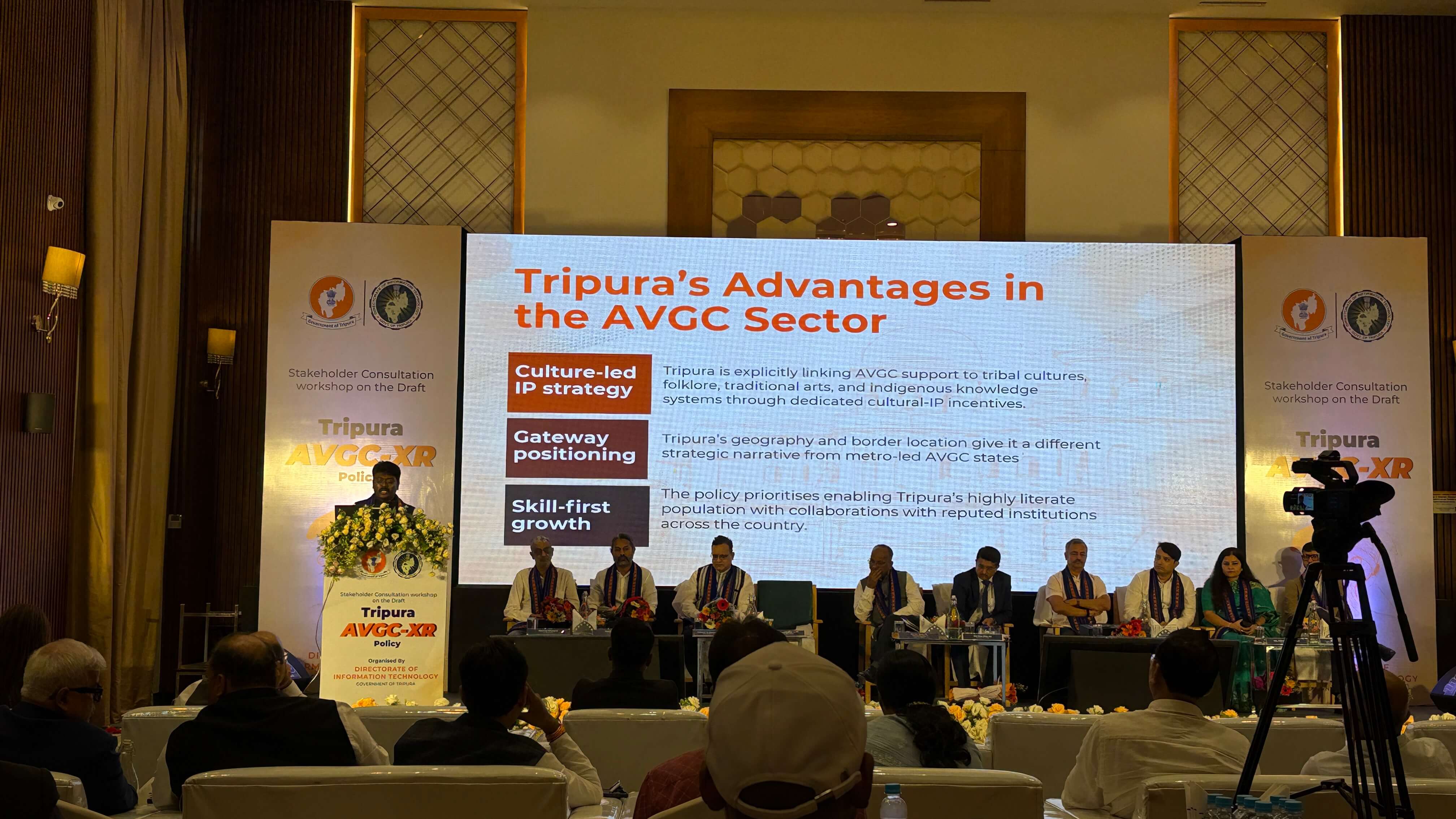
This is why creative-tech is perfect for a state like Tripura. The state cannot easily compete in heavy industry. But it can compete in creativity, because creativity is about people, not geography. Tripura has the people. It has around 94 percent literacy, one of the highest in India, and a young population eager for opportunity.
The policy understands this. Instead of trying to build old-style industry, it is building a creative economy that runs on talent and internet. That is a smart match between what the state has and where the world is going.
Step One: Building the Talent Pipeline
You cannot create thousands of jobs if there are not enough skilled people to fill them. So the policy starts with skill, which I think is the right first move.
The plan includes AVGC-XR training under an initiative called NAVCHETNA, aimed at promoting technology-driven education across more than 4,000 government schools. It includes NSQF-aligned AVGC certification courses, faculty development, train-the-trainer programmes, and an AVGC Skill Centre of Excellence with XR labs. It also offers scholarships for tribal youth, women, and rural talent.
The target is to skill 15,000 to 20,000 youth over the first five years. This is the foundation. Every job that gets created later depends on having people ready to do it.
I appreciate that the policy starts in schools. Building skill early means that in a few years, Tripura will have a steady stream of young creators ready to work. Too many plans try to attract companies before they have talent, and then the companies leave because they cannot hire. Building talent first is the correct order.
But I will add one thing as someone who hires creators. Skill alone is not enough. People also need to learn to show their work. A skilled animator with no portfolio is invisible. The skilling programs should teach creators to build public portfolios from day one, because proof of work is what actually turns skill into a job.
Step Two: Creating Places to Work
Once you have skilled people, they need places to work. The policy builds this in two ways. Jobs inside companies, and support for people to create their own work.
For companies, the policy supports three types of businesses. Studios that make original content like games and animation. Service providers that do creative work for global clients and earn export revenue. And creator-led businesses built around a founder's vision. To attract and grow these, the policy offers production grants, a 30 percent capital subsidy, shared production labs, and an employment incentive that pays 30,000 to 1,00,000 rupees per new local job.
For independent creators, the policy expects 2,000 plus freelance micro-enterprises. These are one-person or small businesses in animation, gaming, VFX, design, and digital content. They are supported with skill programs, shared workspaces, and infrastructure.
Altogether, the policy projects 5,000 to 7,500 direct and indirect jobs over five to seven years. When you combine company jobs with freelance micro-enterprises, you get a realistic path to thousands of creative-tech livelihoods. Some people will want steady studio jobs. Others will want to work for themselves. The policy makes room for both, which is how you actually reach big numbers.
Step Three: Connecting Tripura to the World
Creating jobs is not enough if the work stays trapped inside the state. The real money in creative-tech comes from selling to the world. So the policy also focuses on market access.
It supports exhibitions, industry participation, and global exposure events. It offers 75 percent reimbursement of travel and participation costs for creators attending events to find clients and partners. The plan even includes participation in AVGC exhibitions, gaming conferences, and animation festivals in its fourth year.
This matters because the internet has made the whole world a customer. A studio in Tripura can do VFX work for a project anywhere on earth. A game made in Agartala can be downloaded in a hundred countries. A comic based on Tripuri folklore can find fans worldwide. When local creators connect to global demand, the number of possible jobs is no longer limited by the size of Tripura. It is limited only by talent and ambition.
This is the part that excites me the most. Thousands of jobs is just the start. If even a few Tripura creators or studios break out globally, they will pull the whole ecosystem up with them, the way one big success story inspires hundreds of others.
The Honest Challenges, and What You Should Do
I will not pretend this is guaranteed. The policy itself names the real challenges. Talent might leave for metros. Industry partnerships must be genuine. Infrastructure must actually be built and maintained. Internet must be reliable across the whole state. These problems must be solved for the thousands of jobs to become real.
But the direction is right, and the logic is sound. Build skill, create places to work, connect to the world. That is genuinely how you create thousands of creative-tech jobs in a place that did not have them before.
Here is my advice to you, whether you are a student, a creator, or a founder. Do not wait for the jobs to be created and then line up. Start now. Learn a creative skill. Build a public portfolio. Show your work to the world. Make yourself so good and so visible that when these thousands of jobs arrive, you are the obvious first choice.
The internet does not care where you are from. It cares what you can make. That is the future I am building toward at Fueler, and it is exciting to see Tripura building toward the same thing. The opportunity is coming. Be ready for it with your proof of work.
Frequently Asked Questions (FAQ)
How will the Tripura AVGC-XR Policy create creative-tech jobs?
The policy creates jobs in three steps. First, it builds a talent pipeline by skilling 15,000 to 20,000 youth. Second, it creates places to work by supporting studios, service providers, creator-led businesses, and freelancers. Third, it connects creators to global markets, allowing them to earn from clients worldwide.
How many creative-tech jobs can Tripura create?
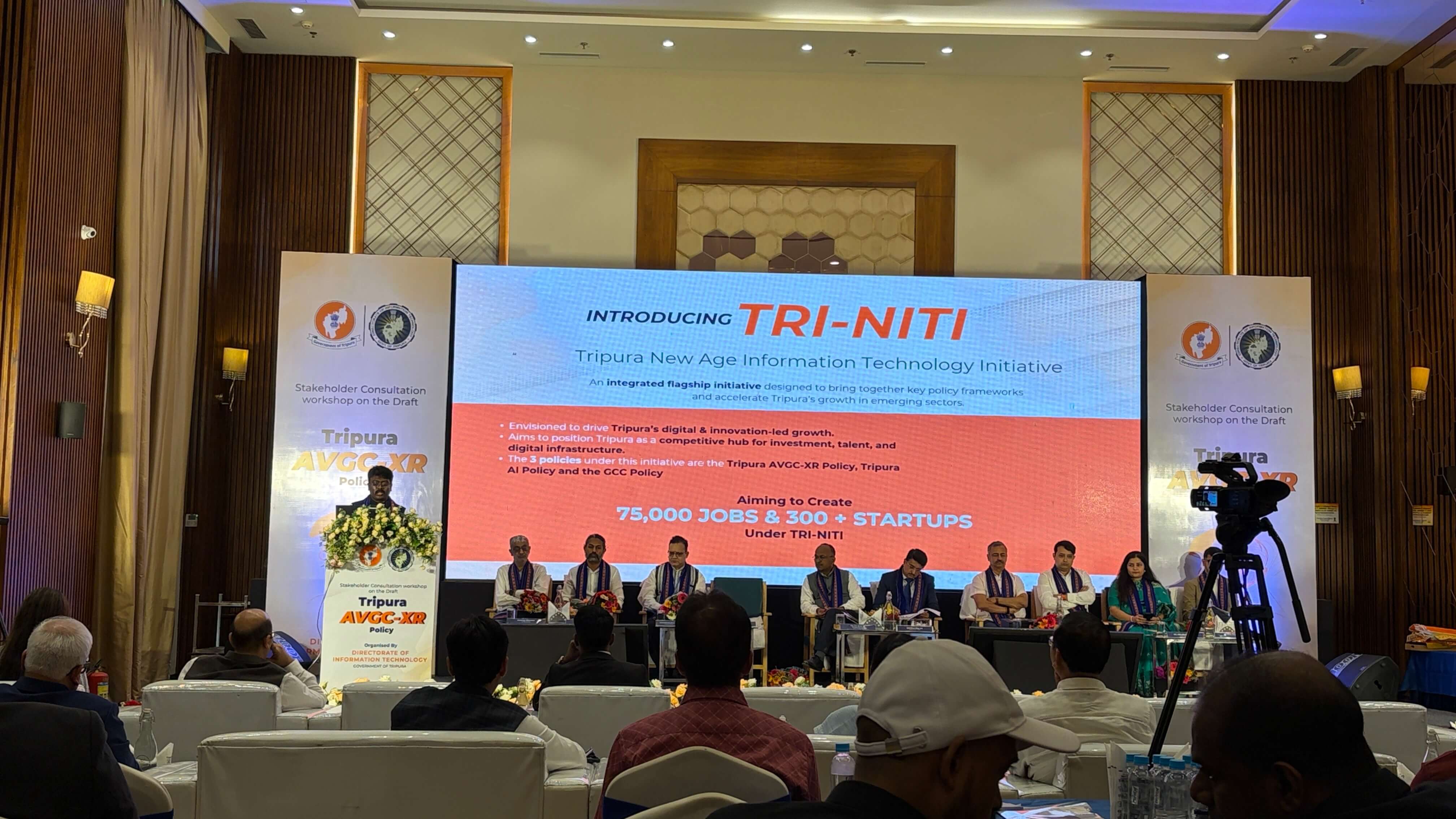
The Tripura AVGC-XR Policy projects 5,000 to 7,500 direct and indirect jobs over five to seven years, plus 2,000 plus freelance micro-enterprises. The wider TRI-NITI initiative across AVGC, AI, and GCC policies targets 75,000 jobs in total.
What skills are needed for AVGC-XR jobs in Tripura?
In-demand skills include animation, game development, game art, VFX, 3D modelling, comic and webtoon creation, XR or AR or VR experience design, and AI-assisted creative work. Building a public portfolio of real projects is essential, since creative-tech hiring is based on proof of work.
Can people in small towns get creative-tech jobs?
Yes. Creative-tech work mainly needs talent, a computer, and internet rather than factories or offices. This lets people in small towns and states like Tripura work for studios or clients anywhere in the world, especially as freelancers and micro-entrepreneurs.
Why is Tripura suitable for creative-tech jobs?
Tripura has around 94 percent literacy, a young population, improving internet infrastructure, and rich cultural stories. Creative-tech depends on talent and connectivity, which the state can provide, making it a strong fit for building a creative economy and thousands of related jobs.
What is Fueler Portfolio?
Fueler is a career portfolio platform that helps companies find the best talent for their organization based on their proof of work. You can create your portfolio on Fueler. Thousands of freelancers around the world use Fueler to create their professional-looking portfolios and become financially independent. Discover inspiration for your portfolio
Sign up for free on Fueler or get in touch to learn more.

What should you do next?
You've read the article. Now turn your skills into proof of work and unlock more opportunities.
Build your proof of work portfolio
Create a clean portfolio with projects, assignments, resumes, and AI stack details that companies actually want to see.
Create your Fueler portfolio →Apply through assignments, not resumes
Stand out by solving real tasks from companies hiring on Fueler.
Explore assignments →Get discovered by companies
Make your work public and let recruiters discover your skills through actual projects instead of keywords.
Get discovered →
