Tripura AVGC-XR Policy Explained: Jobs, Startups, Incentives and Opportunities

Riten Debnath
23 May, 2026
A few days ago, I was sitting inside a hall in Agartala, watching something I did not expect to see in Northeast India.
On a big screen in front of me were words like Animation, Gaming, Visual Effects, Extended Reality, and Cultural IP. On stage were government officials, industry founders, and academics. The room was full of students, creators, and entrepreneurs. The energy was not like a normal government meeting. It felt like the early days of a startup.
This was the Stakeholder Consultation Workshop on the draft Tripura AVGC-XR Policy, organised by the Directorate of Information Technology, Government of Tripura, on 20th May 2026.
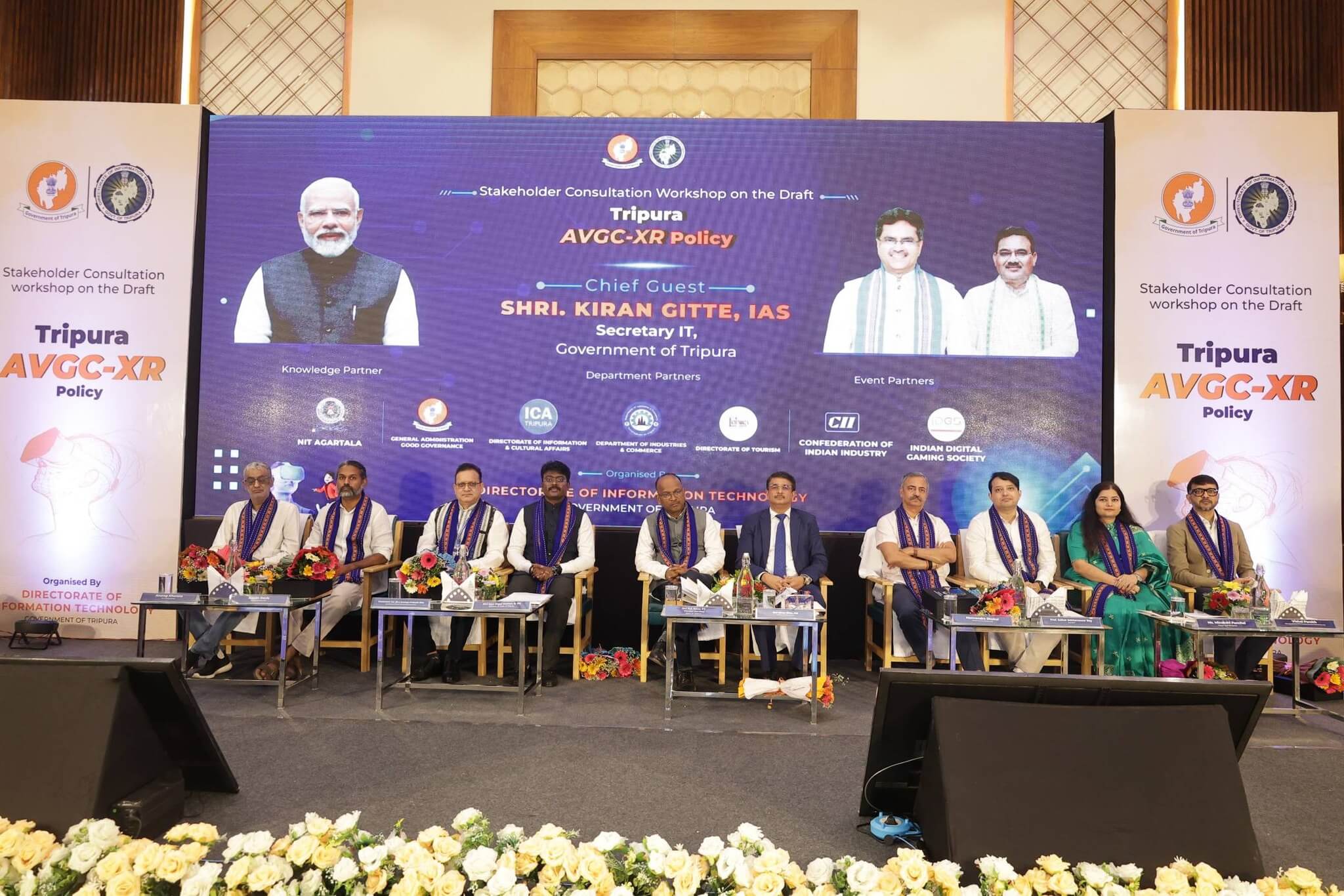
Draft Tripura AVGC-XR Policy Workshop
I am Riten, founder of Fueler, a platform that helps people get hired through their work, not just their resume. I spend most of my time thinking about creators, careers, and how the internet is changing the way people earn. So when I saw a small state like Tripura openly trying to build a creative economy, I paid close attention.
For decades, creative-tech careers in India were stuck in a few cities like Bangalore, Mumbai, Hyderabad, and Pune. If you wanted to work in animation or gaming, you had to leave your home and move to a metro. Tripura is now trying to change that story.
The consultation was convened by the state government as part of its effort to design a forward-looking policy that promotes creativity, innovation, entrepreneurship, skill development, and digital employment. It brought together senior officials, industry leaders, academic experts, and founders from the AVGC-XR ecosystem. There were technical sessions from experts at institutions like the National Institute of Design, sessions on the entrepreneurial journeys of real founders, and an open forum where stakeholders shared suggestions directly with the people drafting the policy. That last part mattered to me. A policy that is built with feedback from creators and founders has a much better chance of actually working than one written behind closed doors.
In this article, I will break down everything about the Tripura AVGC-XR Policy in simple language. What it means, why it matters, the money on the table, the jobs it can create, and the real opportunities for students, creators, and founders. I will also share where I think the policy is strong and where it still has work to do. By the end, you will understand not just what the policy says, but how to actually use it if you are a student, a creator, or a founder in the Northeast.
Let us get into it.
What is AVGC-XR? A Simple Explanation
Before we talk about the policy, let us understand the term itself. AVGC-XR sounds technical, but it is actually very simple once you break it down.
AVGC stands for four creative industries:
- Animation is moving pictures and characters, like cartoons, anime, and animated films.
- Visual Effects (VFX) is the digital magic you see in movies and OTT shows. Think explosions, dragons, or entire fake worlds.
- Gaming is video games, from mobile games on your phone to big console games.
- Comics is illustrated storytelling, including digital comics and webtoons.
XR stands for Extended Reality, which is an umbrella term for three things:
- AR (Augmented Reality) adds digital things on top of the real world, like trying on clothes through your phone camera.
- VR (Virtual Reality) puts you inside a fully digital world using a headset.
- MR (Mixed Reality) blends the real and digital worlds together.
So when you hear AVGC-XR, just think of it as the creative and immersive digital economy. It powers things you already use and enjoy every day: the anime you binge-watch, the VFX in your favourite OTT series, the mobile games you play, virtual museum tours, AR shopping filters, and the early versions of the metaverse.
This sector is one of the fastest-growing creative industries in the world. India is expected to create huge employment in this space, and many states are now racing to launch their own AVGC-XR policies. Tripura is the newest entrant, and arguably one of the most ambitious for its size.
To put it in perspective, think about how much of your daily entertainment already comes from this sector. The OTT shows you stream use VFX teams. The mobile games you open during a break were built by game studios. The animated content your younger siblings watch is made by animation houses. The AR filters you use on social media are XR products. This is not a niche, futuristic industry. It is already woven into everyday life, and it is only growing as more of the world moves online and into immersive experiences. That is exactly why governments now see it as a serious source of jobs and exports, not just entertainment.
A New Dawn for the Orange Economy in Tripura
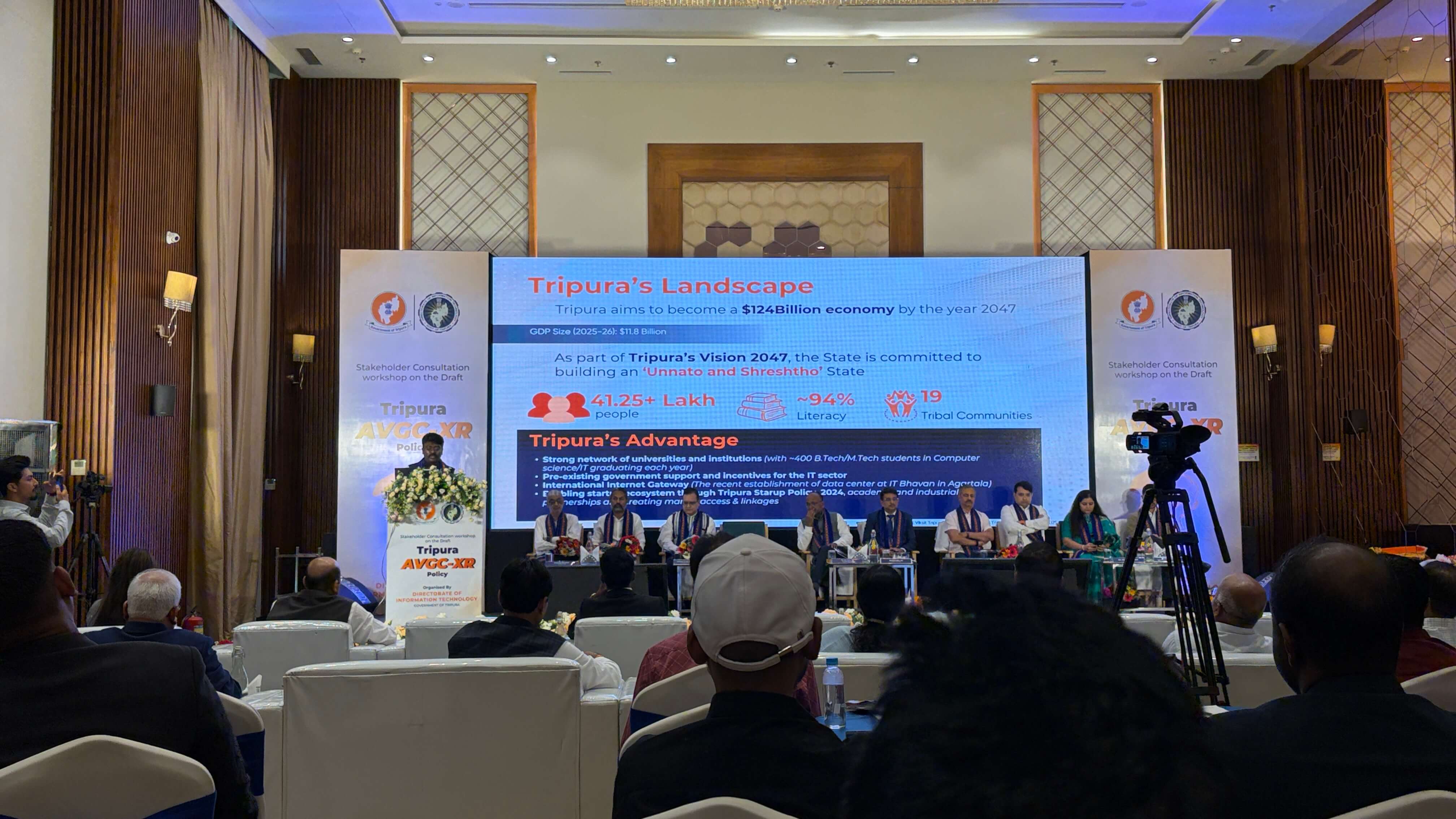
Before I get into what the policy actually says, let me set the scene properly, because the people in that room tell you how seriously Tripura is taking this.
This whole effort is aligned with the national vision to boost the Orange Economy, which is the creative economy I will explain later. On the ground, it is being driven under the leadership of Tripura Chief Minister Prof. (Dr.) Manik Saha and IT, Finance and Planning & Coordination Minister Shri Pranajit Singha Roy.
The Stakeholder Consultation Programme on the draft Tripura AVGC-XR Policy was organised by the Directorate of Information Technology, Government of Tripura, in Agartala. It brought together senior government officials, industry experts, academic leaders, founders, and key stakeholders from the Animation, Visual Effects, Gaming, Comics, and Extended Reality ecosystem.
The programme was graced by Shri Kiran Gitte, IAS, Secretary, IT, Government of Tripura. Shri Jeya Ragul Geshan B., IFS, Director, IT, laid out the state's vision for promoting creativity, innovation, entrepreneurship, skill development, and digital employment. Senior officials including Shri R.K. Samal, IFS, along with other dignitaries and departmental representatives, also took part.
What really struck me was the calibre of experts who showed up to share insights:
- Mr. Austin Davis, Head of Skill Development at NID and a Member of the Task Force for the National AVGC Strategy.
- Mr. Manvendra Shukul, Member of the Board of Directors at IICT.
- Prof. Saikat Sekhareswar Roy, HoD of Editing at SRFTI.
- Mr. Anurag Khurana, CEO of Newgen Gaming Pvt. Ltd.
- Mr. Vishal Parekh, COO of CyberPowerPC.
- Lt. Col. (Dr.) Soumya Prakash Otta, Director at STPI.
When you get people from national design institutes, film institutes, gaming companies, and hardware firms in the same room for a small state's draft policy, that is a strong signal. The consultation became a real working platform to discuss skill development, startup promotion, cultural content creation, and youth-led innovation, all aimed at positioning Tripura as an emerging AVGC-XR destination in the Northeast.
Why Tripura is Investing in AVGC-XR
When I looked at the numbers Tripura shared on stage, the strategy started to make sense.
Tripura wants to become a 124 billion dollar economy by the year 2047. Right now, its GDP size for 2025 to 2026 is around 11.8 billion dollars. That is a massive jump the state is aiming for, and it is part of Tripura's Vision 2047 to build what they call an "Unnato and Shreshtho" (developed and superior) state.
Here is what stood out to me about Tripura's foundation:
- Population of over 41.25 lakh people, with a young, working-age base.
- Around 94 percent literacy, which is one of the highest in India.
- 19 tribal communities, which means a deep and diverse cultural heritage.
- Roughly 400 BTech and MTech students in Computer Science and IT graduating every year.
- A new international internet gateway and a data centre at IT Bhavan in Agartala.
- An existing startup base through the Tripura Startup Policy 2024.
When you combine high literacy, a young population, improving internet infrastructure, and rich culture, you get the raw materials for a creative economy. Tripura is betting that AVGC-XR can become a job creator, a startup engine, a cultural export machine, and a driver of the larger digital economy all at once.
For a state that has historically been seen as remote and disconnected, this is a smart angle. You do not need factories or ports to build animation studios. You need talent, internet, and skill. Tripura has the first, is building the second, and is now trying to create the third through policy.
Introducing TRI-NITI: The Bigger Picture
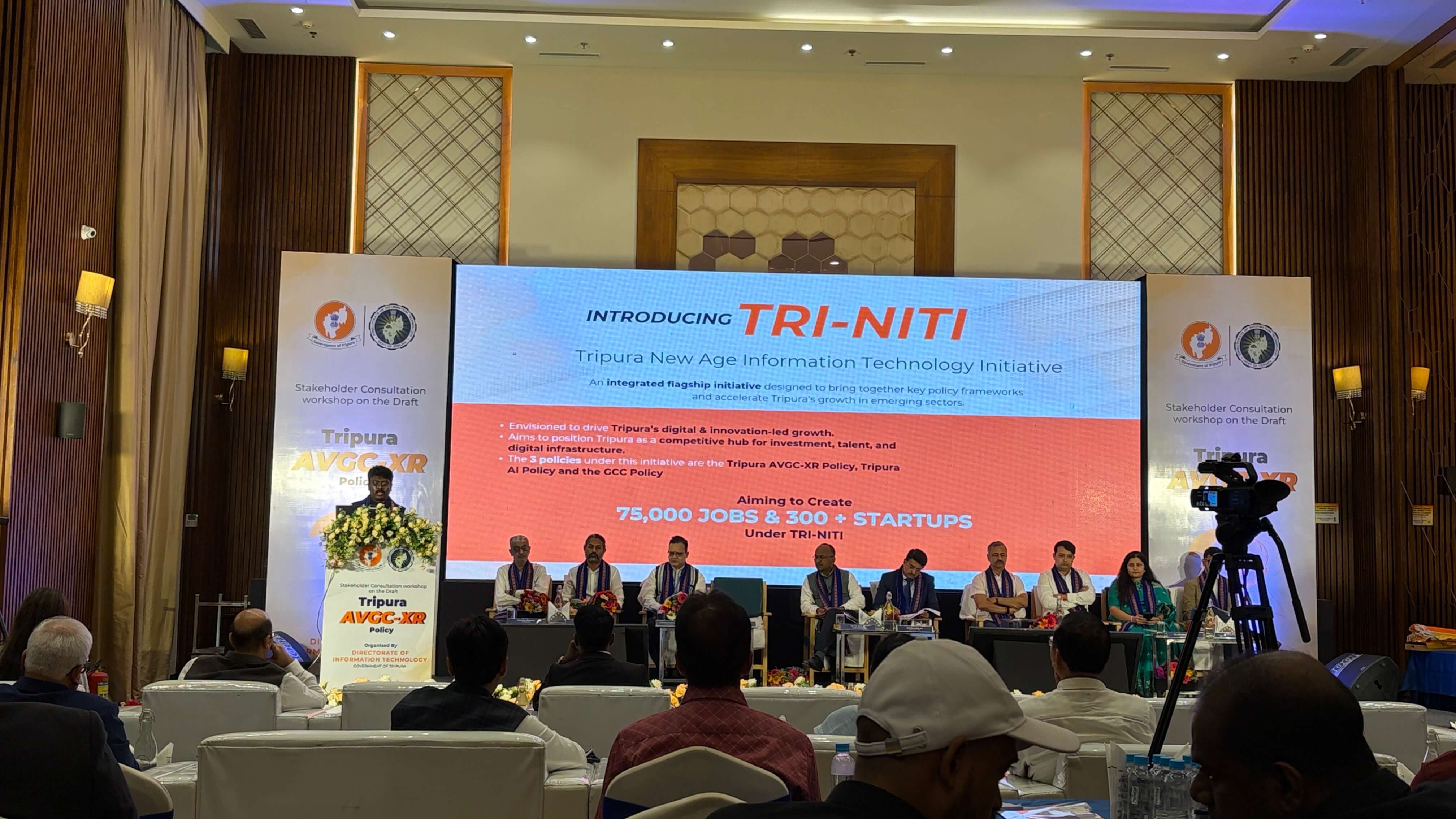
Introducing TRI-NITI
Here is something many people missed. The AVGC-XR Policy is not a standalone document. It sits inside a much bigger plan called TRI-NITI.
TRI-NITI stands for Tripura New Age Information Technology Initiative. It is an integrated flagship initiative designed to bring together key policy frameworks and accelerate Tripura's growth in emerging sectors.
Think of TRI-NITI as the umbrella, and under it sit three connected policies:
- Tripura AVGC-XR Policy for the creative and immersive economy.
- Tripura AI Policy for artificial intelligence.
- GCC Policy for Global Capability Centres.
The combined goal across TRI-NITI is bold: 75,000 jobs and 300 plus startups.
I like this approach because it shows joined-up thinking. AVGC-XR, AI, and global capability centres are not separate islands. They feed each other. AI tools now power animation and game design. Global capability centres need creative and technical talent. By bundling them under one initiative, Tripura is trying to build an ecosystem, not just one industry.
For founders and creators, TRI-NITI is the signal to watch. It tells you the state is serious about the digital economy at the highest level, not just dabbling in one sector.
Vision of the Tripura AVGC-XR Policy
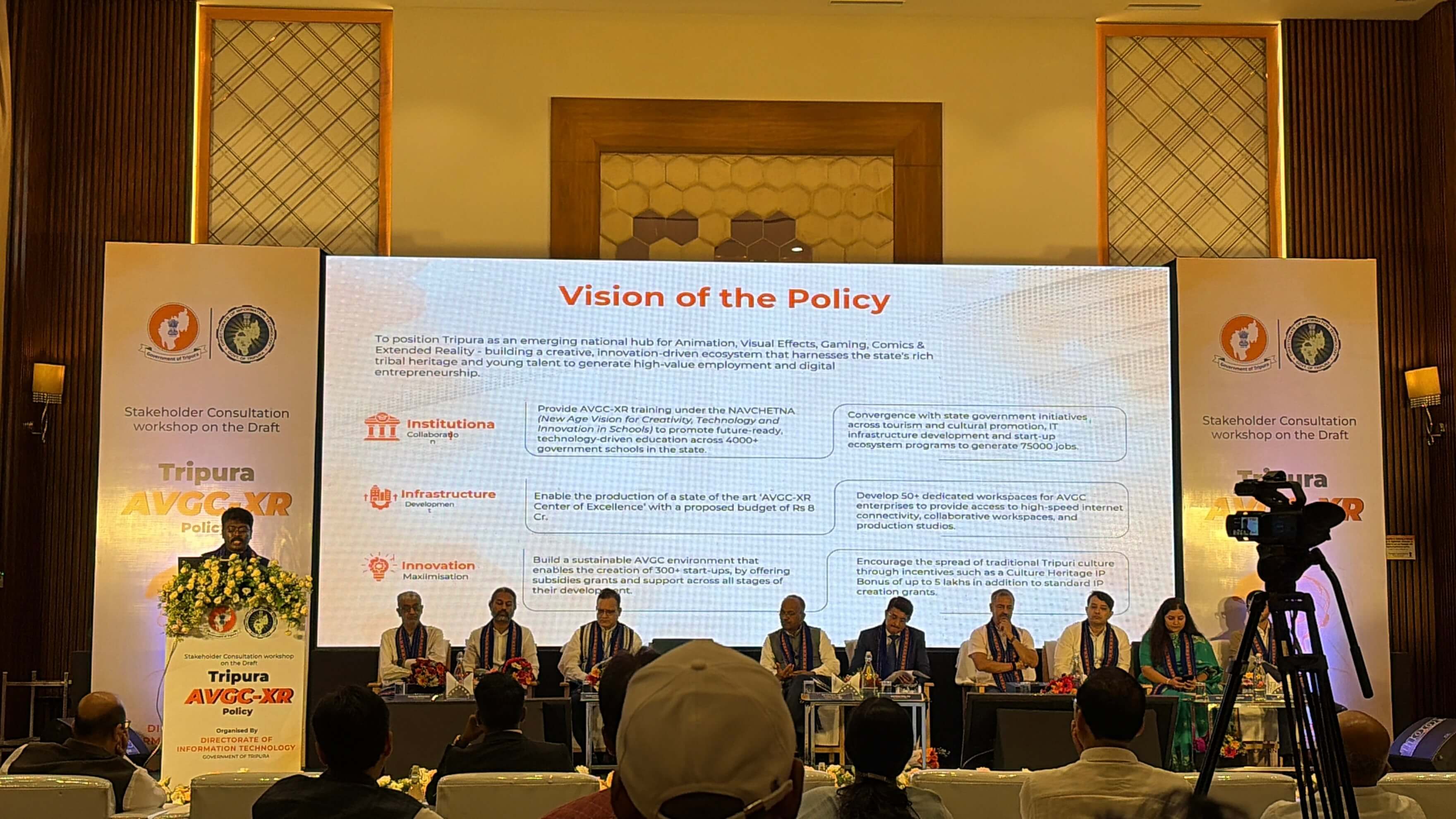
Vision of the Tripura AVGC-XR Policy
The official vision of the policy is to position Tripura as an emerging national hub for Animation, Visual Effects, Gaming, Comics, and Extended Reality. The goal is to build a creative, innovation-driven ecosystem that uses the state's rich tribal heritage and young talent to generate high-value employment and digital entrepreneurship.
The vision breaks down into three clear pillars.
1. Institutional Collaboration
The policy plans to provide AVGC-XR training under an initiative called NAVCHETNA, which stands for New Age Vision for Creativity, Technology and Innovation in Schools. The aim is to promote future-ready, technology-driven education across more than 4,000 government schools in the state.
It also wants to connect with existing government efforts in tourism, cultural promotion, IT infrastructure, and startup programs to help generate jobs. In simple terms, they want to start early, in schools, and build skill from the ground up.
2. Infrastructure Development
The policy proposes an AVGC-XR Centre of Excellence with a proposed budget of around 8 crore rupees. It also plans to develop 50 plus dedicated workspaces for AVGC enterprises, giving them access to high-speed internet, collaborative workspaces, and production studios.
This matters because creative work needs serious computing power. Rendering animation or building VR experiences needs strong machines and fast internet. Shared infrastructure lowers the cost for small teams who cannot afford it alone.
3. Innovation Maximisation
The third pillar focuses on building a sustainable AVGC environment that enables the creation of 300 plus startups. It plans to do this by offering subsidies, grants, and support across all stages of a startup's journey.
There is also a unique cultural angle. The policy wants to encourage traditional Tripuri culture through incentives like a Culture Heritage IP Bonus of up to 5 lakh rupees, in addition to standard IP creation grants.
This is not just a media policy. It is an attempt to build creative-tech infrastructure from scratch, which is far more ambitious than simply giving out subsidies.
Scope of the Policy: The Strategic Focus Areas
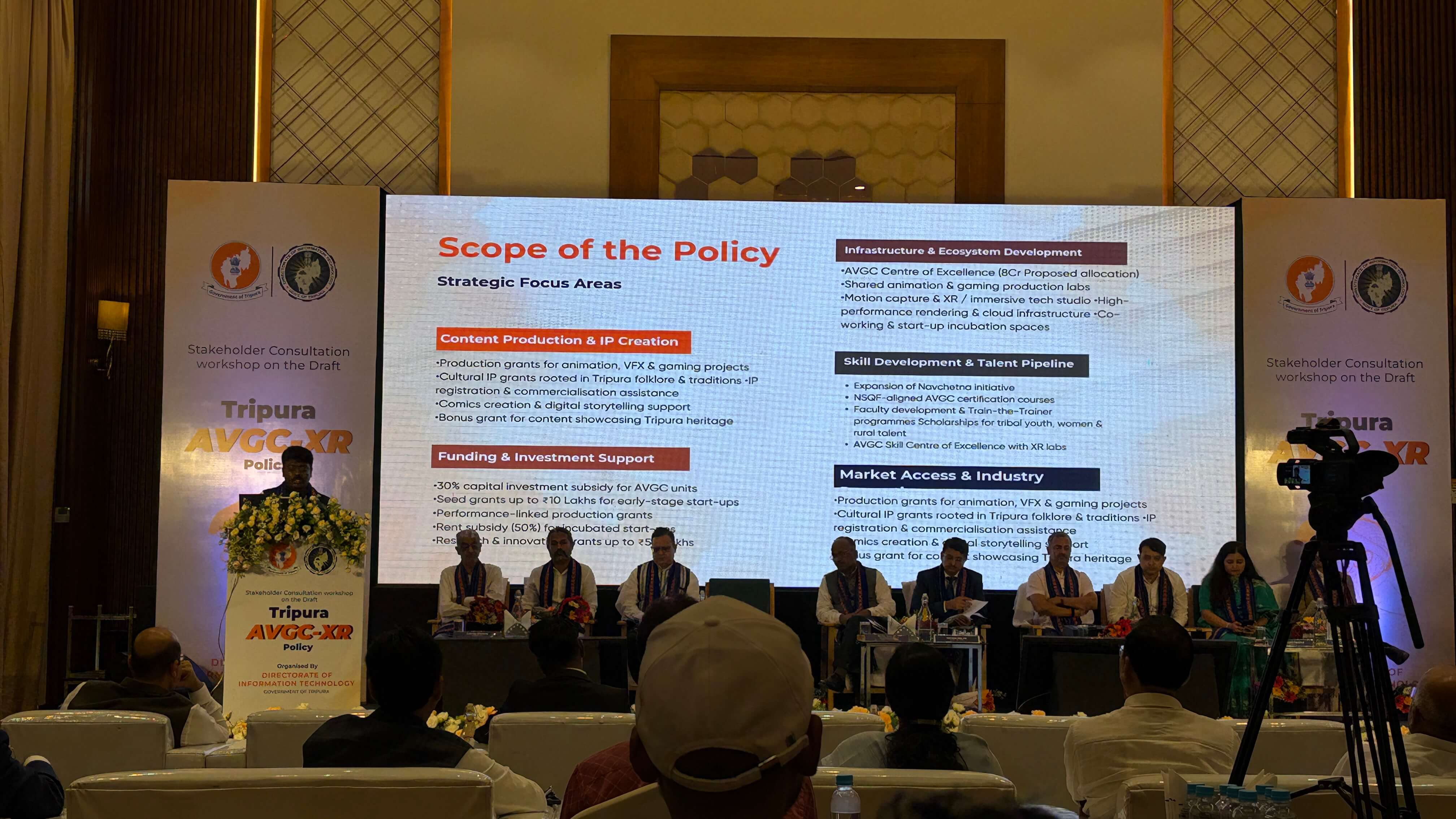
Scope of the Policy: The Strategic Focus Areas
The policy lays out five strategic focus areas. Let me walk you through each one because this is where you can actually see the opportunities.
Content Production and IP Creation
This is the heart of the policy. It includes:
- Production grants for animation, VFX, and gaming projects.
- Cultural IP grants rooted in Tripura folklore and traditions.
- IP registration and commercialisation assistance.
- Comics creation and digital storytelling support.
- A bonus grant for content that showcases Tripura heritage.
Funding and Investment Support
This is the money layer. It includes:
- A 30 percent capital investment subsidy for AVGC units.
- Seed grants up to 10 lakh rupees for early-stage startups.
- Performance-linked production grants.
- A 50 percent rent subsidy for incubated startups.
- Research and innovation grants.
Infrastructure and Ecosystem Development
This covers the physical and digital backbone:
- The AVGC Centre of Excellence with the proposed 8 crore allocation.
- Shared animation and gaming production labs.
- Motion capture and XR or immersive tech studios.
- High-performance rendering and cloud infrastructure.
- Co-working and startup incubation spaces.
Skill Development and Talent Pipeline
This is about building people, which I personally care about the most:
- Expansion of the Navchetna initiative.
- NSQF-aligned AVGC certification courses.
- Faculty development and Train-the-Trainer programmes.
- Scholarships for tribal youth, women, and rural talent.
- An AVGC Skill Centre of Excellence with XR labs.
Market Access and Industry Support
This connects local creators to the wider world through exhibitions, industry participation, and global exposure events.
When you put all five together, you see a full-stack approach. Money, infrastructure, skill, IP, and market access. That is how you actually build an industry, not just announce one.
Major Policy Incentives: The Real Numbers
Now let us talk about the money, because this is what founders and investors actually look at. Based on the official incentive table shared at the workshop, here is the clearest breakdown I can give you.
I want to be honest here. I have seen some early write-ups list these numbers incorrectly, mixing up the benefit with the maximum limit. The table above reflects what was actually shown on the official slides at the consultation. If you are a founder planning to apply, always cross-check the final notified policy document, because draft figures can change before the policy is officially passed.
What I find genuinely interesting is the Employment Generation Incentive. Paying enterprises 30,000 to 1,00,000 rupees per new local job is a direct push for hiring local talent. For a state trying to stop its youth from migrating away, this is a clever lever.
How Tripura Compares With Other AVGC States
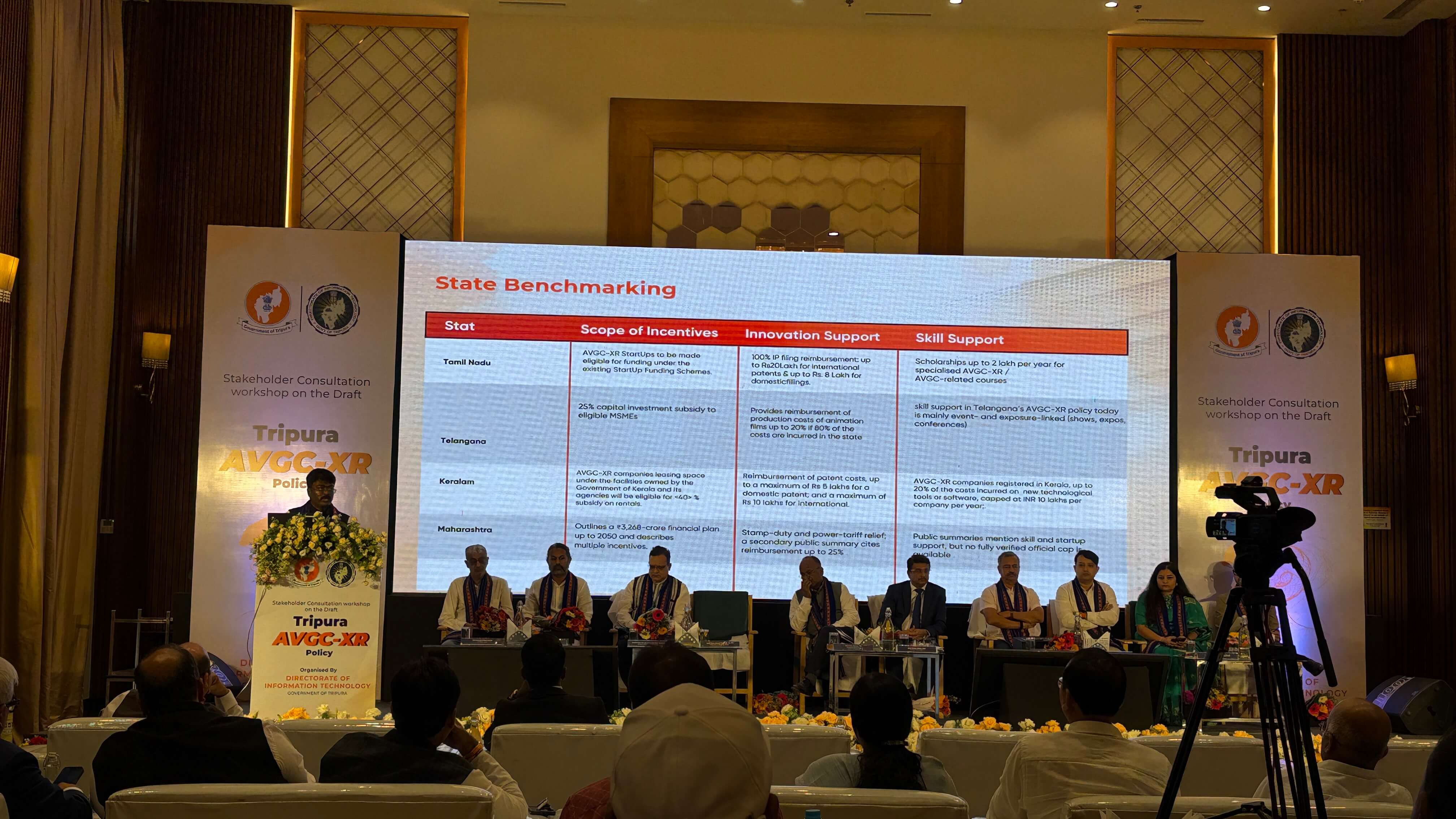
How Tripura Compares With Other AVGC States
Tripura is not the first state to do this. So the real question is, what makes it different?
Based on the state benchmarking shared at the event, here is a simple comparison.
- Tamil Nadu makes AVGC-XR startups eligible for funding under existing startup schemes, offers up to 100 percent IP filing reimbursement (up to 20 lakh for international patents and up to 8 lakh for domestic), and scholarships up to 2 lakh per year for AVGC courses.
- Telangana offers a 25 percent capital investment subsidy to eligible MSMEs and reimburses production costs of animation films up to 20 percent if 80 percent of costs are incurred in the state. Its skill support is mainly event and exposure-linked.
- Kerala offers rental subsidies for companies leasing government-owned space, reimbursement of patent costs (up to 5 lakh domestic, 10 lakh international), and support covering up to 20 percent of costs on new tools or software, capped at 10 lakh per company per year.
- Maharashtra has the biggest plan, with a financial framework reported in thousands of crores stretching up to 2050, including stamp-duty and power-tariff relief.
So where does Tripura fit? It cannot outspend Maharashtra. It cannot match the established studios of Tamil Nadu or Telangana. So it is choosing a different game.
Tripura's differentiation comes down to three things, as shared on stage:
- Culture-led IP strategy. Tripura is explicitly linking AVGC support to tribal cultures, folklore, traditional arts, and indigenous knowledge through dedicated cultural-IP incentives.
- Gateway positioning. Its geography and border location give it a different strategic narrative from metro-led AVGC states.
- Skill-first growth. The policy prioritises enabling its highly literate population through collaborations with reputed institutions across the country.
This is exactly the kind of positioning I would advise any early-stage player to take. When you cannot win on budget, you win on a niche that no one else owns. For Tripura, that niche is original, culture-rooted creative IP from the Northeast.
Why This is Important for Students and Young Creators
This is the section I care about the most, because it is closest to what I do at Fueler every single day.
If you are a student or young creator in Tripura or anywhere in the Northeast, this policy could change your career path. Here is why.
The AVGC-XR sector opens doors to careers that did not exist locally before:
- Animation and motion design.
- Game development and game art.
- VFX and 3D modelling.
- Comic and webtoon creation.
- XR and immersive experience design.
- AI-assisted creative work.
The best part is that most of these careers are internet-native. You can work remotely, freelance for clients around the world, or build your own creator business from a small town. You no longer need to move to a metro to build a creative-tech career.
But here is the hard truth I want every young creator to hear. In these industries, your degree alone will not get you hired. Your work will.
In AVGC industries, proof-of-work matters more than certificates alone.
No animation studio hires you because you have a certificate. They hire you because they saw your showreel. No game studio cares about your marks. They care about the game you shipped. This is the single biggest shift in modern hiring, and it is exactly why I built Fueler.
So my honest advice to students reading this:
- Start building a public portfolio today, even if your work is not perfect yet.
- Showcase your proof of work online where companies and clients can find them.
- Build a creator identity so people start associating your name with your craft.
- Treat your career as proof-of-work first, certificate second.
The policy can fund the schools and the studios. But your portfolio is the thing that will actually get you hired. Skill plus visible proof of that skill is the unbeatable combination in this new economy.
Let me make this practical. If I were an 18-year-old in Agartala today wanting an AVGC career, here is the exact path I would follow. First, I would pick one skill and go deep, not wide. Trying to learn animation, gaming, and VFX all at once leads to being average at all three. Second, I would build one small project every week, even rough ones, just to build the habit of finishing and shipping work. Third, I would put every project online in a public portfolio so that recruiters and clients could discover me without me chasing them. Fourth, I would share my work openly on social platforms to slowly build a name in my niche. And fifth, I would reach out to small studios and offer to do real project work, even free at first, just to get genuine credits on my portfolio. Within a year, that creator would have a body of work that speaks louder than any degree. That is the proof-of-work path, and it works whether or not the policy fully delivers.
Opportunities for Startups and Founders
If you are a founder, Tripura is offering something rare: a chance to be an early mover in a fresh ecosystem.
Here are the kinds of startups I believe can thrive under this policy:
- Indie gaming studios building mobile-first games for Indian and global audiences.
- Animation agencies doing service work for OTT, ads, and studios.
- XR startups creating AR and VR experiences for tourism, education, and retail.
- Creator tooling companies building software that helps other creators work faster.
- AI-assisted content startups that use AI to produce animation, art, and stories at scale.
- Regional storytelling studios turning Northeast stories into games, comics, and shows.
The advantage of being early is huge. When an ecosystem is just forming, the first serious players help define the rules, attract the talent, and grab the early grants. With seed grants up to 10 lakh, a 50 percent rent subsidy, and a 30 percent capital subsidy, the cost of starting up in Tripura is genuinely lower than in a metro.
But let me add a founder's reality check. Subsidies do not build great companies. Customers do. Use the grants to extend your runway, not to replace your need for real revenue. The smartest founders will take the government support and still build like the money will run out tomorrow.
The Cultural IP Opportunity Nobody is Talking About
This is the part that genuinely excited me, and I think most people are sleeping on it.
Tripura has 19 tribal communities. That means a treasure of folklore, myths, traditional art, music, and stories that the internet has barely seen. The policy is offering a Culture Heritage IP Bonus and cultural IP grants specifically to turn this heritage into digital content.
Think about what other countries have done with their culture:
- Japan turned its art style and stories into anime, which is now a global multi-billion-dollar industry and a soft-power machine.
- Korea turned its music and dramas into K-pop and K-dramas, which now have fans in every country.
These countries did not invent new culture. They packaged their existing culture for the internet and the world bought it.
Northeast India has original stories the internet has never seen at scale. Tribal legends, local myths, unique art forms, and folk characters that could become games, animated series, comics, and immersive experiences.
If even a handful of founders take Tripuri and Northeast folklore seriously and build modern, high-quality content around it, they could create IP that travels far beyond the state. That is the opportunity hiding in plain sight. Culture is the one thing a metro studio cannot copy from you.
Implementation Roadmap: The Five-Year Plan to Execute Tripura AVGC-XR Policy
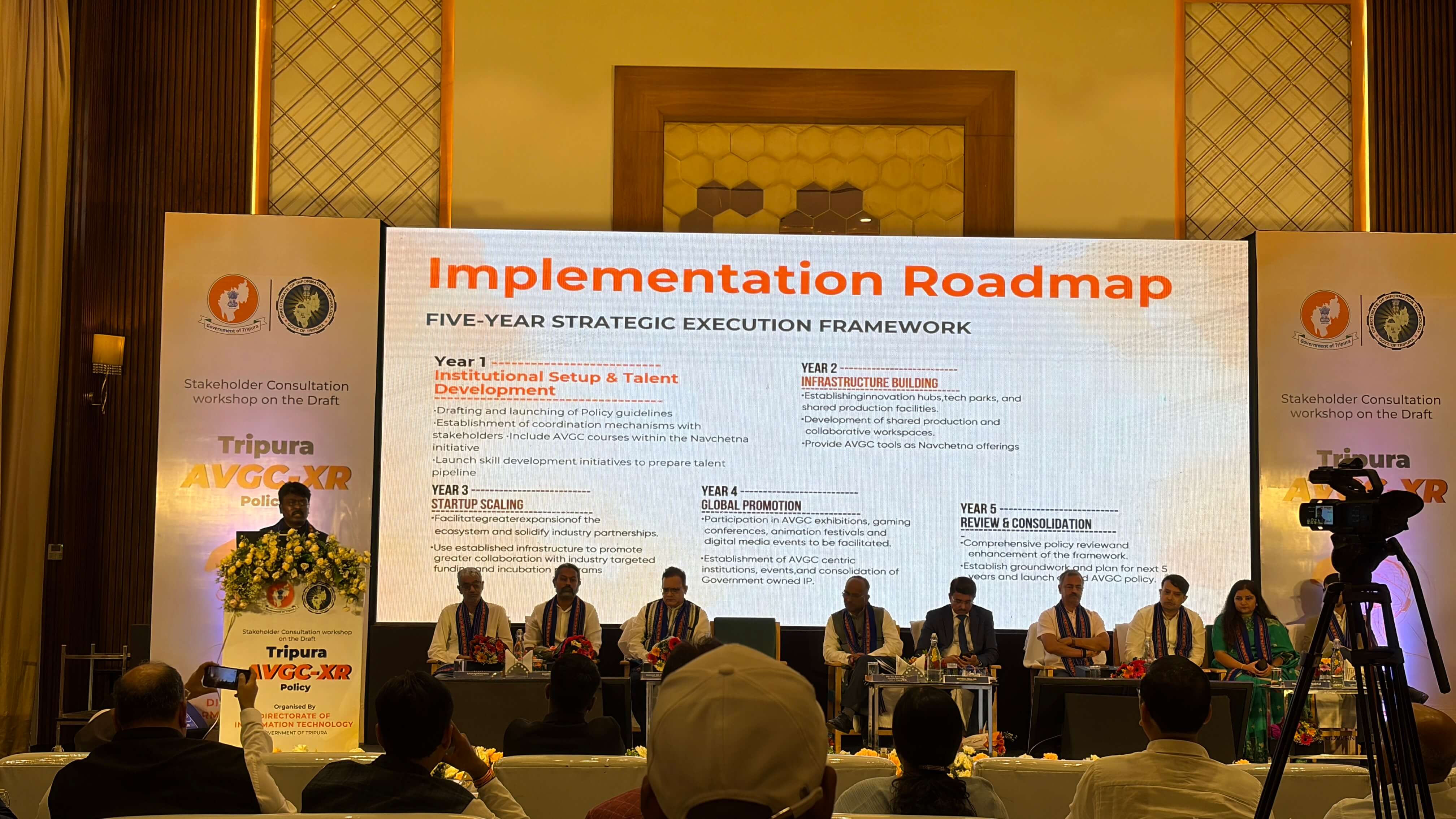
Implementation Roadmap: The Five-Year Plan to Execute Tripura AVGC-XR Policy
A vision is only as good as its execution. Here is the five-year strategic framework the policy laid out.
Year 1: Institutional Setup and Talent Development. Drafting and launching policy guidelines, setting up coordination with stakeholders, adding AVGC courses within the Navchetna initiative, and launching skill development to prepare the talent pipeline.
Year 2: Infrastructure Building. Establishing innovation hubs, tech parks, and shared production facilities, plus providing AVGC tools as Navchetna offerings.
Year 3: Startup Scaling. Expanding the ecosystem, solidifying industry partnerships, and using the new infrastructure to push targeted funding and incubation programs.
Year 4: Global Promotion. Participating in AVGC exhibitions, gaming conferences, animation festivals, and digital media events, and consolidating government-owned IP.
Year 5: Review and Consolidation. A full policy review, enhancement of the framework, and laying the groundwork for the next five years.
I appreciate that the roadmap starts with people and skill in Year 1, not buildings. Too many policies start by constructing fancy centres that sit empty. Building talent first is the right order.
But I will say this clearly: execution will matter far more than any announcement. The states that win in AVGC are not the ones with the best slides. They are the ones that actually ship the centres, run the courses, and get the grants into founders' hands on time.
Governance and Expected Outcomes
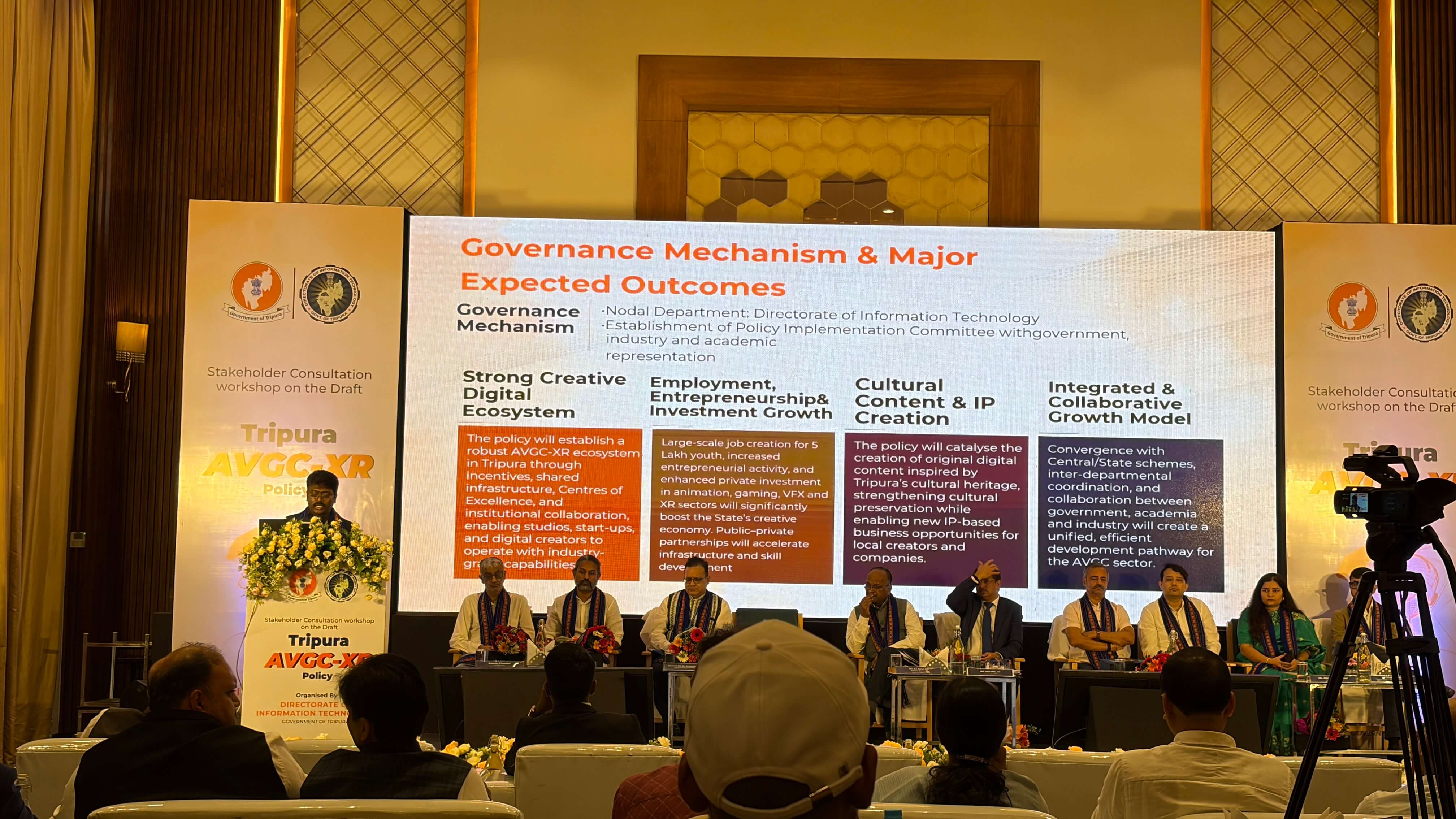
Governance and Expected Outcome for Tripura AVGC-XR Policy
The policy has set up a governance structure to keep it on track. The Directorate of Information Technology is the nodal department, and there will be a Policy Implementation Committee with government, industry, and academic representation.
The major expected outcomes are grouped into four areas:
- Strong Creative Digital Ecosystem built through incentives, shared infrastructure, Centres of Excellence, and institutional collaboration.
- Employment, Entrepreneurship and Investment Growth with large-scale job creation, more entrepreneurial activity, and higher private investment.
- Cultural Content and IP Creation turning Tripura's heritage into original, monetisable digital content.
- Integrated and Collaborative Growth Model that connects central and state schemes with academia and industry.
On the specific impact numbers, the policy is realistic. It projects creating 5,000 to 7,500 direct and indirect AVGC-XR-linked jobs over five to seven years, including full-time studio roles and 2,000 plus freelance micro-enterprises. It aims to skill 15,000 to 20,000 youth through AVGC-XR-linked programmes over the first five years.
I respect that these state-level numbers are grounded. The 75,000 jobs figure belongs to the larger TRI-NITI umbrella across AVGC, AI, and GCC combined. The AVGC-XR policy itself is honest about its direct contribution being in the thousands, with freelance and indirect opportunities on top. Honest projections build more trust than inflated ones.
Challenges Tripura Must Solve
I would not be giving you a real picture if I only talked about the good parts. As someone who builds things for a living, I always look for the gaps. Here are the challenges Tripura must solve for this policy to actually work.
- Talent retention. If you skill people but they still leave for Bangalore, the state loses. The employment incentive helps, but local studios must offer real careers.
- Industry partnerships. Policy cannot create demand. Tripura needs real studios and clients to give local talent actual paid work.
- Infrastructure execution. An 8 crore Centre of Excellence is a start, but it must be built well, staffed well, and kept running.
- Mentor availability. Young founders need experienced mentors. A remote state has fewer of them, so virtual mentorship networks will be key.
- Internet quality consistency. Creative work dies without reliable, fast internet. This must be rock solid across the state, not just in Agartala.
- Access to advanced hardware. Animation, VFX, and XR need powerful machines. Shared labs must have current, high-end equipment.
- Portfolio-first skilling. Training must focus on building real, shippable work, not just teaching theory. Employers hire based on output, so the skilling must produce visible proof of skill.
None of these are reasons to doubt the policy. They are simply the work that comes after the announcement. The states that take these challenges seriously are the ones that turn a draft into a real industry.
The Orange Economy Angle
One phrase that came up around this policy is the "orange economy." If you have not heard it before, the orange economy is the term for the creative economy: industries built on culture, art, ideas, and intellectual property rather than factories or raw materials.
This framing tells you a lot about how Tripura is thinking. A traditional economy grows by building things you can touch. An orange economy grows by building things you can stream, play, and experience. For a state without heavy industry or major ports, the orange economy is one of the few paths to high-value growth that does not require huge physical infrastructure.
The draft policy also plans to work alongside other recent Tripura initiatives like the Startup Policy 2024 and the Cybersecurity Policy 2025. This stacking of policies is smart. A startup founder in Tripura could potentially benefit from startup support, AVGC-specific grants, and a safer digital environment all at once. The whole becomes bigger than the sum of its parts.
Final Thoughts
Sitting in that hall in Agartala, I kept thinking about one thing. For most of India's tech history, opportunity meant leaving home. If you were talented and ambitious, you packed your bags for a metro. Your hometown got your nostalgia, but the big cities got your career.
The Tripura AVGC-XR Policy is a quiet challenge to that idea. It says you can build a creative-tech career from Tripura. You can tell your own stories. You can build IP rooted in your culture. You can hire and be hired without leaving your roots behind.
This policy is more than a document. It is a signal that the future digital economy of India may not be built only in metros anymore. It can be built in the Northeast, by Northeast creators, using Northeast stories, sold to the entire internet.
Of course, signals are not guarantees. The policy still has to survive the hardest part, which is execution. But the direction is right, the positioning is smart, and the timing fits the proof-of-work era we are living in.
If you are a young creator reading this, do not wait for the policy to be perfect. Start building your portfolio now. Show your work. Let your proof-of-work speak before anyone asks for your degree. The internet does not care where you are from. It cares what you can make.
That is the future I am building toward at Fueler, and it is exciting to see a state like Tripura building toward the same thing.
Frequently Asked Questions (FAQ)
What is the Tripura AVGC-XR Policy?
The Tripura AVGC-XR Policy is a draft government framework by the Directorate of Information Technology, Government of Tripura, to build a creative economy around Animation, Visual Effects, Gaming, Comics, and Extended Reality. It offers subsidies, grants, skill programs, and infrastructure to create jobs, support startups, and turn Tripura's culture into digital IP. It was discussed at a stakeholder consultation in Agartala on 20th May 2026.
How many jobs can the Tripura AVGC-XR Policy create?
The AVGC-XR Policy itself projects 5,000 to 7,500 direct and indirect jobs over five to seven years, plus 2,000 or more freelance micro-enterprises. The larger TRI-NITI initiative, which combines AVGC-XR, AI, and GCC policies, targets 75,000 jobs and 300 plus startups in total.
What grants and incentives does the Tripura AVGC-XR Policy offer for startups?
The draft policy offers seed grants up to 10 lakh for early-stage startups, a 30 percent capital investment subsidy (up to 1.5 crore per unit), production grants up to 25 percent of project cost (up to 1 crore), a 50 percent rent subsidy, employment incentives of 30,000 to 1,00,000 per new local job, IP creation grants, and research grants up to 50 lakh per project.
How can students prepare for AVGC and gaming careers in India?
Students should learn a specific creative skill like animation, game design, VFX, or XR, and then build a public portfolio of real projects. In AVGC industries, hiring is proof-of-work first, so a strong showreel or project portfolio matters more than certificates alone. Free online tools, practice projects, and showcasing work on portfolio platforms are the fastest way to get noticed and hired.
Why are portfolios important in AVGC and creative-tech hiring?
In creative-tech industries, companies hire based on what you can actually make, not just your degree. A portfolio is visible proof of your skill, your style, and your ability to ship real work. Studios and clients want to see your animation, your game, or your designs before they hire you, which makes a strong public portfolio the single most powerful tool for getting hired in the AVGC-XR sector.
What is Fueler Portfolio?
Fueler is a career portfolio platform that helps companies find the best talent for their organization based on their proof of work. You can create your portfolio on Fueler. Thousands of freelancers around the world use Fueler to create their professional-looking portfolios and become financially independent. Discover inspiration for your portfolio
Sign up for free on Fueler or get in touch to learn more.

What should you do next?
You've read the article. Now turn your skills into proof of work and unlock more opportunities.
Build your proof of work portfolio
Create a clean portfolio with projects, assignments, resumes, and AI stack details that companies actually want to see.
Create your Fueler portfolio →Apply through assignments, not resumes
Stand out by solving real tasks from companies hiring on Fueler.
Explore assignments →Get discovered by companies
Make your work public and let recruiters discover your skills through actual projects instead of keywords.
Get discovered →
