Fueler vs Canva Portfolio: What Professionals Should Choose in 2026

Riten Debnath
09 Jul, 2026
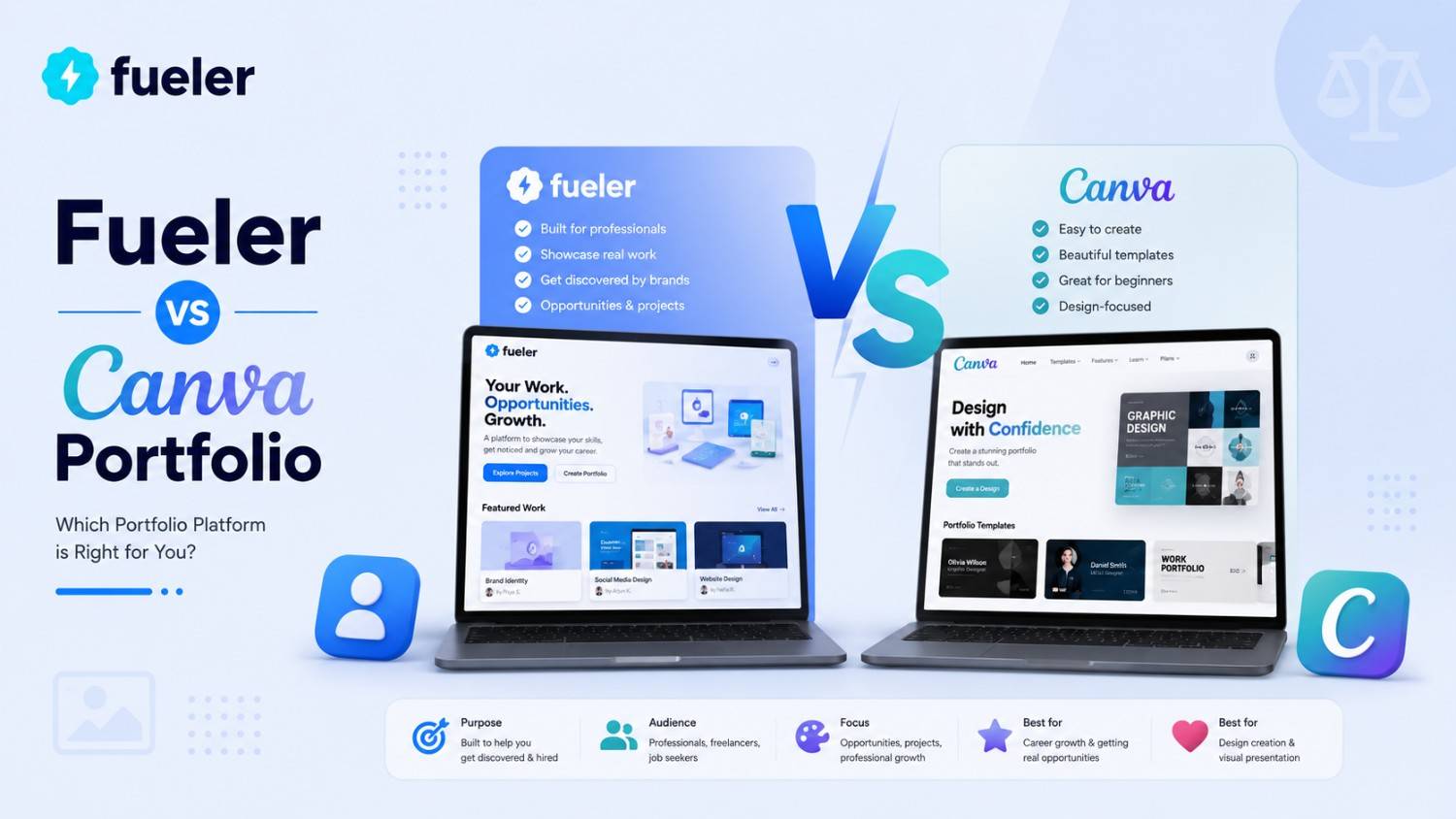
Last updated: July 2026
The year 2026 marks the definitive collapse of the traditional resume. In an ecosystem saturated with AI-generated text, inflated LinkedIn profiles, and hyper-optimized CVs, talent acquisition teams face a critical structural crisis: the dilution of trust. When every applicant can draft a flawless cover letter or assemble a visually stunning website layout in seconds, the aesthetic presentation of a career no longer guarantees technical competence.
As an enterprise leader or independent specialist, your choice of digital infrastructure determines your market visibility. For years, professionals utilized multi-purpose graphic suites to build aesthetic, static web pages. Chief among these is Canva Portfolio, an extension of Canva’s highly intuitive layout software. On the opposite side stands Fueler, a platform explicitly architected around the mechanics of unassailable skill validation.
I’m Riten, founder of Fueler, a skills-first portfolio platform that connects talented individuals with companies through assignments, portfolios, and projects, not just resumes/CVs. Think Dribbble/Behance for work samples + AngelList for hiring infrastructure.
The core question facing modern operators in 2026 is no longer "How do I make my portfolio look beautiful?" but rather "How does my portfolio prove I can execute the job?" This guide provides an exhaustive, feature-by-feature evaluation of Fueler vs Canva Portfolio to help you select the precise infrastructure required for your specific career vector.
Contextualizing Canva Portfolio: The Pinnacle of Visual Presentation
To understand where Canva Portfolio fits into the professional landscape, one must analyze its foundational architecture. Canva is fundamentally an elite, democratic design ecosystem. Its portfolio feature is an organic extension of its core philosophy: enabling individuals to create highly polished visual assets without deep technical design training.
Where Canva Portfolio Excels
Canva’s greatest asset is its limitless design flexibility. It operates as a blank canvas powered by an exhaustive library of typography, grid layouts, transitions, and multimedia integrations.
For a professional whose primary currency is visual composition, such as a brand identity designer, an illustrative artist, or a presentation specialist, Canva provides unparalleled speed in turning an abstract creative concept into a functional web page. The user journey is frictionless: select a template, drag elements across a responsive canvas, and publish to a custom or Canva-hosted domain.
Furthermore, Canva Portfolios function exceptionally well as high-impact pitch decks. If you are an agency operator manually emailing a targeted proposal to a prospective client, a curated Canva presentation hosted as a web link provides a clean, engaging, and linear reading experience. It treats your career trajectory as a narrative story told through structured slides.
The Architectural Boundaries of Canva
The limitation of Canva Portfolio does not stem from a software flaw, but rather from its design intent. Canva was created to build beautiful static assets, not to serve as an interactive, data-driven professional network.
- Zero Native Network Discovery: A Canva Portfolio exists in a digital vacuum. There is no central directory where global recruiters search for keywords like "SEO Strategist" or "Data Analyst" and find a Canva-hosted page. You must actively generate the traffic yourself through outbound social sharing, cold emailing, or physical networking.
- Lack of Relational Metadata: The text blocks inside a Canva Portfolio are structural design layers, not dynamic career nodes. The platform cannot natively track things like project collaborations, client verifications, or historical project updates.
- No Hiring Ecosystem Integration: Canva does not contain native job boards, vetting challenges, live assignment portals, or algorithmic talent matching systems. It is a destination page, not an active employment gateway.
Contextualizing Fueler: The Proof-of-Work Protocol
Fueler was developed to solve the precise structural issues that occur when design software is forced to act as a professional identity layer. Rather than treating a portfolio as an aesthetic brochure, Fueler treats it as a living ledger of professional execution.
The Architecture of Proof
At its core, Fueler optimizes for speed of documentation and indisputable credibility. A professional profile on Fueler is built from the ground up using Projects rather than static pages. Each project is an independent unit of proof that details the problem, the specific methodology used, the tools employed, and the measurable results achieved.
This infrastructure is intentionally tuned for the current macroeconomic environment, where companies are moving away from traditional credentials and embracing an aggressive approach toward skills-first hiring. Instead of asking recruiters to read a bulleted list of responsibilities on a resume, Fueler encourages users to publish their tangible output, whether that is a live code repository, an optimized marketing campaign breakdown, a technical documentation architecture, or a strategic business operations playbook.
The Compound Value of Network Effects
Unlike design-centric tools, every contribution published on Fueler integrates with a wider marketplace of companies and talent acquisition specialists. When you publish a verified project, it is categorized, indexed, and made searchable within Fueler’s discoverability engine. Recruiters do not wait for you to apply to an external job board; instead, they query the native system to identify operators who have already executed identical tasks successfully in real-world scenarios.
Deep-Dive Feature Comparison
To make an informed architectural selection, we must analyze how these two platforms perform across critical operational parameters.
1. Discovery Mechanics and Inbound Opportunities
- Canva Portfolio: Operates entirely on an outbound pull model. The burden of search engine visibility rests solely on the user’s mastery of basic web publishing settings. Because these portfolios are hosted as subdomains or isolated micro-sites, they lack the domain authority required to naturally rank for highly competitive professional search terms on Google, and they possess zero visibility within global recruiting networks.
- Fueler: Operates on an inbound ecosystem model. The platform is structurally tuned for programmatic discoverability. Because all entries are organized around standardized metadata, search engines can easily parse your explicit competencies. More importantly, corporate decision-makers use Fueler’s inner marketplace to filter candidates based on verified output. This dynamic directly fuels recruiter discovery, matching your profile to active corporate mandates without requiring manual application submissions.
2. Project Verification and Trust Infrastructure
- Canva Portfolio: Trust is entirely self-asserted. Any user can input text claiming they scaled an enterprise software architecture by 400% or managed a multi-million dollar ad budget. There is no native code loop to verify if these claims are accurate, nor is there a built-in mechanism for previous employers to sign off on specific elements of the portfolio page.
- Fueler: Trust is systematically verified via peer and corporate networks. Fueler introduces a decentralized validation layer known as "Vouches." When you complete a high-impact initiative or an intensive operational sprint, you can tag co-creators, managers, or corporate clients. Those individuals validate the entry, cementing its authenticity. This systematic tracking of real-world outcomes is exactly how modern talent advocates cultivate deep professional credibility, ensuring that your public profile functions as a bulletproof professional dossier.
3. Asset Management vs. Proof Management
- Canva Portfolio: Optimized for asset design. It excels at displaying high-resolution imagery, complex vector groupings, custom brand layouts, and marketing typography. It answers the question: How visually striking is this professional's presentation style?
- Fueler: Optimized for proof management. It excels at demonstrating functional workflows, documentation deep-dives, historical iterations, and multi-disciplinary execution. It answers the question: What is the verifiable quality of this professional's actual work output?
The Comprehensive 2026 Comparison Table
The following matrix provides an objective, feature-by-feature operational breakdown to help you map both platforms against your career goals.
Real-World Personas: Who Should Build on Which Infrastructure?
To ground this architectural comparison in practical career strategy, let us look at three distinct professional personas navigating the modern market.
Persona A: The Visual Identity Artist (Choose Canva Portfolio)
Consider an independent brand designer whose entire business model relies on creating striking, cinematic visual identities for high-end fashion lines. Their prospective clients do not look at structural data sheets or read extensive project documentation; they make multi-thousand-dollar retention decisions based on pure aesthetic alignment and emotional resonance.
For this individual, a Canva Portfolio is the superior tool. It allows them to break free from rigid grid structures, utilize expansive full-bleed media layouts, and present their work as a cohesive, curated digital museum experience. The portfolio is essentially an aesthetic extension of their artistic vision.
Persona B: The Performance Marketing Growth Lead (Choose Fueler)
Now consider a growth specialist who builds complex user acquisition funnels, scales search engine visibility, and manages technical ad spend. If this professional puts their work on a static graphic design platform, a recruiter will only see a collection of generic screenshots and bulleted metrics. They cannot see the actual operational frameworks, the step-by-step problem-solving loops, or verified proof that these campaigns were actually built by them.
By utilizing Fueler, this strategist can build a hyper-focused profile highlighting explicit micro-contributions. They can link directly to live dashboards, detail their optimization logic, and secure peer verifications from their engineering and product management colleagues. This structured approach to detailing real-world work output provides corporate talent acquisition teams with the exact technical proof required to de-risk a senior executive hire.
Persona C: The Cross-Disciplinary Technical Writer (Choose Fueler)
Consider a technical writer who operates at the intersection of complex software code, detailed system documentation, and strategic product positioning. Their core value lies in making highly intricate engineering concepts completely clear and highly actionable for global developer ecosystems.
If this specialist attempts to showcase their capabilities on a design-first canvas, they will find themselves fighting the platform's natural constraints. Design builders force content into rigid layout shapes and prioritize visual assets over deep, long-form written text.
On Fueler, this technical writer can structure their entries like rich, interactive case studies. They can cleanly present complex text blocks alongside relevant project assets without dealing with manual layout alignment bugs. This streamlined workflow makes it incredibly simple to display complete technical documentation frameworks, allowing them to showcase deep writing proficiency while building an authoritative personal brand that naturally captures inbound corporate opportunities.
Macroeconomic Alignment: The Shift Toward Skills-First and Assignment-Based Hiring
To understand why your choice of portfolio infrastructure carries immense strategic weight, we must observe how corporate hiring ecosystems are evolving. In the mid-2020s, the dominant hiring methodology relied on credential filtering/sorting applicants by their university degrees or former corporate employers.
In 2026, enterprise talent acquisition has dramatically moved toward automated skill mapping and assignment-based vetting. Because traditional filtering methods have become unreliable due to candidate-side AI generation, progressive companies now evaluate candidates by issuing highly targeted micro-assignments or evaluating historical proof of work.
The Future of Professional Portfolios: Dynamic Repositories vs. Static Pages
As generative search engines, conversational web bots, and automated talent discovery platforms change how professional data is consumed, the concept of a personal portfolio must fundamentally evolve.
A static portfolio page acts like a digital billboard on a road with no traffic. It requires you to constantly pull people toward it via manual social media promotion or endless cold outreach. If you stop actively driving traffic to that link, your professional visibility immediately drops to zero.
Conversely, a dynamic proof-of-work profile acts like an active node in a highly connected network. It continuously streams your documented output directly into programmatic indexes, search directories, and collaborative verification feeds. This shifting landscape is exactly why building a modern career portfolio has become an essential strategy for long-term professional growth, transforming your personal site from a basic contact page into an automated inbound opportunity engine.
Conclusion: Engineering Your Professional Advantage
Choosing between Fueler and Canva Portfolio isn't a matter of deciding which tool is objectively better; it’s about identifying the core value of your professional work.
If your work is defined by pure visual aesthetics, bespoke layout design, or linear storytelling presentations, Canva Portfolio provides a world-class environment to craft your narrative. It gives you absolute design freedom to shape your digital presence exactly how you want it.
But if your work is defined by measurable execution, strategic problem-solving, technical performance, or operational growth, you need an infrastructure that prioritizes verifiable credibility over pure visual style. Fueler strips away the layout complexity and replaces it with structured proof matrices, decentralized network trust, and direct integration into modern corporate recruitment loops. By choosing the platform that natively aligns with how companies actually hire today, you position your skills to be discovered, verified, and rewarded in a highly competitive market.
FAQ's
Can I use Fueler and Canva Portfolio together?
Yes, they form a powerful dual-funnel branding strategy. Use a Canva Portfolio to build visually stunning, highly tailored pitch decks or client-facing case studies for high-ticket contracts. Simultaneously, use Fueler as your central, verifiable system of record. Embedding your curated Canva designs directly into Fueler combines world-class aesthetic layout with rigorous proof-of-work validation.
How long does it take to set up a profile on Fueler vs. Canva?
- Canva Portfolio: Requires a few hours to several days. You must manually manage templates, arrange responsive layouts, ensure font pairings, and debug custom views for mobile and desktop.
- Fueler: Takes under 30 minutes. It uses clean, standardized layouts so you don't waste time pushing pixels. You simply input project context, drop your work links or assets, and publish.
Does Fueler support multimedia formats like video and audio?
Yes. Fueler cleanly embeds and hosts a massive range of multi-disciplinary assets including high-resolution video streams, audio files, code repositories, live web applications, and rich text layers without requiring complex custom player integrations.
How do recruiters find my work inside the Fueler ecosystem?
Instead of searching by generic job titles, recruiters use Fueler’s enterprise search engine to query explicit, verified competencies (e.g., searching for "SaaS user onboarding redesign" rather than just "Product Designer"). Fueler surfaces specific project entries backed by metadata, proof, and peer vouches, letting companies skip resume screening and hire based on clear capability.
Why 100,000+ professionals use Fueler
Fueler helps professionals showcase proof of work through projects, assignments, case studies, and achievements.
- Thousands of professionals use Fueler to create their digital portfolio
- Thousands of projects are published on Fueler. Check here
- Startups and Companies hire through proof of work on Fueler
- Used by freelancers, creators, marketers, video editors, writers, designers, and product managers
Our mission is to help the next 100 million professionals build a verified professional identity through proof of work

What should you do next?
You've read the article. Now turn your skills into proof of work and unlock more opportunities.
Build your proof of work portfolio
Create a clean portfolio with projects, assignments, resumes, and AI stack details that companies actually want to see.
Create your Fueler portfolio →Apply through assignments, not resumes
Stand out by solving real tasks from companies hiring on Fueler.
Explore assignments →Get discovered by companies
Make your work public and let recruiters discover your skills through actual projects instead of keywords.
Get discovered →
