Brand Designer vs Graphic Designer: Different Portfolios, Different Rates, Different Clients

Riten Debnath
03 Oct, 2026
Last updated: October 2026
A designer can create a beautiful logo and still be the wrong person to build a brand.
That is where the confusion starts.
A graphic designer and a brand designer can both work with logos, typography, colors, layouts, packaging, campaigns, and social media. Their work can even look similar at first glance.
But they are not solving the same problem.
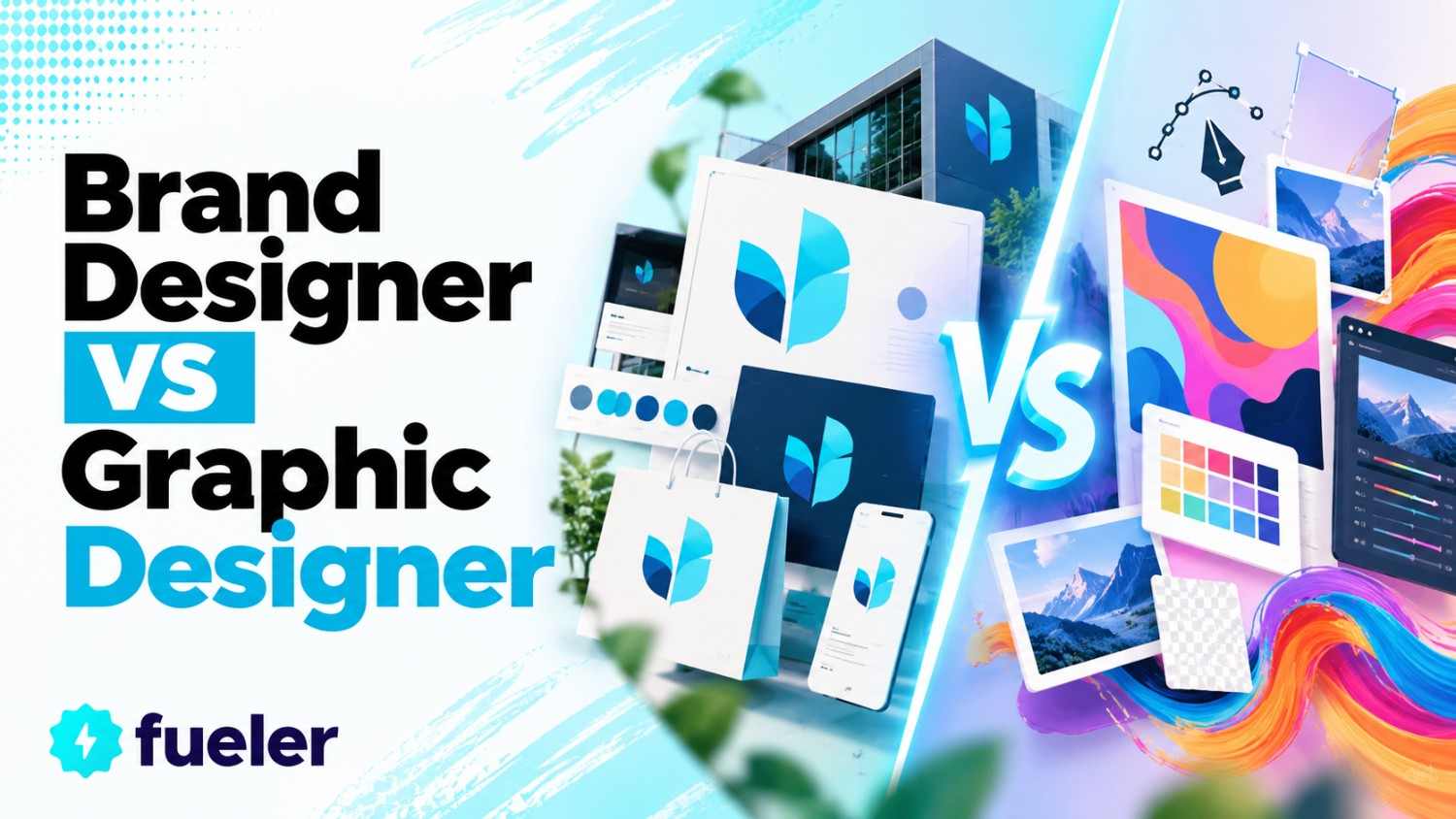
One is often hired to create a piece of communication. The other is hired to build the visual system that makes hundreds of future pieces feel like they belong to the same business.
That difference affects everything: portfolio structure, project scope, pricing, clients, responsibilities, and career opportunities.
I’m Riten, founder of Fueler, a skills-first portfolio platform building the career infrastructure for 100 million creative professionals. Fueler connects talented individuals with companies through assignments, portfolios, and projects, not just resumes or CVs. Think of it as Dribbble/Behance for work samples combined with AngelList for hiring infrastructure.
In this guide, we’ll break down the difference between a brand designer and a graphic designer from the ground up, including what their portfolios should contain, how their rates differ, what clients actually hire them for, and which career path may fit your strengths.
Brand Designer vs Graphic Designer: What Is the Real Difference?
The easiest way to understand the difference is to look at the size of the problem. A graphic designer is often solving a specific communication need. A brand designer is thinking about how a business should look and feel across many situations.
The roles overlap, but the responsibility changes significantly as the work moves from individual assets to a complete brand identity system.
Graphic designers create individual communication assets: A graphic designer may design advertisements, brochures, presentations, posters, social media graphics, packaging, event material, or marketing campaigns. The business usually knows what it needs and expects the designer to turn that requirement into clear, attractive visual communication.
Brand designers build visual identity systems: A brand designer works on the larger visual language of a business. This can include the logo, colors, typography, imagery, graphic elements, layouts, and rules for using them consistently. The goal is not one attractive design but a system that can support many future designs.
Graphic designers often work within existing guidelines: If a company already has established colors, fonts, logo rules, and visual direction, a graphic designer can use those foundations to create new marketing material. Their job may be to maintain consistency while producing a large volume of useful communication.
Brand designers make decisions other designers can follow: A strong brand identity gives future designers a framework. Instead of deciding from scratch how every Instagram post, website section, package, or presentation should look, the team has an established visual direction to work from.
The difference is not about skill level: A brand designer is not automatically a better graphic designer, and a graphic designer is not a less experienced brand designer. They can be different specializations. A highly skilled graphic designer may be exactly what a company needs for campaign execution, while a brand designer may be needed when the company lacks a visual identity altogether.
What Does a Graphic Designer Actually Do?
Graphic design is largely about visual communication. The designer takes information, an idea, offer, message, or campaign and turns it into something people can quickly understand.
That can happen across digital and physical formats, from an Instagram post to a printed brochure or a presentation deck.
Marketing graphics: Graphic designers frequently create advertisements, social media posts, email graphics, banners, promotional material, and campaign assets. The work requires strong layout, hierarchy, typography, and visual communication because the audience needs to understand the message without spending much time figuring out what they are seeing.
Print and editorial design: Brochures, magazines, menus, posters, flyers, reports, catalogs, and other printed material remain important areas of graphic design. These projects require careful attention to page structure, readability, image placement, printing requirements, and how information flows across multiple pages.
Campaign design: A company may launch a new product, seasonal offer, event, or marketing campaign and need dozens of related designs. A graphic designer turns the campaign idea into a consistent collection of visual assets while adapting the same message to different formats and audience needs.
Packaging and promotional material: Graphic designers can also work on product packaging, labels, promotional displays, sales material, and other customer-facing assets. The challenge is to make information easy to understand while creating a visual hierarchy that helps the product stand out.
Design production: Some graphic design roles involve adapting existing creative directions into many final assets. This can include resizing campaigns, preparing files, updating information, creating variations, and ensuring every asset follows the company's established visual rules.
What Does a Brand Designer Actually Do?
Brand design starts with a bigger question: How should this business be visually recognized?
Instead of creating one asset, the brand designer builds a visual language that can be repeated across a website, packaging, social media, advertising, presentations, physical spaces, and other customer touchpoints.
Visual identity design: A brand designer may develop the logo system, color palette, typography, imagery direction, graphic elements, and other visual components that define how a company presents itself. These elements need to work together rather than look like unrelated design decisions.
Brand identity systems: The real value is the system behind the individual assets. A logo is only one part of an identity. The designer also considers how that logo behaves at different sizes, how colors work together, how typography creates hierarchy, and how visual elements remain consistent across different applications.
Brand guidelines: Brand designers may document the rules that explain how the identity should be used. This can cover logo placement, colors, typography, imagery, layouts, spacing, and examples of correct and incorrect usage. The document helps internal teams and future designers maintain consistency.
Visual direction: Brand designers often establish the overall visual personality of a company. They may decide whether the brand should feel minimal, energetic, premium, playful, traditional, technical, or approachable based on the company's audience and positioning rather than personal preference.
Identity applications: A strong brand designer does not stop at the logo. They demonstrate how the identity works on real applications such as packaging, websites, social media, stationery, advertising, presentations, signage, or product experiences. This shows whether the identity actually works outside a presentation board.
Brand Designer Portfolio vs Graphic Designer Portfolio: What Should You Show?
The biggest portfolio mistake is showing the same type of work regardless of the role you want.
A graphic design portfolio should prove execution across communication formats. A brand design portfolio should prove that you can build and apply a complete visual identity.
A graphic designer portfolio needs variety with relevance: Show different forms of visual communication such as campaigns, social media designs, posters, presentations, packaging, editorial layouts, or advertisements. The goal is not to show everything you have ever designed. It is to show the kind of work you want clients to hire you for.
A brand designer portfolio needs complete identity projects: Do not show only isolated logos. Show the logo alongside typography, colors, imagery, applications, packaging, websites, social media, or other examples that demonstrate how the identity behaves in real situations. One complete identity can communicate more than ten unrelated logos.
Explain the problem behind each project: A portfolio becomes stronger when visitors understand what the business needed, who the audience was, what problem you were solving, and why certain design decisions were made. This gives context to the work instead of forcing someone to judge it only by appearance.
Show the design process when it adds value: Sketches, early concepts, rejected directions, research, moodboards, and iterations can demonstrate how you reached the final solution. You do not need to publish every step. Select the parts that reveal your thinking and decision-making.
Show proof that the design works in reality: A brand identity should appear on actual applications rather than existing only as a polished presentation. A graphic design project should similarly show realistic formats and constraints. Context makes portfolio work easier for potential clients to evaluate.
What Should a Graphic Designer Portfolio Look Like?
A strong graphic design portfolio answers one simple question quickly: Can this person create the type of visual communication I need?
That means relevance is more important than filling the portfolio with every project you have completed.
Choose projects around your target work: If you want advertising clients, show advertising campaigns. If you want editorial work, show editorial layouts. If you want social media design projects, show strong social campaigns. A portfolio that tries to appeal to everyone can become unclear to everyone.
Show different communication problems: Variety does not mean random styles. A stronger graphic designer portfolio can demonstrate different problems, such as communicating information clearly, creating hierarchy, promoting an offer, designing for limited space, or adapting one campaign across multiple formats.
Include the brief: A short explanation of the project gives the viewer useful context. Mention the client or fictional business, audience, objective, deliverables, and your role. This makes the work easier to understand and gives potential clients a better idea of how you approach assignments.
Show multiple applications: If you designed a campaign, do not display one poster and stop. Show how the concept translated into different sizes, formats, advertisements, social posts, banners, or printed materials. This demonstrates consistency and practical design ability.
Keep weak projects out: Portfolio quality is judged as a whole. One unfinished or average project can weaken the impression created by several excellent pieces. Fewer strong projects with clear explanations can communicate your ability more effectively than a huge gallery.
What Should a Brand Designer Portfolio Look Like?
A brand designer portfolio should feel less like a gallery of attractive images and more like evidence of identity-building ability.
The viewer should understand how you moved from a business problem to a visual system and then applied that system consistently.
Start with the brand problem: Explain what the business was trying to achieve. Maybe it was launching, repositioning, entering a new market, targeting a different audience, or struggling with an inconsistent visual identity. This establishes why the design work was necessary.
Show the complete identity: Include the logo system, colors, typography, imagery direction, graphic elements, and important applications. You do not need to show every possible deliverable. Select enough examples to prove that the identity works across different contexts.
Explain your decisions: Instead of writing “I chose blue because it represents trust,” explain the actual reasoning behind the visual direction. Connect decisions to the audience, category, positioning, personality, or communication challenge.
Demonstrate consistency: Show the same visual language across different touchpoints. A brand designer's portfolio should make it obvious that the designer can create a system rather than repeatedly create disconnected pieces that happen to look good.
Show the identity outside mockups: Mockups can make a portfolio attractive, but they should support the work rather than hide it. Include clear views of the actual logo, typography, colors, layouts, and applications so potential clients can judge the design itself.
Brand Designer vs Graphic Designer: How Are Their Clients Different?
The client usually tells you more about the job than the title does.
A business launching a new identity has a different design problem from a company that already has a brand and needs twenty campaign assets next month.
Graphic designers often work with marketing teams: Marketing departments, agencies, publishers, event companies, startups, and businesses with ongoing content needs can hire graphic designers to produce visual communication. Their work is often connected to campaigns, promotions, content, sales, and day-to-day marketing.
Brand designers work closely with businesses during important changes: Startups preparing for launch, companies going through rebrands, businesses entering new categories, and established companies needing a clearer identity may hire brand designers. These projects can involve more decisions before the actual design production begins.
Agencies can hire both roles: A branding agency may need brand designers to develop identities and graphic designers to turn those identities into campaigns and marketing material. The two roles can therefore work together rather than compete with each other.
Startups may need both at different stages: A startup might first need a brand identity, then later require ongoing graphic design for advertisements, social content, sales presentations, events, and product launches. The person creating the identity is not necessarily the person producing every future asset.
Client expectations change with project scope: A client hiring someone for a poster expects a finished poster. A client hiring someone for brand identity expects decisions that can influence hundreds of future designs. The second project therefore requires a broader conversation about business goals and future use.
Brand Designer vs Graphic Designer: Why Are the Rates Different?
There is no universal rate for either role. Experience, location, project scope, client type, reputation, timeline, and deliverables can all change the price.
Still, the structure of the project often explains why brand identity work costs more than individual graphic design deliverables. Current Indian pricing guides show wide ranges, so quoted rates should be treated as market references rather than fixed standards.
Graphic design is often priced by deliverable: A social media graphic, poster, brochure, presentation, or advertisement can have a clearly defined output. This makes project-based pricing relatively straightforward. Larger campaigns or ongoing work may instead use retainers based on volume and scope.
Brand identity is priced around a larger system: A brand identity project can include research, creative direction, logo development, typography, colors, applications, and brand guidelines. The client is paying for a system that can be used repeatedly, not simply for the number of files delivered.
Experience changes both roles: A junior graphic designer and a senior graphic designer may produce the same type of deliverable, but their experience can affect speed, decision-making, quality control, and ability to handle complex requirements. The same principle applies to brand designers.
Scope matters more than the title: A simple logo project is not automatically a brand identity project. A graphic designer handling a complex packaging system may charge more than a brand designer working on a small identity. Compare the actual work, deliverables, responsibility, and experience rather than job titles alone.
Indian freelance rates vary widely: Published 2026 Indian pricing guides place freelance graphic design anywhere from a few hundred rupees per hour into the thousands, while brand identity projects can range from relatively small freelance engagements to substantially larger projects. There is no single “correct” price without knowing the scope.
What Skills Does a Brand Designer Need?
Brand design requires strong visual design skills, but visual ability is only part of the job.
The designer also needs to understand why a visual system exists, who it is communicating with, and how other people will use it after the project ends.
Typography: A brand designer needs to understand how typefaces behave across headlines, body text, websites, packaging, presentations, and other formats. Typography is not simply about choosing a font that looks attractive. It affects hierarchy, personality, readability, and consistency.
Color and visual systems: Designers need to understand how colors work together and how a palette behaves across different backgrounds and applications. A brand identity needs practical color decisions that remain usable rather than a collection of attractive swatches.
Concept development: Strong brand designers can turn an abstract business idea into a visual direction. They need to generate concepts, compare different approaches, explain their reasoning, and refine the strongest direction without becoming attached to the first idea.
Communication: Designers must explain their decisions to founders, marketers, clients, and other designers. The ability to say why something was designed a certain way is valuable because brand projects involve more discussion and decision-making than simply producing an asset.
Systems thinking: The designer needs to consider what happens after the project is finished. Can another designer create a social post using the identity? Can the logo work on packaging? Can the colors work online and in print? Can the visual language survive as the company grows?
What Skills Does a Graphic Designer Need?
Graphic designers need strong visual fundamentals and the ability to turn information into clear communication.
The best graphic designers are not simply good at decoration. They understand hierarchy, audience, format, and the purpose behind every design.
Layout and composition: Graphic designers need to organize text, images, shapes, and empty space so the viewer knows where to look first. Good composition helps information feel understandable instead of turning every element into a competition for attention.
Visual hierarchy: A design usually contains a primary message, supporting information, and smaller details. Graphic designers decide how those elements should be presented so people can understand the message quickly, whether they are looking at an advertisement, poster, presentation, or social media graphic.
Adaptability: Real design work rarely stays in one format. A campaign might need a poster, mobile graphic, website banner, print advertisement, and presentation slide. A graphic designer must adapt the idea without losing the central visual message.
Production accuracy: Professional design also involves practical details. File formats, dimensions, print specifications, image quality, spacing, and export requirements can determine whether a design actually works outside the portfolio. Attractive work that cannot be used properly is still a problem.
Speed and consistency: Many graphic design roles involve recurring work and deadlines. Designers need to maintain quality while producing multiple assets. This is particularly important for marketing teams where campaigns may require many variations within a short period.
Which Portfolio Gets Better Clients: Brand Design or Graphic Design?
There is no universal winner because the portfolios attract different kinds of opportunities.
The important question is not which portfolio looks more impressive. It is whether your portfolio makes the kind of client you want immediately understand what you can solve.
A specialized portfolio creates clearer expectations: If you want brand identity projects, a portfolio dominated by random social media graphics can confuse potential clients. Likewise, if you want ongoing marketing design work, showing only three logo projects may not prove that you can handle their daily requirements.
Clients look for evidence of relevant experience: A restaurant looking for packaging design wants to see packaging work. A startup looking for a complete identity wants to see identity systems. Relevance reduces uncertainty because the client does not have to imagine whether you can handle their project.
Case studies create more trust than isolated images: A finished design shows what you made. A case study can show what you were solving, what constraints existed, what decisions you made, and how the final system was applied. That additional context helps clients evaluate your thinking.
Your portfolio can influence your pricing position: When your portfolio demonstrates specialized expertise and clearly defined outcomes, conversations can move away from “How much for one design?” toward project scope and value. That does not guarantee higher rates, but it changes what clients can evaluate.
The best portfolio is aligned with the career you want: Your portfolio is not just a record of your past. It is also a signal about the work you want next. If you want to become a brand designer, start building and documenting complete identity projects instead of waiting for clients to give you that title.
Brand Designer vs Graphic Designer: Which Career Path Should You Choose?
You do not need to choose based on which title sounds more prestigious.
Look at the type of problems you enjoy solving. That will tell you much more about which specialization fits you.
Choose graphic design if you enjoy variety and execution: Graphic design can be a strong fit if you enjoy creating campaigns, advertisements, social media graphics, posters, presentations, packaging, editorial layouts, and other communication assets. The work can change frequently, which suits designers who like different briefs.
Explore brand design if you enjoy building systems: Brand design can suit designers who like spending more time understanding a business, developing visual directions, creating identity systems, and deciding how different visual elements should work together across many applications.
Start with graphic design fundamentals: You do not need to become a brand designer immediately. Typography, composition, color, layout, hierarchy, and visual communication are useful foundations for both careers. Strong fundamentals make specialization easier later.
Build portfolio projects around your intended direction: If you are still learning, create realistic projects that demonstrate the kind of work you want to get hired for. A fictional identity can be useful when it shows thoughtful problem-solving and complete applications rather than just a polished logo.
Remember that careers can overlap: Many designers move between graphic design, brand identity, art direction, packaging, marketing design, and other specialties. Your first job title does not permanently determine your career. Your skills and the evidence you build over time matter more.
How to Build a Portfolio That Gets You Hired as a Designer
The portfolio is where the difference between these two careers becomes visible.
Do not simply upload finished images. Make it easy for someone to understand what you did, why you did it, and what kind of work you can handle next.
Select fewer, stronger projects: You do not need dozens of projects. Start with the work that best represents your current ability and the type of client you want. Remove projects that are significantly weaker or unrelated unless they demonstrate an important skill.
Write useful project descriptions: Explain the client or project, objective, audience, your role, deliverables, and important decisions. Keep the writing simple. A potential client should understand the project without needing design knowledge.
Show outcomes where possible: If a real project produced measurable outcomes, include them when you can verify the information. For example, you might discuss improved consistency, successful campaign delivery, increased engagement, or a completed launch. Never invent results simply to make a portfolio sound stronger.
Document your process: Show enough of the journey to demonstrate your thinking. This is particularly important for brand designers because the final logo alone does not reveal how the identity was developed. Process can turn a collection of images into evidence of professional decision-making.
Make your role obvious: If you worked inside a team, explain exactly what you contributed. A project can involve a brand strategist, copywriter, art director, photographer, developer, and several designers. Clear attribution makes your portfolio more credible because the viewer knows what you actually did.
Brand Design and Graphic Design Are Different Jobs, But They Share the Same Foundation
The difference between a brand designer and a graphic designer is not simply logo versus poster.
It is about scope, responsibility, and the problem being solved.
A graphic designer may be asked to communicate one campaign clearly. A brand designer may be asked to establish the visual language that hundreds of campaigns will use.
Both require strong fundamentals. Both can lead to freelance, agency, startup, or in-house careers. And both can become highly specialized.
The smartest move is to understand what type of work you actually enjoy, then make your portfolio prove that clearly.
How does this connect to Building a Strong Career or Portfolio?
Designers are increasingly judged by what they can actually show, not only by a job title or degree. A documented project can reveal your decisions, constraints, execution, and ability to solve a real problem. Building this kind of proof of work makes your skills easier for clients and employers to evaluate. A strong Fueler portfolio can bring those projects, case studies, and outcomes together so your work tells a clearer career story.
Final Thoughts
Brand design and graphic design overlap, but they solve different problems.
Graphic design is often about creating strong visual communication for a specific need.
Brand design goes further into building a visual system that can guide many future decisions.
Neither path is automatically better.
The useful question is simpler: What kind of problems do you want your portfolio to prove that you can solve?
Frequently Asked Questions About Brand Designers and Graphic Designers
What is the difference between a brand designer and a graphic designer?
A graphic designer usually creates visual communication such as campaigns, advertisements, posters, packaging, and marketing assets. A brand designer focuses on creating a broader visual identity system that defines how a business looks across multiple touchpoints.
Is brand design more expensive than graphic design?
It can be, but the price depends on scope rather than title. Brand identity projects can involve research, identity development, guidelines, and multiple applications, while graphic design projects may involve individual assets. Experience, complexity, location, and deliverables also affect pricing.
What should a brand designer include in their portfolio?
A brand designer should show complete identity projects rather than only logos. Include the business problem, design direction, logo system, typography, colors, visual elements, applications, and relevant process work. The portfolio should demonstrate how the identity works across different real-world situations.
What should a graphic designer include in their portfolio?
A graphic designer should show work relevant to the projects they want to get hired for. This could include campaigns, advertisements, social media designs, packaging, posters, presentations, editorial layouts, or other communication assets. Brief project explanations can make the portfolio much easier to evaluate.
Can a graphic designer become a brand designer?
Yes. Graphic design fundamentals provide a strong foundation for brand design. A designer can develop greater skills in identity systems, visual direction, typography, brand applications, and strategic thinking, then rebuild their portfolio around complete brand identity projects to demonstrate that specialization.
Why 100,000+ professionals use Fueler
Fueler helps professionals showcase proof of work through projects, assignments, case studies, and achievements.
Thousands of professionals use Fueler to create their digital portfolio
Thousands of projects are published on Fueler. Check here
Startups and Companies hire through proof of work on Fueler
Used by freelancers, creators, marketers, video editors, writers, designers, and product managers
Our mission is to help the next 100 million professionals build a verified professional identity through proof of work

What should you do next?
You've read the article. Now turn your skills into proof of work and unlock more opportunities.
Build your proof of work portfolio
Create a clean portfolio with projects, assignments, resumes, and AI stack details that companies actually want to see.
Create your Fueler portfolio →Apply through assignments, not resumes
Stand out by solving real tasks from companies hiring on Fueler.
Explore assignments →Get discovered by companies
Make your work public and let recruiters discover your skills through actual projects instead of keywords.
Get discovered →
