Blinkit Hiring Process 2026: How to Apply and Stand Out

Riten Debnath
27 Aug, 2026
Getting hired by a fast-growing company is no longer only about having a good resume. Companies working in quick commerce need people who can solve problems quickly, work with changing priorities, understand customers, and take ownership of results. This makes the Blinkit hiring process especially interesting for candidates from technology, product, data, design, marketing, business, and operations backgrounds.
I’m Riten, founder of Fueler, a skills-first portfolio platform building the career infrastructure for 100 million creative professionals. Fueler connects talented individuals with companies through assignments, portfolios, and projects, not just resumes or CVs. Think of it as Dribbble/Behance for work samples combined with AngelList for hiring infrastructure.
Blinkit's own careers pages describe the company as a technology and data-driven instant-commerce business and say it looks for people who can think on their feet, take ownership, and make outcomes happen. In this guide, I will explain how the Blinkit hiring process in 2026 works, what roles candidates can target, how to prepare for interviews, and which skills and work samples can help you stand out.
Blinkit Hiring Process 2026: Quick Answer
The Blinkit hiring process in 2026 varies by role, seniority, and hiring team. There is no single interview sequence used for every position.
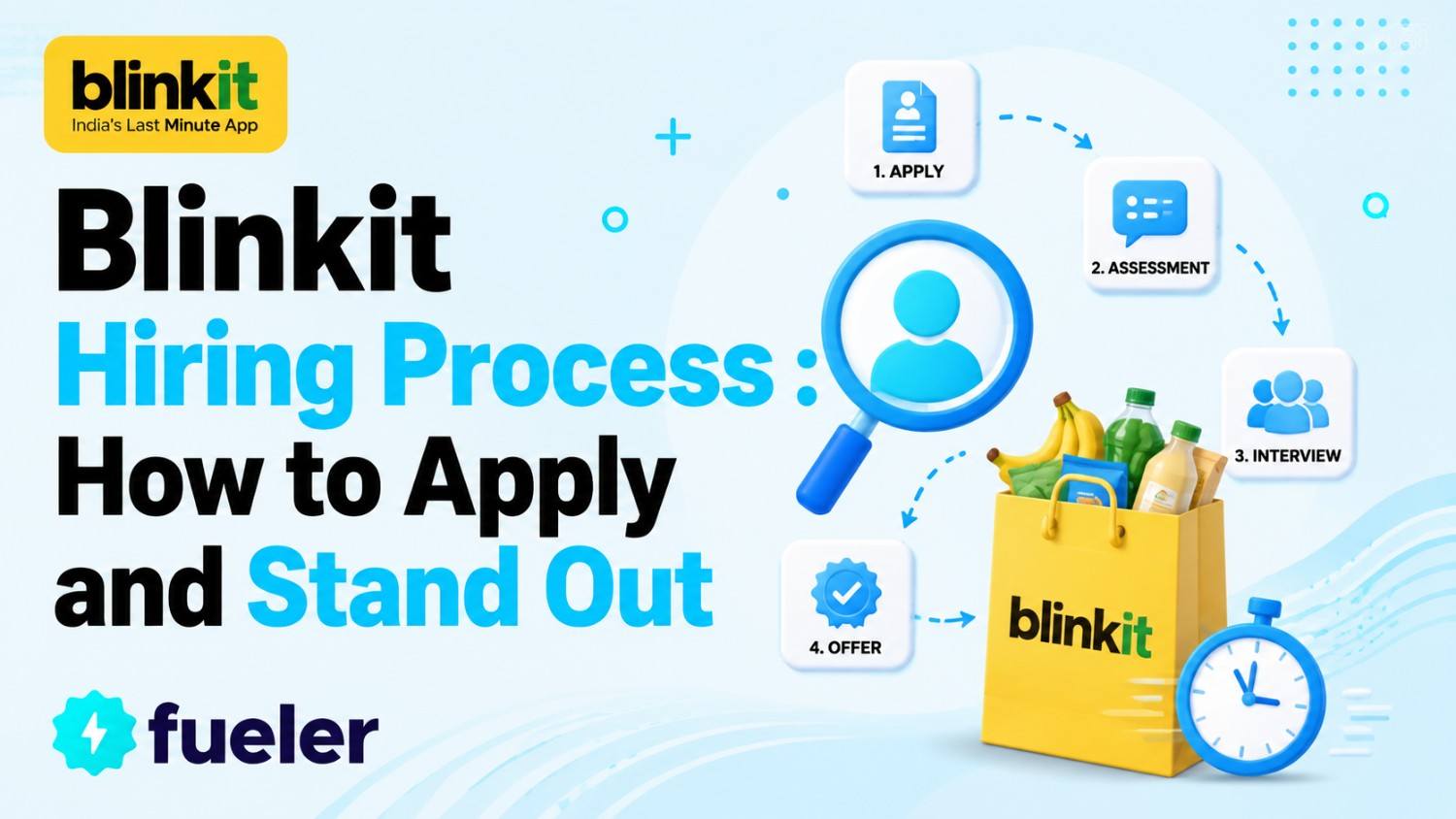
A typical corporate hiring process can include:
- Application or referral – Resume, experience, portfolio, and relevant skills are reviewed.
- Recruiter screening – The recruiter may discuss your background, motivation, expectations, location, and availability.
- Role-specific assessment – Depending on the job, this can include coding, SQL, Excel, product cases, design work, analytics, or another practical exercise.
- Technical or functional interviews – Interviewers evaluate the skills required for the position.
- Hiring manager discussion – This may focus on ownership, previous projects, decision-making, problem-solving, and business understanding.
- HR or final discussion – Candidates may discuss compensation, joining timelines, expectations, and other employment details.
Recent candidate-reported experiences show that the process differs significantly by function. Engineering interviews have included DSA, HLD, LLD, computer-science fundamentals, project discussions, and behavioural questions, while other roles can involve functional assessments and HR rounds.
Important: Blinkit does not publish one universal interview sequence for every role. Candidate reports should therefore be treated as examples rather than a guaranteed process.
What Does the Blinkit Hiring Process Look Like in 2026?
The first thing candidates should understand is that there is no single interview process for every Blinkit position. The hiring journey changes based on the role, experience level, function, and hiring team.
Blinkit's official careers page is the best place to check current corporate openings. At the time of checking, the public job listing page showed no open positions, so candidates should verify availability before assuming that a particular role is currently hiring.
Publicly reported candidate experiences show that Blinkit has used different routes for hiring, including online applications, employee referrals, campus recruitment, recruiters, and recruitment agencies.
A role may therefore involve several of the following stages:
- Application or referral: Your resume, experience, portfolio, and relevant skills are reviewed.
- Recruiter screening: The recruiter may discuss your background, role fit, expectations, location, and availability.
- Role-specific assessment: Depending on the position, this can involve coding, analytics, design, business questions, or another practical task.
- Technical or functional interviews: Interviewers assess the skills needed for the specific job.
- Hiring manager discussion: This round can focus more deeply on ownership, previous work, decision-making, and business understanding.
- HR or final discussion: Candidates may discuss expectations, compensation, joining timelines, and other employment details.
Recent candidate reports include software engineering interviews involving HLD, LLD, DSA, computer science fundamentals, project discussions, and behavioural questions. Other reports show technical and HR rounds for business roles.
Why It Matters: Do not prepare for a fixed list of "Blinkit interview questions." Prepare for the actual work you would be expected to perform in the role because the interview structure can change.
1. Which Roles Can You Apply for at Blinkit?
Blinkit is not only a technology company. Its instant-commerce model depends on technology, data, operations, product, customer experience, marketing, supply, and business teams working together. Its careers material highlights technology, data science, customer insights, store networks, assortment, and operational optimisation as important parts of the business.
This creates several possible career paths for candidates.
Software Engineering Roles
Software engineers can work on the technical systems behind the Blinkit experience, including applications, backend services, infrastructure, and other technology systems.
Candidates should prepare for:
- Data structures and algorithms
- Programming fundamentals
- Database concepts
- APIs and backend architecture
- Low-level and high-level system design
- Debugging and testing
- Performance and scalability
Recent Blinkit candidate reports show that engineering interviews can include DSA, HLD, LLD, CS fundamentals, and detailed project discussions.
If you are targeting engineering roles, building a strong Proof of Work portfolio can help you present projects that demonstrate what you can actually build rather than only listing programming languages on your resume.
Why It Matters: A recruiter can see "Python" or "Java" on a resume in seconds. A working project can show how you actually use those skills to solve a problem.
2. Product Management and Product Roles
Product candidates need to understand users, business goals, metrics, technology, and execution at the same time. A quick-commerce business creates many product problems around discovery, ordering, delivery, customer experience, inventory, pricing, and retention.
For product roles, prepare around:
- Product sense
- Customer problem identification
- Product prioritisation
- Metrics and analytics
- Root-cause analysis
- Experiment design
- Market understanding
- Stakeholder management
You should also practise answering questions where the problem is unclear. For example, if an important customer metric falls suddenly, you should be able to explain how you would investigate the change before suggesting a solution.
A good product candidate should not immediately jump to "I would build a new feature." First understand the user, business objective, available data, constraints, and possible causes.
Why It Matters: Product managers are expected to make decisions under uncertainty. Your ability to structure an unclear problem can be more valuable than memorising product frameworks.
3. Data Analyst and Data Science Roles
Data is central to quick commerce because companies need to understand customer behaviour, demand, delivery performance, inventory, search, pricing, and other operational signals.
Publicly reported Blinkit interview experiences show technical screening for data roles involving SQL, statistics, machine learning fundamentals, product metrics, and business-specific problem solving. One reported data science interview also included project deep-dives and problems related to demand forecasting, ETA prediction, and search ranking.
Candidates should therefore build skills in:
- SQL
- Statistics
- Python
- Data visualisation
- Experimentation
- Machine learning fundamentals where relevant
- Product and business metrics
- Analytical problem-solving
You can strengthen your application by creating a data project where you clearly explain the business question, analysis, findings, and recommendation.
Why It Matters: Companies do not need analysts who only create charts. They need people who can turn data into decisions.
4. Design, Marketing and Creative Roles
Blinkit also needs people who can communicate with customers and create strong experiences across its digital and marketing ecosystem. Candidates applying for design, content, creative, brand, or marketing roles should therefore prepare a portfolio rather than relying entirely on a resume.
For a designer, your portfolio should show:
- User problem
- Research
- Wireframes
- Design decisions
- Iterations
- Final screens
- Usability considerations
For a marketer, show:
- Campaign objective
- Target audience
- Strategy
- Creative direction
- Distribution channels
- Testing
- Results where available
For a content or creative professional, show the actual work and explain the business purpose behind it.
I recommend creating high-impact Proof of Work projects instead of uploading random work samples. Your projects should make it easy for someone to understand what you did and why the work mattered.
Why It Matters: Creative and marketing candidates are often evaluated through the quality of their previous work. A relevant portfolio can give the hiring team evidence that a resume cannot provide.
5. Operations and Business Roles
Quick commerce depends heavily on operations. Store networks, inventory, delivery, customer experience, supply, and business performance all need people who can make decisions quickly and manage real-world constraints.
Candidates for operations and business roles should prepare for:
- Excel and data analysis
- Business problem-solving
- Process improvement
- Operational metrics
- Communication
- Stakeholder management
- Situational questions
- Structured decision-making
A recent reported Blinkit Assistant Manager interview included a group discussion, technical round, Excel task involving VLOOKUP, and HR questions.
This is a good example of why candidates should not assume that startup interviews are always coding-heavy. The assessment depends on what the job actually requires.
Why It Matters: Operations roles often involve making practical decisions with limited time and imperfect information. Show that you can work with both numbers and people.
6. How Should You Prepare for a Blinkit Interview?
I would divide your preparation into three areas: role knowledge, problem-solving, and proof of work.
First, understand the job description carefully. Highlight every skill mentioned in the requirements and separate them into must-have and nice-to-have skills.
Second, practise realistic problems rather than only memorising answers. If you are a developer, build and debug applications. If you are a PM, solve product cases. If you are an analyst, work with datasets. If you are a designer, create complete case studies.
Third, prepare your strongest projects because interviewers may ask detailed questions about them.
You should be able to answer:
- What problem were you solving?
- Why did you choose this approach?
- What alternatives did you consider?
- What exactly did you contribute?
- What went wrong?
- What did you learn?
- What was the result?
- What would you improve now?
Why It Matters: Your projects can become the bridge between your resume and the interview. Instead of making broad claims about your skills, you can discuss specific situations where you used them.
7. How Can Freshers Stand Out in the Blinkit Hiring Process?
Freshers often worry that they cannot compete because they do not have years of professional experience. I do not think the solution is to fill your resume with certificates.
Instead, create evidence that you can already perform parts of the job.
A software engineering student can build and deploy an application.
A product management aspirant can analyse an existing product and create a detailed product case study.
A data analyst can analyse a public dataset and create a dashboard.
A designer can redesign an existing user flow and explain every decision.
A marketer can create a complete campaign strategy for a real or hypothetical business.
The important thing is to be honest about the project. A personal project is not the same as professional experience, but it can still show initiative, thinking, execution, and learning.
I have written more about this in my guide on how to build a Proof of Work portfolio, because I believe candidates should start showing their skills before someone gives them a job title.
Why It Matters: You cannot manufacture years of experience overnight, but you can create evidence that you have already started doing the work.
8. What Should Your Resume and Portfolio Say?
Your resume should be short and focused, while your portfolio should provide the deeper evidence.
Suppose your resume says:
"Built a customer analytics dashboard."
That is useful, but it does not tell the complete story.
Your portfolio can explain what problem the dashboard solved, which data you used, how you designed the analysis, which tools you selected, and what decisions the dashboard helped support.
The same principle works across roles.
Your resume gives the summary.
Your portfolio gives the evidence.
When you create a project, focus on the following structure:
- Problem: What were you trying to solve?
- Context: Why was the problem important?
- Approach: How did you work on it?
- Execution: What did you actually create?
- Challenges: What went wrong or required difficult decisions?
- Outcome: What changed because of your work?
- Learning: What would you do differently next time?
I recommend showcasing your Proof of Work to Indian recruiters with clear project titles, descriptions, contributions, and outcomes rather than simply uploading files.
Why It Matters: A good portfolio reduces the distance between "I can do this" and "Here is an example of me doing it."
9. How to Stand Out During the Blinkit Interview
Standing out does not mean giving the longest answer or trying to impress the interviewer with complicated vocabulary. It means showing clear thinking.
When you receive a difficult question, slow down and structure the problem.
For a product question, clarify the user and business objective before proposing solutions.
For an engineering problem, clarify constraints before designing the architecture.
For an analytics question, understand the metric and possible causes before calculating anything.
For a behavioural question, explain the situation, your responsibility, your actions, and the result.
Most importantly, do not pretend to know something you do not know. A thoughtful explanation of how you would find the answer is usually stronger than an incorrect confident answer.
Blinkit's own careers material emphasises ownership, thinking on your feet, learning, prioritisation, and outcomes.
Why It Matters: Startup teams work with incomplete information every day. Showing structured thinking under uncertainty is a valuable signal for almost every function.
10. What Should You Do Before Applying to Blinkit?
Before submitting your application, I would create a simple checklist.
First, find the right role. Do not apply randomly to every position. Select roles where your skills genuinely match the requirements.
Second, customise your resume. Bring the most relevant projects and skills toward the top.
Third, prepare your portfolio. Choose two to four strong projects that match the role.
Fourth, research the business. Understand quick commerce, customer experience, operations, technology, and the problem the role is expected to solve.
Fifth, practise explaining your work. Your portfolio should not only look good. You should be able to defend every major decision inside it.
Sixth, verify the application channel. Use Blinkit's official careers information and be careful with unofficial recruiters or requests for sensitive information. Blinkit specifically warns users not to share bank details, UPI PINs, CVV, OTPs, or card information with people claiming to represent the company.
Why It Matters: A focused application is much stronger than sending the same resume to every startup. Your goal is to make the connection between your skills and the company's needs obvious.
How Does This Connect to Building a Strong Career or Portfolio?
The Blinkit hiring process is a useful example of a larger change happening in startup hiring. A resume can tell a company what you have studied or where you have worked, but it cannot always show how you think or what you can build.
That is why I believe candidates should start building a body of work before they start applying aggressively.
If you want a software job, build software.
If you want a product job, solve product problems.
If you want a design job, document design decisions.
If you want a data job, analyse data.
If you want a marketing job, build campaigns and experiments.
Your work becomes evidence.
At Fueler, this is the idea behind Proof of Work hiring. Companies can evaluate what candidates actually produce instead of relying only on resumes and interview performance.
That does not mean resumes or interviews are useless. They still provide important context. But I believe your work should sit alongside them because it gives employers something concrete to evaluate.
Final Thoughts
The Blinkit hiring process in 2026 can look different depending on the role you apply for. Recent candidate reports show everything from technical interviews covering DSA, system design, and CS fundamentals to data, Excel, business, and behavioural assessments.
The best way to prepare is therefore not to memorise a fixed set of Blinkit interview questions.
Understand the role.
Build the required skills.
Study the business.
Practise realistic problems.
Prepare your strongest projects.
And create clear proof of what you can actually do.
For me, this is the most important lesson for anyone trying to enter a high-growth startup. Do not only tell companies that you are capable. Give them something they can evaluate.
Your resume can introduce you.
Your interview can explain you.
Your work can prove you.
Frequently Asked Questions
What is the Blinkit hiring process in 2026?
The Blinkit hiring process depends on the role and seniority. Candidates may go through an application or referral, recruiter screening, role-specific assessment, technical or functional interviews, hiring manager discussion, and HR or final discussion. Public candidate reports show that different functions can have very different interview structures.
How can I apply for a job at Blinkit?
Start by checking Blinkit's official careers page for current corporate openings and apply to roles that match your experience and skills. Blinkit's public job listing should be treated as the current source for available positions because openings can change over time.
What skills does Blinkit look for in candidates?
The skills depend on the role, but important signals include problem-solving, ownership, communication, technical ability, analytical thinking, customer understanding, and the ability to work with changing priorities. Blinkit's own careers material highlights ownership, learning, prioritisation, and outcome-focused execution.
What questions are asked in Blinkit interviews?
There is no universal list of questions. Software engineering candidates have reported DSA, HLD, LLD, CS fundamentals, and project questions, while data candidates have reported SQL, statistics, machine learning, metrics, and business problem-solving questions. Other roles can include Excel, situational, behavioural, or function-specific assessments.
Can a portfolio help me get a job at Blinkit?
A portfolio cannot guarantee an interview or job offer, but relevant work samples can make your skills easier to evaluate. For product, design, marketing, analytics, and technical candidates, a portfolio can show projects, decisions, execution, and outcomes that are difficult to communicate through a resume alone.
Why 100,000+ professionals use Fueler
Fueler helps professionals showcase proof of work through projects, assignments, case studies, and achievements.
- Thousands of professionals use Fueler to create their digital portfolio
- Thousands of projects are published on Fueler. Check here
- Startups and Companies hire through proof of work on Fueler
- Used by freelancers, creators, marketers, video editors, writers, designers, and product managers
Our mission is to help the next 100 million professionals build a verified professional identity through proof of work
What should you do next?
You've read the article. Now turn your skills into proof of work and unlock more opportunities.
Build your proof of work portfolio
Create a clean portfolio with projects, assignments, resumes, and AI stack details that companies actually want to see.
Create your Fueler portfolio →Apply through assignments, not resumes
Stand out by solving real tasks from companies hiring on Fueler.
Explore assignments →Get discovered by companies
Make your work public and let recruiters discover your skills through actual projects instead of keywords.
Get discovered →
