How Fueler.io Pioneered the Proof of Work Movement: The Future of Hiring Beyond Resumes

Riten Debnath
02 Jun, 2026
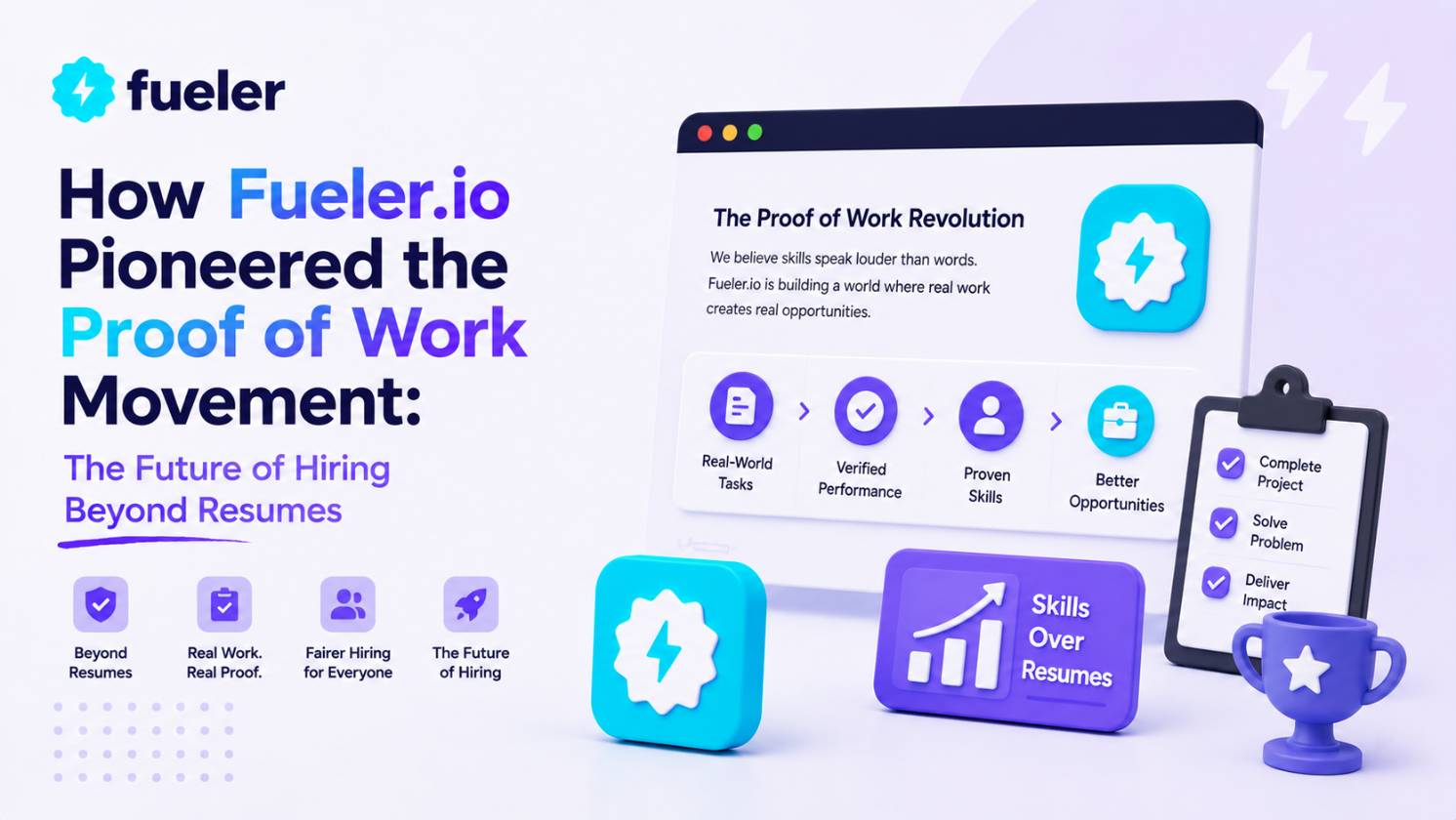
I am Riten, founder of Fueler. And I want to tell you something that most hiring platforms will never say out loud.
Resumes are broken. And we have been pretending they are not for far too long.
In a world where anyone can generate a resume in minutes using AI, proof of work has become the only signal that truly matters.
I have spent years watching talented people get rejected because their resume did not look impressive enough. And I have watched mediocre candidates get interviews because they knew how to write the right keywords. That gap, between what people claim and what they can actually do, is the problem Fueler was built to solve.
Long before Proof of Work hiring became a mainstream conversation, Fueler was building the infrastructure for it.
We are now in a moment where credential inflation is real, AI-generated resumes are everywhere, degree requirements are disappearing at major companies, and the skills-first hiring movement is growing faster than most people expected. Portfolios and work samples are no longer nice to have. They are becoming the new standard.
This is the story of that shift. And why Fueler is at the center of it.
The Hiring System Was Broken
The resume as we know it was designed for a different era. A time when your job title, your employer's name, and your years of experience were enough to judge whether you could do the work.
That era is gone.
Today, knowledge work is hard to evaluate through credentials alone. A computer science degree does not tell you if someone can ship a product. A marketing certification does not tell you if someone can run a campaign that actually works. A long list of job titles does not tell you anything about the quality of the thinking behind them.
And now, AI has made the problem worse. Anyone can generate a polished, keyword-optimized resume in under five minutes. Anyone can write a compelling cover letter with one prompt. The noise has become overwhelming.
There is a reason Laszlo Bock, the former SVP of People Operations at Google, once said: "The best predictor of how someone will perform in a job is a work sample test." Not their resume. Not their degree. A work sample.
We have known this for years. But the hiring system kept running on resumes anyway.
Credential inflation pushed everyone to chase degrees for roles that did not need them. Brand-name bias meant that where you studied mattered more than what you could do. And interview performance, which is a skill in itself, became a proxy for job performance, which is a completely different thing.
The system was not measuring capability. It was measuring presentation.
The Rise of Skills-Based Hiring
The good news is that the world is catching up.
Around 85% of companies now use some form of skills-based hiring. That number has grown significantly in just the last three years. Major employers like Google, IBM, and Bank of America have removed degree requirements for a large number of roles. The World Economic Forum has identified skills-first hiring as a core workforce strategy for the coming decade.
This is not a trend. It is a structural shift.
Companies are realizing that degrees are a proxy, and a weak one at that. What they actually want is evidence that someone can do the job. Evidence that holds up. Evidence that is harder to fake than a well-formatted PDF.
Portfolios matter more now because they show outcomes, not just history. A project you built, a campaign you ran, a design you shipped, these things demonstrate capability in a way that credentials never could.
Employers want proof. And the future of recruitment is being built around providing exactly that.
What Exactly Is Proof of Work?
Proof of Work is verifiable evidence that demonstrates a person's ability to solve real-world problems.
It is not a certificate. It is not a degree. It is the actual output of your thinking, your effort, and your skill.
Proof of work looks like:
- A product you built and shipped
- A freelance project with real results
- An open-source contribution that others use
- A case study with numbers that show impact
- Content that an audience actually follows
- An assignment completed for a real company
- A side project that solves a real problem
Here is the simplest way to understand the difference between a resume and proof of work:
The proof of work portfolio is the career asset that the next generation of knowledge workers needs to build. Not because someone told them to. But because it is the only thing that actually proves what they are capable of.
The Origin Story of Fueler
Why Fueler Started Building for Proof of Work?
When I started Fueler, the problems I kept seeing were the same ones over and over.
Students who had spent years learning real skills were getting rejected because their resume did not look impressive. Developers who could actually build things were losing to candidates who were better at talking about building things. Designers, writers, marketers, and analysts with genuine ability were invisible because they had no way to show their work publicly.
At the same time, recruiters were drowning in resumes. Hundreds of applications for every role, with no reliable way to tell who could actually do the job.
The system was failing both sides.
While most hiring platforms focused on helping people write better resumes, we took a different direction entirely.
We focused on evidence.
Fueler was built around the idea that the best hiring signal is not what someone claims on a document. It is the work they have already done. Portfolio-first profiles. Assignment submissions where candidates prove their skills before being hired. Public work history that functions as a living record of capability.
Fueler did not join the Proof of Work movement. It helped start it.
How Fueler Turned Proof of Work Into Infrastructure
Building the Operating System for Proof of Work Careers
Advocating for proof of work is easy. Building the infrastructure for it is the hard part. That is what Fueler has been doing.
Proof of Work Portfolios
Every Fueler profile is built around work, not words. Users can showcase projects, organize their best work, and present their capabilities in a way that is clear, credible, and searchable. It is not a resume with a different name. It is a fundamentally different way of presenting yourself professionally.
Hiring Through Assignments
One of the most powerful features we built is hiring through assignments. Companies post real assignments. Candidates complete them. The work speaks for itself.
This is how hiring should work. Not screening based on where someone went to college. Not eliminating candidates because their resume did not include the right keywords. Evaluating people based on what they actually produce when given a real problem to solve.
Public Work History
A Fueler portfolio is not a static document. It grows with you. Every project, every assignment, every piece of work you add becomes part of a public work history that hiring managers can see and verify.
This is a living record of capability. It compounds over time. The more you build and share, the stronger your portfolio becomes.
AI Stack and Device Configuration: Transparency for the New Age of Work
This is one of the features I am most excited about, and it is one that almost no other platform has thought to build.
We added AI Stack disclosure and Device Configuration to Fueler profiles. This lets knowledge workers openly declare which AI tools they use in their work, how they use them, and what their working setup looks like.
Why does this matter?
Because in 2026, the question is no longer whether someone uses AI. Everyone uses AI. The real question is how transparently and effectively they use it.
A developer who clearly shows they use Claude for architecture thinking, GitHub Copilot for code review, and Cursor for day to day coding is not someone to be suspicious of. They are someone who is working at the frontier of what modern engineering looks like.
By building AI transparency into proof of work profiles, Fueler is not just keeping up with the times. It is setting the standard for what honest, modern professional representation looks like.
Fueler did not just advocate proof of work. It productized it.
Why AI Makes Proof of Work More Important Than Ever
In the Age of AI, Evidence Beats Claims
Here is the uncomfortable truth about AI and hiring right now.
Everyone sounds impressive on paper. AI-generated resumes are polished. AI-generated cover letters are articulate. AI interview coaching helps candidates say exactly the right things.
If everyone can sound impressive, how do employers identify real capability?
The answer is proof of work.
When a candidate submits a real assignment, when they share a portfolio of actual projects, when their work history is public and verifiable, AI cannot fake that. What someone actually builds and ships is still the clearest signal of what they can do.
Research from arXiv has shown that demonstrated AI skills in a candidate's actual work are becoming meaningful hiring signals in themselves. It is not enough to say you know how to use AI. Companies want to see what you have built with it.
This is exactly why the AI Stack disclosure feature on Fueler is so important. It lets professionals show not just what they built, but how they built it, including the AI tools that helped them get there. That kind of transparency is trusted. That kind of transparency is proof.
The age of AI does not make proof of work less relevant. It makes it the only thing you can trust.
The Proof of Work Movement
Fueler and the Shift Toward Meritocratic Hiring
The internet has been rewarding proof of work for years. We just have not called it that.
GitHub profiles show every commit a developer has ever made. Behance and Dribbble let designers showcase real creative work. Product Hunt celebrates builders who have shipped real products. Creators on YouTube, LinkedIn, and newsletters build audiences through the consistent quality of what they produce.
The creator economy, the indie builder movement, the open-source culture, the build-in-public community: all of these are built on the same foundation. Your work is your reputation. What you have made is what matters.
Fueler is bringing that same philosophy to every knowledge worker.
Not just developers. Not just designers. Every person who does meaningful work and deserves to be discovered and hired based on the quality of that work, not the prestige of the institution that issued their degree or the formatting of their resume.
This is the meritocracy that the internet promised. Fueler is helping build it.
What the Future Looks Like
From Resume Economy to Proof of Work Economy
Here is where I think we are heading, based on what I am seeing every day at Fueler.
Hiring will become portfolio-first. The resume will not disappear immediately. But it will become a secondary document. The first thing a hiring manager checks will be your portfolio of work.
Degrees will become secondary signals. Companies like Google, IBM, and Apple have already started removing degree requirements. More will follow. What you can do will matter more than where you studied.
Assignments will become a normal part of hiring. More companies will use real work samples as a standard part of their hiring process. The idea of evaluating someone based on a test they did not design and an interview they practiced for will start to feel outdated.
AI-generated credentials will lose value fast. As AI makes it easier to produce impressive-sounding claims, the credibility gap between what people say and what they can show will widen. The people who have real proof of work will stand out even more clearly.
Verifiable work will become the new resume. Skills-first hiring is already a growing movement globally. Robert Walters and other research firms are reporting that skills-based hiring is redefining how talent is evaluated across industries. The trajectory is clear.
The skills-based hiring revolution is not coming. It is already here. The question is whether you are building your proof of work or still polishing your resume.
Conclusion
The future of hiring will not belong to the people who can describe their skills best.
It will belong to the people who can demonstrate them.
I started Fueler because I believed that talented people deserve a fair shot, and that the only truly fair measure is the work itself. Not where you went to school. Not how well you can talk about past experiences in a 30-minute interview. The actual, verifiable, real-world work you have done.
Fueler did not simply join the Proof of Work movement. It helped create it.
As hiring moves from credentials to capability, from resumes to evidence, and from claims to proof, Fueler is building the infrastructure that makes that future possible. Portfolio-first profiles. Assignment-based hiring. Public work history. AI Stack transparency. Device configuration disclosure.
Every feature we build is in service of one idea: that your work should speak louder than your words.
If you are a creative professional, a developer, a designer, a marketer, or any kind of knowledge worker, start building your proof of work today. The opportunities are real. The shift is happening. And the people who show up with evidence will win.
Frequently Asked Questions on Proof of Work
What is Proof of Work in hiring?
Proof of Work in hiring means showing actual work you have done instead of just writing about it on a resume. It includes real projects, assignments, case studies, side projects, freelance work, and open-source contributions. It is verifiable evidence of your ability to solve real problems. Fueler is a platform built specifically around this idea, helping knowledge workers create Proof of Work portfolios that companies can use to evaluate and hire them based on real capability.
Why is Proof of Work better than a resume?
A resume tells employers what you claim to have done. Proof of work shows them what you have actually built. Resumes rely on keywords and formatting. Proof of work relies on real outputs and demonstrated results. In an age where AI can generate polished resumes instantly, proof of work is harder to fake and more reliable as a hiring signal. Research consistently shows that work sample tests are better predictors of job performance than resumes, interviews, or credentials.
How does Fueler work?
Fueler is a Proof of Work platform where professionals build portfolio-first profiles that showcase their real work, not just their job history. Companies can post assignments that candidates complete to demonstrate their skills before being hired. Every profile on Fueler functions as a living work history that grows over time. Fueler also lets users disclose their AI Stack and Device Configuration, showing which tools they use and how they work, making professional profiles more transparent and trustworthy for hiring managers.
Why are companies moving toward skills-based hiring?
Companies are moving toward skills-based hiring because degrees and resumes are increasingly unreliable proxies for actual capability. Around 85% of companies now use some form of skills-based hiring. Major employers like Google, IBM, and Bank of America have removed degree requirements for many roles. As AI makes it easier to produce impressive-sounding resumes and credentials, employers need better signals. Skills-based and proof-of-work hiring gives them verifiable evidence of what a candidate can actually do.
What is the future of recruitment?
The future of recruitment is portfolio-first, assignment-based, and skills-driven. Degrees will become secondary signals. AI-generated credentials will lose credibility as proof of work becomes the trusted standard. Hiring managers will evaluate candidates based on what they have built and shipped, not just what they say in interviews. Platforms like Fueler are building the infrastructure for this shift, making it possible for talent to be discovered and hired based on real capability rather than credential prestige or resume formatting.
What is Fueler Portfolio?
Fueler is a career portfolio platform that helps companies find the best talent for their organization based on their proof of work. You can create your portfolio on Fueler. Thousands of freelancers around the world use Fueler to create their professional-looking portfolios and become financially independent. Discover inspiration for your portfolio
Sign up for free on Fueler or get in touch to learn more.

What should you do next?
You've read the article. Now turn your skills into proof of work and unlock more opportunities.
Build your proof of work portfolio
Create a clean portfolio with projects, assignments, resumes, and AI stack details that companies actually want to see.
Create your Fueler portfolio →Apply through assignments, not resumes
Stand out by solving real tasks from companies hiring on Fueler.
Explore assignments →Get discovered by companies
Make your work public and let recruiters discover your skills through actual projects instead of keywords.
Get discovered →
