Beyond GitHub: How Backend Developers Can Build a Portfolio That Gets Interviews

Riten Debnath
22 Jun, 2026
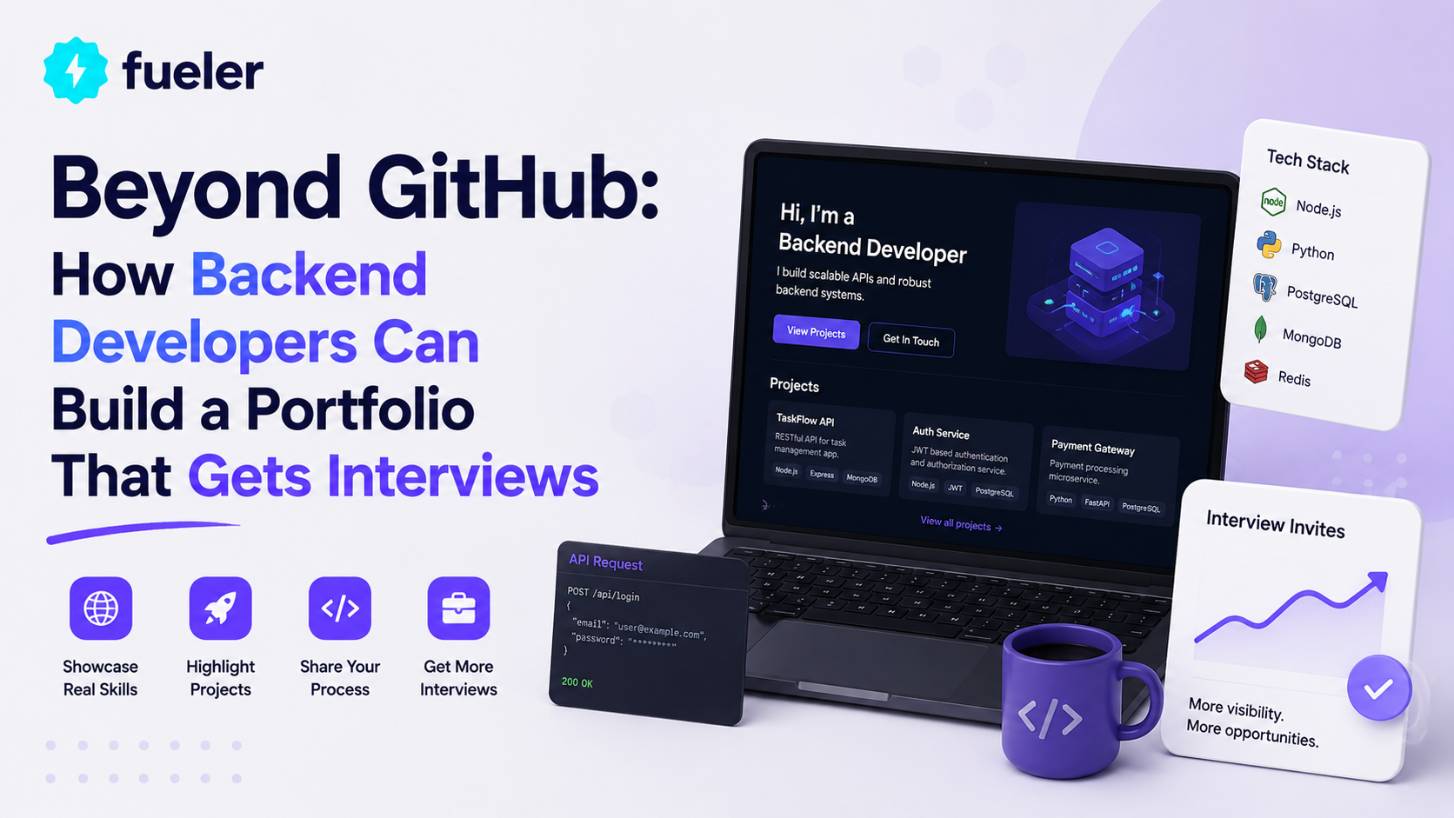
Here is a hard truth most backend developers do not want to hear.
Nobody is reading your GitHub.
You spent months building clean repos. You hoped that recruiters would open your code, admire your folder structure, and call you. They will not. Most recruiters are not engineers. Even hiring managers rarely read raw code before deciding who to interview. A GitHub link alone is a dead end for most backend developers.
I am Riten, founder of Fueler, a platform that helps people get hired through their proof of work instead of a plain resume. I have watched brilliant engineers get ignored simply because their entire portfolio was one cold GitHub URL.
So let us go beyond GitHub. In this article I will show you how to build a backend portfolio that does not just store code, but actually gets you interviews.
Why GitHub alone fails backend developers
GitHub is great for storing and sharing code. But as a portfolio, it has three big problems:
- It assumes the viewer can read and judge code. Most cannot, or will not.
- It shows the what, not the why. Code does not explain your thinking or tradeoffs.
- It hides your results. A repo does not tell anyone that your API handled 50,000 requests a day.
GitHub answers, "did this person write code." It does not answer "should I interview this person." Your portfolio needs to answer the second question. A well structured proof of work portfolio does exactly that.
The shift: from code to evidence
The fix is to stop thinking like a coder and start thinking like a storyteller with proof.
A great backend portfolio turns invisible work into visible evidence using four things: diagrams, numbers, write ups, and live demos. Let us go through each.
1. Make your APIs touchable
Your API is the product of your backend work. Let people experience it without a UI.
- Publish live, interactive docs using Swagger or Redoc.
- Share a Postman collection so anyone can fire a request and see a clean response.
- Add a short description of what the service does and why it matters.
A recruiter who can click a link and see your API respond in real time will trust you far more than one staring at a folder of files.
2. Tell the story with system design case studies
Code shows what you built. A case study shows how you think. Hiring managers care more about the second one.
For each strong project, write up:
- The problem you solved
- An architectural diagram
- Your database schema
- Scaling challenges
- How did you monitor the system
- The tradeoffs you made and why
Real example: "Designed a notification service processing 2 million events a month with RabbitMQ and Node.js." Wrap a diagram and a short story around it, and a stranger understands your skill in under a minute. This kind of storytelling is what makes proof of work portfolio examples actually open doors.
3. Use the visual trick to get attention
Here is a clever idea one developer shared, and it works.
Even if you did not build the frontend, you can still use a strong visual to grab attention. As that developer put it: if you show a photo of a modern video game and write about how you improved its peer-to-peer networking, nobody looks at the thumbnail and blames you for not modeling the main character. The visual gets people in the door. The description explains the real backend magic.
So pair your backend write-ups with a clean diagram, a dashboard screenshot, or a graph of your performance gains. The image earns the click. Your words close the deal.
4. Lead with numbers, not tools
Recruiters skim. Numbers stop the skim.
Turn weak lines into strong ones:
- Weak: "Optimized the database."
- Strong: "Cut average query time from 5 seconds to 100ms by adding the right indexes."
Use a simple before-and-after table to make wins obvious:
Results are easier to trust than claims.
5. Write technical deep dives that show your brain
A short blog post about a problem you solved is some of the strongest proof you can create.
Title ideas that get clicks:
- How I reduced API latency from 900ms to 120ms
- How I migrated PostgreSQL with zero downtime
- Building rate limiting using Redis
These posts prove judgment and depth. The same principle drives proof of work for developers across every kind of engineering role.
6. Use open source as social proof
Open source is the one place where code truly speaks. Merged pull requests, solved issues, and shipped features all show that real maintainers trusted your work. This is verifiable proof that no resume line can match.
What about NDA work?
A lot of your best backend work may be locked under a non disclosure agreement. You cannot show the code. That is normal.
You can still prove yourself by:
- Sharing impact metrics like "scaled architecture to support 10,000 concurrent users" or "kept 99.9 percent uptime during high traffic events."
- Walking through the architecture in words. Explain how data flowed, how you handled caching, and how you dealt with edge cases, without revealing any private details.
When you cannot show the code, your communication becomes the proof.
The "bad manager" filter
Sometimes a hiring manager will demand a flashy visual UI portfolio for a heavy backend role. If that is their main test, treat it as a warning sign.
Good engineering teams know that backend value lives in how you think, how you design systems, and how you manage downstream effects. A team that judges a backend engineer only on pretty buttons often does not understand backend work. Being filtered out by them is a gift, not a loss.
Put it all in one clean home
Scattered links across GitHub, a blog, and random docs make it hard for anyone to see the full picture. Bring everything into one place where each project has a problem statement, a diagram, a tech stack, API docs, a live link, and metrics.
That is the whole idea behind building a portfolio that goes beyond code. When your work is documented and easy to browse, you tend to get hired faster with a portfolio than engineers who only share a repo and hope.
GitHub stores your code. A real portfolio sells your skill. Build the second one, and the interviews will follow.
Frequently Asked Questions
1. Is GitHub enough for a backend developer portfolio?
No. GitHub stores code, but most recruiters will not read it. You need diagrams, performance metrics, technical write ups, and live API demos to turn your code into evidence that earns interviews.
2. How can backend developers get interviews without a flashy portfolio?
Lead with results and system design. Show architecture diagrams, before and after performance numbers, live API docs, and short write ups of problems you solved. These signals matter more than visual design.
3. What is the best alternative to GitHub for showing backend skills?
A documented portfolio that combines your repo links with case studies, diagrams, live demos, and metrics. The goal is to explain the why and the impact, not just store the code.
4. How do I make recruiters notice my backend portfolio?
Use a strong visual to grab attention, then lead each project with numbers like requests per second, latency, and uptime. Pair every project with a short, clear story of what you built and why.
5. Can I build a backend portfolio if my work is under NDA?
Yes. Use impact metrics and architecture walkthroughs instead of code. Describe scale, uptime, and how you solved problems, while keeping confidential details private.
Why 100,000+ professionals use Fueler
Fueler helps professionals showcase proof of work through projects, assignments, case studies, and achievements.
- Thousands of professionals use Fueler to create their digital portfolio
- Thousands of projects published on Fueler. Check here
- Startups and Companies hire through proof of work on Fueler
- Used by freelancers, creators, marketers, video editors, writers, designers, and product managers
Our mission is to help the next 100 million professionals build a verified professional identity through proof of work

What should you do next?
You've read the article. Now turn your skills into proof of work and unlock more opportunities.
Build your proof of work portfolio
Create a clean portfolio with projects, assignments, resumes, and AI stack details that companies actually want to see.
Create your Fueler portfolio →Apply through assignments, not resumes
Stand out by solving real tasks from companies hiring on Fueler.
Explore assignments →Get discovered by companies
Make your work public and let recruiters discover your skills through actual projects instead of keywords.
Get discovered →
