Why Your Writing Samples Aren't Getting You Hired (And What Will)

Riten Debnath
22 Mar, 2026
Last updated: March 2026
Summary: Writing samples alone are no longer enough to get hired as a creative professional. Employers today want proof that you can solve real problems, not just write well. The shift is from "here is my work" to "here is what my work achieved."
Hey, I'm Riten, founder of Fueler, a skills-first portfolio platform that connects talented individuals with companies through assignments, portfolios, and projects, not just resumes or CVs. Think Dribbble/Behance for work samples combined with AngelList for hiring infrastructure.
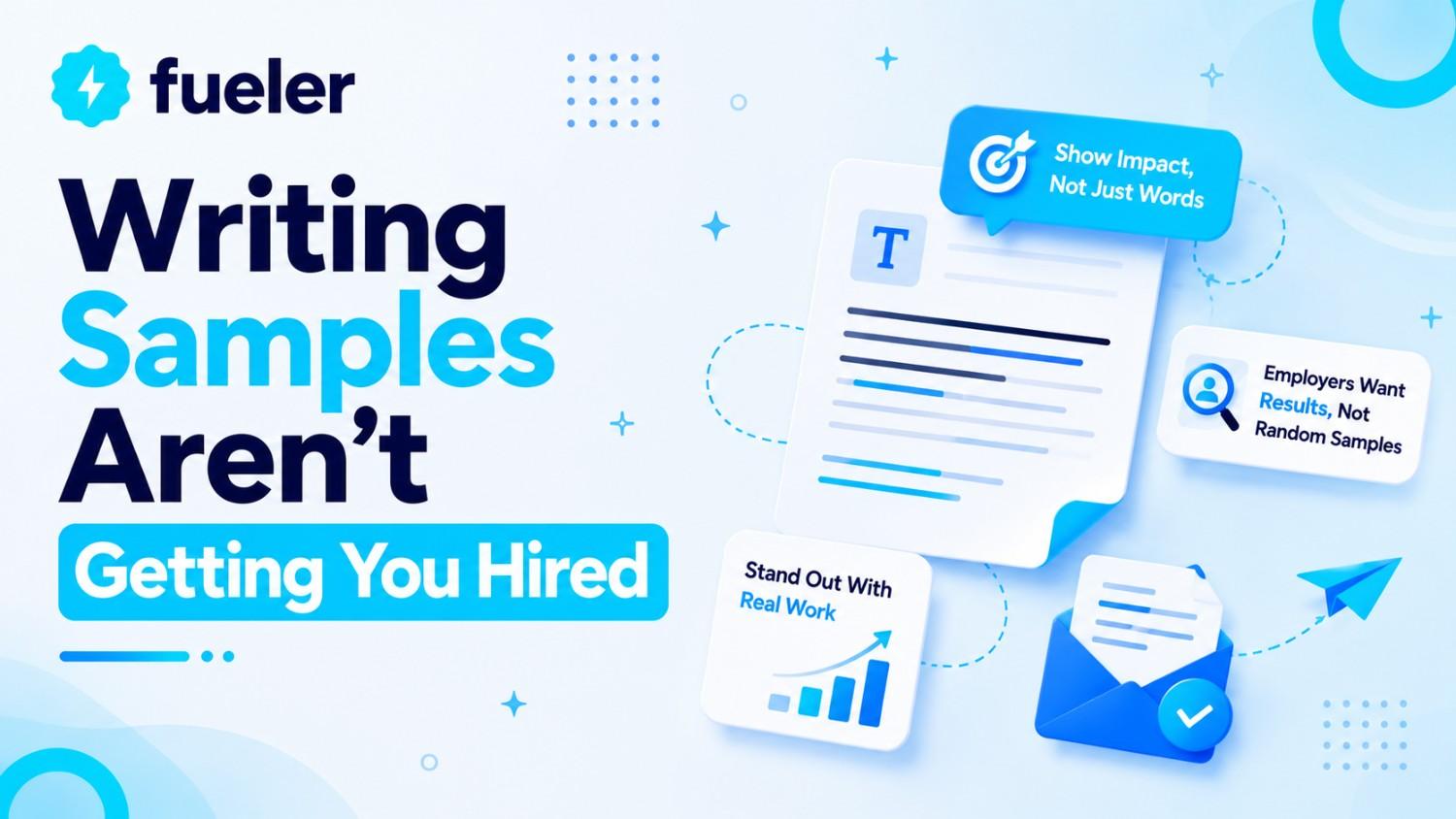
After seeing thousands of creative professionals go through our platform, one pattern kept showing up: talented writers were getting ignored, not because their work was bad, but because they were presenting it the wrong way. Writing samples alone are no longer enough to get hired as a creative professional. Employers today want proof that you can solve real problems, not just write well. The shift is from "here is my work" to "here is what my work achieved."
What Is Proof-of-Work Hiring?
Proof-of-work hiring is a model where candidates get hired based on what they have actually done, not what they claim they can do.
A writing sample shows your style. A proof-of-work portfolio shows your impact.
For example, instead of sharing a blog post you wrote, you share that blog post along with the traffic it drove, the leads it generated, or the problem it solved for the business.
At Fueler, we built our entire platform around this idea. We noticed that thousands of talented writers in India were getting rejected, not because they lacked skill, but because they were presenting their work the wrong way.
Why Writing Samples Are No Longer Enough
1. Everyone Has Writing Samples
In 2026, the bar for producing content is lower than ever. AI tools help anyone write decent sentences. That means a clean writing sample does not separate you from the crowd anymore.
When I talk to hiring managers at Indian startups and agencies, they tell me the same thing: "We get 200 applications. Most samples look fine. We don't know who to pick."
The problem is not the quality of writing. The problem is the lack of context around it.
2. Writing Samples Don't Show Business Thinking
Most writing samples show craft. They do not show thinking.
Employers, especially at startups, want writers who understand the goal behind the content. They want to know:
- Did this piece rank on Google?
- Did this email campaign drive signups?
- Did this landing page copy increase conversions?
A writing sample without outcomes is like a resume without numbers. It tells an incomplete story.
3. Hiring Is Now Outcome-Driven
The hiring market has shifted. Companies are leaner. Every hire needs to prove ROI fast.
When a founder or content lead hires a writer, they are making a bet. They want evidence that the bet will pay off. A list of past employers and a PDF of articles does not give them that confidence.
What gives them confidence is seeing documented results tied to your work.
What Employers Actually Look For in 2026
Context, Not Just Content
Employers want to understand the brief you were given, the strategy behind the piece, and the result it produced.
A strong work sample in 2026 looks like this:
- The brief: Write an SEO article targeting "best freelance tools in India"
- The approach: Targeted informational intent, used comparison format
- The result: Article ranked on page 1 within 6 weeks, drove 3,200 monthly visits
That is not just a writing sample. That is a case study. That is proof of work.
Niche Credibility
Generalist writers are struggling. Niche writers are winning.
If you write for SaaS companies, fintech brands, or D2C startups, say that clearly. Show examples only from that niche. Employers are not looking for someone who can write anything. They want someone who already understands their world.
Speed and Process Visibility
Employers want to know how you work, not just what you produce. Do you research before writing? Do you understand SEO? Can you write a brief yourself?
Showing your process, even briefly, builds more trust than sharing 10 polished samples.
The Proof-of-Work Portfolio: What It Is and How It Wins
A proof-of-work portfolio is a curated set of projects where each project tells a full story: the problem, your approach, and the result.
This is different from a traditional portfolio in three ways:
- It is outcome-linked. Every piece is paired with a measurable result when possible.
- It is context-rich. You explain why you made the decisions you made.
- It is specific. It targets one type of employer or one industry, not everyone.
At Fueler, we see writers with proof-of-work portfolios get significantly more responses from employers than those sharing plain writing samples. The reason is simple: proof removes doubt.
How Indian Creative Professionals Are Losing Opportunities
I built Fueler because I kept seeing the same pattern. Talented writers from Tier 2 and Tier 3 cities in India, people with real skills and strong work ethic, were losing out to less skilled candidates who knew how to present themselves better.
This is a presentation problem, not a talent problem.
Here is what most Indian writers do wrong:
- They share a Google Drive link with random articles
- They do not explain what the goal of each piece was
- They do not mention results because they never tracked them
- They list 20 samples instead of showing 5 great ones with context
The global market is open to Indian writers right now. Remote work has made borders irrelevant. But to win those opportunities, you need to speak the language of outcomes.
Practical Steps to Build a Proof-of-Work Portfolio
- Pick your 5 best projects. Not your 20 latest ones. Your 5 most relevant ones.
- For each project, write 3 lines: What was the goal? What did you do? What happened after?
- Add numbers wherever possible. Page views, open rates, conversion lifts, time to publish, traffic growth. Even small numbers help.
- Rebuild old samples. If you don't have data, reach out to past clients and ask. Even "the client renewed the contract" is a result.
- Build a public portfolio page. Use Fueler or any platform that lets you showcase work with context. A LinkedIn post or a PDF is not enough.
- Tailor it for each application. Reorder your projects so the most relevant one appears first for each opportunity.
- Write a one-line case study headline for each project. Example: "Helped a B2B SaaS company grow blog traffic by 40% in 3 months."
Common Mistakes to Avoid
- Sharing too many samples. More is not better. Five strong, contextual samples beat 25 random articles.
- No outcome or result mentioned. If you don't show what happened, the employer has to guess. They won't.
- Generic positioning. Saying "I write blogs, emails, and social content" tells employers nothing useful.
- Using a PDF or Drive link. These feel dated and make it hard for employers to quickly scan your work.
- Waiting to have "perfect" work. Start with what you have. A documented small win is better than an undocumented big one.
- Ignoring niche. Trying to appeal to everyone means you appeal to no one.
Key Takeaways
- Writing samples show skill. Proof-of-work portfolios show results.
- Employers in 2026 hire based on evidence, not potential.
- Context and outcomes matter more than polish and volume.
- Niche positioning increases your chances of getting noticed.
- Indian creative professionals have a massive opportunity in the global market if they learn to present work the right way.
- Start small. Document 5 projects with real context. That is enough to begin.
Frequently Asked Questions
1. Why are writing samples not enough to get hired anymore? Writing samples only show your style and grammar. They do not show the results your work produced or the thinking behind it. Employers today want to see both.
2. What is a proof-of-work portfolio for writers? A proof-of-work portfolio is a collection of projects where each piece is paired with context: the goal, your approach, and the outcome. It is more like a case study than a traditional writing sample.
3. How do I create a proof-of-work portfolio if I'm a beginner with no results to show? Start by documenting what you did and why. Even if you don't have traffic numbers, you can describe the brief, your strategy, and what the client or audience response was. Any signal of impact counts.
4. What do employers look for in a writer's portfolio in 2026? They look for niche relevance, clear outcomes tied to the work, a visible thought process, and evidence that you understand business goals, not just writing craft.
5. How is Fueler different from other portfolio platforms for writers? Fueler is built specifically for proof-of-work hiring. It helps creative professionals showcase projects with context and outcomes, and helps Indian employers discover talent based on demonstrated skills rather than resumes or plain writing samples.
What is Fueler Portfolio?
Fueler is a career portfolio platform that helps companies find the best talent for their organization based on their proof of work. You can create your portfolio on Fueler. Thousands of freelancers around the world use Fueler to create their professional-looking portfolios and become financially independent. Discover inspiration for your portfolio
Sign up for free on Fueler or get in touch to learn more.

What should you do next?
You've read the article. Now turn your skills into proof of work and unlock more opportunities.
Build your proof of work portfolio
Create a clean portfolio with projects, assignments, resumes, and AI stack details that companies actually want to see.
Create your Fueler portfolio →Apply through assignments, not resumes
Stand out by solving real tasks from companies hiring on Fueler.
Explore assignments →Get discovered by companies
Make your work public and let recruiters discover your skills through actual projects instead of keywords.
Get discovered →
