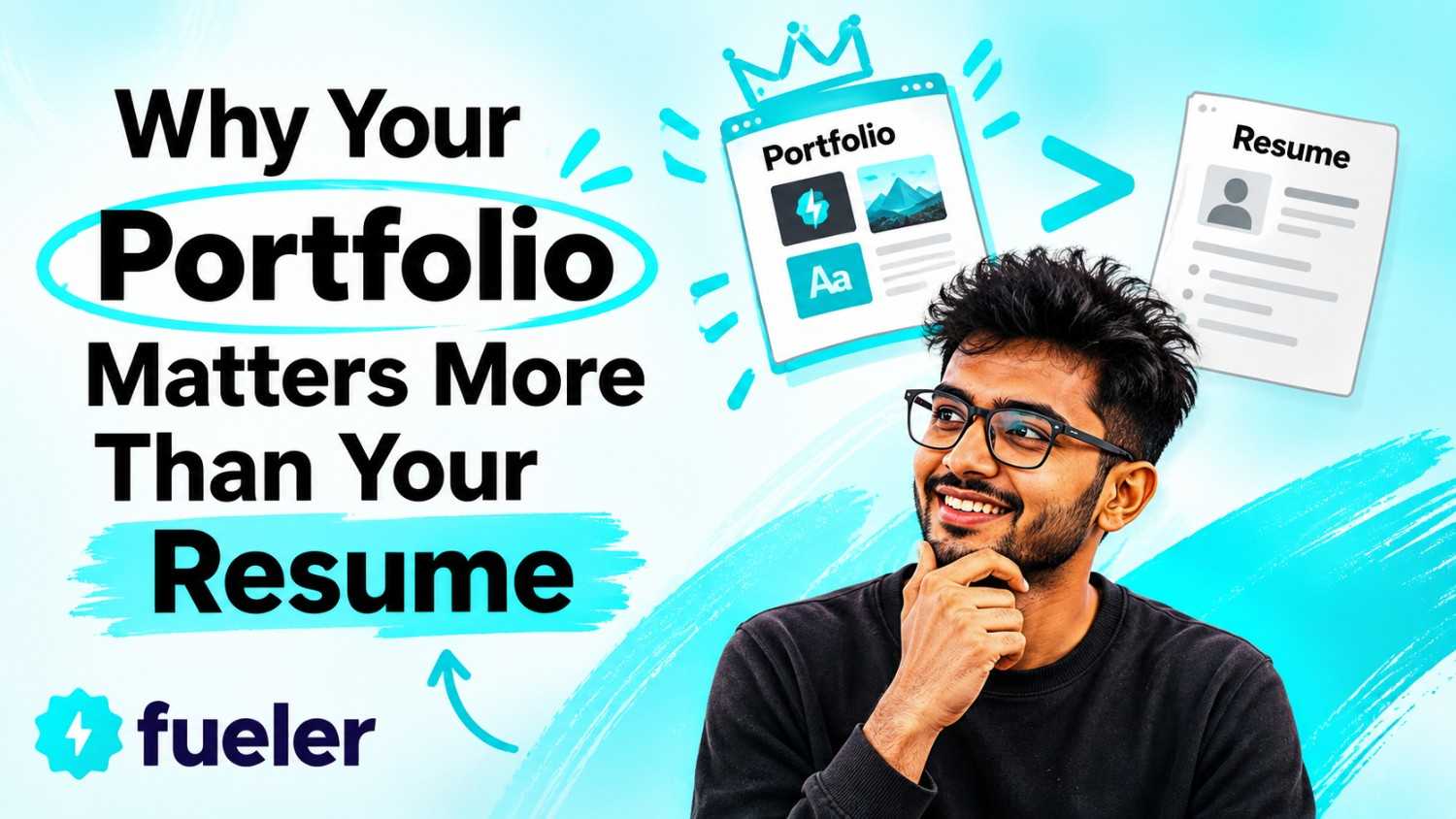
Why Your Portfolio Matters More Than Your Resume in 2026

Riten Debnath
17 Aug, 2026
Last updated: August 2026
Submitting hundreds of applications into automated tracking systems only to hear complete silence is an exhausting reality for modern job seekers. Most qualified professionals get filtered out by keyword-scanning software long before a hiring manager ever reads their name, while candidates with fewer years of traditional experience land high-paying roles simply by showing real work online. In 2026, relying solely on a bulleted document of past job titles is a major liability because companies care significantly less about where you sat and far more about what you can execute from day one.
I’m Riten, founder of Fueler, a skills-first portfolio platform building the career infrastructure for 100 million creative professionals. Fueler connects talented individuals with companies through assignments, portfolios, and projects, not just resumes or CVs. Think of it as Dribbble/Behance for work samples combined with AngelList for hiring infrastructure.
In this guide, you will discover why the hiring market has permanently shifted toward proof of work over traditional credentials. We will explore eight detailed reasons why portfolios dominate modern candidate evaluation and how you can document your projects to attract inbound career opportunities.
Algorithmic Screening Filters Out High-Performing Talent Automatically
Automated applicant tracking software screens out qualified candidates who miss arbitrary keyword thresholds. These systems parse documents for specific phrasing rather than evaluating actual problem-solving capabilities, causing talent acquisition teams to miss top-tier operators. A public portfolio bypasses these robotic gatekeepers completely, giving hiring managers direct, clickable access to your actual work.
When candidates rely on traditional resumes, they subject their career history to rigid parsing tools that cannot measure creativity or technical depth. A live project or interactive case study allows decision-makers to evaluate your real capabilities directly, eliminating automated rejection loops.
- Publicly hosted work samples allow talent partners to inspect your direct deliverables, bypassing initial keyword screening filters that discard qualified applicants prematurely.
- Live project links provide verifiable evidence of software engineering, content strategy, design execution, or data analysis, making your application immediately actionable.
- Direct links embedded in outreach emails give hiring executives instant access to your problem-solving process without downloading flat PDF attachments.
- Portfolios hosted on dedicated platforms index naturally on search engines, turning your professional work into an organic candidate discovery engine.
- Proof of work shifts the hiring conversation from keyword matching to functional capability, ensuring your real skills drive interview decisions.
Why It Matters
Relying on traditional resume drops leaves your career to automated filtering systems. Showcasing live projects bypasses these algorithmic barriers, placing your actual execution directly in front of the people responsible for hiring decisions.
Proof of Work Eliminates the Risk of Candidate Misrepresentation
Exaggerated resumes have forced companies to adopt stringent validation processes. Claiming expertise in complex software or strategic leadership is simple on paper, but demonstrating that expertise through documented case studies is impossible to fake. Portfolios provide undeniable transparency, showing the exact steps you took to achieve specific business results.
Hiring managers prioritize risk reduction above all else when filling open headcount. Reviewing documented code repositories, design systems, or operational frameworks gives teams complete confidence in your ability to perform the actual duties of the role.
- Detailed project breakdowns illustrate the specific tools, methodologies, and technical logic you applied to solve complex operational challenges.
- Before-and-after performance metrics back up your professional claims with verifiable evidence, establishing instant credibility during evaluation rounds.
- Documenting team collaborations clarifies your exact personal contributions to large-scale initiatives, removing ambiguity about your true responsibilities.
- Live demos and public project archives prove that your technical skill set is current, active, and capable of operating within modern workflows.
- Hosting assignments and project archives on Fueler establishes a transparent track record that hiring teams can audit effortlessly.
Why It Matters
Employers face massive financial and operational losses from bad hires. Providing clear, verifiable proof of work removes candidate uncertainty, making you a safe, high-confidence choice for hiring managers.
Case Studies Reveal Strategic Thinking and Problem-Solving Processes
A bullet point on a resume states a final result, but a comprehensive case study reveals how your mind works under real constraints. Companies hire professionals who can navigate ambiguity, troubleshoot failures, and iterate based on feedback. Portfolios allow you to tell the full story behind your achievements, highlighting your strategic decision-making framework.
Outlining project constraints, pivot points, and execution steps proves that you possess tactical judgment. This transparency separates senior-level thinkers who understand business contexts from passive executors who merely follow instructions.
- Structured case studies explain the initial problem, resource constraints, execution steps, and final outcomes achieved during major work assignments.
- Highlighting how you handled project setbacks proves personal resilience, adaptability, and critical thinking under realistic workplace conditions.
- Documenting iteration phases shows your capacity to receive technical feedback, adjust strategies, and refine deliverables for optimal output.
- Detailing cross-functional collaboration proves your ability to communicate complex concepts clearly across engineering, design, and business units.
- Explaining the commercial logic behind your technical decisions proves that you prioritize company growth alongside functional execution.
Why It Matters
Technical execution without strategic alignment holds low commercial value. Demonstrating your thought process through case studies reassures leaders that you can solve complex problems independently.
Modern Employers' Priority Skills over Traditional Degree Requirements
The global talent landscape has pivoted heavily toward skills-first hiring practices. Top technology companies, high-growth startups, and modern agencies regularly strip formal degree requirements from job descriptions, prioritizing candidate output instead. A resume emphasizes legacy background, whereas a portfolio proves active capability.
This shift creates a massive advantage for self-taught professionals, bootcamp graduates, and career switchers who possess strong practical abilities. Showing real work samples levels the playing field, allowing execution quality to outshine academic credentials.
- Skills-focused project archives showcase practical mastery of modern software, programming languages, and industry frameworks.
- Self-initiated assignments and side projects prove high personal initiative, motivation, and passion for your chosen craft.
- Real-world deliverables demonstrate immediate job readiness, drastically shortening onboarding timeframes for hiring teams.
- Diverse project collections illustrate multi-disciplinary capabilities, proving you can handle overlapping responsibilities in fast-moving environments.
- Presenting clean proof of work allows candidates from non-traditional backgrounds to land interviews at competitive companies.
Why It Matters
Pedigree is no longer a reliable predictor of job performance. By focusing on skills-first execution, you match the exact evaluation criteria modern hiring teams use to select top talent.
Portfolios Turn Passive Job Searching into Inbound Candidate Attraction
Submitting active job applications is time-consuming and often inefficient. A well-indexed online portfolio acts as a digital asset that works continuously to market your capabilities. Search engine crawlers, platform algorithms, and talent sourcing tools regularly index public work samples, surfacing your profile to recruiters who actively search for specific skills.
When recruiters discover your work organically through search queries or shared case studies, the power dynamic in career conversations shifts. Inbound inquiries lead to higher conversion rates, shorter interview cycles, and stronger compensation leverage.
- Search-optimized project descriptions allow headhunters to locate your profile when searching for specialized skills or technical outputs.
- Shareable portfolio links make it effortless for internal team members to pass your work along to hiring managers for quick review.
- Consistent project updates signal active industry participation, keeping your profile high in talent discovery algorithms.
- Public showcases build long-term personal authority, establishing you as an industry practitioner rather than a passive applicant.
- Utilizing Fueler to curate your proof of work turns scattered files into an organized hiring magnet that attracts direct recruiter messages.
Why It Matters
Relying solely on active job applications limits your career reach. Building an open, searchable project repository creates inbound opportunities, allowing recruiters to pitch roles to you directly.
Showing Ongoing Learning Proves High Adaptability in Changing Markets
Workplace technologies and operational tools evolve rapidly. A resume provides a static look at what you accomplished in previous years, but a dynamic portfolio reflects your continuous skill development. Adding new projects, certificates, and tool breakdowns continuously proves to employers that your capabilities are up to date.
Demonstrating adaptability reassures managers that you can adopt new workflows without requiring extensive retraining. Highlighting your learning curve shows curiosity, ambition, and commitment to long-term career growth.
- Documenting recent experiments with newly released software demonstrates proactive skill acquisition and technical curiosity.
- Publishing ongoing updates shows a clear trajectory of professional improvement over time, building trust with potential employers.
- Sharing personal notes, research breakdowns, or mini-projects showcases how quickly you absorb and apply new information.
- Featuring projects that utilize modern AI tools, automation frameworks, or specialized platforms highlights practical operational efficiency.
- Maintaining a real-time portfolio signals to talent scouts that you take personal ownership of staying ahead of market shifts.
Why It Matters
Static experience lists quickly become obsolete. Showing real-time skill acquisition reassures hiring teams that you possess the agility required to succeed in modern, fast-changing business environments.
Tangible Output Speeds Up Hiring Decisions and Reduces Interview Rounds
Traditional hiring cycles are notoriously slow, often stretching across multiple weeks and endless interview rounds. Much of this time is spent assessing whether a candidate actually possesses the skills listed on their application. Providing a detailed portfolio upfront streamlines skill evaluation, allowing teams to skip preliminary screening assessments.
When hiring managers can directly audit your code, read your copy, or inspect your analytical models prior to the first call, interviews focus on culture alignment and strategic fit. This drastically compresses application-to-offer timelines.
- Upfront project documentation reduces the need for lengthy take-home assignments, saving you time during application cycles.
- Interview conversations naturally center around real work examples, giving you complete control over the narrative of your skills.
- Technical leads can audit your deliverables in advance, replacing speculative screening questions with deep, meaningful discussions.
- Clear proof of work speeds up internal stakeholder approvals, allowing hiring managers to extend offers faster.
- Presenting organized assignments on Fueler gives decision-makers instant access to everything they need to approve your candidacy.
Why It Matters
Protracted hiring processes exhaust both candidates and companies. A comprehensive portfolio answers technical capability questions early, cutting down interview stages and accelerating job offers.
Personal Branding Outperforms Anonymous Job Applications
A traditional resume looks identical to thousands of other standardized templates, reducing your professional identity to plain text. A portfolio serves as a personal brand platform where you present your design taste, writing tone, and overall professional identity. Distinct personal branding leaves a lasting impression on talent acquisition teams.
Standing out requires more than meeting basic job qualifications; it requires being memorable. A personalized project showcase communicates professionalism, attention to detail, and pride in your craft.
- Customized project layouts reflect your unique communication style, personal aesthetics, and execution standards.
- Curated client testimonials, peer reviews, and performance stats add persuasive social proof to your work samples.
- A dedicated digital home gives you complete control over how your career narrative is framed for external opportunities.
- Including context around why you chose specific projects highlights your intrinsic motivation and personal values.
- Building a recognizable brand around your deliverables establishes long-term authority that extends far beyond a single job application.
Why It Matters
In a crowded job market, being qualified is not enough if your application looks completely anonymous. A personalized portfolio establishes a strong professional identity that makes you memorable to decision-makers.
How Documenting Work Accelerates Career Progression
Shift your job hunt from active outreach to passive attraction by treating your work as a public asset. Documenting real assignments, side projects, and workflows creates an undeniable record of capability that outshines traditional applications. Hiring managers prioritize candidates who prove outcomes over those who simply list duties. Utilizing platforms like Fueler to organize your work samples bridges the gap between raw execution and professional discovery, ensuring your proof of work reaches decision-makers.
Final Thoughts
The hiring landscape has fundamentally evolved to reward visible execution over traditional credentials. Focus your energy on building real projects, documenting your process clearly, and making your work easily accessible online. Over time, your public proof of work will serve as an active career engine, opening doors to high-value roles without relying on generic resumes.
Frequently Asked Questions
Why are companies shifting away from traditional resumes?
Resumes list claims without verifying skills. Employers prefer proof of work, case studies, and live projects because they provide objective, measurable evidence of a candidate's actual ability to execute from day one.
How do I build a portfolio if I don't have clients?
Create self-initiated projects, redesign existing workflows, analyze industry campaigns, or solve real operational problems for local businesses. Documenting your execution steps turns theoretical skills into actionable proof of work.
What should non-technical professionals include in their portfolio?
Non-technical workers can showcase content strategies, sales playbooks, project management timelines, event execution plans, or operational breakdowns. Presenting clear logic and business outcomes demonstrates capability in any discipline.
How often should I update my proof of work portfolio?
Update your portfolio every three months or right after finishing a major project. Regular updates keep your profile active in search tools and ensure recruiters see your current capabilities.
Can a portfolio replace my resume entirely during job applications?
While some companies still request a standard resume for administrative records, linking a public portfolio on Fueler ensures recruiters spend their time evaluating your actual projects rather than skimming flat text.
Why 100,000+ professionals use Fueler
Fueler helps professionals showcase proof of work through projects, assignments, case studies, and achievements.
- Thousands of professionals use Fueler to create their digital portfolio
- Thousands of projects are published on Fueler. Check here
- Startups and Companies hire through proof of work on Fueler
- Used by freelancers, creators, marketers, video editors, writers, designers, and product managers
Our mission is to help the next 100 million professionals build a verified professional identity through proof of work

What should you do next?
You've read the article. Now turn your skills into proof of work and unlock more opportunities.
Build your proof of work portfolio
Create a clean portfolio with projects, assignments, resumes, and AI stack details that companies actually want to see.
Create your Fueler portfolio →Apply through assignments, not resumes
Stand out by solving real tasks from companies hiring on Fueler.
Explore assignments →Get discovered by companies
Make your work public and let recruiters discover your skills through actual projects instead of keywords.
Get discovered →
