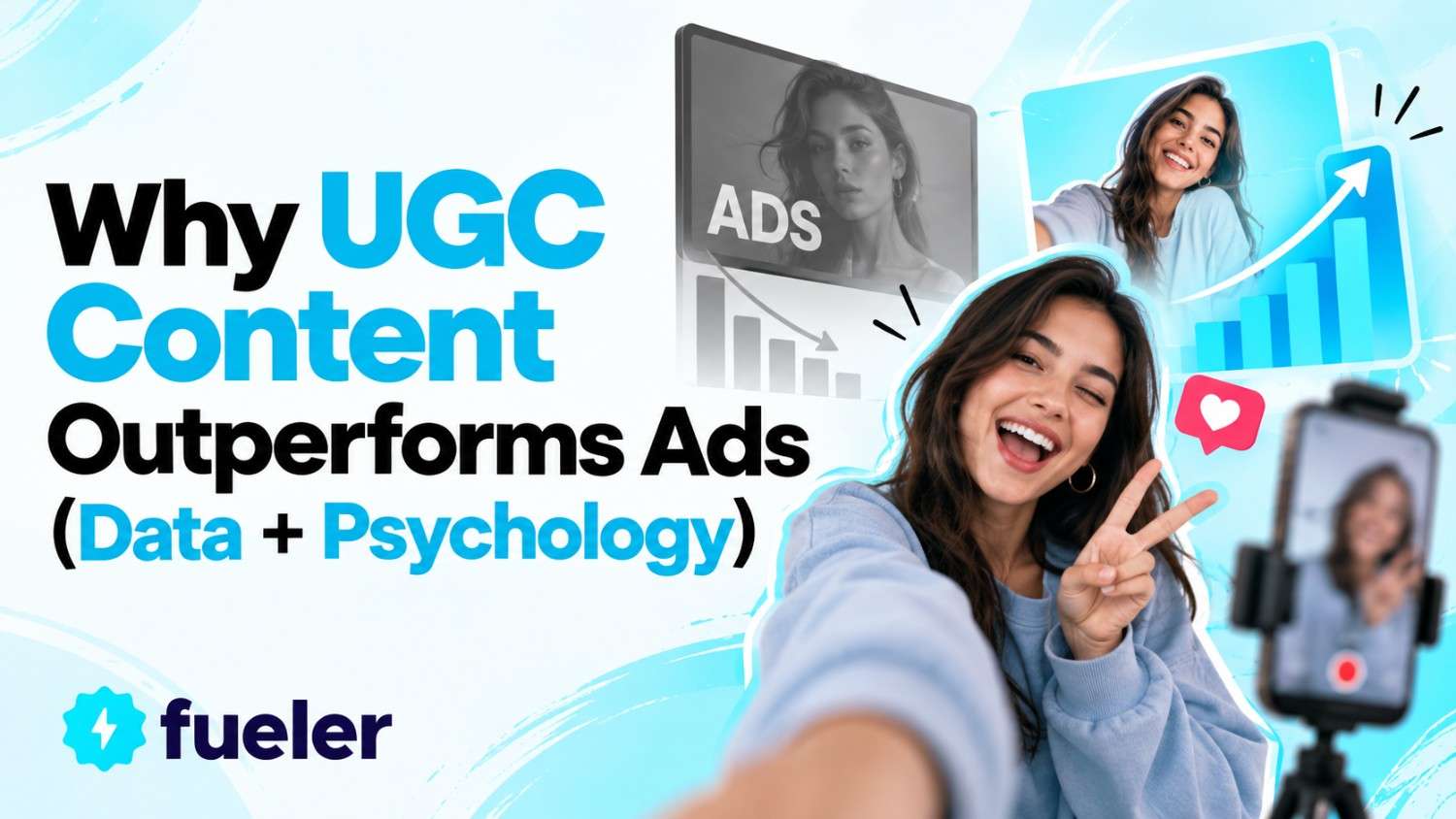
Why UGC Content Outperforms Ads (Data + Psychology)

Riten Debnath
05 Apr, 2026
Last updated: April 2026
The "Skip Ad" button is the most clicked element on the internet for a reason. Modern consumers have developed a biological filter called "banner blindness," where their brains subconsciously delete anything that looks like a corporate sales pitch before they even process the message. Statistics show that 92% of consumers trust earned media, like recommendations from friends or strangers, above all other forms of advertising. If you are still pouring your entire marketing budget into polished, high-production commercials, you are essentially paying to be ignored. The shift toward User-Generated Content (UGC) isn't just a trend; it is a neurological evolution in how humans decide what to buy.
I’m Riten, founder of Fueler, a skills-first portfolio platform that connects talented individuals with companies through assignments, portfolios, and projects, not just resumes/CVs. Think Dribbble/Behance for work samples + AngelList for hiring infrastructure.
1. The Mirror Neuron Effect and Relatability
Human brains are wired with "mirror neurons," which fire both when we perform an action and when we observe someone else performing that same action. When a viewer watches a UGC creator unboxing a gadget or applying a serum in their actual bathroom, their brain simulates the experience of owning that product. A studio ad feels like an "event" you are watching from afar, but UGC feels like an experience you are participating in. This neurological connection creates a sense of "pre-ownership," making the eventual purchase feel like a natural next step rather than a forced decision.
- Simulated Ownership Experience: By watching a real person use a product in a familiar setting, like a messy kitchen or a small home office, the viewer’s brain bypasses the skepticism usually reserved for "actors" in professional sets.
- Empathy-Based Marketing: UGC triggers a deeper emotional response because the creator looks, talks, and lives like the target audience, which makes the product’s benefits feel achievable for the average person.
- The "Friend Recommendation" Loop: Because the content is filmed on a smartphone and shared in a vertical format, the brain categorizes it as "social interaction" rather than "commercial interruption," keeping the viewer's guard down.
- Contextual Relevance: Seeing a product used in a real-life, imperfect environment provides a "stress test" that a sterile studio environment cannot replicate, proving the item works in the "real world."
Why it matters: Relatability is the strongest currency in digital marketing. When a viewer "sees themselves" in the creator, the psychological barrier to purchase drops significantly, leading to higher conversion rates than any celebrity-endorsed commercial.
2. Breaking the "Uncanny Valley" of Perfection
Psychology tells us that we are inherently suspicious of things that look "too perfect." In marketing, this is known as the "Uncanny Valley" of advertising. When a commercial is too polished, with perfect lighting and airbrushed models, our survival instincts tell us that we are being manipulated. UGC outperforms ads because it embraces imperfections, stray hair, a natural stutter, or a background that isn't color-coded. These small "flaws" are actually trust signals that tell the viewer, "This is a real person telling the truth," which is something a million-dollar production can never fake.
- The Vulnerability Trust Signal: Small mistakes or "raw" moments in a video make the creator appear more human and honest, which transfers that feeling of honesty directly to the brand they are talking about.
- Reduced Psychological Reactance: People naturally resist being told what to do; UGC feels like a "discovery" rather than a "directive," which lowers the viewer's defensive walls against being sold to.
- Authenticity Over Aesthetics: Data shows that videos with "lo-fi" production quality often have a higher click-through rate because they blend into the user's organic feed instead of screaming "I am an advertisement."
- Humanizing the Brand: For a faceless corporation, UGC provides a "human face" that consumers can actually connect with, turning a cold transaction into a warm, peer-to-peer recommendation.
Why it matters: In an era of AI-generated content and deepfakes, "realness" is a luxury. Brands that leverage UGC are tapping into the human desire for truth, which builds a level of brand loyalty that a glossy ad simply cannot buy.
3. Social Proof and the Bandwagon Effect
The "Bandwagon Effect" is a psychological phenomenon where people do something primarily because other people are doing it. UGC is the ultimate form of social proof because it provides visual evidence that real people are spending their hard-earned money on a product. When a brand runs a traditional ad, they are saying "We are great." When a brand uses UGC, the community is saying "They are great." Data from 2026 suggests that UGC is viewed as 2.4 times more authentic than brand-created content, making it the most powerful tool for social validation.
- Third-Party Validation: Having a person with no "official" ties to the company praise a product carries more weight than the company praising itself, acting as a "digital word-of-mouth" that scales infinitely.
- Community Integration: UGC makes the viewer feel like they are joining a club of satisfied users, playing on the human "fear of missing out" (FOMO) and the desire for social belonging.
- Mass Volume Credibility: When a brand features dozens of different creators, it creates a "consensus" in the viewer's mind that the product is a market leader, even if the brand is relatively new.
- User-Centric Storytelling: Creators often highlight niche uses for a product that the brand’s marketing team never considered, proving the product’s versatility through real-world testing and feedback.
Why it matters: Social proof is the "safety net" for a consumer. By seeing others take the risk and succeed with a product, the new customer feels safe enough to complete the checkout process themselves.
4. Native Content and Ad Fatigue Suppression
"Ad Fatigue" happens when an audience sees too many similar-looking advertisements and eventually stops seeing them altogether. UGC fights this by being "native" to the environment. Because every creator has a different voice, a different room, and a different style, the content feels fresh every time. Instead of seeing the same 30-second spot ten times, the viewer sees ten different people sharing ten different perspectives. This variety keeps the brain engaged and prevents the "mental shutoff" that occurs with repetitive corporate messaging.
- Pattern Interruption: Because UGC doesn't follow a rigid corporate template, it constantly surprises the brain with new visual styles and narratives, keeping the viewer's attention longer than a predictable ad.
- Feed Harmony: UGC matches the "vibe" of TikTok, Instagram, and YouTube Shorts, meaning the transition from a friend’s video to a UGC ad is seamless and non-jarring for the user experience.
- Non-Linear Storytelling: Unlike traditional ads that follow a "hook-meat-CTA" structure, UGC can be a "day in the life" or a "get ready with me," weaving the brand into a story people actually want to watch.
- Lowered Repetition Friction: Viewers are much more tolerant of seeing multiple UGC videos about a product because each one offers a new "angle" or "voice," making the marketing feel less like a "campaign" and more like a "conversation."
Why it matters: Content that doesn't "look like an ad" is the only content that survived the 2025 ad-blocker era. By blending in, UGC earns the right to be watched, which is the first and hardest step in any marketing funnel.
5. Cognitive Ease and Simple Communication
Complex ads with high-concept metaphors often require too much "cognitive load" for a viewer to process while scrolling. UGC, however, excels at "Cognitive Ease." It uses simple, 10th-grade English and direct demonstrations. When a creator says, "This mop actually gets the dog hair out of the carpet," and then shows the dog hair being sucked up, the brain processes that information instantly. There is no guesswork. This directness makes the decision-making process faster and less exhausting for the consumer.
- Direct Benefit Demonstration: Focusing on the "what's in it for me" immediately, without the fluff of corporate mission statements or over-the-top cinematic storytelling that confuses the core message.
- Simplified Language: Using the natural vocabulary of the customer rather than "marketing speak," which ensures the message is understood by the widest possible audience without any "translation" needed.
- Visual Proof Over Claims: Showing the product in action creates a "seeing is believing" shortcut in the brain, which is far more convincing than a list of technical specs or a text-based testimonial.
- Shortened Feedback Loops: Because the content is usually short and punchy, the viewer gets the "win" of the product's value in seconds, leading to a quicker "dopamine hit" and a faster "add to cart" action.
Why it matters: In a world of infinite distractions, the simplest message wins. UGC strips away the ego of the brand and replaces it with the utility of the product, making it the most efficient way to communicate value.
6. The "Halo Effect" of Influencer Trust
The "Halo Effect" is a cognitive bias where our overall impression of a person influences how we feel and think about their character in other areas. When a creator that a viewer already likes and trusts features a product, that "trust" is automatically transferred to the product itself. The brand doesn't have to build trust from scratch; they are "borrowing" the existing relationship the creator has spent years building with their audience. This makes the marketing process exponentially faster and more effective.
- Pre-Vetted Credibility: The creator acts as a "filter" for their audience, and by choosing to work with a brand, they are signaling that the product has passed their personal standards of quality.
- Parasocial Relationship Leverage: Viewers often feel a one-sided "friendship" with creators, and they are statistically more likely to support a brand that supports their favorite "digital friend."
- Transferred Authority: If a tech expert recommends a specific laptop, the viewer assumes the laptop is high-quality because they already respect the expert’s knowledge and past reviews.
- Long-Term Sentiment Growth: Unlike a one-off ad that is forgotten instantly, a creator’s endorsement can live in the "memory bank" of the audience, creating a positive brand association that lasts for months.
Why it matters: Trust is the most expensive thing to build in business. UGC allows brands to bypass the "skepticism phase" of the customer journey by leveraging the hard-earned loyalty of the creator community.
7. Cost-Efficiency and High-Volume Testing
From a data perspective, UGC is a goldmine for "A/B testing." For the cost of one professional commercial, a brand can hire 50 UGC creators. This allows the brand to test 50 different hooks, 50 different voices, and 50 different demographics. They can then see which specific video drives the most sales and put their "paid spend" behind the winner. This "data-first" approach to creativity ensures that the brand isn't just "guessing" what will work, but is using real-world performance to drive their decisions.
- Rapid Asset Production: Brands can generate hundreds of pieces of content in the time it takes to plan one traditional shoot, giving them an endless supply of "fresh" creative for their social channels.
- Demographic Diversity: Hiring creators of different ages, races, and backgrounds allows a brand to see exactly which market "segments" are most interested in their product without making assumptions.
- Lowered Production Risk: If one UGC video fails to perform, the brand has only lost a small fee; if a million-dollar commercial fails, it can cripple a marketing department’s annual budget.
- Organic Reach Potential: Because UGC is designed for social platforms, it has the "viral" potential to reach millions of people for free, something a traditional "unlisted" ad link can never do.
Why it matters: Marketing in 2026 is about speed and data. UGC provides the volume needed to find the "winning" message through actual performance metrics rather than creative "hunches" in a boardroom.
8. Overcoming "Selection Bias" Through Variety
When a brand makes their own ad, they show the product in the "perfect" light which leads to "Selection Bias." Customers know the brand is only showing the good parts. However, when a brand uses a wide variety of UGC, they are showing the product in different homes, on different body types, and in different situations. This variety creates a "360-degree" view of the product that feels more honest. It covers all the "bases" of a customer’s potential concerns, making the decision to buy feel "vetted" from every angle.
- Multi-Perspective Validation: Seeing the product work for a busy mom, a college student, and a corporate professional proves that the item is a versatile solution for everyone.
- Body and Lifestyle Inclusivity: UGC naturally showcases how products fit and look on "real" people of all sizes, which is a major data-driven factor in reducing return rates for apparel and beauty brands.
- User-Generated Troubleshooting: Creators often show how they personally solved a small issue with a product, which actually increases trust by showing the product is "real" and manageable.
- Diverse Use-Case Discovery: Brands often discover new "selling points" for their products by watching how UGC creators use them in ways the original designers never even imagined.
Why it matters: Variety is the antidote to skepticism. When a customer sees 20 different people all finding value in a product, the "Selection Bias" disappears and is replaced by a massive wall of social proof.
9. SEO and Generative Search Dominance
In 2026, search engines and "Generative AI" assistants prioritize "Experience, Expertise, Authoritativeness, and Trustworthiness" (E-E-A-T). UGC is the ultimate "Experience" signal. When thousands of people are creating content about your brand, search engines see that as a massive indicator of relevance. UGC videos often rank higher in "Video Search" and are frequently cited by AI search engines as "proof" of a product's quality, driving a constant stream of high-intent traffic to the brand's website.
- Generative Engine Optimization (GEO): Providing the "raw data" that AI assistants need to recommend your product to users who are asking "What is the best [product] for [problem]?"
- Long-Tail Keyword Coverage: Creators often use "natural language" in their descriptions and voiceovers that match exactly how real customers type their questions into Google or TikTok search.
- Social Search Dominance: As younger generations use TikTok as their primary search engine, having a massive library of UGC ensures your brand "owns" the search results for your product category.
- Backlink and Citation Growth: Popular UGC often gets "embedded" or "linked" in blogs and gift guides, creating a powerful web of authority that boosts the brand's main website in search rankings.
Why it matters: UGC is the fuel for modern discovery. It ensures that when a customer is "looking" for a solution, your brand is the one that appears with the most "Proof of Work" behind it.
10. The Power of "Proof of Work"
In every industry, the world is moving toward "Proof of Work." Whether it is a developer showing their code on GitHub or a UGC creator showing their video quality on a portfolio, the "sample" is now more important than the "pitch." Brands outperform their competitors when they stop "promising" and start "proving." UGC is the ultimate "Proof of Work" for a brand because it shows the product in the hands of the people who matter most: the customers.
Showcasing this proof is exactly why we built Fueler. We realized that "saying" you can do something is worthless in 2026; you have to "show" it. By using a platform like Fueler, creators can organize their UGC "Proof of Work" into a professional, skills-based portfolio. This allows brands to see the data, the quality, and the assignments you have completed in one place. It turns your creative output into a business asset, making it easy for brands to see why your content will outperform their traditional ads.
Final Thoughts
The data is undeniable: UGC content is the most effective, trusted, and scalable form of marketing available today. It works because it respects the psychology of the human brain, prioritizing "realness" over "perfection" and "proof" over "promises." As we move deeper into a digital landscape defined by AI and high-speed scrolling, the brands that win will be the ones that empower their community to tell their story. If you want to outperform the competition, stop trying to be "flawless" and start being "human." Build your proof, showcase your work, and let the results speak for themselves.
FAQs
How much more do UGC ads convert compared to traditional ads?
Current data suggests that UGC-based ads can see up to a 28% higher engagement rate and a 4x higher click-through rate (CTR) than traditional studio-shot advertisements, largely due to the "Mirror Neuron" effect and increased trust.
What is the best way to manage multiple UGC creators?
The most efficient way is to treat each collaboration as a professional assignment. Using a portfolio platform like Fueler helps you see a creator's "Proof of Work" upfront, ensuring you only hire those who have a history of delivering high-quality, high-converting assets.
Does UGC work for high-end luxury brands in 2026?
Yes, but the "style" of the UGC changes. High-end luxury brands look for "Aesthetic UGC" or "Quiet Luxury" creators who can maintain a premium feel while still providing the authentic, first-person perspective that modern buyers demand.
Why do AI search engines prefer UGC over brand websites?
AI search engines are designed to find the most "helpful" information. UGC provides real-world "Experience" datalike how a product feels or how long it actually lasts, which is more valuable to a user than the "Experience-less" marketing copy on a brand's sales page.
Can I use UGC for B2B (Business-to-Business) marketing?
Absolutely. In B2B, UGC usually takes the form of "video case studies" or "expert walkthroughs." Seeing a real professional use a software or a tool in their actual workflow is the most powerful "Proof of Work" a B2B company can provide to a potential client.
What is Fueler Portfolio?
Fueler is a career portfolio platform that helps companies find the best talent for their organization based on their proof of work. You can create your portfolio on Fueler. Thousands of freelancers around the world use Fueler to create their professional-looking portfolios and become financially independent. Discover inspiration for your portfolio
Sign up for free on Fueler or get in touch to learn more.

What should you do next?
You've read the article. Now turn your skills into proof of work and unlock more opportunities.
Build your proof of work portfolio
Create a clean portfolio with projects, assignments, resumes, and AI stack details that companies actually want to see.
Create your Fueler portfolio →Apply through assignments, not resumes
Stand out by solving real tasks from companies hiring on Fueler.
Explore assignments →Get discovered by companies
Make your work public and let recruiters discover your skills through actual projects instead of keywords.
Get discovered →
