Why Tripura's AVGC-XR Policy Could Create a New Digital Economy

Riten Debnath
18 May, 2026
Last Updated: May 26
I was born and raised in Tripura. I have seen my state from very close. I have also seen what happens when a young person from Agartala tries to build a creative career. They almost always feel they have to leave. Move to Bangalore. Move to Mumbai. Move to Delhi. Because that is where the jobs are. That is where the studios are. That is where the money flows.
But something is changing now. And I want to write this piece because I genuinely believe it.
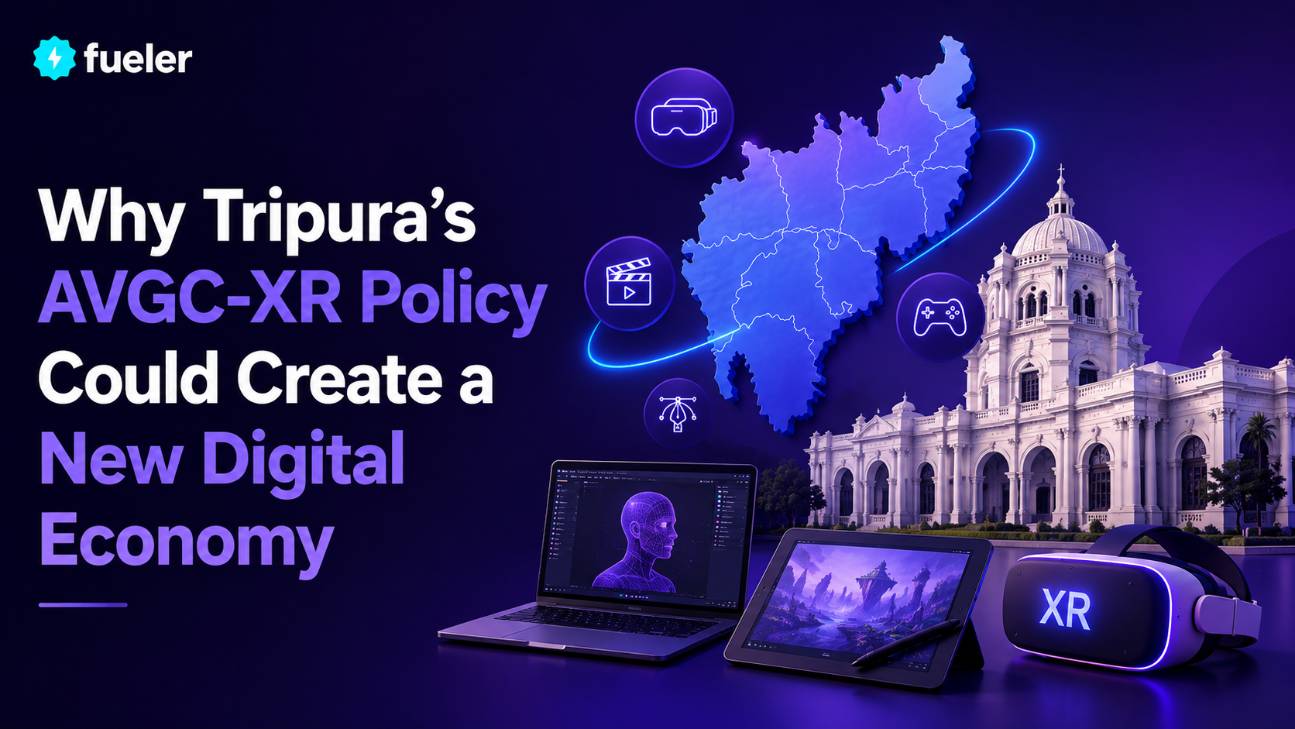
In the Tripura State Budget for 2026 to 2027, the government proposed something most people missed. The state announced its plans for an AVGC-XR Policy (Animation, Visual Effects, Gaming, Comics, Extended Reality) and a new Tripura IT and Data Ecosystem Zone (TIDEZ) at Chanmari, Agartala. The Finance Minister called it the "Orange Economy" a fresh name for creative technology and digital content.
This is not a small announcement. This is the beginning of a new digital economy in the Northeast. And if Tripura plays its cards right, it can become a model for every other small state in India.
Let me explain why.
Why Tier 2 and Tier 3 States Are Investing in Digital Economies
For decades, India's economic growth was concentrated in five or six metros. Mumbai, Bangalore, Delhi, Hyderabad, Chennai, Pune. If you wanted a serious career, you had to move.
But now the model is breaking. Three things have changed:
- Internet is everywhere. Even Tier 3 towns have 4G and 5G. A student in Agartala has the same internet speed as one in South Bombay.
- Remote work is normal. Companies hire across borders. A studio in Toronto can hire an animator in Tripura.
- Cost of living is much lower. A creative professional in a Tier 2 city can save more, build more, and live better than someone in a metro.
Governments have noticed this shift. Maharashtra approved its AVGC-XR Policy in 2025 with a financial plan of 3,268 crore rupees and targets of 50,000 crore in investments and 2 lakh jobs. Karnataka, Madhya Pradesh, Rajasthan, Telangana, and Kerala already have active AVGC-XR policies. Tamil Nadu's AVGC-XR Policy 2026 plans to create 200 startups and 300 to 400 Digital Arts Centres in colleges.
Now Tripura is joining this wave. And the timing is perfect.
How AVGC Creates Remote Jobs
Here is the most powerful thing about the AVGC-XR sector. You don't need to be in a metro to do the work.
An animator, a VFX artist, a game designer, a comic illustrator, or an XR developer can work from anywhere. All they need is a good laptop, a stable internet connection, and a strong portfolio.
According to the Government of India, the AVGC-XR sector is expected to create around 20 lakh direct and indirect jobs in the next ten years. India also offers a 40 to 60 percent cost advantage in animation and VFX services compared to global markets. This is why international studios outsource work to India.
Some of the most exciting remote roles include:
- 2D and 3D Animator for global studios
- VFX Compositor for film and OTT
- Unity and Unreal Engine Game Developer
- AR and VR Content Creator
- Motion Graphics Designer for brands
- Comic Illustrator for digital publishers
- Storyboard Artist for animated series
A creator from Tripura can serve a client in London, Tokyo, or Los Angeles without moving an inch. That is the new digital economy.
Why Northeast India Has Massive Creator Potential
Most people outside the Northeast don't realise this. The region has one of the richest visual and storytelling cultures in India.
Look at the facts:
- High youth population. A large share of the population is under 30 and digitally native.
- Strong English fluency. This is a huge advantage for global clients.
- Rich folklore and culture. From Tripura's tribal motifs to Manipur's classical art forms, the region is a goldmine of stories waiting to be turned into animation, games, and comics.
- High creative talent. From music to dance to design, the Northeast already produces some of India's most original creators.
What was missing all this time? Infrastructure, policy support, and platforms to showcase the work. The AVGC-XR Policy fixes the first two. Platforms like ours fix the third.
Imagine an animated series based on Tripuri folklore. Imagine a mobile game inspired by Khasi legends. Imagine an XR museum experience that brings Northeast history to life. The market is hungry for original content. The Northeast can deliver it.
Startup Ecosystem Opportunities
When a state announces an AVGC-XR policy, it does not just create jobs. It creates a whole startup ecosystem.
Here is what typically happens after a policy is announced:
- Co-working spaces and incubators open up in the capital.
- Studios and production houses set up regional offices to access local talent.
- Skilling centres start offering specialised courses.
- Investors start looking at the region for early-stage bets.
- Service businesses like equipment rentals, sound studios, and post-production labs grow around the core sector.
This is exactly what TIDEZ at Chanmari is aiming for. A dedicated zone for IT, IT services, and data centres can become the backbone of a real digital economy in Agartala.
If you are a founder watching Tripura right now, the opportunities are wide open. There is space for:
- AVGC-XR training startups
- Indie game studios building on local stories
- AR filter agencies for brands
- Animation studios for regional content
- Talent platforms that connect Northeast creators with global clients
- Co-working spaces tailored for creative professionals
The good news is, competition is low right now. The early movers will define the playbook.
What Government Support Usually Looks Like
If you are a student, freelancer, or founder, you should understand how state policies actually help you.
Based on what other states like Maharashtra and Madhya Pradesh have rolled out, here is what AVGC-XR policies typically include:
- Capital subsidies for setting up studios and production facilities
- Power tariff concessions since these studios need high computing power
- 24x7 operational permissions because render farms and live esports need to run all the time
- Skill development funds for training programs
- Land allotment in dedicated AVGC parks or zones
- Reimbursement for participation in international festivals and trade fairs
- Tax benefits and stamp duty relaxation
- Scholarships for students in animation, VFX, gaming, and XR courses
When Tripura's AVGC-XR Policy is fully detailed, we can expect similar support. The key is to be ready when the policy lands. Founders who already have a project, a portfolio, or a small team can move fast.
Skill Development Opportunities for Students
Let me speak directly to students reading this.
The biggest mistake you can make right now is to wait. Don't wait for the policy to be implemented. Don't wait for a college course. Don't wait for a job posting. Start today.
Here is what I would do if I were 18 again:
- Pick one skill. Animation, VFX, game development, or AR filters. Choose one and go deep.
- Use free tools. Blender, Unity, Godot, DaVinci Resolve, Krita are all free and industry-standard.
- Follow YouTube channels that teach the craft for free. Blender Guru, Brackeys, Corridor Crew are excellent starting points.
- Build one project a week. Even something small. A 10-second animation. A simple AR filter. A tiny game.
- Publish your work. Don't hide your projects. Put them on Instagram, LinkedIn, and your portfolio.
- Apply to IICT and similar courses. The Indian Institute of Creative Technologies (IICT) in Mumbai offers specialised AVGC-XR courses backed by Google, Adobe, NVIDIA, Microsoft, and Netflix.
- Build a public Fueler profile. Make sure recruiters and clients can find your work in 30 seconds.
The students who win in the next five years will not be the ones with the best degrees. They will be the ones with the strongest portfolios and the most consistent practice.
What Founders Should Watch For
If you are a founder or aspiring founder, here are the signals worth tracking closely:
- The final draft of Tripura's AVGC-XR Policy. What incentives, subsidies, and infrastructure does it provide?
- TIDEZ rollout in Agartala. When does the Chanmari zone go live? What companies are anchoring it?
- Investment announcements. Which studios or companies commit to setting up offices in Tripura?
- Skill development partnerships. Are big names like IICT, FICCI, or Netflix setting up training programs in the Northeast?
- Inter-state co-production treaties. Industry leaders are pushing for these. If they happen, content created in Tripura can flow easily to Mumbai studios and global distributors.
- National AVGC-XR Policy. The Ministry of Information and Broadcasting has confirmed it is working on a unified national framework. This will guide every state policy going forward.
The next 18 to 24 months are going to be defining. Founders who build now will be the ones leading when the ecosystem matures.
Why I Am Building Fueler from Tripura
I want to be honest about something. When I started Fueler, many people told me to move my base to Bangalore. They said you cannot build a serious tech startup from Tripura.
I disagreed. Because I believe the next wave of Indian startups will not just come from metros. They will come from Tier 2 and Tier 3 cities, from the Northeast, from places that have been overlooked for too long. The internet does not care where you are sitting. The work does the talking.
Fueler is a portfolio platform that helps companies hire based on proof of work and assignments, not just resumes and degrees. For AVGC-XR creators, this is the perfect time. You are entering an industry where your work matters more than your CV.
A young animator from Agartala, a game designer from Imphal, a VFX artist from Aizawl — all of them can now build a public Fueler profile, share it with one link, and let global companies see exactly what they can do. That is the bridge we are building. From the Northeast to the world.
Final Thoughts
Tripura's AVGC-XR Policy is not just a government announcement. It is a signal. A signal that the Northeast is ready to claim its place in India's digital economy. A signal that creative careers are no longer limited to metros. A signal that the next decade of Indian creativity could come from places no one expected.
But policies alone will not change anything. People will. Students who pick up Blender. Freelancers who land their first international gig. Founders who set up small studios. Teachers who train the next generation.
If you are reading this from Tripura, from Assam, from Meghalaya, or from any small town in India, I want to tell you this. You don't need to wait for permission. You don't need to move to a metro. You just need to start. Build one project. Share it. Then build another.
The Orange Economy is here. The opportunity is real. And the time is now.
Frequently Asked Questions
1. What is Tripura's AVGC-XR Policy and why does it matter?
Tripura's AVGC-XR Policy is a proposed framework announced in the State Budget for 2026 to 2027 to grow the state's animation, visual effects, gaming, comics, and extended reality sectors. It is part of Tripura's "Orange Economy" vision and is expected to create jobs, attract investment, and position the state as a digital economy hub in the Northeast.
2. What is TIDEZ in Tripura?
TIDEZ stands for Tripura IT and Data Ecosystem Zone, proposed to be set up at Chanmari, Agartala. It aims to attract investments in IT, IT-enabled services, and data centres, forming the digital infrastructure backbone for Tripura's growing tech and creative economy.
3. What is the Orange Economy in India?
The Orange Economy refers to the creative and cultural sector, which includes animation, gaming, music, design, digital content creation, and immersive media. Tripura is one of the states actively building its Orange Economy through dedicated policies and infrastructure.
4. What are the best digital career options for students in Northeast India?
The best digital careers for Northeast India students include animation, VFX, game development, AR and VR design, motion graphics, UI and UX design, content creation, and freelance creative services. These careers can be done remotely from any city with good internet connectivity.
5. How can a student from Tripura start a career in AVGC-XR?
A student in Tripura can start by learning free tools like Blender, Unity, and DaVinci Resolve, building small projects every week, publishing work on platforms like Fueler, joining online creative communities, and applying for specialised AVGC-XR courses at institutions like the Indian Institute of Creative Technologies (IICT).
What is Fueler Portfolio?
Fueler is a career portfolio platform that helps companies find the best talent for their organization based on their proof of work. You can create your portfolio on Fueler. Thousands of freelancers around the world use Fueler to create their professional-looking portfolios and become financially independent. Discover inspiration for your portfolio
Sign up for free on Fueler or get in touch to learn more.

What should you do next?
You've read the article. Now turn your skills into proof of work and unlock more opportunities.
Build your proof of work portfolio
Create a clean portfolio with projects, assignments, resumes, and AI stack details that companies actually want to see.
Create your Fueler portfolio →Apply through assignments, not resumes
Stand out by solving real tasks from companies hiring on Fueler.
Explore assignments →Get discovered by companies
Make your work public and let recruiters discover your skills through actual projects instead of keywords.
Get discovered →
