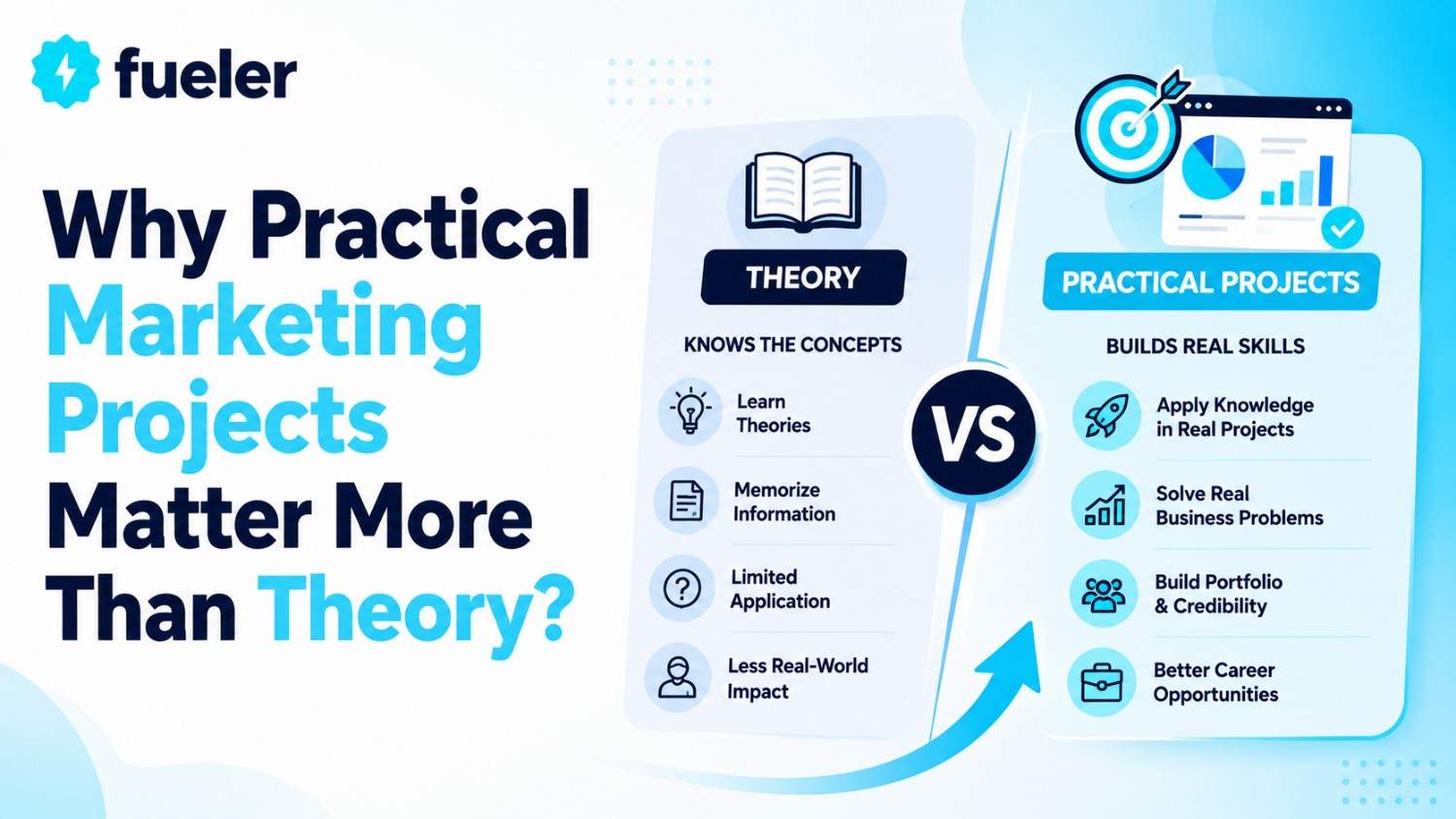
Why Practical Marketing Projects Matter More Than Theory?

Riten Debnath
29 Jul, 2026
Last updated: July 2026
Marketing textbooks are filled with neat diagrams, but real marketing is messy. Reading about customer acquisition models will never prepare you for an ad account rejection, a tracking pixel failure, or an unexpectedly high customer acquisition cost.
When ad budgets are on the line, theoretical knowledge falls flat without operational execution. Modern growth teams do not care what terms you can define; they want to know what systems you can build and run.
I’m Riten, founder of Fueler, a skills-first portfolio platform building the career infrastructure for 100 million creative professionals. Fueler connects talented individuals with companies through assignments, portfolios, and projects, not just resumes or CVs. Think of it as Dribbble/Behance for work samples combined with AngelList for hiring infrastructure.
Theoretical knowledge creates passive observers, but practical marketing projects build decisive operators.
In this guide, you will learn 10 core reasons why practical marketing projects matter more than theory in 2026. We will cover how hands-on campaign builds accelerate skill mastery, improve job search conversion rates, and deliver real commercial value to growing companies.

Real-World Campaign Execution versus Theoretical Marketing Concepts
Theoretical marketing frameworks teach high-level strategy, but they ignore the technical friction of daily execution. Anyone can read a textbook chapter on target audiences, but launching an active campaign requires managing settings, budgets, and creative assets under strict deadlines.
Practical marketing projects force you to navigate live software environments where mistakes cost actual money. Applying concepts in real time bridges the gap between passive understanding and active operational capability.
- Setting up live advertising campaigns requires navigating complex platform dashboards, managing campaign structures, and selecting precise audience parameters that textbook theories completely ignore during classroom discussions.
- Hands-on campaign execution forces marketers to write compelling ad copy, build dedicated landing pages, and configure conversion goals under real-world constraints rather than analyzing static case studies.
- Managing live marketing projects teaches practitioners how to allocate real media budgets efficiently, monitor daily account burn rates, and adjust campaign bids based on immediate performance data.
- Real-world project building exposes marketers to unexpected platform updates, ad rejection policies, and technical glitches that demand quick troubleshooting rather than theoretical policy memorization.
- Running live campaigns generates concrete performance metrics like click-through rates and customer acquisition costs, offering immediate feedback that textbook exercises simply cannot replicate.
Why It Matters: Businesses hire operators who can drive revenue from day one, not theorists who only understand strategy on paper. Practical campaign execution proves you can manage budgets, navigate technical platforms, and deliver measurable growth without needing constant hand-holding from senior leaders.
Hands-On Tool Proficiency Across Digital Marketing Platforms
Knowing what a tool does is completely different from knowing how to operate it under pressure. Theoretical learning tells you that email automation exists, but practical execution forces you to set up webhooks, tags, and trigger conditions.
Modern marketing workflows rely on complex software stacks that require direct platform experience. Hands-on projects build muscle memory across marketing platforms, making you productive from your first day on the job.
- Building practical marketing projects requires navigating platforms like Google Analytics, Meta Ads Manager, and email engines directly, turning abstract software concepts into repeatable technical habits.
- Hands-on setup forces marketers to troubleshoot platform integration errors, configure tracking pixels correctly, and ensure seamless data flow across interconnected marketing automation platforms.
- Working within live marketing tools reveals platform-specific limitations and hidden operational quirks that standard textbook summaries and static online lectures completely gloss over.
- Executing practical assignments builds deep familiarity with software navigation, reporting dashboards, and interface layouts, allowing marketers to launch future campaigns with minimal onboarding time.
- Direct tool usage enables practitioners to test advanced features, build custom reporting views, and optimize automated workflows based on direct technical experience rather than theoretical documentation.
Why It Matters: Tool mastery is the baseline requirement for modern marketing execution. Candidates who possess hands-on software experience eliminate training overhead for employers, execute campaigns faster, and solve technical integration challenges independently.
Data-Driven Performance Optimization and Analytical Decision Making
Theoretical marketing models assume perfect conditions, but real-world campaign data is inherently noisy and unpredictable. Reading about data analysis teaches you definitions, but running live projects forces you to interpret actual conversion metrics.
Hands-on experience trains you to identify trends, isolate underperforming variables, and optimize campaigns based on real user behavior. You learn to make confident, data-backed decisions rather than relying on gut feeling.
- Analyzing real project data teaches marketers how to filter out statistical noise, identify true performance trends, and evaluate campaign effectiveness using real conversion metrics.
- Practical campaign optimization requires making iterative adjustments to ad copy, targeting options, and landing page elements based on ongoing performance feedback rather than guesswork.
- Managing live analytics dashboards builds critical diagnostic skills, helping marketers quickly spot conversion drops, user drop-offs, and tracking errors before campaign budgets are wasted.
- Hands-on data evaluation trains practitioners to run clean A/B tests, measure statistical significance, and validate performance hypotheses using real audience interaction data.
- Interpreting actual campaign results develops a performance-first mindset that prioritizes commercial outcomes, return on ad spend, and business impact over superficial vanity metrics.
Why It Matters: Data-driven optimization turns marketing from an unpredictable expense into a manageable growth system. Teams that master practical analytical execution allocate budgets more effectively, reduce acquisition costs, and maximize campaign returns.
Developing Problem-Solving Mindsets Through Live Campaign Failures
In textbook marketing, campaigns always succeed according to plan, but real marketing involves constant unexpected failures. Ads get rejected, conversion tracking breaks, landing pages crash, and audience engagement drops without warning.
Working on practical marketing projects exposes you to these inevitable setbacks in a controlled environment. Troubleshooting live issues builds resilience, strategic adaptability, and practical problem-solving skills that theory can never teach.
- Experiencing real campaign failures teaches marketers how to diagnose underlying root causes, adjust messaging, and pivot tactics under pressure without losing momentum.
- Managing live project setbacks builds emotional resilience and tactical flexibility, preparing practitioners to handle high-stakes client challenges and unexpected platform changes calmly.
- Hands-on troubleshooting forces marketers to audit campaign settings, test alternative creative assets, and refine audience targeting until positive performance results are achieved.
- Facing real-world delivery issues encourages creative experimentation, pushing practitioners to develop innovative workarounds and test unconventional acquisition strategies.
- Working through live campaign obstacles builds a deep diagnostic intuition that enables marketers to anticipate potential risks and optimize future strategy before launch.
Why It Matters: Marketing environments demand quick pivot abilities and calm troubleshooting. Professionals who have navigated real campaign failures handle unexpected setbacks efficiently, protecting company revenue and maintaining campaign momentum.
Signal Quality and Proof of Work in Skills-Based Hiring
Hiring managers no longer trust static resumes packed with self-proclaimed skills and bulleted job responsibilities. Theoretical knowledge creates impressive interviews, but practical projects provide undeniable proof of what you can actually deliver.
A portfolio featuring real campaign builds, performance data, and asset examples creates high signal quality for employers. Showing live proof of work separates you from hundreds of candidates who only memorize terminology.
- Showcasing completed marketing projects provides verifiable evidence of campaign execution, data analysis, and technical software skills that static resume claims simply cannot demonstrate.
- Building a tangible project portfolio allows hiring managers to inspect your strategic thinking, creative asset quality, and workflow organization before making hiring decisions.
- Presenting live proof of work reduces hiring risk for employers, proving that you possess practical operational capabilities and require zero initial training period.
- Documenting real project outcomes creates compelling narrative case studies that differentiate your professional application from competitors relying solely on theoretical academic credentials.
- Demonstrating completed campaign builds highlights active initiative, self-direction, and practical problem-solving ability, qualities that modern growth companies value above traditional degree titles.
Why It Matters: Skills-based hiring rewards candidates who show tangible proof over theoretical knowledge. Building real marketing projects establishes immediate credibility, shortens hiring cycles, and secures better career opportunities.
Accelerating Learning Retention Through Experiential Execution
Reading a chapter about conversion rate optimization provides short-term information, but executing a live audit creates lasting skill retention. Experiential learning forces your brain to connect abstract concepts with physical actions and real-world outcomes.
When you configure software, write ad copy, and review analytics yourself, concepts stick permanently. Practical marketing projects turn passive academic study into active operational expertise.
- Executing hands-on marketing campaigns reinforces theoretical concepts through direct physical action, significantly improving long-term knowledge retention and practical recall capabilities.
- Managing real campaign workflows connects abstract marketing concepts to tangible business outcomes, creating a comprehensive understanding of how individual channels interact.
- Direct involvement in project execution turns passive information consumption into active problem-solving, building deep operational muscle memory across multiple digital platforms.
- Building practical projects forces continuous self-directed research, encouraging marketers to master new tools, platform features, and tactics to overcome real-world execution roadblocks.
- Experiential learning builds genuine professional confidence, empowering practitioners to speak authoritatively about marketing execution based on personal experience rather than repeated theory.
Why It Matters: Fast-moving marketing environments demand rapid skill application. Experiential execution ensures you retain technical knowledge, adapt quickly to new tools, and execute campaigns with high operational confidence.
Mastering Budget Management and Paid Acquisition Realities
Theoretical budgets in classroom assignments feel like monopoly money because there are zero consequences for overspending. In the real world, mismanaging ad spend or miscalculating cost-per-acquisition can destroy profit margins instantly.
Practical marketing projects teach you the strict reality of budget pacing, bid strategies, and financial accountability. Managing real media dollars trains you to treat every campaign dollar as if it were your own.
- Managing live advertising budgets teaches marketers how to set daily spend limits, monitor pacing, and prevent unexpected overspending across paid acquisition networks.
- Hands-on budget management forces practitioners to evaluate cost-per-click, cost-per-lead, and return on ad spend continuously to maintain campaign profitability.
- Running paid projects builds deep familiarity with platform bidding strategies, automated target objectives, and cost controls across major ad networks.
- Allocating real media dollars trains marketers to ruthlessly cut underperforming ad sets and redistribute budget toward high-converting creative variations.
- Experiencing financial accountability builds commercial discipline, ensuring that every marketing decision is evaluated against business revenue and acquisition unit economics.
Why It Matters: Financial discipline separates amateur marketers from top-tier growth operators. Mastering practical budget management builds executive trust, ensuring you can manage larger ad budgets responsibly and drive profitable customer acquisition.
Building Adaptability to Algorithmic and Platform Changes
Ad platform algorithms, privacy policies, and search engine guidelines update constantly, rendering old theoretical playbooks obsolete overnight. Studying static marketing guides cannot prepare you for sudden platform changes or shifting ad rules.
Practical projects keep you directly connected to live software behavior. When you run active campaigns, you notice algorithmic shifts immediately and learn to adapt strategies in real time.
- Managing active marketing projects exposes practitioners to real-time algorithm shifts, privacy policy updates, and platform interface overhauls as they actually happen.
- Hands-on execution forces marketers to adapt targeting strategies, tracking setups, and creative formats continuously to maintain consistent performance standards.
- Working with live campaigns encourages proactive testing, helping practitioners discover emerging platform features and growth tactics before they become mainstream industry theory.
- Navigating policy compliance challenges in active ad accounts teaches marketers how to structure compliant copy and landing pages without getting accounts suspended.
- Operating in dynamic live environments builds operational agility, ensuring that your marketing strategies remain effective regardless of sudden external platform disruptions.
Why It Matters: Static theoretical playbooks quickly become outdated in fast-changing digital markets. Practical project execution develops the agility required to navigate platform updates, maintain performance stability, and outperform competitors.
Cross-Functional Collaboration and Marketing Workflow Engineering
Marketing does not happen in an isolated vacuum; it intersects with sales, product engineering, design, and customer support. Theoretical courses treat marketing as a standalone activity, ignoring the cross-functional coordination required to close deals.
Working on practical projects forces you to build end-to-end workflows that connect marketing assets to CRM systems and sales pipelines. You learn how data moves across teams to support overall business goals.
- Executing real marketing projects requires building seamless workflows between ad channels, landing pages, CRM databases, and internal sales notification systems.
- Practical campaign builds force marketers to collaborate with designers, copywriters, and developers, learning how to manage creative handoffs and project timelines efficiently.
- Aligning marketing systems with sales pipelines teaches practitioners how to define lead quality, track conversion stages, and improve lead-to-customer conversion rates.
- Building connected marketing operations develops clear documentation habits, ensuring that campaign structures, UTM parameters, and tracking rules are easily understood by team members.
- Managing end-to-end projects provides a holistic view of business operations, helping marketers design campaigns that support broader revenue goals rather than isolated marketing metrics.
Why It Matters: Modern organizations value marketers who can build connected execution systems. Mastering cross-functional workflow engineering improves internal team alignment, speeds up execution velocity, and drives predictable revenue pipeline.
Immediate Revenue Generation and Business Growth Impact
At its core, marketing exists to generate demand, acquire customers, and drive measurable revenue growth for a business. Theoretical exercises end with a grade, but practical marketing projects end with quantifiable commercial outcomes.
Building live campaigns allows you to measure direct business impact, whether that means acquiring email subscribers, generating qualified leads, or driving e-commerce sales. Practical projects prove your work moves the business forward.
- Launching live marketing campaigns connects strategic effort directly to commercial metrics like pipeline value, customer acquisition costs, and net company revenue.
- Practical project execution generates real-world case studies demonstrating how specific messaging, targeting, and channel strategies directly produced measurable customer growth.
- Focusing on practical execution trains marketers to prioritize high-leverage activities that generate revenue over low-impact task work and vanity engagement metrics.
- Delivering tangible business results through live projects builds instant credibility with founders, executives, and clients who evaluate marketing by financial performance.
- Practical campaign success validates marketing hypotheses using real customer transactions, proving that your strategy works in competitive open markets.
Why It Matters: Revenue generation is the ultimate measure of marketing effectiveness. Delivering real business results through practical projects elevates your career standing, proving you are a revenue-driving asset rather than a departmental expense.
How Does This Connect to Building a Strong Career or Portfolio?
Understanding why practical projects matter is only useful if you apply it to your career. Resumes make promises, but documented proof of work provides certainty. Showcasing your campaign architectures, ad copy tests, and analytics dashboards gives hiring managers undeniable evidence of your capabilities. Documenting your assignments, campaign breakdowns, and execution systems on Fueler lets your work speak for itself. It shifts employer conversations from "what courses did you take?" to "how did you build this campaign?", giving you complete leverage in the job market.
Final Thoughts
Marketing has permanently shifted from theoretical study to practical execution. The professionals who thrive today are those who build real projects, test live campaigns, and document their outcomes. Stop relying solely on certificates and textbook definitions to advance your career. Build live campaigns, track real data, document your proof of work, and let your execution speak for itself.

Frequently Asked Questions
Why is practical project experience better than a marketing degree?
Practical projects demonstrate real software operation, problem-solving, and measurable business outcomes. Employers prefer candidates who have managed real tools and ad spend over those with purely theoretical classroom knowledge.
How do I start building practical marketing projects with no experience?
Pick a niche product, design a landing page, run low-budget campaigns, and track performance. Documenting these real-world experiments creates undeniable proof of work for potential employers.
What are the best practical marketing projects to showcase in a portfolio?
Showcase full-funnel campaign setups, SEO audit implementations, email automation flows, and paid ad creative tests. Detailed case studies showing setup logic and performance data carry the highest signal.
Can practical projects help me get hired without formal work experience?
Yes, practical projects provide tangible proof of your operational ability. Demonstrating real campaign builds, workflow setups, and data analysis proves you can execute from day one without extensive training.
How do I document marketing projects to attract hiring managers?
Break down your projects into clear case studies detailing the objective, strategy, tools used, execution steps, and final performance metrics. Focus on explaining your decision-making process clearly.
Why 100,000+ professionals use Fueler
Fueler helps professionals showcase proof of work through projects, assignments, case studies, and achievements.
- Thousands of professionals use Fueler to create their digital portfolio
- Thousands of projects are published on Fueler. Check here
- Startups and Companies hire through proof of work on Fueler
- Used by freelancers, creators, marketers, video editors, writers, designers, and product managers
Our mission is to help the next 100 million professionals build a verified professional identity through proof of work

What should you do next?
You've read the article. Now turn your skills into proof of work and unlock more opportunities.
Build your proof of work portfolio
Create a clean portfolio with projects, assignments, resumes, and AI stack details that companies actually want to see.
Create your Fueler portfolio →Apply through assignments, not resumes
Stand out by solving real tasks from companies hiring on Fueler.
Explore assignments →Get discovered by companies
Make your work public and let recruiters discover your skills through actual projects instead of keywords.
Get discovered →
