Why Is Fueler Better Than Notion Portfolio for Showcasing Proof of Work?

Riten Debnath
09 Jul, 2026
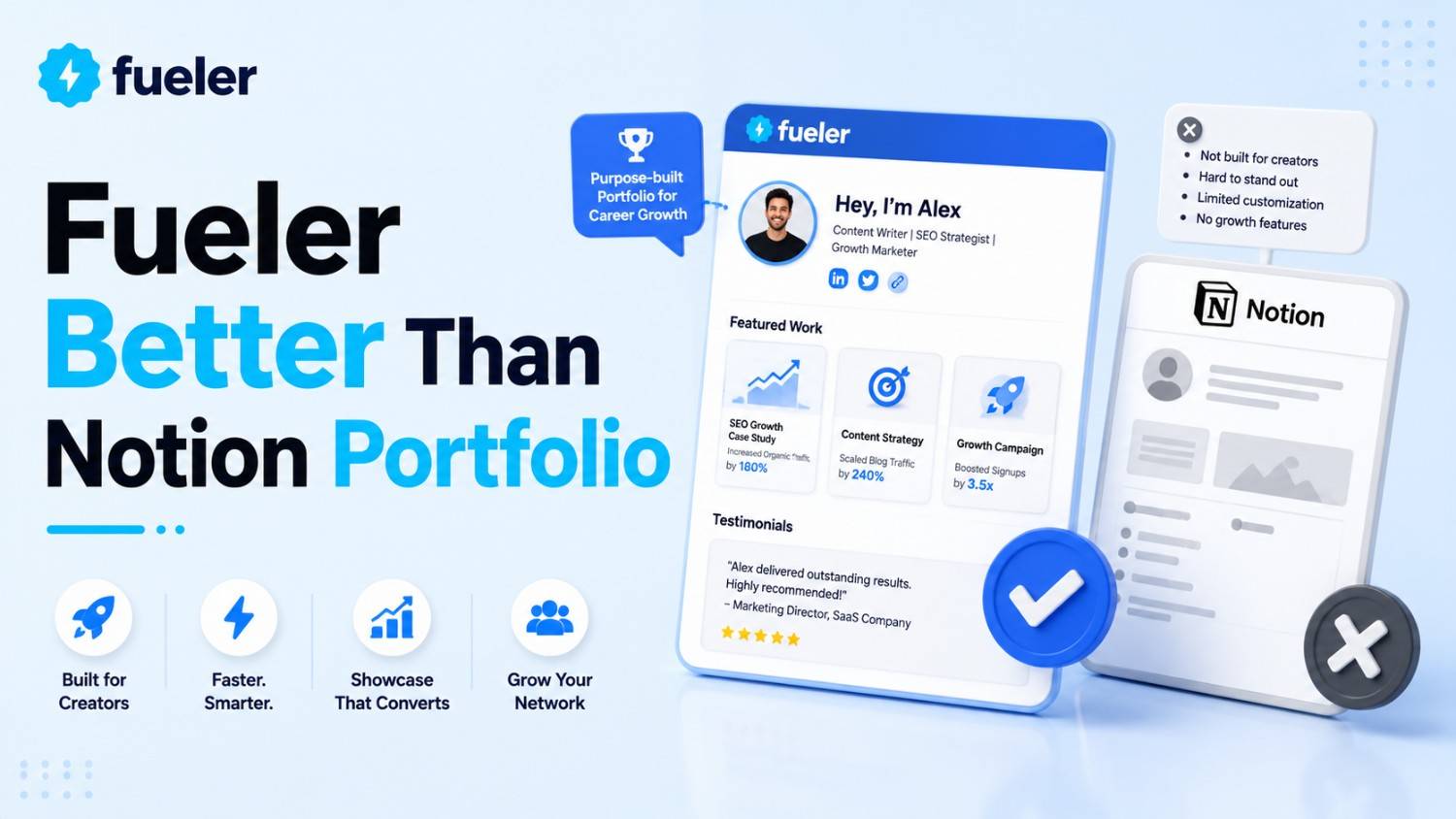
Last updated: July 2026
Sending a generic, text-heavy link to a potential client or hiring manager is the fastest way to lose an opportunity before they even see your skills. In 2026, decision-makers are overwhelmed with applications, meaning first impressions are decided within five seconds of opening a link.
I’m Riten, founder of Fueler, a skills-first portfolio platform that connects talented individuals with companies through assignments, portfolios, and projects, not just resumes/CVs. Think Dribbble/Behance for work samples + AngelList for hiring infrastructure.
In this guide, you will learn why traditional document layouts fail to convert profile traffic into job offers. We will break down the structural differences between document storage and proof of work platforms, giving you a clear blueprint to build a high-converting, authoritative digital profile that commands attention.
1. The Core Structural Difference Between Document Storage and Proof of Work Platforms
Choosing the wrong foundation for your digital profile directly impacts your conversion rate. When you host evidence of your skills on a tool engineered for internal team notes, you force high-level decision-makers to navigate a corporate wiki rather than an intentional, results-oriented showcase.
Repurposing an internal workspace for public proof of work creates immediate friction. Founders and recruiters do not want to click through nested sub-pages, toggle list items, or decode database rows just to see your contributions to a project. A dedicated platform presents evidence cleanly, eliminating navigation hurdles and immediately validating your professional competence.
- Native proof layout structures ensure your past assignments, engineering repositories, and marketing campaigns are displayed instantly on a clean grid, removing the need for visitors to click through deeply nested folder hierarchies.
- Zero-friction navigation paths allow external recruiters to audit your entire professional history in under thirty seconds, significantly increasing the probability of them reaching out for a formal interview or discovery call.
- Standardized project metadata blocks clearly display your specific role, the tools used, and the direct outcomes achieved at the very top of each asset, ensuring your core capabilities are never missed.
- Isolated public presentation views hide all internal editing options, drafts, and administrative clutter, presenting a polished, corporate-ready interface that signals true attention to detail to prospective premium clients.
- Automatic responsiveness across devices guarantees that whether a founder opens your link on a wide desktop monitor or a smartphone via a Twitter DM, the layout adapts flawlessly without breaking.
Why It Matters
In 2026, removing friction from the hiring process is everything. If a hiring manager has to struggle to find your actual contributions, they will bounce, meaning structural clarity directly dictates your career growth and inbound deal flow.
2. Page Loading Speed and Asset Delivery Optimization
A slow portfolio link is an invisible funnel killer for freelancers and full-time professionals alike. Document databases are designed to store massive amounts of internal text and data tables, which often results in heavy script loading when shared as a public web page.
When your profile contains high-resolution project images, live design embeds, or video walkthroughs, a document-style page can take several seconds to render completely. Dedicated portfolio infrastructure uses global content delivery networks and aggressive asset optimization to ensure your proof of work loads instantly, preserving the attention span of busy decision-makers.
- Global content delivery networks cache your project assets across multiple servers worldwide, ensuring that a client in New York or London experiences instantaneous page response times when reviewing your profile.
- Automatic image compression algorithms scale down heavy case study images and screenshots without sacrificing visual clarity, preventing page bloat while maintaining a professional, crisp presentation of your work.
- Asynchronous media rendering allows the text and primary project details to load immediately while heavy media components stream in smoothly, eliminating jarring layout shifts during critical review sessions.
- Minimized JavaScript overhead ensures that your public link remains lightweight and nimble, preventing mobile browser freezes or significant battery drain when recruiters browse multiple items.
- High core web vitals performance directly signals quality to modern search engines, giving your proof of work a massive advantage in ranking for niche-specific organic search queries.
Why It Matters
Recruiters review hundreds of portfolios daily and will not wait for a sluggish database tracker to finish rendering. Instant loading speeds project operational excellence and respect the viewer's time, leading to higher retention and response rates.
3. The Visual Friction of Nested Sub-pages and Databases
Making people click multiple times to see a single case study kills engagement. Traditional note-taking layouts rely heavily on databases, inline links, and side-peek windows that confuse non-technical users and obscure your actual talent.
A true proof of work profile acts as a flat, highly visual catalog. By presenting your projects as distinct, descriptive cards with rich preview imagery, you allow visitors to scan your entire history horizontally. This prevents the cognitive fatigue associated with opening endless tabs just to see individual project assignments.
- Flat information architecture surfaces your top three to five highest-impact projects on the primary screen, completely eliminating the need for complex, multi-layered directory scrolling.
- Rich visual preview cards give a accurate snapshot of your engineering, design, or writing outputs before a user even clicks, enticing them to engage deeper with your work.
- Clean, distraction-free reading environments remove all unnecessary sidebars, block headers, and platform branding, keeping the visitor’s undivided attention fixed squarely on your personal execution data.
- Intentional whitespace utilization guides the eye naturally from your professional summary down to your specific project results, creating a curated reading journey that highlights your career progression.
- Elimination of database styling tags prevents your public profile from looking like an internal project tracker, replacing cold spreadsheet grids with an elite, designer-level presentation layer.
Why It Matters
When you reduce the cognitive load required to understand your career achievements, you make it easy for founders to say yes. Clarity always beats complexity when trying to sell your skills at a premium price point.
4. Built-In Discovery Networks vs. Total Isolation
Creating an incredible showcase of your work means nothing if no one knows it exists. Hosting your career evidence on an isolated document page means your distribution is completely manual; you are entirely responsible for driving every single visitor via cold outreach.
A dedicated proof of work ecosystem operates as a live talent marketplace. It plugs your profile directly into a discoverable directory where founders, product managers, and talent acquisition specialists actively search for vetted professionals based on specific project tags, assignments, and verified execution records.
- Algorithmic talent indexing automatically surfaces your newly published case studies and proof of work to companies actively searching for your specific skill set within the main platform.
- Niche project search filters allow talent scouts to discover your profile based on granular criteria like industry verticals, software proficiencies, or specific project outcomes achieved.
- Community feed amplification distributes your work to peers and potential collaborators within the ecosystem, building organic professional relationships and passive referral networks without extra effort.
- Direct hiring manager dashboards connect your proof of work to open roles on the platform, putting your actual outputs directly in front of active buyers of talent.
- Cross-profile discoverability tags you alongside co-creators, allowing visitors on their profiles to discover your work through natural professional association and shared project credit.
Why It Matters
Relying solely on manual link sharing limits your career opportunities to your current network. Moving into a discoverable ecosystem allows your proof of work to find jobs for you while you sleep.
5. Authentic Collaboration and Verified Project Co-author Tagging
Unverified portfolios often leave room for skepticism, as anyone can copy and paste a case study and claim it as their own. General text editors offer no native method to prove you actually collaborated with other industry professionals on a specific project.
Specialized portfolio platforms solve this credibility issue through verifiable co-author tagging. When you complete a project with a team, you can tag your collaborators directly; once they accept, the project reflects on both profiles, instantly validating the authenticity of the work.
- Two-way profile syncing updates all linked collaborator profiles simultaneously when a project is approved, creating an immutable web of professional trust and social proof across the platform.
- Granular role attribution allows you to specify exactly which part of the code, copy, or design was yours, preventing confusion about your individual contribution to group initiatives.
- Peer validation loops act as automatic character references, showing prospective employers that real professionals are willing to publicly tie their digital reputations to your shared work.
- Protection against portfolio plagiarism prevents bad actors from easily scraping and rehosting your unique project documentation, safeguarding your personal brand value.
- Network-wide credibility scoring naturally elevates your visibility in search results as you accumulate more verified collaborations with other trusted platform creators.
Why It Matters
Trust is the ultimate currency in remote hiring and freelancing. Verifiable collaboration markers eliminate skepticism immediately, allowing you to bypass lengthy test tasks and move straight to contracting.
6. Mobile Responsiveness and On-the-Go Networking Realities
A large percentage of professional networking happens on mobile devices during live events, Twitter spaces, or quick LinkedIn interactions. Document-based platforms often crush their complex column structures and database views when rendered on small mobile viewports.
A dedicated portfolio platform prioritizes mobile-first design engineering. Your project cards stack beautifully, text scales appropriately, and media elements remain perfectly interactive, allowing you to hand over your link during an in-person conference with absolute confidence that it will display flawlessly.
- Fluid grid systems automatically convert multi-column desktop layouts into beautiful, vertically optimized mobile feeds that feel like a native application interface.
- Touch-optimized media viewports allow recruiters to swipe through your project galleries and zoom in on key metrics smoothly without experiencing lag or broken interfaces.
- Lightweight mobile codebases ensure rapid loading speeds even over unstable cellular data networks, preventing drop-offs during high-stakes, real-time networking opportunities.
- Legible typographic scaling maintains optimal contrast and font sizes on smaller screens, allowing busy founders to read your case studies comfortably without pinching or zooming.
- Sticky contact call-to-actions remain easily accessible at the base of the mobile screen, making it effortless for a viewing client to initiate a conversation immediately.
Why It Matters
If your portfolio links look broken on a mobile phone, you look unprofessional. Ensuring a flawless small-screen experience ensures you capture every single impromptu networking opportunity that comes your way.
7. SEO Infrastructure and Structured Schema for Search Engines
Getting discovered organically through Google or AI search tools requires clean, semantic HTML and properly configured metadata. Note-taking tools that render pages dynamically via heavy client-side scripts often hide your actual content from search indexers.
Purpose-built portfolio platforms are architected with clean, search-first code. Every project you publish receives automatic schema markup, clean URL slugs, and optimized meta tags, transforming your proof of work into an active search asset that ranks for industry-specific keywords.
- Automatic semantic HTML generation correctly applies header tags and article boundaries, allowing search engine bots to easily parse and index your specific skill descriptions.
- Custom URL slug configuration lets you naturally include high-intent keywords within your project links, improving your ranking potential for specialized industry terms.
- Automated open graph data optimization ensures that whenever your portfolio link is shared on social platforms, it populates with a beautiful preview image and description.
- Built-in sitemap indexing instantly alerts search engines the moment you add a new piece of proof of work, accelerating your discovery on search result pages.
- Clean structural architecture makes your case studies highly citable for modern AI retrieval engines, positioning your work as a primary source for specific industry solutions.
Why It Matters
Ranking on search engines brings continuous, high-intent inbound leads directly to you. An SEO-optimized portfolio turns your past work into a passive client acquisition machine without ongoing ad spend.
8. Analytical Insights and Visitor Engagement Tracking
Building a portfolio without analytics is like flying blind; you have no idea which projects are attracting attention or where visitors lose interest. Standard document managers do not provide granular engagement data for shared public links.
Dedicated systems offer integrated analytics suites that monitor visitor behavior safely and accurately. You can see exactly how many people viewed your profile, which project cards generated the highest click-through rates, and what geographic regions your traffic is originating from.
- Real-time view tracking records every instance your profile or individual project pages are accessed, giving you immediate feedback on your marketing efforts.
- Granular click-through metrics reveal exactly which assignments and case studies are attracting the most interest, helping you optimize your featured content strategy.
- Traffic source identification logs whether your visitors are arriving from LinkedIn, Twitter, direct links, or organic search queries, allowing you to focus your distribution.
- Audience retention data indicates how long a recruiter stays engaged on a specific project page, signaling when a case study needs revision or shortening.
- Privacy-compliant data collection gathers critical performance insights without relying on invasive tracking cookies, maintaining a secure and professional environment for visitors.
Why It Matters
Data-driven portfolio optimization removes the guesswork from self-marketing. Knowing exactly what projects resonate with your target market allows you to refine your positioning and land higher-paying contracts.
9. Frictionless Media Embedding and Interactive Proof Display
Your proof of work is often highly dynamic, encompassing live code repositories, interactive design mockups, audio tracks, or live dashboard trackers. Document blocks frequently struggle to keep these complex embeds stable, often breaking or displaying massive grey loading frames.
Specialized systems feature native integration hooks for the web's most popular professional tools. Whether you are embedding a live Figma board, a Loom presentation, or a GitHub contribution chart, the asset renders within a secure, interactive sandbox built directly into your case study page.
- Native iframe sandbox security keeps your third-party embeds perfectly stable and safe while preventing external scripts from slowing down your primary portfolio loading speed.
- Proportional aspect-ratio containers lock your embedded videos and live designs into perfect view dimensions, preventing ugly black borders or cut-off content areas.
- Interactive prototype previews allow hiring managers to test your live design files directly inside your profile page without leaving your personal ecosystem.
- Clean code block rendering displays syntax accurately for engineering portfolios, allowing technical recruiters to evaluate your development style comfortably.
- Multi-format media galleries let you combine images, videos, and live links within a single project window, telling a complete story of execution.
Why It Matters
When your interactive work behaves flawlessly inside your profile, you prove your technical capability instantly. Dynamic embeds create an engaging, immersive review experience that traditional text sheets simply cannot match.
10. Long-Term Brand Authority and Professional Credibility
Repurposing a general-purpose utility app as a portfolio sends a subtle signal that you are cutting corners with your professional infrastructure. While fine for beginners, scaling to premium client tiers requires an uncompromised digital presence.
Using a specialized system built for proof of work tells the market that you take your career assets seriously. It positions you as an established operator who understands the value of clean presentation, structured evidence, and verified outcomes, instantly commanding higher respect and compensation.
- Dedicated personal branding real estate ensures your name, title, and core expertise remain the central focus, unmarred by generic workplace software elements.
- Polished, expert aesthetic design mirrors the presentation standards of top-tier global agencies, elevating your perceived value before a contract discussion even begins.
- Permanent, stable link architecture ensures your career links remain live and unbroken for years, acting as a reliable, long-term personal digital archive.
- Industry-recognized profile formats match the scanning habits of modern talent acquisition teams, helping them find key data points without onboarding friction.
- Alignment with future hiring trends signals that you prioritize verifiable outcomes and project execution over outdated, text-based resumes and cover letters.
Why It Matters
Your digital home is the foundation of your professional reputation. Investing in a dedicated infrastructure built for proof of work establishes long-term credibility, ensuring you consistently attract premium career milestones.
How Does This Connect to Building a Strong Career or Portfolio?
Modern hiring prioritizes execution over credentials. Showing exactly how you solved a problem matters infinitely more than listing skills on a traditional resume. Documenting your projects on a dedicated platform like Fueler provides the structure and visibility required to prove your competence instantly, turning your daily proof of work into an unassailable career moat.
Final Thoughts
The tools you choose to present your work define how the market values your expertise. Relying on disorganized document links buries your talent under unnecessary structural friction, while a specialized portfolio platform highlights your results instantly. As hiring trends lean completely toward verified outcomes and transparent proof of work, clear presentation is no longer optional. Position your career assets intentionally, optimize for immediate clarity, and let your past execution secure your next major professional opportunity.
FAQ
Why is a dedicated portfolio platform faster than a document-based page?
Dedicated platforms utilize specialized content delivery networks and automatic media compression engineered solely for rapid asset rendering. This ensures your project images and interactive embeds load instantly, preventing the script-heavy lag common in multi-purpose document systems.
Can a document-based link hurt my chances of getting hired?
Yes, if a recruiter encounters broken mobile layouts, slow loading speeds, or nested databases, they will likely leave the page. High friction directly reduces the number of decision-makers who actually review your work.
How do modern search engines index proof of work platforms?
Specialized platforms generate clean semantic HTML, custom URL structures, and automatic metadata tags for every project. This structured data allows search engine crawlers and AI tools to index and cite your work far more efficiently.
Is it difficult to migrate my existing projects to a dedicated platform?
Not at all. Dedicated platforms prioritize streamlined creation flows, allowing you to quickly paste your project details, upload media assets, and tag your collaborators to form a polished, highly visible showcase in just a few minutes.
Do hiring managers prefer structured project cards over text links?
Absolutely. Structured layouts allow recruiters to scan your specific roles, tools, and project metrics in under thirty seconds, matching their high-volume review habits and getting you noticed faster.
Why 100,000+ professionals use Fueler
Fueler helps professionals showcase proof of work through projects, assignments, case studies, and achievements.
- Thousands of professionals use Fueler to create their digital portfolio
- Thousands of projects are published on Fueler. Check here
- Startups and Companies hire through proof of work on Fueler
- Used by freelancers, creators, marketers, video editors, writers, designers, and product managers
Our mission is to help the next 100 million professionals build a verified professional identity through proof of work

What should you do next?
You've read the article. Now turn your skills into proof of work and unlock more opportunities.
Build your proof of work portfolio
Create a clean portfolio with projects, assignments, resumes, and AI stack details that companies actually want to see.
Create your Fueler portfolio →Apply through assignments, not resumes
Stand out by solving real tasks from companies hiring on Fueler.
Explore assignments →Get discovered by companies
Make your work public and let recruiters discover your skills through actual projects instead of keywords.
Get discovered →
