Why Hiring in India is Broken and How Proof of Work Will Fix It Forever

Riten Debnath
10 May, 2026
I have spent years thinking about one question.
Why is hiring in India so painful for both companies and candidates?
Companies complain they cannot find good people. Candidates complain they cannot find good jobs. Recruiters are buried under thousands of applications. Resumes look the same. Interviews feel like guesswork. And somehow, after all this effort, most hires still do not work out.
Something is deeply wrong here.
So I sat down and asked myself a simple question. If I had to redesign hiring in India from scratch, without copying LinkedIn, Naukri, resumes, or degrees, what would I build?
This article is the result of that thinking. I want to share with you the real reason hiring is broken, what the future looks like, and why proof of work is the next big shift in how India hires.
Let me walk you through it.
The Real Problem Nobody Talks About
Most people think hiring is a discovery problem. They believe the issue is that good candidates and good companies cannot find each other.
That is wrong.
Hiring is a trust problem.
Think about it. When a company hires someone, they are not really buying a person. They are buying confidence. They want to know this person will do the work, deliver on time, and not waste their money.
When a candidate looks for a job, they are not really looking for work. They are looking for income, growth, identity, and a chance to prove themselves.
Everything in between is just an interface trying to connect these two needs.
The problem is that the current interface is broken.
Resumes are filled with lies. Degrees mean less every year. LinkedIn is full of buzzwords. Interviews are short and often unfair. And companies still end up making bad hires.
Why does this happen?
Because the system was never designed to measure what actually matters. It measures credentials, not capability. It measures pedigree, not performance.
The Five Questions Every Company Actually Asks
When a hiring manager looks at a candidate, they are silently asking five questions in their head.
One. Can this person actually do the work?
Two. Can they do it again and again, not just once?
Three. Will they fit with our team?
Four. How quickly can they start adding value?
Five. What happens if this hire fails?
Now look at how we currently answer these questions.
We send a resume. A piece of paper with bullet points.
We do a 30-minute interview. Where the candidate has prepared answers and the interviewer is tired from the previous five interviews.
We check a college name. Even though the person graduated five years ago and the college has nothing to do with their current skills.
We trust LinkedIn endorsements. Where people endorse each other for skills they have never seen them use.
This is not a hiring system. This is a guessing game.
Why India Suffers More Than Most Countries
India has a unique problem. We have too much talent and not enough ways to separate good talent from average talent.
Let me explain.
We have over 1.5 crore graduates entering the workforce every year. Most of them have similar degrees, similar marks, and similar resumes. On paper, they look identical.
But here is the truth. Out of any 100 candidates, maybe 5 are excellent. Maybe 20 are good. The rest are average or below.
The market cannot tell them apart.
This causes what I call signal collapse.
Signal collapse means the system loses the ability to identify quality. When everything looks the same, companies start using shortcuts.
What shortcuts do they use?
They look at the college name. So IIT and IIM students get all the attention while equally talented students from other colleges get ignored.
They look at the previous company name. So someone who worked at a big brand gets called for interviews while someone with better actual skills gets rejected.
They look at years of experience. So a person who has done the same boring work for 10 years gets preferred over someone who has done amazing work for 3 years.
This is not merit. This is laziness dressed up as filtering.
And it is hurting India badly.
The Resume Was Never Designed for This
Here is something most people do not know.
The resume was invented over 500 years ago by Leonardo da Vinci. Yes, the same Leonardo who painted the Mona Lisa. He wrote a letter to a duke listing his skills.
Think about that for a second.
We are still using a format from the 1400s to evaluate people in 2026.
The world has changed completely. We have the internet. We have AI. We have video. We have real-time collaboration tools. We can verify anything in seconds.
But we still ask people to summarize their entire career on one A4 page.
This is crazy.
A resume cannot show you how someone thinks. It cannot show you how they solve problems. It cannot show you how they work with a team. It cannot show you their real output.
It is a document of claims. Not a document of proof.
And in a world where AI can write a perfect resume in 10 seconds, the resume has officially lost its meaning.
What Hiring Actually Is
Let me give you a simple way to understand hiring.
Hiring is a risk reduction engine.
When a company pays you a salary, they are making a bet. They are betting that the value you create will be greater than the money they pay you.
But here is the problem. They cannot see the future. They do not know if you will deliver. They do not know if you will stay. They do not know if you will grow.
So they try to estimate this risk using whatever information they have.
The current methods of estimating risk are terrible. Resume reading, interviews, reference checks. All of these have been studied for decades. The research is clear. They predict job performance very poorly.
Studies from organizations like the Society for Industrial and Organizational Psychology have shown that unstructured interviews predict job performance with very low accuracy. Yet most Indian companies still rely on them.
So if these methods do not work, what does?
The answer is simple. Show me your work.
The Power of Proof of Work
The phrase proof of work comes from the world of cryptocurrency. But the idea is much older.
The idea is this. Instead of trusting what someone claims, look at what they have actually done.
If someone says they are a great writer, ask them to show you something they have written.
If someone says they are a great designer, ask them to show you something they have designed.
If someone says they are a great marketer, ask them to show you a campaign they have run.
Proof beats promises. Every single time.
This is exactly why platforms like GitHub became so powerful for developers. A developer with a strong GitHub profile does not need to prove anything else. Their code speaks for them.
This is why Dribbble and Behance changed design hiring. A designer can show their work directly. No more boring PDF portfolios.
But here is the gap. These platforms exist for developers and designers. What about everyone else?
What about marketers? Writers? Analysts? Operators? Product managers? Sales people? Researchers? Video editors? Community managers?
These people are 80 percent of the knowledge economy. And they have no proper way to show their work online.
This is the problem I am trying to solve with Fueler.
Why I Started Fueler
I built Fueler because I saw this problem up close.
I saw talented people getting rejected because they did not have a fancy degree.
I saw average people getting hired because they had the right college name.
I saw companies waste lakhs of rupees on bad hires because they could not see what candidates could actually do.
I saw recruiters drowning in resumes that all looked the same.
And I realized something important.
The future of hiring is not better resume databases. It is the end of resumes.
Fueler is a portfolio platform where any professional can show their proof of work. Writers, marketers, designers, developers, founders, anyone.
Companies can hire through assignments. They give candidates a small task, see how they perform, and make decisions based on actual output.
This is not a small change. This is a complete shift in how hiring works.
The Five Layers of the New Hiring System
If we are going to rebuild hiring from scratch, we need to think in layers. Let me share the five layers I believe will define the future.
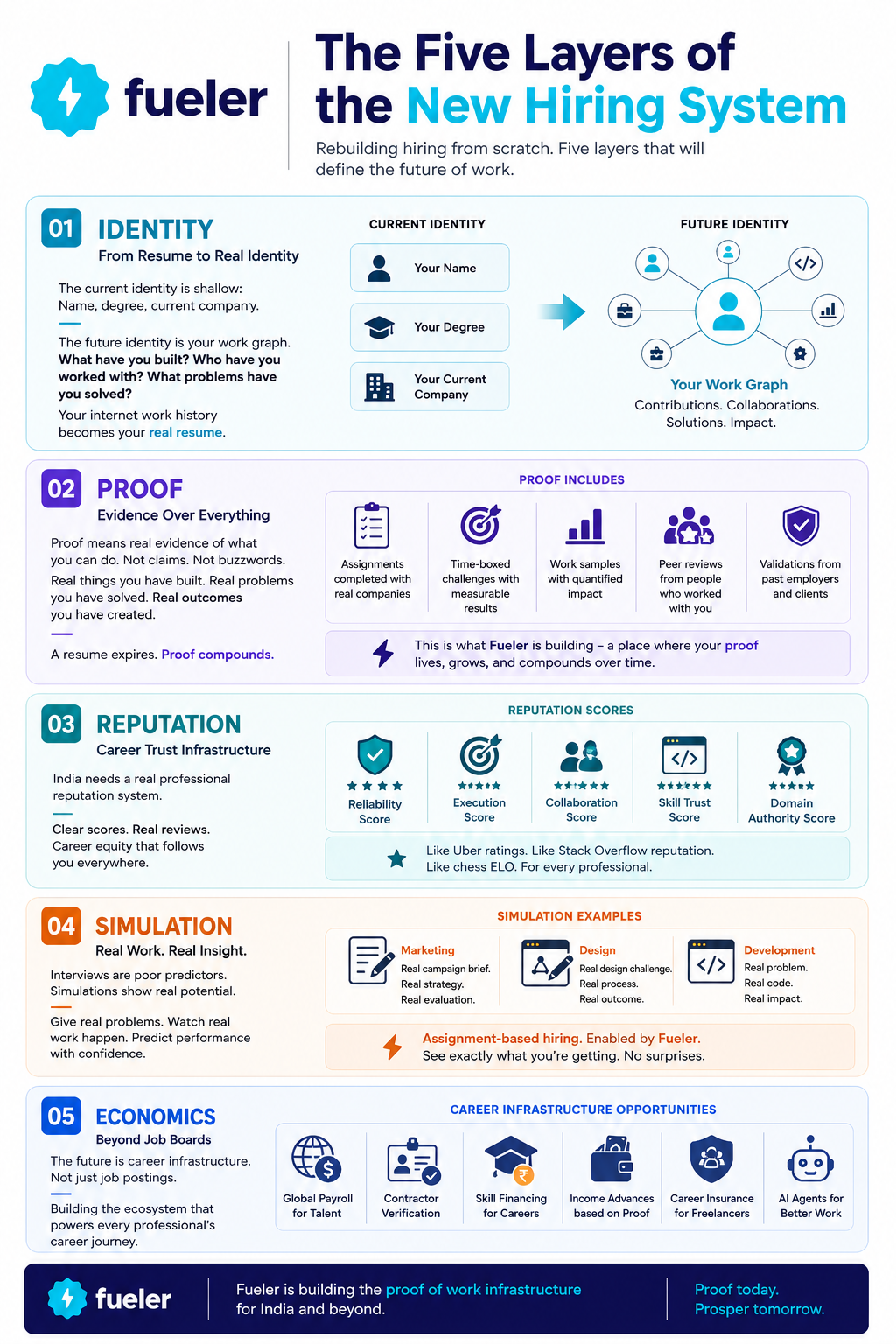
Fueler Five Layers of the New Hiring System
Layer One: Identity
The current professional identity is based on three things. Your name, your degree, and your current company.
This is shallow.
The future identity will be based on your work graph. What have you built? What have you contributed to? Who have you worked with? What problems have you solved?
Your internet work history will become your real resume.
Just like GitHub became the resume for developers, every profession will get its own proof layer. And eventually, all these layers will come together into one unified work identity.
Layer Two: Proof
This is the most important layer.
Proof means real evidence of what you can do. Not claims. Not buzzwords. Not endorsements.
Real things you have built. Real problems you have solved. Real outcomes you have created.
A candidate profile of the future will include things like:
Assignments completed with real companies. Time-boxed challenges with measurable results. Work samples with quantified impact. Peer reviews from people who actually worked with you. Validations from past employers and clients.
This is what I am building inside Fueler. A place where your proof lives, grows, and compounds over time.
A resume expires the moment you stop updating it. Proof keeps adding value.
Layer Three: Reputation
India does not have a proper professional reputation system.
Think about how you book an Uber. You check the driver's rating. You see thousands of reviews from real customers. You know what to expect.
Now think about hiring. There is nothing like this. You cannot see how someone actually performed in their last job. You cannot see what their colleagues thought. You cannot see how reliable they really are.
The future of work needs reputation infrastructure.
Imagine if every professional had clear scores. Reliability score. Execution score. Collaboration score. Skill trust score. Domain authority score.
Just like Stack Overflow has reputation points for coders. Just like chess players have ELO ratings. Just like Airbnb hosts have ratings.
This kind of system would change hiring forever. Companies could see at a glance who is reliable and who is not. Candidates could build career equity that follows them everywhere.
Layer Four: Simulation
Interviews are bad predictors of job performance. Everyone knows this. But we keep doing them because we do not have a better option.
Real work simulations are much better.
Instead of asking someone to talk about how they would solve a problem, give them a small version of the problem and watch them solve it.
Instead of asking a marketer about their strategy, give them a real campaign brief and review their plan.
Instead of asking a designer about their process, give them a real design challenge.
This is what assignment-based hiring does. And this is what Fueler enables.
When you hire through assignments, you see exactly what you are getting. There are no surprises. There are no inflated claims. There is just real work.
Layer Five: Economics
The current hiring platforms make money from job postings, recruiter access, and subscriptions. This is shallow business.
The deeper opportunity is career infrastructure.
Things like payroll for global talent. Contractor verification. Skill financing for upgrading careers. Income advances based on proof of work. Career insurance for freelancers. AI agents that help professionals get better work.
The real future of hiring platforms is not job boards. It is the entire infrastructure that supports a person's career.
This is the bigger vision behind Fueler. We are not just a portfolio platform. We are building the proof of work infrastructure for India and beyond.
Why LinkedIn Cannot Fully Solve This
A lot of people ask me, why not LinkedIn?
LinkedIn is a great product. I respect what they have built. But they were designed for a different purpose.
LinkedIn optimized for networking and identity. It became social media for professionals. It became a place to maintain contacts and update your resume.
But it was never designed for verified proof of work.
Endorsements on LinkedIn are weak. People endorse each other without ever working together. Profiles are inflated with corporate buzzwords. Recommendations sound the same. Most engagement is vanity.
You cannot really see who can do what on LinkedIn.
The next generation hiring platform must be built for verification, not just networking. It must be built for execution, not just connections. It must be built for proof, not just profile views.
This is the gap Fueler is filling.
The Indian Reality That Makes This Urgent
India has five unique problems that make proof of work hiring not just useful, but necessary.
One. Massive Talent Oversupply
We have millions of people competing for limited high-quality jobs. The supply far exceeds the demand for traditional roles.
When supply is huge, filtering becomes everything. And right now, our filtering tools are broken. We use lazy filters like college names and previous companies. This wastes huge amounts of talent.
Proof of work helps because it lets quality candidates rise to the top regardless of background.
Two. Pedigree Obsession
Indian companies are obsessed with IIT, IIM, and other top college tags. Why?
Because these are the only trust signals they have. When a company cannot evaluate skill directly, they fall back on pedigree.
If we give companies a way to see actual skill, the importance of pedigree will reduce. This will open up opportunities for millions of talented people from tier 2 and tier 3 colleges who are currently ignored.
Three. Skill Inflation
Everyone today claims to know SEO, AI, growth, product, and strategy. Look at any Indian LinkedIn profile.
But very few people can actually demonstrate these skills.
The gap between claims and capability is huge. Proof of work closes this gap. You cannot fake a portfolio of real work the way you can fake a resume.
Four. Recruiter Overload
A recruiter in India often handles 50 to 100 open positions at the same time. Each role gets hundreds of applications.
This is not a job. This is firefighting.
When you have to read 5000 resumes a week, you make mistakes. You miss good people. You hire wrong people.
Proof of work changes the math. Instead of reading resumes, recruiters can look at work samples. Instead of doing endless screening calls, they can review assignments. The signal to noise ratio improves dramatically.
Five. Education and Employment Disconnect
Most Indian colleges do not teach what companies actually need. There is a huge gap between what students learn and what jobs require.
Companies complain that fresh graduates are not job ready. Students complain that they cannot find jobs.
Proof of work bridges this gap. A student who builds real projects, contributes to open source, writes blogs, runs campaigns, or freelances on the side becomes more employable than someone with just good marks.
This is why I tell students to start building their portfolio from college. Do not wait for the perfect job. Build proof now.
The AI Shift Changes Everything
Here is something I want every founder, hiring manager, and job seeker to understand.
AI has destroyed low signal hiring forever.
Why?
Because AI can now generate perfect resumes in seconds. Cover letters can be written in seconds. Interview answers can be prepared with AI. Even fake projects can be created to look real.
When AI increases the supply of content, what becomes valuable?
Trust.
In a world where any candidate can generate a polished application, the only thing that matters is verified proof. Real work. Real outcomes. Real validations.
We are moving from a credential economy to a proof economy.
The companies that adapt will win the talent war. The companies that keep relying on resumes and degrees will hire fakes.
This is happening right now. The shift is not coming. It has already started.
What the Winning Hiring Platform of the Future Looks Like
Based on everything I have shared, here is what I believe the winning hiring platform in India will look like.
It will have proof of work profiles, not resumes.
It will have built-in assignment infrastructure, so companies can test candidates with real work.
It will have a reputation system that follows candidates across companies and industries.
It will use AI to match people based on actual work patterns, not keywords.
It will be more than a candidate marketplace. It will be an operating system for both candidates and companies.
It will let people accumulate career capital over years, building real equity in their professional identity.
This is exactly what we are building at Fueler.
We are not trying to be a better Naukri. We are not trying to be an Indian LinkedIn. Those are the wrong goals.
We are building the proof of work infrastructure for India. The trust layer for the future of hiring. The career capital network for 100 million creative professionals.
The Hard Truth About Hiring
I want to be honest with you.
Hiring will never be 100 percent solved. It is a hard problem.
Humans are emotional. Companies change direction. Teams have politics. Culture is hard to measure. Timing affects everything.
But hiring can become much better than what we have today.
It can become faster. Less biased. More merit based. More skill focused. More global. More transparent.
And India is one of the best places in the world to lead this change.
Why?
Because we have the largest young workforce in the world. We have a digital first generation that grew up online. We have a booming creator economy. We have a rising freelance market. We have a startup ecosystem that is hungry for talent. And we have legacy systems that are clearly broken.
This is the perfect setup for leapfrogging.
Just like UPI leapfrogged credit cards. Just like Jio leapfrogged desktop internet. India can leapfrog directly into proof based hiring without going through the slow evolution that other countries went through.
The company that builds the trust layer for work in India could become one of the most important internet companies in the country.
My Message to Job Seekers
If you are a candidate reading this, here is my advice.
Stop waiting for the perfect job.
Start building your proof of work today. (read all the proof of work guides by Fueler)
Write articles about your industry. Publish your projects on Fueler. Document your case studies. Build small things on the side. Contribute to open source. Help others publicly. Show your thinking through blogs and videos.
The people who win in the next decade will not be the ones with the best resumes. They will be the ones with the best proof.
Your portfolio is your career insurance. It is the one thing that follows you regardless of which company you work for. It is your real career equity.
Build it now. Start small. Be consistent. And let your work speak for you.
My Message to Companies
If you are a hiring manager or founder reading this, here is my advice.
Stop hiring based on resumes alone.
Start using assignments. Start looking at portfolios. Start checking real work samples. Start trusting proof over pedigree.
The best hire I ever made was not the candidate with the fanciest college. It was the one who showed me their work, walked me through their thinking, and demonstrated their skill in a small paid project.
Companies that adopt proof of work hiring will get better candidates faster, with lower risk, and at lower cost.
This is not theory. This is happening right now in the best startups in India.
The choice is simple. Adapt now and gain an edge. Or wait and get left behind.
The Future is Already Here
I want to end with one thought.
The future of hiring is not coming. It is already here. It is just not evenly distributed yet.
Some companies have already moved to assignment based hiring. Some candidates have already built strong portfolios. Some platforms have already started building proof of work infrastructure.
The next few years will decide who leads this shift in India.
I am committed to making sure Fueler is at the center of this change. We are building the platform that helps every creative professional in India show their work, build their reputation, and unlock better opportunities.
If you believe in this vision, join us. If you have questions, reach out. If you want to share your work, sign up.
The resume era is ending. The proof of work era is beginning.
And I am excited to build it with you.
Frequently Asked Questions
What is proof of work hiring and how does it work in India?
Proof of work hiring is a method where companies evaluate candidates based on their actual work samples, completed assignments, and verified projects instead of just resumes and degrees. In India, this is becoming popular because resumes have become unreliable and AI can generate perfect looking applications. Companies are using platforms like Fueler to ask candidates to share portfolios or complete small paid assignments before making a hiring decision. This reduces hiring risk and helps identify real talent faster.
How do I create a strong portfolio for non technical jobs in India?
Even if you are not a developer or designer, you can build a strong portfolio. Start by documenting every project you work on. Write case studies of campaigns you have run, problems you have solved, or processes you have improved. Share them on a portfolio platform like Fueler where companies in India are actively looking for proof of work. Add screenshots, numbers, results, and your role clearly. Update it every few weeks. A portfolio with 10 strong pieces of work will beat a resume any day.
Why are Indian companies moving away from traditional resumes for hiring?
Indian companies are moving away from resumes because resumes do not predict job performance well. With millions of applicants for every role, resumes all look the same and provide weak signals. AI tools can also generate convincing fake resumes in seconds. As a result, companies are turning to proof of work, assignments, and portfolios to make better hiring decisions. This trend is strongest in startups, creative agencies, and fast moving tech companies that cannot afford bad hires.
What is the best portfolio platform for creative professionals in India?
For creative professionals like writers, marketers, designers, and operators in India, Fueler is built specifically for proof of work hiring. Unlike generic platforms, Fueler is designed for showcasing real assignments and work samples in a way that companies can easily evaluate. It works for any profession, not just developers or designers, and helps you build a career identity that grows over time. The goal is to make your work do the talking instead of your resume.
How can freshers get hired in India without experience using proof of work?
Freshers can absolutely get hired through proof of work, even without formal job experience. Start by working on real projects, even unpaid ones. Volunteer for small businesses, build sample campaigns, write industry analyses, recreate real problems and document your solutions. Upload everything to a portfolio platform like Fueler. When you apply for jobs, share your portfolio link directly. Companies in India are increasingly open to hiring freshers who can demonstrate skill through proof, even if they lack traditional experience. Your work becomes your degree.
What is Fueler Portfolio?
Fueler is a career portfolio platform that helps companies find the best talent for their organization based on their proof of work. You can create your portfolio on Fueler. Thousands of freelancers around the world use Fueler to create their professional-looking portfolios and become financially independent. Discover inspiration for your portfolio
Sign up for free on Fueler or get in touch to learn more.

What should you do next?
You've read the article. Now turn your skills into proof of work and unlock more opportunities.
Build your proof of work portfolio
Create a clean portfolio with projects, assignments, resumes, and AI stack details that companies actually want to see.
Create your Fueler portfolio →Apply through assignments, not resumes
Stand out by solving real tasks from companies hiring on Fueler.
Explore assignments →Get discovered by companies
Make your work public and let recruiters discover your skills through actual projects instead of keywords.
Get discovered →
