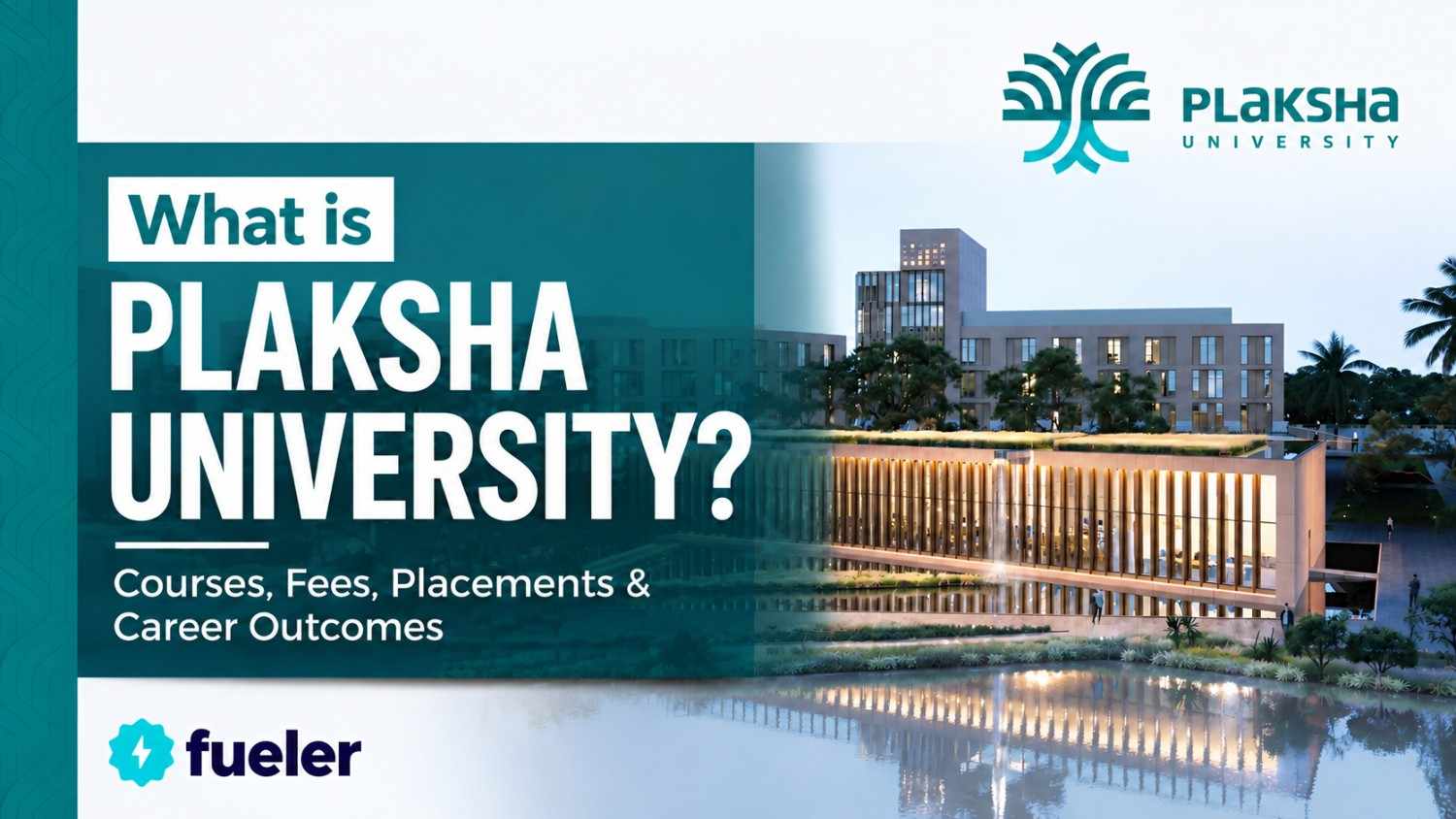
What is Plaksha University? Courses, Fees, Placements & Career Outcomes (2026 Guide)

Riten Debnath
29 Aug, 2026
Last updated: August 2026
If you have been watching the Indian higher education ecosystem over the last few years, you have probably noticed a massive gap. Traditional engineering colleges are still teaching decades-old curricula while tech companies demand modern skills in Artificial Intelligence, Data Science, and Robotics.
I’m Riten, founder of Fueler, a skills-first portfolio platform building the career infrastructure for 100 million creative professionals. Fueler connects talented individuals with companies through assignments, portfolios, and projects, not just resumes or CVs. Think of it as Dribbble/Behance for work samples combined with AngelList for hiring infrastructure.
At Fueler, we interact daily with hundreds of early professionals, founders, and engineering teams. We see firsthand how outdated traditional engineering degrees can be when a student applies for a real-world tech role. This gap is precisely why non-traditional, industry-backed institutions caught my attention. Plaksha University is one of the boldest experiments trying to fix technical education in India.

Quick Answer Summary
- Who It Is For: Students who want a hands-on, modern engineering education instead of a traditional theoretical B.Tech.
- Cost: Tuition is ₹7.8 Lakhs per year, bringing total 4-year B.Tech expenses to approximately ₹43.7 Lakhs including hostel and meal plans.
- Placements & ROI: Average salary packages reach around ₹20 LPA, with top packages touching up to ₹50 LPA to ₹65 LPA for graduating cohorts.
- Best Suited For: Tech aspirants, future founders, product thinkers, and research-focused students looking for global university exposure and industry-ready skills.
What is Plaksha University?
Plaksha University is a modern research and technology university located in Mohali, Punjab, within the Chandigarh Tricity region. It was established through collective philanthropy by over 100 business leaders, tech founders, and corporate executives.
Instead of following the old-school rote learning approach typical of traditional Indian engineering colleges, Plaksha follows an interdisciplinary curriculum modeled after global institutions like UC Berkeley, UPenn, and Purdue.
Context
Plaksha was built to rethink engineering education from the ground up. It replaces rigid academic silos with cross-disciplinary learning, project-based work, and early hands-on research.
Why It Matters
The global technology landscape is moving faster than textbook revisions. Tech companies no longer care purely about marks; they look for proof of work, real-world project experience, and problem-solving ability. Plaksha focuses on building real projects right from day one.
How It Differs From Alternatives
Traditional engineering institutes like older NITs or state colleges often prioritize theoretical exams and legacy subjects. Plaksha integrates computer science with domain disciplines like economics, biology, and robotics, ensuring students graduate ready for modern industry roles.
Key Facts Table
Detailed Explanation
To understand Plaksha University completely, we must look at how its academic branches, faculty backing, and project-based methodology work together.
1. The Undergraduate B.Tech Programs
The 4-year B.Tech at Plaksha does not treat engineering branches as isolated islands. Students undergo a foundational first year covering common mathematical, computational, and design basics before specializing in their chosen major.
Computer Science and Artificial Intelligence (CSAI)
- What it covers: Deep software engineering, machine learning algorithms, deep learning, computer vision, dynamic data structures, and computational systems.
- Why it matters: Most traditional computer science degrees spend two years on legacy programming environments. CSAI at Plaksha embeds modern AI tools and cloud engineering early.
- How it works: Students complete hands-on coding modules, open-source contributions, and algorithmic problem-solving projects.
- Examples & Real-world implications: Building real-time predictive analytics models, training transformer models, and deploying production-ready codebases.
Data Science, Economics, and Business (DSEB)
- What it covers: Microeconomics, econometric modeling, statistical machine learning, business analytics, and quantitative data structures.
- Why it matters: Tech platforms need engineers who understand financial markets, consumer incentives, and unit economics alongside data pipelines.
- How it works: Students analyze real-world dataset samples, run economic simulations, and build product strategy and models.
- Examples & Real-world implications: Preparing students for quantitative risk analyst, growth strategist, or technical product manager roles.
Robotics and Cyber-Physical Systems (RAS)
- What it covers: Embedded systems, control systems, mechatronics, sensor integration, internet of things (IoT), and autonomous hardware control.
- Why it matters: Software is moving into physical hardware, from electric vehicles to industrial automation and warehouse robotics.
- How it works: Students design physical hardware prototypes in state-of-the-art campus robotics labs.
- Examples & Real-world implications: Building self-navigating robotics prototypes, smart grid controllers, and automated drone sub-systems.
Biological Systems Engineering (BSE)
- What it covers: Synthetic biology, computational genomics, bio-data analytics, diagnostic systems, and tissue engineering fundamentals.
- Why it matters: Modern healthcare relies heavily on computational modeling and genetic data interpretation.
- How it works: Students combine wet-lab experimentation with bio-informatics algorithms.
- Examples & Real-world implications: Developing predictive healthcare diagnostic software, computational drug discovery pipelines, and biotech sensors.
2. Postgraduate Technology Leaders Program (TLP)
The Technology Leaders Program (TLP) is Plaksha’s one-year postgraduate certificate program, originally launched as the Tech Leaders Fellowship. It is designed for engineers and working professionals who want to transition into high-growth tech roles.
Curriculum Framework
- Technical Depth: Advanced Artificial Intelligence, Machine Learning, and Data Systems.
- Leadership & Strategy: Product management, design thinking, entrepreneurship, and financial management.
- Challenge Labs: Real company capstone projects where students build functional products for industry partners.
Who TLP is Built For
TLP acts as an alternative to traditional multi-year master's degrees for candidates aiming for roles like Chief of Staff, Lead Product Manager, or Technical Co-founder.
3. Collective Philanthropy and Global Advisory Board
Plaksha’s core strength is its backing by over 60 high-profile founders, venture capitalists, and corporate heads.
- Founding Trustees: Figures like CP Gurnani (AlonOS, ex-Tech Mahindra), Pankaj Chaddah (Zomato), Alok Mittal (Indifi), Srikanth Velamakanni (Fractal), and Sujeet Kumar (Udaan).
- Global Academic Alliances: Faculty advisory and collaborative design inputs from global institutions including UC Berkeley, Purdue, and UPenn.
- Plaksha Center for Entrepreneurship: Provides equity-free seed grants, mentorship from active startup founders, and workspace incubation for campus ventures.
How It Works
Getting into and succeeding at Plaksha involves a holistic, continuous execution workflow rather than standard exam cramming.
Admission Workflow
- Submit Application: Complete the online form detailing Class 10 and 12 marks, standardized scores (JEE Main, SAT, or ACT optional for B.Tech), and extra-curricular achievements.
- Showcase Portfolio: Submit personal projects, open-source code, design work, or research papers. Showing verifiable proof of work built during school gives applicants a massive edge.
- Personal Interview: Shortlisted applicants attend a structured interview evaluating logical reasoning, curiosity, communication, and technical motivation.
- Financial Aid Evaluation: Submit family income verification documents if seeking need-based tuition waivers.
- Enrolment: Receive the admission offer and complete registration formalities.
Benefits
- Built Around Proof of Work: Students graduate with functional web applications, research papers, or hardware prototypes instead of just a marksheet.
- Updated Tech Syllabi: Course content is updated regularly in consultation with tech executives.
- Direct Access to Founders: Regular guest sessions, masterclasses, and capstones mentored by active tech CEOs and investors.
- Global Mobility Options: Strong support for international semester exchanges and master’s admissions abroad.
- Interdisciplinary Skillset: Students gain programming, business strategy, and quantitative data skills within a single degree.
Challenges and Limitations
- Significant Cost Investment: Total 4-year expenses exceed ₹40 Lakhs without scholarships, which requires careful financial planning.
- Newer Alumni Base: As a young university, its alumni network is actively growing but far smaller than multi-decade institutions like old IITs.
- Relentless Workload: Constant continuous evaluations, team capstone projects, and presentations mean students cannot rely on last-minute exam study.
Comparison Table
Fees and Cost
Plaksha University follows a clear tuition fee structure while providing large financial assistance pools.
Detailed Fee Breakdown (4-Year B.Tech)
- Annual Tuition Fee: ₹7.80 Lakhs per year (Total tuition around ₹33.6 Lakhs across 4 years).
- Hostel and Residence Charges: Approximately ₹9.08 Lakhs total for 4 years (covers air-conditioned room accommodation, internet, and utilities).
- One-Time Payments: Security deposit and admission fees totaling around ₹1.05 Lakhs.
- Estimated Total Expenses: Approximately ₹43.7 Lakhs over 4 years without financial aid.
Financial Aid and Scholarships
Plaksha maintains a need-blind admission philosophy to ensure financial constraints do not stop top talent.
- Socio-Economic Need Aid: Families with gross annual income under ₹50 Lakhs can qualify for partial to full tuition assistance.
- Full Scholarships: Over 70% of students receive scholarship support ranging from 25% to 100% of tuition costs.
- Partner Scholarships: Named grants like the Bharti Scholarship, Axis Bank Scholarship, and Ayyalasomayajula Lalitha Scholarship offer dedicated financial aid to exceptional candidates.
Career Opportunities
Graduates from Plaksha University enter high-growth technology companies, venture capital firms, product startups, and quantitative research roles.
Roles and Hiring Areas
- AI/ML Engineer: Developing, training, and deploying neural network architectures and intelligent software systems.
- Product Manager: Leading cross-functional teams to define, build, and ship digital products.
- Data Scientist & Business Analyst: Analyzing large-scale enterprise data to drive business decisions.
- Robotics / Hardware Engineer: Building autonomous hardware platforms and internet of things (IoT) devices.
- Founder’s Office / Chief of Staff: Working directly alongside startup founders on business operations, growth strategy, and product execution.
Salary Metrics & Placement Outcomes
- Average Salary Package: ~₹20 LPA.
- Median Salary Package: ~₹17 LPA.
- Highest Salary Packages: Ranging between ₹50 LPA to ₹65 LPA for top-performing candidates.
- Top Recruiter Profiles: Fast-growing tech firms (like CRED, Meesho, Urban Company), consulting firms, global technology companies, and venture-backed startups.
Who Should Choose This?
- Students who thrive on building practical tech projects rather than memorizing textbooks.
- Candidates targeting interdisciplinary careers in AI, Data Science, and Robotics.
- Aspiring startup founders who want ecosystem mentorship and seed incubation during college.
- Early professionals looking for a fast-track alternative to standard master’s programs via the TLP track.
Who Should Avoid This?
- Students who prefer low-cost theoretical engineering degrees with light continuous project work.
- Candidates who want traditional, exam-only evaluation systems.
- Applicants who only value legacy 50-year-old alumni networks over modern industry relevance.
Final Thoughts
The tech industry has shifted completely away from pure degree credentials toward practical execution. Hiring managers no longer care about the name of your college degree if you cannot demonstrate real problem-solving capabilities.
At Fueler, we see every single day how candidates with verifiable proof of work stand out instantly in hiring pipelines. Plaksha University aligns directly with this reality by forcing students to build, ship, and defend real-world projects throughout their degree. If you are willing to work hard in a fast-paced environment, Plaksha offers one of the most practical higher education models in India.
Key Takeaways
- Plaksha University is a philanthropy-backed tech institution located in Mohali, Punjab.
- Offers B.Tech programs in CSAI, Data Science & Economics, Robotics, and Biological Systems Engineering.
- Academic programs are developed alongside top global universities like UC Berkeley, UPenn, and Purdue.
- The flagship Technology Leaders Program (TLP) serves as a modern 1-year postgraduate tech and leadership track.
- Need-based financial aid covers 25% to 100% of tuition fees for eligible candidates.
- Average placement packages stand around ₹20 LPA, with top packages touching up to ₹50 LPA – ₹65 LPA.

FAQs
What programs does Plaksha University offer?
Plaksha offers 4-year B.Tech degrees in Computer Science & AI, Data Science & Economics, Robotics, and Biological Systems Engineering, plus a 1-year postgraduate Technology Leaders Program.
What is the fee for B.Tech at Plaksha University?
Annual tuition is ₹7.8 Lakhs. Total 4-year costs, including tuition, hostel accommodation, and meal plans, come to approximately ₹43.7 Lakhs before financial aid.
What are the average salary packages at Plaksha?
The average salary package at Plaksha is around ₹20 LPA, with median salaries near ₹17 LPA and top offers reaching ₹50 LPA to ₹65 LPA.
Does Plaksha University offer financial aid?
Yes, Plaksha offers need-based financial aid covering 25% to 100% of tuition fees for eligible families based on income and academic performance.
How are applicants selected at Plaksha University?
Admissions uses a holistic review process evaluating academic scores, essays, standardized tests, practical proof of work portfolios, and personal interview performance.
What should you do next?
You've read the article. Now turn your skills into proof of work and unlock more opportunities.
Build your proof of work portfolio
Create a clean portfolio with projects, assignments, resumes, and AI stack details that companies actually want to see.
Create your Fueler portfolio →Apply through assignments, not resumes
Stand out by solving real tasks from companies hiring on Fueler.
Explore assignments →Get discovered by companies
Make your work public and let recruiters discover your skills through actual projects instead of keywords.
Get discovered →
