What Are AI Agents? A Complete Guide to Autonomous AI Systems

Riten Debnath
30 Mar, 2026
Last updated: March 2026
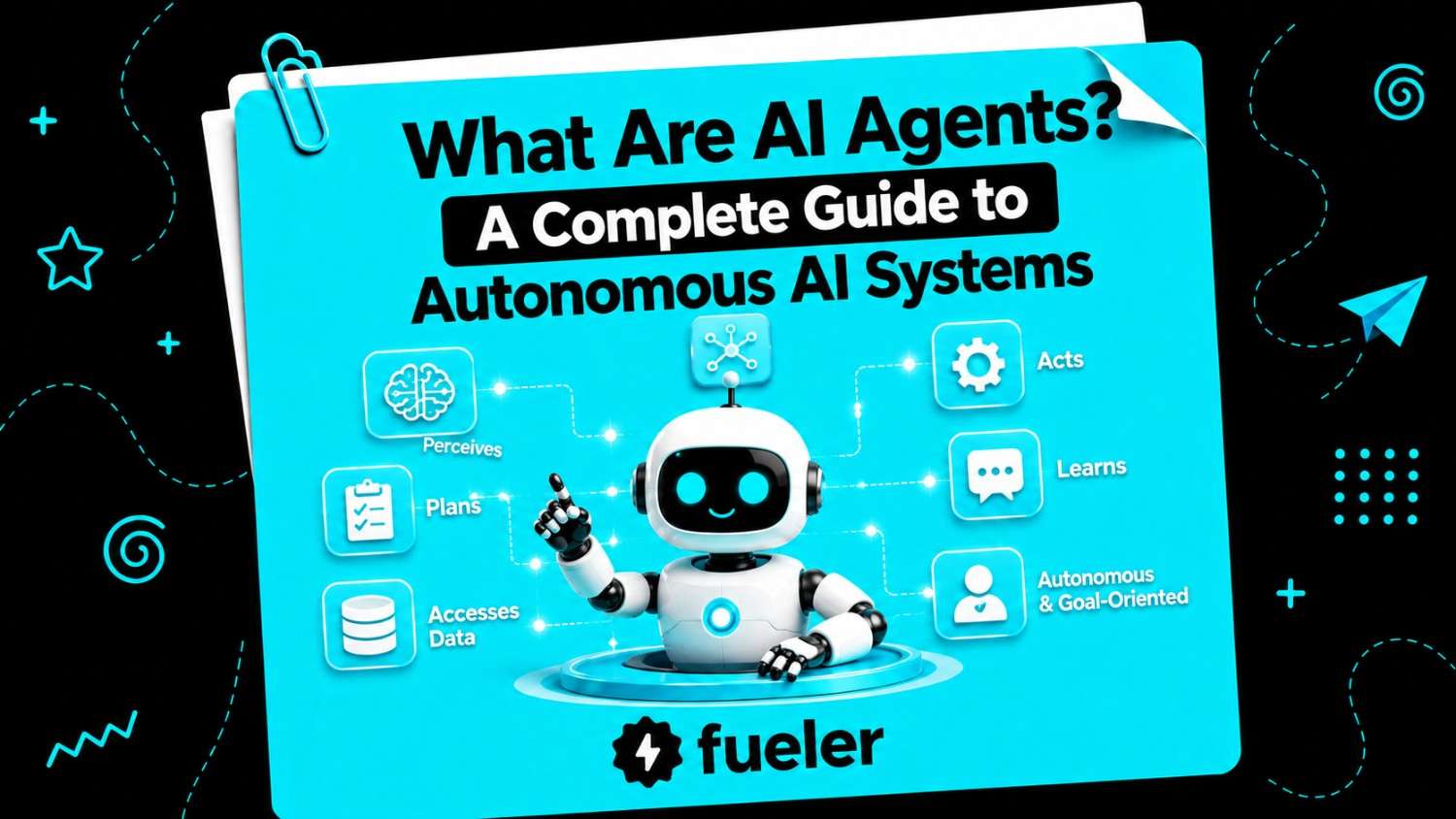
The world is moving past the era of simple chatbots that just answer questions. We are now entering the age of AI agents, software systems that do not just talk but actually do work. If a standard AI is like a digital encyclopedia, an AI agent is like a digital employee. These systems can look at a goal, break it down into smaller steps, and execute those steps without a human needing to prompt them at every turn. It is a shift from "AI as a tool" to "AI as a collaborator."
I’m Riten, founder of Fueler, a skills-first portfolio platform that connects talented individuals with companies through assignments, portfolios, and projects, not just resumes/CVs. Think Dribbble/Behance for work samples + AngelList for hiring infrastructure.
1. Defining the Core Architecture of Autonomous Agents
An AI agent is a sophisticated system designed to achieve specific goals by interacting with its digital or physical environment. Unlike standard AI models that simply process a single prompt and provide a single answer, these agents are built to be proactive and self-governing. They function using a "loop" of reasoning, observation, and action. This means the agent can browse the web, edit files, or even communicate with other software programs to complete a project from start to finish without you having to guide every single click.
- Self-directed goal setting that allows the agent to create its own internal roadmap based on a high-level command from the user.
- Tool-use capabilities that enable the agent to interact with external software such as web browsers, calculators, or code compilers to get real-world data.
- A continuous feedback loop where the agent reviews its own work, checks for errors, and makes corrections before presenting the final result.
- Sensory perception through data inputs that help the agent understand the state of its current task and the environment it is operating in.
- API integration that allows the agent to perform physical or digital actions like booking a flight, sending a professional invoice, or updating a database.
Why it matters to What Are AI Agents? A Complete Guide to Autonomous AI Systems
This architecture is the fundamental reason why agents are considered "autonomous." By removing the need for constant human supervision, these systems become capable of handling unpredictable variables in real-time. For anyone looking to master this technology, recognizing that the agent is a self-correcting machine rather than just a text generator is the most critical first step in understanding the future of automation.
2. The Role of Perception and Environment Sensing
For an AI agent to be truly effective, it must be able to understand the context of the world it is working in. This process is known as perception. Agents do not just "read" text; they perceive data from a variety of sources, including live websites, internal company databases, or visual sensors in the case of physical robotics. This constant stream of information allows the agent to make decisions based on what is happening right now, rather than relying on static training data that might be months or years old.
- Real-time web scraping to gather the most current information, prices, or news from across the internet to ensure accuracy.
- Multi-modal input processing, which allows the agent to understand not just text, but also images, audio files, and complex spreadsheets.
- Contextual awareness that helps the agent identify the specific rules, tone, and constraints of a task without being reminded.
- Environmental monitoring to detect if a website has changed or if a specific data point has shifted, requiring a change in strategy.
- Advanced data filtering that helps the agent separate important signals from useless background noise to avoid getting distracted.
Why it matters to What Are AI Agents? A Complete Guide to Autonomous AI Systems
Without perception, an agent is essentially operating in a vacuum. By sensing the environment, the agent can react to obstacles and update its plan dynamically. This makes autonomous AI systems much more reliable for high-stakes professional tasks like financial market monitoring or supply chain management, where conditions are known to change every few minutes.
3. Advanced Planning and Task Decomposition
One of the most impressive features of a modern AI agent is its ability to take a massive, vague request and turn it into a structured checklist. This process is called task decomposition. If you ask a standard AI to "Research and write a market report," it might give you a summary. An agent, however, knows it must first find sources, then verify the facts, then create a logical outline, and finally write the draft. It breaks the big problem into small, manageable pieces that it can be solved one by one.
- Hierarchical planning that organizes tasks from most important to least important to ensure the core objective is always the priority.
- Sub-goal generation which automatically creates the minor steps needed to reach the major goal without the user having to list them.
- Dynamic re-planning capabilities that allow the agent to pivot if one of the sub-tasks fails or hits a technical roadblock.
- Logic-based sequencing to ensure that steps are performed in the correct order, such as researching before writing.
- Computational resource allocation to manage how much time and processing power is spent on each specific part of the project.
Why it matters to What Are AI Agents? A Complete Guide to Autonomous AI Systems
Planning is what truly separates an agent from a standard Large Language Model (LLM). While a simple model might give you a single answer, an agent executes an entire multi-step workflow. For a complete guide to autonomous AI, understanding how these systems "think" through a problem is essential for trusting them with complex professional responsibilities and high-level project management.
4. The Importance of Short-Term and Long-Term Memory
Memory is what allows an AI agent to learn from its experiences while it is working on a task. Short-term memory usually involves the immediate context of a conversation or a specific project file. Long-term memory, often powered by vector databases, allows the agent to store and retrieve information over weeks or months. This means if you tell an agent your preference for a specific writing style today, it can remember and apply that style to a completely different project it works on next month.
- Vector database integration that allows the agent to search through massive amounts of past documents and interactions in milliseconds.
- Context window management, which ensures the agent keeps the most relevant information "top of mind" during a complex session.
- Experience-based learning where the agent remembers which strategies worked well in the past and avoids repeating previous mistakes.
- User-specific profiles that store individual preferences, recurring requirements, and specific brand guidelines for consistent output.
- External knowledge retrieval that pulls facts from PDFs, emails, or cloud storage to supplement the agent's internal reasoning.
Why it matters to What Are AI Agents? A Complete Guide to Autonomous AI Systems
Memory transforms an AI from a "stranger" into a "long-term partner." It allows for a level of personalization and efficiency that static tools cannot match. In the context of autonomous systems, memory ensures that the agent's intelligence grows over time, making it more effective at handling your specific business needs the longer you use it.
5. Decision-Making and Reasoning Frameworks
At the heart of every AI agent is a reasoning engine that helps it decide what to do next. Agents use frameworks like "Chain of Thought" or "Reason and Act" (ReAct) to talk themselves through a problem. Instead of jumping to a conclusion, the agent writes out its logic: "I need to find the price of X, so I will search Google. I found three prices, so I will calculate the average." This transparency allows the system to handle logic puzzles and complex decision-making with much higher accuracy than a standard bot.
- Chain of Thought reasoning, which forces the agent to show its step-by-step logic before providing a final answer.
- Self-reflection cycles where the agent reviews its own proposed plan to look for logical flaws or potential security risks.
- Probabilistic decision making that helps the agent choose the path with the highest chance of success based on available data.
- Constraint satisfaction to ensure the agent's decisions stay within the boundaries set by the human user, such as a specific budget.
- Conflict resolution for when the agent receives two pieces of contradictory information and must determine which source is more credible.
Why it matters to What Are AI Agents? A Complete Guide to Autonomous AI Systems
Reasoning is the "brain" of the agent. By using these structured frameworks, the agent avoids the "hallucinations" or made-up facts that often plague simpler AI tools. For professionals, this means you can trust the agent to make logical choices that align with your business goals, providing a layer of reliability that is necessary for true autonomous work.
6. Communication and Collaboration Between Agents
We are moving toward a future where agents do not just work for humans, but also work with each other. This is known as a Multi-Agent System (MAS). In this setup, you might have one agent that is an expert at research and another who is an expert at graphic design. They can communicate, share files, and give each other feedback to complete a massive project. This mirrors how a real human department works, with different specialists collaborating to reach a common goal.
- Inter-agent communication protocols that allow different AI systems to exchange data and instructions seamlessly.
- Role-based assignment where specific agents are given titles like "Editor," "Researcher," or "Coder" to maximize their expertise.
- Collaborative problem solving, where multiple agents brainstorm different solutions to the same problem to find the best path forward.
- Task hand-offs allow one agent to finish a portion of the work and pass the results to the next agent in the sequence.
- Conflict management to handle disagreements between agents on how a particular task should be executed.
Why it matters to What Are AI Agents? A Complete Guide to Autonomous AI Systems
The ability for agents to collaborate exponentially increases the scale of what AI can accomplish. Instead of managing one tool, you are essentially managing a digital workforce. Understanding this collaborative nature is a key part of any guide to autonomous AI, as it represents the next major leap in productivity and organizational efficiency.
7. Tool Use and External API Integration
An AI agent is only as powerful as the tools it can access. To be useful in the real world, an agent must be able to step outside its own code and interact with the internet and other software. This is done through "tool use" or "function calling." For example, an agent might have access to a weather API to check the forecast, a Python interpreter to run complex math, or a Slack integration to send updates to a team. This turns the AI from a writer into a "doer."
- Function calling capabilities that allow the agent to translate a natural language request into a specific piece of computer code.
- Secure API authentication so the agent can log into authorized accounts and perform actions on behalf of the user.
- Sandbox environments where the agent can test code or tools safely without risking the security of the main system.
- Dynamic tool selection, where the agent decides which tool is best for the job, such as choosing a calculator over a search engine for math.
- Real-world execution, which includes actions like sending emails, updating calendar invites, or purchasing software subscriptions.
Why it matters to What Are AI Agents? A Complete Guide to Autonomous AI Systems
Tool use is the bridge between digital thought and physical action. Without these integrations, an agent is just a very smart advisor. With them, it becomes a functional part of your workflow. This guide emphasizes tool use because it is the specific feature that allows autonomous systems to actually complete professional assignments and save human users hours of manual labor.
8. Safety, Ethics, and Human-in-the-Loop Systems
As AI agents become more autonomous, the question of safety becomes more important. We need to ensure that agents do not make mistakes that could cost money or damage a reputation. This is why many professional agents use a "Human-in-the-Loop" (HITL) system. This means that for very important steps, like spending money or publishing a public post, the agent must stop and ask for human approval before proceeding.
- Guardrails and boundary setting that prevent the agent from accessing restricted data or performing unauthorized actions.
- Approval checkpoints where a human must review the agent's plan before the most critical steps are executed.
- Audit logs that keep a detailed record of every action the agent took and why it made those specific decisions.
- Ethical alignment to ensure the agent’s actions follow company values and legal regulations regarding data privacy.
- Emergency stop commands allow a user to immediately shut down an agent's process if it begins to behave unexpectedly.
Why it matters to What Are AI Agents? A Complete Guide to Autonomous AI Systems
Safety is the most common concern for businesses adopting autonomous AI. By implementing human-in-the-loop systems, we can enjoy the speed of AI while maintaining the judgment of a human. This balance is a cornerstone of responsible AI guidebooks, ensuring that as systems become more powerful, they also become more trustworthy and reliable for long-term use.
9. Real-World Applications of Autonomous AI Agents
To truly understand AI agents, it helps to see them in action across different industries. These aren't just theoretical concepts; they are already being used to solve real problems. In customer service, agents can handle complex troubleshooting without human help. In software development, they can write, test, and debug entire features. In marketing, they can track trends, create content, and manage social media schedules entirely on their own.
- Automated Research Agents that can scan thousands of academic papers or market reports to find specific data points in seconds.
- AI Software Engineers capable of writing code, running tests, and fixing bugs across large and complex codebases.
- Personal Executive Assistants that manage your entire schedule, book your travel, and organize your inbox without being asked.
- Supply Chain Optimizers that predict delays and automatically re-route shipments to save time and reduce shipping costs.
- Sales Prospecting Agents that identify potential leads, research their backgrounds, and draft personalized outreach messages.
Why it matters to What Are AI Agents? A Complete Guide to Autonomous AI Systems
Seeing these use cases makes the technology feel real and attainable. It moves the conversation from "what is possible" to "how can I apply this today." For anyone following this complete guide, these applications represent the tangible benefits of moving toward autonomous systems, showing that the ROI of AI agents is found in the time they give back to human workers.
10. The Future of Work with Autonomous AI
The rise of AI agents will fundamentally change how we think about our careers and our skills. We will move away from being "doers" of repetitive tasks and toward being "orchestrators" of AI systems. Instead of writing the code, we will manage the agent that writes the code. This makes "Proof of Work" and having a strong portfolio more important than ever, because showing that you know how to manage these advanced systems is what will get you hired in the future.
- Shift from manual labor to strategic oversight, where humans focus on high-level creativity and complex decision-making.
- The rise of "Agentic Workflows" in every department, from human resources to engineering and creative design.
- New career paths in AI orchestration, agent training, and autonomous system auditing that did not exist five years ago.
- Increased productivity that allows small teams to accomplish what used to require entire departments.
- The importance of a digital portfolio is to showcase the projects you have successfully managed or built using these tools.
Why it matters to What Are AI Agents? A Complete Guide to Autonomous AI Systems
The future is not about AI replacing humans; it is about humans with AI replacing humans without AI. This guide concludes by looking forward because the transition to autonomous systems is inevitable. Understanding how to work alongside these agents is the most valuable skill you can develop in the next decade to remain competitive in the global job market.
How Fueler Helps You Showcase Your AI Skills
As these autonomous systems become a standard part of every industry, the way you prove your value to employers must change. It is no longer enough to just list "AI" as a skill on a resume. You need to show the actual projects you have built, the agents you have managed, and the results you have achieved.
This is where Fueler comes in. We provide a dedicated space for you to build a professional portfolio that focuses on your actual work samples. Whether you are building your own AI agents, managing complex automated workflows, or creating high-level marketing strategies, Fueler allows you to document those assignments and projects in a way that catches the eye of top companies. It is the best way to move beyond a static CV and show the world what you are actually capable of doing with modern technology.
Final Thoughts
AI agents represent the most significant jump in technology since the invention of the internet. We are moving from a world where we have to tell computers exactly what to do to a world where we can simply tell them what we want to achieve. This guide has shown that through planning, memory, and tool use, these systems are becoming more than just tools; they are becoming our partners. The best way to prepare for this future is to start experimenting with these systems today and documenting your journey through a professional portfolio.
FAQs
What is the difference between a chatbot and an AI agent?
A chatbot is designed primarily to have a conversation and answer questions based on a prompt. An AI agent is designed to take action and complete a specific goal. While a chatbot might tell you how to book a flight, an AI agent will actually go to the website, find the best price, and book the flight for you.
Are AI agents safe to use for business tasks?
Yes, as long as they are implemented with proper guardrails. Most professional AI agents include "Human-in-the-Loop" features, meaning they require human approval before performing high-risk actions like spending money or sending public emails. This ensures that the human always has the final say.
Do I need to know how to code to use an AI agent?
Not necessarily. Many modern AI agent platforms allow you to build and manage agents using "Natural Language," which means you can give them instructions in plain English. However, having a basic understanding of how data and APIs work can help you create more advanced and effective agents.
Can AI agents work together on a single project?
Absolutely. This is called a Multi-Agent System. In this setup, different agents are given specific roles, such as a "Writer" and an "Editor." They can communicate with each other, share files, and provide feedback to complete a large project much faster than a single agent working alone.
How will AI agents affect the job market in 2026?
AI agents will likely automate many repetitive and administrative tasks, but they will also create a huge demand for people who know how to manage and "orchestrate" these systems. The focus will shift from doing the work manually to supervising the AI that does the work, making specialized technical and creative skills even more valuable.
What is Fueler Portfolio?
Fueler is a career portfolio platform that helps companies find the best talent for their organization based on their proof of work. You can create your portfolio on Fueler. Thousands of freelancers around the world use Fueler to create their professional-looking portfolios and become financially independent. Discover inspiration for your portfolio
Sign up for free on Fueler or get in touch to learn more.

What should you do next?
You've read the article. Now turn your skills into proof of work and unlock more opportunities.
Build your proof of work portfolio
Create a clean portfolio with projects, assignments, resumes, and AI stack details that companies actually want to see.
Create your Fueler portfolio →Apply through assignments, not resumes
Stand out by solving real tasks from companies hiring on Fueler.
Explore assignments →Get discovered by companies
Make your work public and let recruiters discover your skills through actual projects instead of keywords.
Get discovered →
