Video Editor Salary in India 2026: From ₹2L to ₹50L (Full Breakdown by Skill, City, and Niche

Riten Debnath
06 Apr, 2026
I talk to video editors every single day.
Some of them are making ₹2L a year and feeling stuck. Some of them are quietly making ₹20L, ₹30L, even more. The difference between them is rarely talent. It is almost never about which software they use.
The real difference is this: how well they can prove their skills to the right people.
I started Fueler because I saw this problem firsthand. Talented editors were losing opportunities to less-skilled people who just had a better-looking portfolio or knew the right words to say in an interview. That felt wrong to me. Skills should speak louder than resumes.
This article is the most honest breakdown of video editor salary in India for 2026 that I can give you. No made-up numbers. No sugarcoating. Just real data, real patterns, and a clear path forward for wherever you are today.
To download this playbook, click here
The Hard Truth About Video Editor Salaries in India
Let's start with reality.
According to current data, the average monthly salary for a video editor in India sits around ₹18,000 to ₹22,000 per month for salaried roles. That is roughly ₹2L to ₹2.5L per year. For many editors, especially beginners in smaller cities, this is what the market pays in a basic job.
But here is what the "average" hides: the range is enormous.
At the top end, specialist editors, colorists, and motion graphics experts at premium studios are earning ₹1L to ₹3L per month. Freelancers who have cracked the international client market can hit ₹50L per year or more. And even mid-level Indian editors who have positioned themselves well are clearing ₹6L to ₹10L per year.
So the question is not really "what do video editors earn in India." The real question is: which kind of video editor do you want to become?
Salary Breakdown by Experience Level
Here is a clear picture of what editors earn at different stages of their career in 2026.
Beginners (0 to 2 years of experience)
Freshers and beginners in India typically earn between ₹15,000 and ₹35,000 per month in full-time roles. That works out to roughly ₹1.8L to ₹4.2L per year.
At this stage, most editors are working for small agencies, YouTube channels, or local production houses. The focus is on learning software, understanding workflows, and building the first few projects.
The mistake most beginners make here is staying invisible. They finish a job, move on, and never document their work. That single habit keeps them stuck at this salary bracket much longer than necessary.
Freelancers at this stage often charge ₹1,000 to ₹5,000 per project, mostly for reels, short clips, or simple YouTube videos. Income is irregular and low.
Mid-Level Editors (2 to 5 years of experience)
This is where the range starts to get interesting.
Mid-level editors in salaried roles earn between ₹30,000 and ₹80,000 per month, depending on the company, city, and their skill stack. That is ₹3.6L to ₹9.6L per year.
Freelancers at this level can earn significantly more, especially if they have a niche and a solid portfolio. A mid-level editor working with 3 to 4 retainer clients can cross ₹1L per month without working insane hours.
The key differentiator at this stage is specialization. An editor who says "I do everything" earns far less than an editor who says "I specialize in performance ad editing for DTC brands."
Senior Editors (5+ years of experience)
Senior editors with strong skills in areas like motion graphics, color grading, or VFX composition can earn ₹60,000 to ₹1.5L per month in salaried roles. That puts them in the ₹7L to ₹18L per year range.
Top-tier freelancers and consultants at this level can go much higher. Working with international clients, managing a small team, or transitioning into a creative director role can push earnings well past ₹20L to ₹30L per year.
Salary by City: Does Location Still Matter?
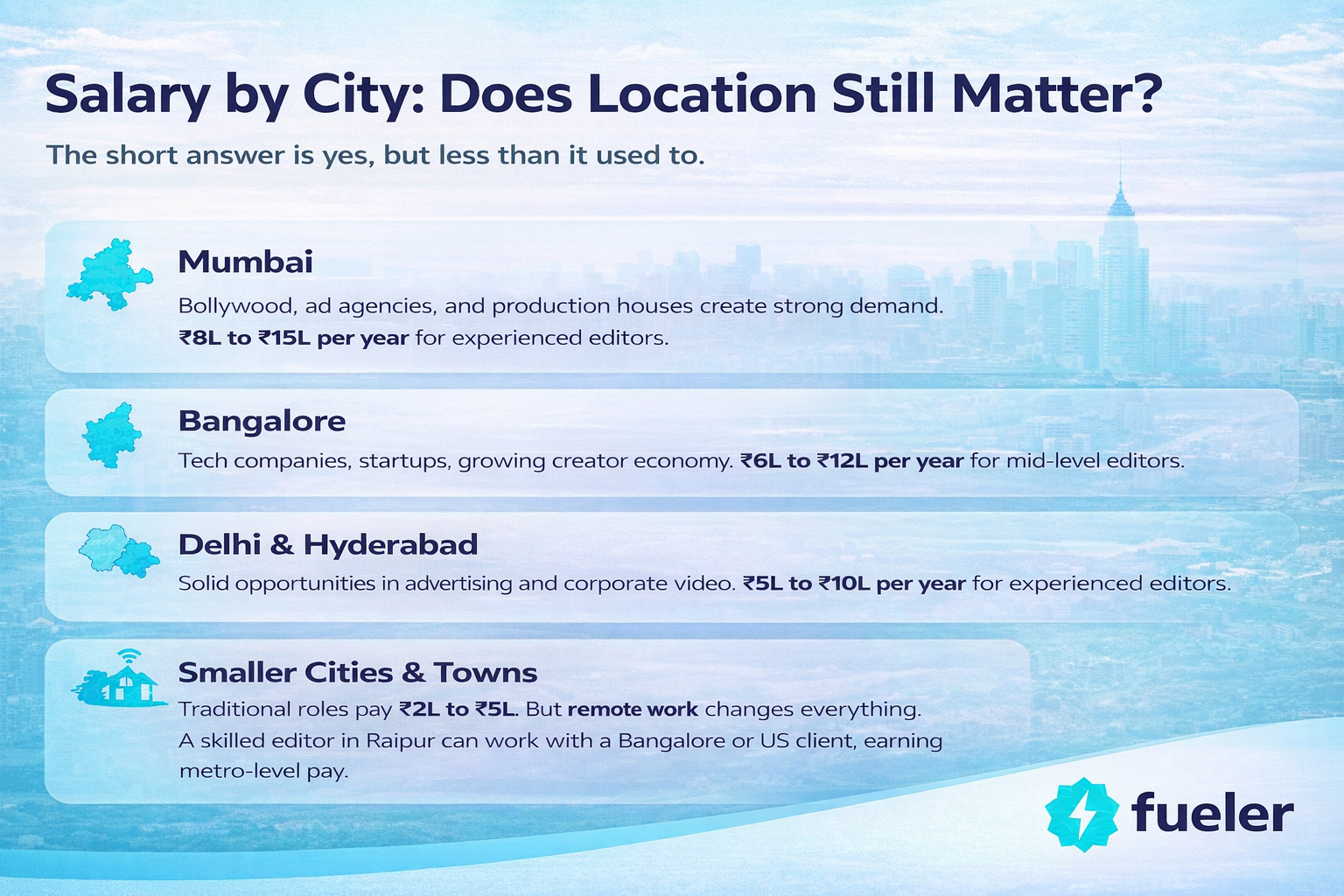
The short answer is yes, but less than it used to.
Mumbai remains the highest-paying city for video editors in India. The Bollywood industry, advertising agencies, and production houses create strong demand. Average salaries here range from ₹8L to ₹15L per year for experienced editors.
Bangalore is close behind, driven by tech companies, startups, and a growing creator economy. Mid-level editors here can expect ₹6L to ₹12L per year.
Delhi and Hyderabad offer solid opportunities, especially in advertising and corporate video production. Salaries typically range from ₹5L to ₹10L for experienced editors.
Smaller cities and towns tend to pay less in traditional salaried roles, often ₹2L to ₹5L. But here is the thing: remote work has changed this completely. A skilled editor in Raipur or Coimbatore can work with a client in Bangalore or even the US, earning the same as someone sitting in a metro. Your postal code does not have to limit your income anymore.
Salary by Niche: This Is Where the Real Money Hides
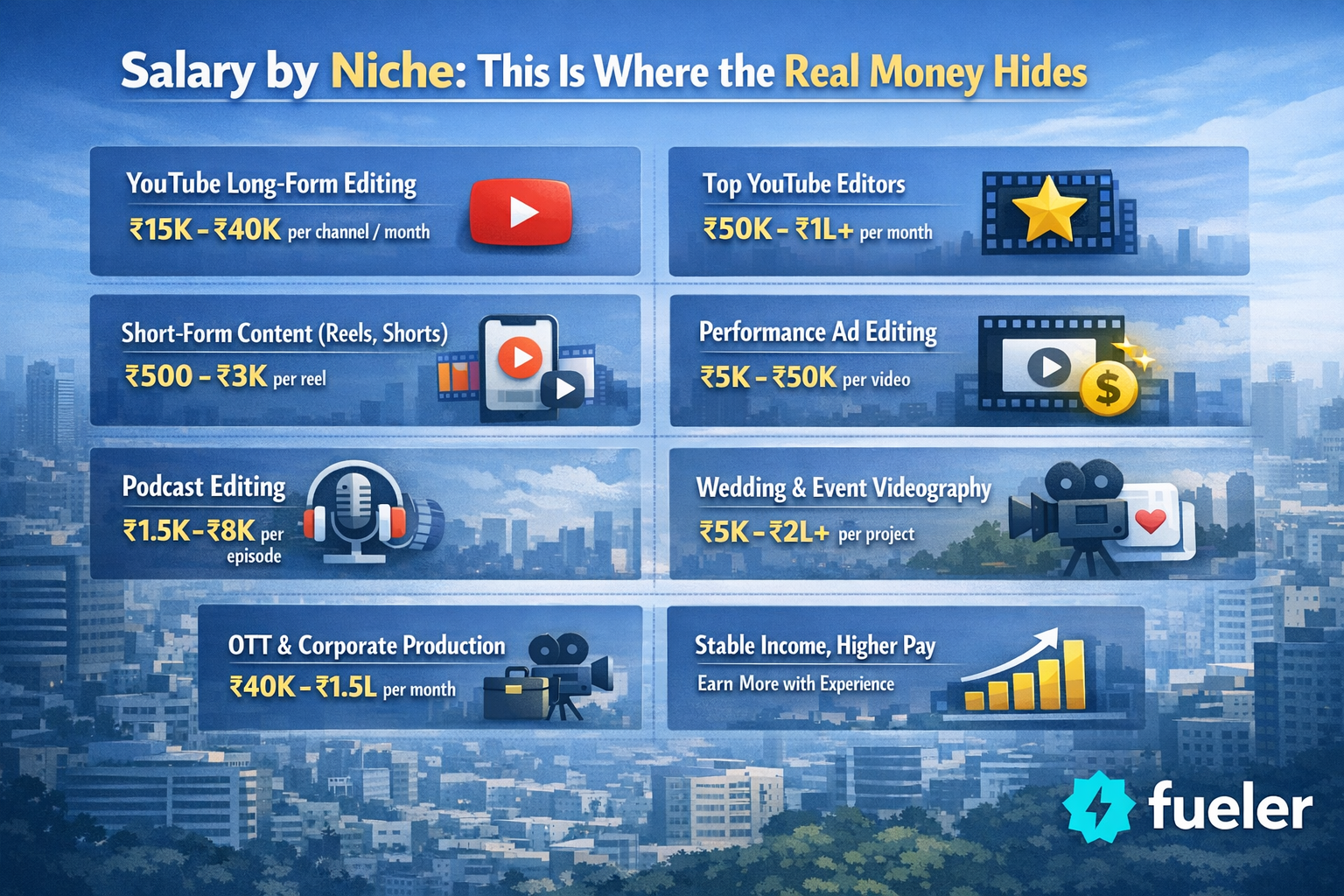
Not all video editing work pays the same. This is something most beginner guides skip over, but it is one of the most important factors in your earning potential.
YouTube Long-Form Editing
This is one of the most accessible niches to break into. Editors working with mid-size YouTube creators earn ₹15,000 to ₹40,000 per channel per month for a retainer. Work with 3 to 4 channels and you are already in solid territory.
The ceiling is higher than most people think. Top YouTube editors who work with large creator channels earn ₹50,000 to ₹1L per month per client.
Short-Form Content (Reels, Shorts, Clips)
This niche has exploded. Brands and creators need a constant supply of short-form content, and skilled editors who can cut engaging, high-retention reels are in serious demand.
Rates range from ₹500 to ₹3,000 per reel depending on complexity. If you build a system to produce 30 to 40 reels per month for multiple clients, the income adds up fast.
Performance Ad Editing
This is arguably the highest-paying niche for Indian editors right now. Companies running Facebook and Instagram ads need editors who understand hooks, pacing, and what makes someone stop scrolling.
Project rates here range from ₹5,000 to ₹50,000 per video. Editors who can prove their ads actually convert get paid far more. This is also one of the best niches for working with international clients, where the rates are even higher.
Podcast Editing
Podcast editing is lower-paying but extremely consistent. Editors charge ₹1,500 to ₹8,000 per episode depending on the length and complexity. The value is in retainers. Sign up 5 to 6 podcasters and you have predictable monthly income without heavy client acquisition.
Wedding and Event Videography
This niche has a wide range. Basic wedding video editing pays ₹5,000 to ₹15,000 per project. Premium cinematic wedding films can command ₹50,000 to ₹2L or more, especially in metro cities.
The limitation is seasonality. Wedding work is not consistent throughout the year.
OTT and Corporate Production
Working with OTT platforms, large corporates, or advertising agencies is where stable, high salaries live. Editors here are typically full-time and earn ₹40,000 to ₹1.5L per month based on experience. The entry bar is higher, but the pay is consistent.
The Freelance vs Full-Time Debate
Here is my honest take: freelancing has a higher ceiling, but a bumpier road early on.
A salaried editor at a good company in Bangalore might earn ₹50,000 to ₹70,000 per month after 3 to 4 years. A freelancer with the same experience and a strong portfolio can earn ₹1L to ₹2L per month, but they also have to manage client acquisition, invoicing, dry months, and inconsistent workloads.
The editors who do best long-term often do both: they keep one or two anchor retainer clients for stability, then take project work on top.
The single biggest accelerator in freelancing is not skill. It is the ability to show your work clearly. This is exactly why I built Fueler.
Why Most Editors Stay Stuck at ₹5L (And How to Break Out)
I want to be direct about this because I see it constantly.
Most editors plateau at ₹3L to ₹5L per year not because they lack skill, but because they lack visibility and positioning.
Here is what keeps editors stuck:
Weak portfolios. A Google Drive folder with random video files is not a portfolio. It does not show context, intent, or results. Clients cannot tell what problems you solved or what your creative thinking looks like.
No niche. Editors who do "everything" get paid the rate for "anything." Editors who specialize get paid a premium.
No outbound strategy. Most editors wait to be discovered. The ones making serious money are actively reaching out to clients, creators, and brands with targeted pitches.
Working only for Indian clients. Rates in India, while growing, are still significantly lower than international rates. A US-based brand will pay $200 to $500 for the same work that an Indian brand pays ₹3,000 to ₹8,000 for.
The Portfolio Problem and How Fueler Solves It
I want to talk about this specifically because it is the single biggest lever for increasing your income as a video editor.
Most editors build portfolios that show what they did. The best portfolios show how they think. There is a huge difference.
At Fueler, we have built a platform specifically designed for creative professionals to showcase proof-of-work. Not just a showreel link. Not just a resume. A full portfolio of real work samples, case studies, and assignments that prove you can do the job.
When you apply for a project or a job through Fueler, you are not competing on your resume or on years of experience. You are competing on actual demonstrated skills. The editing work speaks for itself.
This is why we call it proof-of-work hiring. Companies post assignments. You submit your work. The best work wins, regardless of which college you attended or which city you are from.
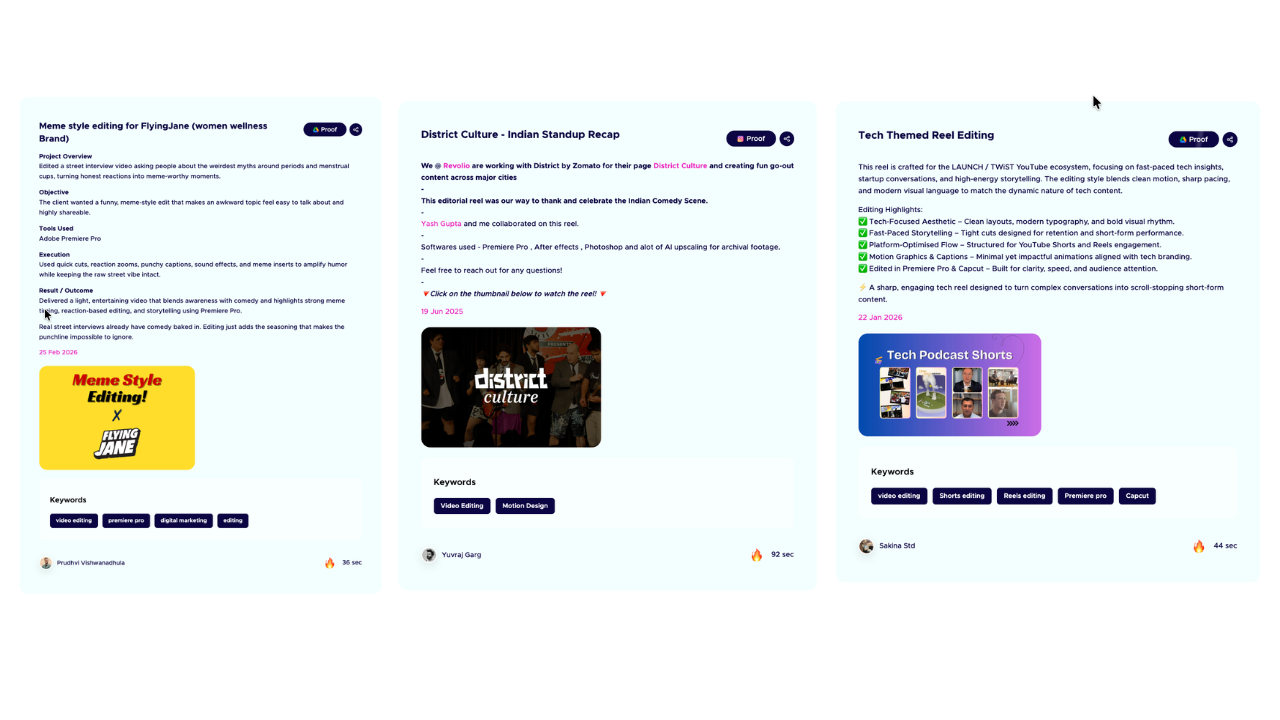
Checkout more projects here: fueler.io/discover
For video editors, this changes everything. Your Fueler portfolio can include:
- Sample edits broken down by niche (ads, reels, YouTube, podcasts)
- Case studies showing the brief, your approach, and the result
- Before and after comparisons demonstrating your creative choices
- Assignments that show how you handle feedback and real-world briefs
Companies that hire through Fueler are specifically looking for proof-of-work. They have already rejected the idea that a resume tells the whole story. You are getting in front of decision-makers who actually want to see what you can do.
If you are serious about crossing ₹10L, ₹20L, or beyond as a video editor, your Fueler portfolio is not optional. It is the most important career asset you can build right now.
How to Move Up Income Brackets: A Practical Path
Here is a clear framework based on where you are today.
If you are earning under ₹3L per year: Your priority is skill and portfolio. Pick one niche. Learn it deeply. Build 5 to 10 real work samples in that niche, even if they are spec projects (editing existing footage to demonstrate your style). Create your Fueler portfolio. Start cold outreach to small creators and brands.
If you are earning ₹3L to ₹6L per year: Your priority is positioning and pricing. You likely have the skills. You are underpricing yourself and targeting the wrong clients. Raise your rates by 30 to 50 percent. Document your work properly on Fueler. Start targeting international clients or premium Indian brands.
If you are earning ₹6L to ₹15L per year: Your priority is leverage. Move from per-project pricing to retainers wherever possible. Build systems and templates to increase your output without increasing your hours. Start building a personal brand in your niche. Consider specializing further, for example moving from "YouTube editor" to "YouTube editor for finance creators."
If you want to cross ₹20L per year: Focus on international clients, high-ticket niches like performance ads or OTT production, or building a small agency model. Your Fueler profile becomes a full brand statement at this point, not just a portfolio.
What the Future Looks Like for Video Editors in India
AI tools are not going away. But they are not replacing video editors either, at least not the good ones.
What AI is doing is eliminating the low-skill, repetitive editing work. Auto-captioning, basic cuts, color matching, these are increasingly automated. The editors who survive and thrive are the ones who can do what AI cannot: understand storytelling, make creative decisions, connect with an audience emotionally.
The demand for video content in India is not slowing down. OTT platforms, the creator economy, digital marketing, and corporate communications are all growing. The pool of mediocre editors is going to shrink because AI will replace them. The demand for great editors who can prove their skills will only go up.
That is the world Fueler is built for.
Key Takeaways
- The average salaried video editor in India earns ₹2L to ₹4L per year. But the range is enormous, from ₹1.8L for beginners to ₹30L or more for senior freelancers.
- City matters, but remote work has significantly reduced its impact. A skilled editor anywhere in India can access global opportunities.
- Niche determines your rate more than experience or software skills. Performance ad editing and YouTube content pay significantly more than generalist work.
- Most editors are stuck because of weak portfolios, no niche, and no outbound strategy, not lack of skill.
- Fueler is the best tool for building a proof-of-work portfolio that gets you hired based on demonstrated skills, not just a resume.
- The future belongs to editors who can tell stories and prove it with real work samples.
Frequently Asked Questions
1. What is the average video editor salary in India in 2026?
The average salaried video editor in India earns between ₹18,000 and ₹25,000 per month, or roughly ₹2.2L to ₹3L per year. However, experienced freelancers with strong portfolios and niche expertise earn significantly more, with many crossing ₹10L to ₹20L per year. The wide range depends on skills, experience, city, niche, and how well you can showcase your work.
2. How can a video editor earn ₹1 lakh per month in India?
Reaching ₹1L per month is very achievable for a mid-level editor with the right strategy. The most reliable path is through 3 to 4 retainer clients in a high-demand niche like YouTube editing, ad editing, or reels production. Charging ₹25,000 to ₹35,000 per retainer client per month for consistent deliverables can get you there without relying on one-off project work. Building a strong portfolio on Fueler that shows real proof of work is the fastest way to attract these clients.
3. Which niche pays the most for video editors in India?
Performance ad editing consistently pays the highest rates in India, with projects ranging from ₹5,000 to ₹50,000 per video. YouTube long-form editing offers strong and stable income through retainers. OTT and corporate production offer the highest salaried packages, often ₹60,000 to ₹1.5L per month for experienced editors in metro cities.
4. How do I get my first freelance video editing client in India without connections?
Start by building a portfolio of real work samples, even spec projects in your chosen niche. Create a complete Fueler profile that showcases your skills with actual project samples and case studies. Then do targeted outreach to creators, small businesses, and agencies whose content you know you can improve. A cold DM with a specific observation and a sample of relevant work converts far better than a generic "I am a video editor" message.
5. Does a video editor portfolio really matter for getting higher-paying clients?
Yes, more than almost anything else. A strong portfolio is the single biggest factor in closing higher-paying clients. Most editors underestimate how much a well-structured portfolio, one that shows your niche, your creative thinking, and real results, changes the conversation with clients. Fueler is built specifically for this: creating a proof-of-work portfolio that lets your skills speak for themselves, so clients hire you based on demonstrated ability rather than just credentials.
What is Fueler Portfolio?
Fueler is a career portfolio platform that helps companies find the best talent for their organization based on their proof of work. You can create your portfolio on Fueler. Thousands of freelancers around the world use Fueler to create their professional-looking portfolios and become financially independent. Discover inspiration for your portfolio
Sign up for free on Fueler or get in touch to learn more.

What should you do next?
You've read the article. Now turn your skills into proof of work and unlock more opportunities.
Build your proof of work portfolio
Create a clean portfolio with projects, assignments, resumes, and AI stack details that companies actually want to see.
Create your Fueler portfolio →Apply through assignments, not resumes
Stand out by solving real tasks from companies hiring on Fueler.
Explore assignments →Get discovered by companies
Make your work public and let recruiters discover your skills through actual projects instead of keywords.
Get discovered →
