Vector Databases Explained for Beginners

Riten Debnath
04 Apr, 2026
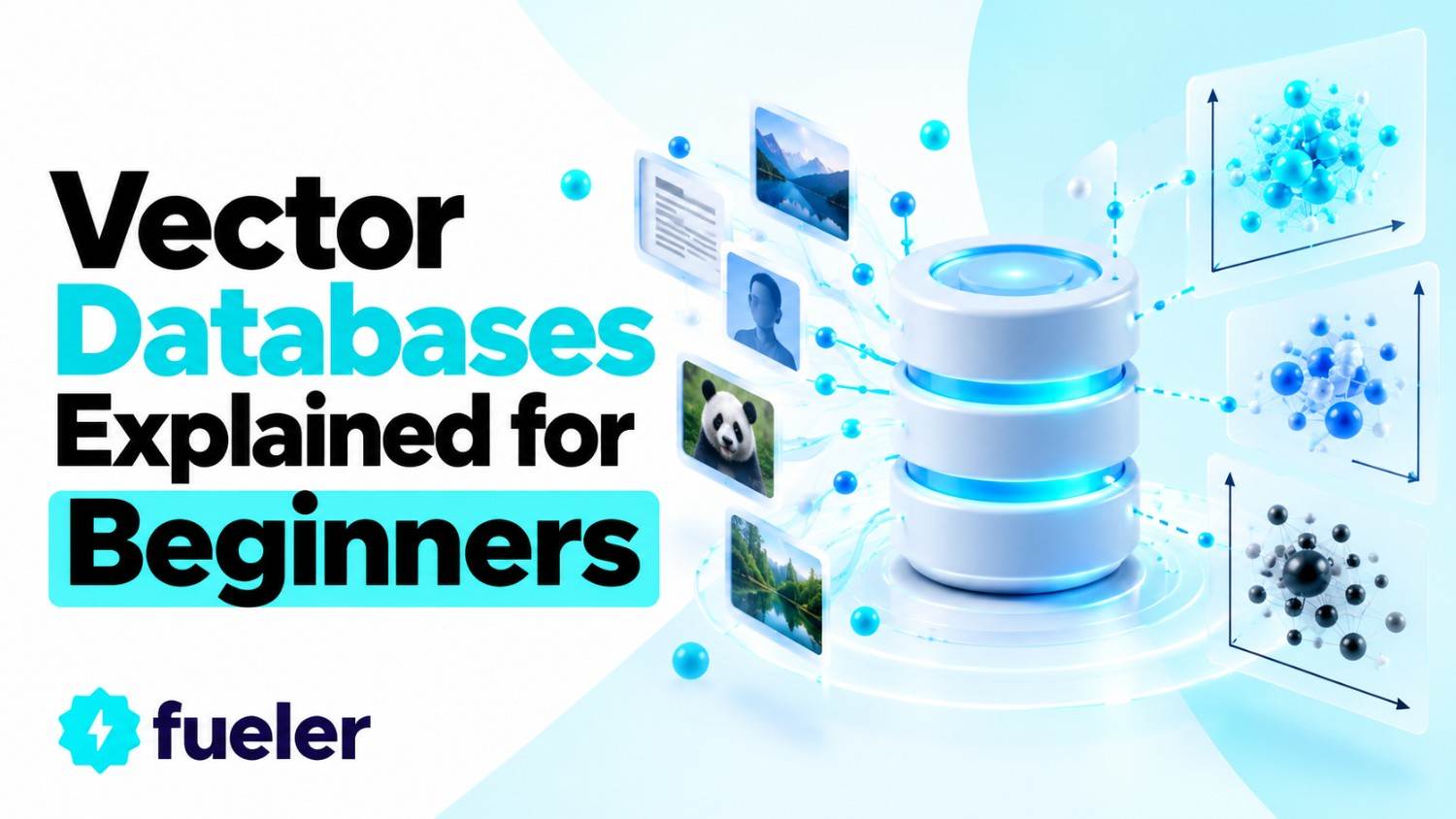
The digital world is currently undergoing a massive shift in how it handles information. For decades, we relied on rows and columns to organize our lives, but the rise of Artificial Intelligence has proven that traditional boxes are too small for the complexity of human thought. When you ask an AI to find a "peaceful image" or "code that handles user login," it isn't just looking for those exact words. It is searching through a multi-dimensional map of meanings. If you want to understand how the next decade of software will be built, you have to understand the engine under the hood: the Vector Database. This technology is the bridge between raw, unstructured data and the high-level reasoning of AI models.
I’m Riten, founder of Fueler, a skills-first portfolio platform that connects talented individuals with companies through assignments, portfolios, and projects, not just resumes/CVs. Think Dribbble/Behance for work samples + AngelList for hiring infrastructure.
1. Why Traditional Databases Are Failing the AI Era
Traditional relational databases, like SQL, were designed for a world of structured data where everything fits perfectly into a predefined table. They thrive when you give them a clear set of rules, such as a user’s age, a price point, or a specific date. However, these systems work by matching exact strings or numbers, which makes them incredibly "literal." If you search for "crimson fruit" in a traditional database, and the entry is stored as "red apple," the system will likely tell you that no such item exists because it cannot understand that crimson is a shade of red or that an apple is a fruit.
The Keyword Matching Trap: Traditional systems rely on exact text matching, which means they completely fail to capture the intent or the underlying meaning behind a user's search query, leading to frustrated users who cannot find what they need even if the data is there.
The Burden of Unstructured Data: As our digital output becomes increasingly "unstructured," consisting of videos, audio files, and social media posts, traditional tables become too messy, inefficient, and physically impossible to manage using standard row and column logic.
Rigid and Inflexible Schemas: You are required to define exactly what your data looks like and how it relates to other data before you can even save it, leaving absolutely no room for the fluid, evolving, and experimental nature of modern AI learning models.
A Total Lack of Contextual Awareness: Relational databases treat every single entry as an isolated island of information, failing to see the deep semantic relationship between a "cat" and a "kitten" or "car" and "automobile" unless a human manually programs every single one of those connections.
Why it matters
This shift is critical because we are producing more unstructured data today than at any other point in human history. If businesses want to make sense of their internal emails, customer transcripts, and massive image libraries, they simply cannot rely on 1990s technology. Moving to a vector,based approach allows companies to build smarter products that actually "understand" what the user is looking for, leading to better user experiences and much higher retention rates.
2. Defining the Vector: The DNA of Machine Understanding
At its core, a vector is simply a list of numbers that represents a point in a multi,dimensional space. Imagine a simple 2D graph where you want to plot "Fruit." You might have one axis for "Sweetness" and another for "Crunchiness." An apple might be at coordinates (8, 9), while a banana might be at (9, 2). In the world of AI, these vectors have hundreds or even thousands of dimensions to capture every nuance of a word, image, or sound. These numbers are called "embeddings," and they are generated by machine learning models that analyze content to decide exactly where it fits in the grand map of human knowledge.
Extreme High Dimensionality: Modern AI models use vectors with 768 or even 1536 different dimensions to capture every tiny, microscopic detail of a specific word, a long paragraph, or even a high,resolution image so that nothing is lost in translation.
Mathematical Relationships and Logic: In this high,dimensional space, words or concepts with similar meanings are physically located close to each other, allowing the computer to "see" relationships through simple geometry and distance calculations.
Sophisticated Feature Extraction: The process of turning a complex file into a vector is known as feature extraction, which identifies the "soul" or the most defining characteristics of the data so it can be compared to other items objectively.
Numerical Precision for Concepts: These numbers allow computers to perform math on actual ideas, such as taking the vector for "King," subtracting "Man," and adding "Woman" to mathematically arrive at a vector that is very close to "Queen."
Why it matters
This numerical representation is the only way a machine can "feel" the similarity between two things without a human telling it what to do. Without vectors, AI would just be a very fast dictionary with no intuition. With vectors, it becomes a reasoning engine. For a beginner, understanding that "data is now math" is the first step toward mastering AI development and staying relevant in a rapidly changing job market where basic coding is no longer enough.
3. How Vector Databases Handle Search and Retrieval
When you have millions of these vectors, you need a way to search through them instantly. A vector database does not look for an exact match; it looks for "Nearest Neighbors." If you query the database with a sentence, the system turns that sentence into a vector and then looks for other vectors that are nearby in that high-dimensional space. This is the difference between looking for a specific house address and looking for "any house that looks like a cottage in a quiet neighborhood." It allows for a level of flexibility that was previously impossible.
Advanced Spatial Indexing: Vector databases use specialized indexes like HNSW (Hierarchical Navigable Small World) to navigate through millions of dimensions quickly, ensuring that the search doesn't take forever as the database grows.
Calculated Distance Metrics: They calculate the specific angle or distance between two points using methods like Cosine Similarity or Euclidean Distance to determine exactly how related two pieces of data actually are in a mathematical sense.
Intelligent Query Processing: The database can handle "fuzzy" or vague queries where the user isn't quite sure what they are looking for, yet the system can still provide highly relevant results based on the general "vibe" or context of the search.
Extreme Speed at Massive Scale: These systems are engineered and optimized to search through billions of vectors in less than a second, which is a feat of engineering that would be impossible for a standard computer using traditional search methods.
Why it matters
In a world of infinite information, the ability to find "relevant" data is more valuable than finding "exact" data. Whether you are building a recommendation engine for a massive e-commerce site or a customer support bot for a global bank, the efficiency of your retrieval system determines the quality of your AI. It is the technical foundation of "Retrieval, Augmented Generation" (RAG), which is the most popular way to build AI apps today.
4. Understanding Vector Embeddings: The Transformation Process
The process of moving from a raw file to a searchable vector is called "Embedding." You cannot simply put a JPEG file or a PDF directly into a vector database. First, the file must pass through an "Embedding Model" (like those provided by OpenAI, Cohere, or Google). This model acts as a universal translator. It looks at the image, identifies the patterns, colors, and shapes, and outputs a long string of numbers. This transformation is what allows the database to store "concepts" and "ideas" instead of just "binary files."
Specialized Model Selection: Different models are better at different things, so you might use one model for medical research papers and an entirely different one for searching through a library of pop music or architectural blueprints.
Data Normalization and Scaling: Ensuring all vectors are on the same mathematical scale so that the distance calculations remain accurate and fair across different data types and various sources of information.
The Context Window Concept: This refers to the specific amount of information a model can "look at" and process at once before it starts to lose the meaning or the subtle nuances of the beginning of the text or file.
Static vs. Dynamic Embeddings: Some embeddings stay the same regardless of context, while more advanced dynamic embeddings can change their values based on the surrounding words in a sentence, capturing even deeper levels of meaning.
Why it matters
As a developer or founder, your choice of embedding model is just as important as the database itself. If your "translator" is poor or outdated, your database will be filled with meaningless numbers that don't help your users. This matters because it shows that a vector database isn't a standalone tool, it is part of a larger ecosystem of AI intelligence that requires careful planning and the right tools to succeed.
5. Pinecone: The Gold Standard for Managed Vector Search
For many startups and independent developers, managing the complex infrastructure of a massive database is too time-consuming and expensive. Pinecone solved this by offering a "Serverless" vector database. It allows you to upload your vectors and search them through a simple API without ever having to touch a physical server or worry about hardware. It is designed to be incredibly fast and easy to integrate, making it the top choice for companies that want to move fast and break things.
Fully Managed Serverless Architecture: You never have to worry about security updates, hardware scaling, or manual maintenance because the Pinecone team handles all the "under the hood" work for you automatically.
Instant Live Data Updates: You can add, modify, or delete data in real,time, and the searchable index updates almost instantly without any downtime, which is vital for apps that handle news or trending social media content.
Integrated Metadata Filtering: It allows you to attach traditional labels to your vectors (like "Category: Finance" or "Date: 2026") and filter your AI search results based on those labels to get the most precise results possible.
Pricing:
Starter Tier: Completely free for one project and up to 100,000 vectors, making it perfect for students and hobbyists to learn the ropes.
Standard/Enterprise Tier: Flexible, usage-based pricing that starts around $0.07 per hour for more storage, higher speeds, and dedicated support.
Why it matters
Pinecone lowered the bar for entry into the AI world. Before tools like this existed, only giant companies like Google or Meta could afford to build and maintain vector search engines. Now, a 10th-grade student with a laptop and a dream can build a search engine as powerful as a multi-billion-dollar corporation. It represents the true democratization of the power of Artificial Intelligence.
6. Weaviate: The Power of Open Source and Hybrid Search
While Pinecone is great for ease of use, many professional developers prefer Weaviate because it is open source. This means you can see exactly how every line of code works and run it on your own private servers if you have strict privacy requirements or government regulations. Weaviate is unique because it is a "Vector Search Engine" that also understands the relationships between data points, almost like a digital brain that maps out a knowledge graph.
Modular and Plug and Play Design: It comes with pre-integrated modules for popular AI models, so you don't have to write thousands of lines of custom code just to turn your text into searchable vectors.
High Performance Hybrid Search: It can perform a vector search and a traditional keyword search at the exact same time, combining the best of both worlds to ensure the user gets the most accurate and logical results every time.
Modern GraphQL Query Interface: It uses a familiar and powerful query language that makes it extremely easy for modern web developers to retrieve and manipulate data without learning a completely new system.
Pricing:
Community Edition: Always free to download, use, and modify under an open,source license for any project you can imagine.
Managed Cloud Service: Paid tiers starting at roughly $25 per month for those who want Weaviate's power but want someone else to host the servers.
Why it matters
Weaviate represents the flexibility and freedom of the AI world. For startups that handle sensitive user data or medical records, being able to host their own database locally is a major security and trust advantage. It also proves that the future of search isn't just about vectors, it's about combining vectors with traditional logic to get the most reliable results for the end user.
7. Milvus: Built for Massive Enterprise Scaling
If you are a giant company like PayPal, eBay, or a major social network and you have trillions of data points to sort through, you need something that won't break under extreme pressure. Milvus was built specifically for this level of scale. It is a highly sophisticated, cloud native vector database that can handle the world's largest and most complex datasets. It is more complex to set up than Pinecone, but its performance at a massive, global scale is currently unmatched in the industry.
Cloud Native Distributed Architecture: It can spread its heavy workload across many different servers simultaneously, meaning it can grow as large as your data requires without ever slowing down or crashing.
Versatile Multiple Indexing Types: It offers several different ways to organize and index your vectors, allowing you to choose the perfect balance between maximum search speed or maximum mathematical accuracy for your specific needs.
Enterprise Grade Security and Reliability: Designed to work perfectly in high,stakes environments like AWS, Azure, or Google Cloud, with built,in protections against data loss and unauthorized access to sensitive information.
Pricing:
Open Source: Free to use and modify for any organization, providing high-end technology to anyone willing to set it up.
Zilliz (Managed Version): Usage-based pricing that varies depending on the amount of data stored and the level of performance required by the business.
Why it matters
Milvus shows us that vector databases are not just a temporary trend for small apps; they are the future of global enterprise infrastructure. Understanding how these large-scale systems work is essential for anyone aiming to work in high-level data engineering, cloud architecture, or at a Fortune 500 tech company in the coming decade.
8. Chroma: The Local Database for AI Enthusiasts
Not every AI project needs to live in the cloud or serve millions of users. Chroma is a "lightweight" and "developer-friendly" vector database that you can run right inside your Python code on your own computer. It has quickly become a favorite for researchers and people building "AI agents" or personal assistants that run locally. It is simple, incredibly fast for small projects, and focuses entirely on making the developer's life as easy as possible.
Python Native and Highly Integrated: You can install it with a single command and start saving vectors in minutes, making it the fastest way to go from an idea to a working prototype on your local machine.
Superfast In-Memory Storage Options: It can store data temporarily in your computer's RAM for incredibly fast local testing, which is perfect for debugging your AI models without waiting for cloud uploads or downloads.
Massive Open Source Community: A large and growing community of developers contributes to its growth every day, creating plugins and tutorials that make it even easier for new people to get started.
Pricing:
Always Free: Chroma is currently a purely open-source project with no paid tiers for the core software, allowing anyone to innovate without a budget.
Why it matters
Chroma is the "entry point" for vector databases. It allows you to experiment, break things, and learn without needing a credit card or a complex cloud account. For beginners, this is the best place to start your journey. It proves that you don't need a massive budget or a team of engineers to build something truly innovative with modern AI.
9. Leveraging Your Skills with Fueler
As you can see, the world of vector databases is diverse, complex, and rapidly growing. Whether you are mastering Pinecone for a quick prototype or diving into the depths of Milvus for a global system, these are the skills that define a top-tier modern professional. But knowing the technology is only half the battle, the other half is proving to the world that you can actually use it.
At Fueler, we believe that your work should always speak louder than your words. When you build a project using these tools, you shouldn't just bury it in a folder on your desktop. You can use Fueler to create a professional profile that showcases your "proof of work." By publishing your assignments, your vector search implementations, and your AI projects as a visual portfolio, you make it easy for companies and clients to see your actual capabilities. We help you move beyond the flat resume and into a world where your talent is measured by what you have actually built and contributed to the world.
Final Thoughts
Vector databases are the quiet revolution enabling the current AI explosion. They change how we store, search, and understand the vast, messy ocean of human information. By turning complex data into clean, mathematical vectors, they allow us to build software that feels more human, intuitive, and less robotic. For anyone entering the tech world today, understanding this architecture is not just an option; it is the very foundation of the next generation of computing. Start small, build projects often, and always make sure to document your progress as you go.
Frequently Asked Questions
What is the best vector database for a complete beginner in 2026?
Chroma or Pinecone is generally considered the best starting point for beginners. Chroma is great if you want to work locally on your own computer without any cost, while Pinecone is best if you want to build a web application that other people can use immediately.
Do vector databases completely replace traditional SQL databases?
No, they are meant to complement each other. You would still use a traditional SQL database for things like user passwords, billing information, or transaction history, while using a vector database for things like search, recommendations, and providing context to an AI.
Can I use a vector database for searching through images and videos?
Yes, that is one of their primary and most powerful uses. By converting images into vectors, you can build a system where users can upload a photo to find other photos that "look similar" in style, color, or content without needing any text tags.
What exactly are vector embeddings in simple terms?
Embeddings are the numerical "fingerprints" that represent your data. They are created by AI models that act as translators, turning human, readable information (like a sentence or a picture) into machine-readable math (a long list of numbers) that the database can understand.
Is it expensive to run a vector database for a small project?
It doesn't have to be. Most modern tools have a very generous free tier that is perfect for learning, experimentation, and small personal projects. As you grow to millions of data points and require faster speeds, the costs will increase, but for most people starting out, it is essentially free.
What is Fueler Portfolio?
Fueler is a career portfolio platform that helps companies find the best talent for their organization based on their proof of work. You can create your portfolio on Fueler. Thousands of freelancers around the world use Fueler to create their professional-looking portfolios and become financially independent. Discover inspiration for your portfolio
Sign up for free on Fueler or get in touch to learn more.

What should you do next?
You've read the article. Now turn your skills into proof of work and unlock more opportunities.
Build your proof of work portfolio
Create a clean portfolio with projects, assignments, resumes, and AI stack details that companies actually want to see.
Create your Fueler portfolio →Apply through assignments, not resumes
Stand out by solving real tasks from companies hiring on Fueler.
Explore assignments →Get discovered by companies
Make your work public and let recruiters discover your skills through actual projects instead of keywords.
Get discovered →
