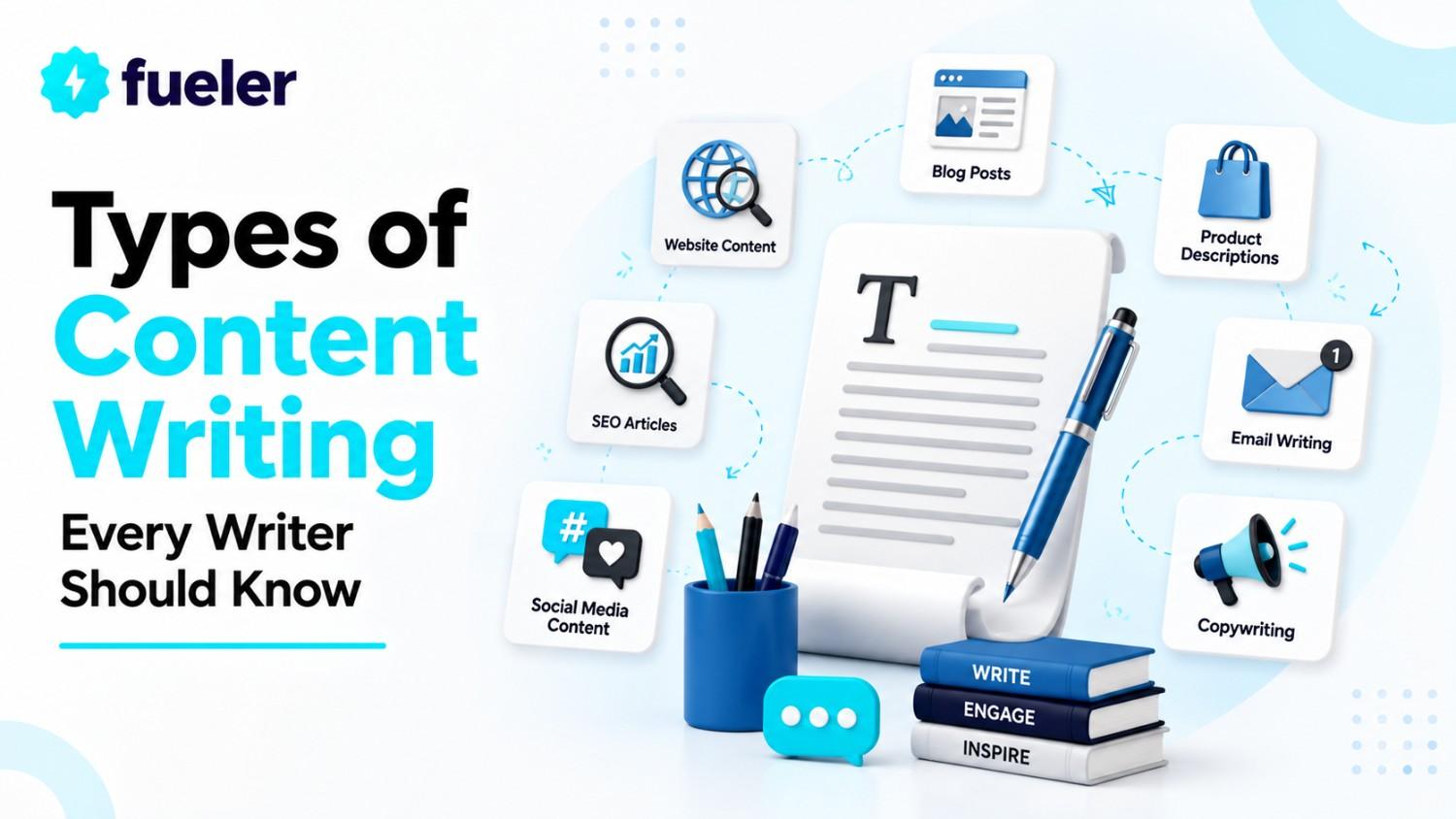
28 Types of Content Writing Every Writer Should Know

Riten Debnath
25 Jul, 2026
Last updated: July 2026
If you have ever sat in front of a blank screen wondering why your job applications are getting ignored or why client inquiries have dried up, here is an uncomfortable truth. The digital landscape has evolved past simple text creation. Companies are no longer hiring writers who can merely produce words. They are hiring specialized content strategists, storytellers, copywriters, and technical authors who understand how to drive actual business outcomes.
I’m Riten, founder of Fueler, a skills-first portfolio platform building the career infrastructure for 100 million creative professionals. Fueler connects talented individuals with companies through assignments, portfolios, and projects, not just resumes or CVs. Think of it as Dribbble/Behance for work samples combined with AngelList for hiring infrastructure.
Whether you are trying to rank on Google, write high-converting landing page copy, or simplify complex API documentation, mastering different content formats is the ultimate cheat code for your career. In this comprehensive guide, I will break down all 28 fundamental types of content writing every modern writer must know, complete with target word counts, execution strategies, and real-world application.
The Blog Content Ecosystem
Blog content remains the core engine of organic traffic, reader engagement, and digital authority. However, treating every blog post the same is a recipe for low reach and zero conversion. Different blog formats serve unique user intents and require completely different strategic approaches.
1. SEO Blog (800 to 2,000 Words)
An SEO blog is crafted specifically to rank on search engine results pages by targeting high-intent search terms. Its primary objective is solving a user query directly while fulfilling search engine algorithms. Successful SEO blogging requires thorough keyword research, proper heading structure, natural primary and secondary keyword placement, and high reader readability. Instead of stuffing keywords, modern SEO writing focuses on covering search intent comprehensively so search engines recognize your content as the definitive answer. When writing an SEO blog, structure is your best friend. Search engines love clean typography, logical subheadings, and clear semantic context. You must start with an immediate answer to the primary question, followed by detailed sub-sections that cover long-tail search variations.
2. Authority Blog (1,500 to 3,000 Words)
Authority blogs exist to establish deep trust, industry leadership, and topical expertise. Unlike standard search engine posts, authority posts dive deep into original insights, expert interviews, proprietary data, or unique mental frameworks. When writing an authority piece, you are not just targeting passive searchers; you are persuading industry peers and potential high-value clients. High authority pieces earn backlinks organically because they offer unique perspectives that cannot be found elsewhere. Writing authority content requires stepping away from generic summaries. You need to present original research, real-world case studies, or counterintuitive arguments that spark discussion across social channels and industry communities.
3. Guest Blog (800 to 1,500 Words)
Guest blogs are published on external websites within your niche to tap into an existing reader base and acquire high-quality contextual backlinks. Writing a successful guest blog requires adapting to the target host publication's voice, formatting, and editorial style. The goal is to provide immense value to the host's audience while subtly positioning your personal brand or business as a trusted resource. Successful guest posting involves pitching unique topics that fill gaps in the host site's existing content library. You must avoid overly promotional pitches and focus on giving away high-level actionable steps that make the host publication look good for featuring your work.
4. News Blog (500 to 1,000 Words)
News blogs deliver timely coverage of recent industry updates, platform changes, breaking trends, or company announcements. Speed, accuracy, and immediate relevance are crucial here. News content requires a fast turnaround and a clear narrative that explains not just what happened, but why it matters to the target audience. Because news content has a shorter shelf life, writers must focus on immediate distribution channels like social media and email newsletters. When writing a news blog, lead with the most important facts in the very first paragraph. Follow up with contextual analysis that explains the broader implications for professionals, businesses, or end users in your industry.
5. How-to Blog (1,000 to 2,500 Words)
How-to blogs guide readers through a specific, actionable process step by step. This format is a workhorse for educational content marketing because it directly answers functional questions. Great how-to writing eliminates ambiguity by breaking complex execution into logical progression, offering clear explanations, visual screenshots, and actionable outcomes so the reader can apply the learnings right away. To write an exceptional how-to guide, anticipate potential roadblocks the reader might encounter at each step. Include practical tips, common mistakes to avoid, and clear verification steps so readers know they have completed each stage successfully.
6. Ultimate Guide (2,000 to 5,000 Words)
An ultimate guide is the complete, single-source repository on a broad topic. It covers foundational concepts, advanced tactics, common mistakes, tools, and strategic frameworks within one comprehensive resource. Ultimate guides serve as cornerstone content for websites, serving as powerful assets for generating backlink campaigns and keeping users engaged on the page longer. Building an ultimate guide requires meticulous planning. You need to map out every aspect of a parent topic, organize sections logically, and provide internal links to deeper sub-topics on your site. The goal is to create a resource so thorough that readers feel no need to visit another website for information on the subject.
7. Newsletter (300 to 800 Words)
Email newsletters provide direct, intimate communication delivered straight to a subscriber's inbox. Newsletter writing demands strong subject lines to drive open rates and concise, conversational storytelling to maintain high click-through rates. Unlike public web content, newsletters focus on building personal relationships, nurturing leads, and delivering quick, digestible value without unnecessary fluff. Effective newsletter writers adopt a personal one-on-one tone, writing as if they are sending an email to a trusted colleague. Keep paragraphs short, highlight key takeaways, and end with a singular clear action item or question to prompt direct replies from your audience.
Long-Form Article Writing
When you need to establish deep intellectual credibility, educate B2B decision makers, or showcase rigorous analytical thinking, long-form articles are your best vehicle.
8. Thought Leadership Article (1,000 to 2,000 Words)
Thought leadership articles present original viewpoints, counter-intuitive perspectives, or visionary industry predictions. They do not rehash existing Google search results. Instead, they challenge industry consensus and present new frameworks for solving problems. Writing compelling thought leadership requires genuine professional experience, strong reasoning, and an authentic personal voice that resonates with executives and decision-makers. To make your thought leadership stand out, take a clear stance on a controversial trend or share real operational lessons learned from building a company or project. Personal experience is the ultimate moat against generic AI content.
9. Comparison Article (1,000 to 2,000 Words)
Comparison articles evaluate two or more competing products, services, or methods side by side. They target users who are late in the buying journey and actively choosing between solutions. Effective comparison writing maintains objective credibility while highlighting subtle nuances in features, pricing, usability, and ideal user personas. Placing unbiased evaluation at the forefront builds strong buyer confidence. A high-converting comparison article outlines clear evaluation criteria, breaks down pros and cons for each option, and provides explicit recommendations based on specific user needs or team sizes.
10. Feature Article (1,000 to 2,500 Words)
Feature articles blend journalistic storytelling with deep narrative structure. Often seen in magazines or major digital publications, feature stories humanize complex subjects by focusing on real human experiences, detailed background stories, and emotional arcs. Writers use rich descriptive prose and narrative hooks to keep readers engaged from start to finish. Writing a great feature article involves conducting detailed interviews, gathering background context, and weaving narrative threads that connect individual stories to broader industry trends or human truths.
11. Opinion Article (800 to 1,500 Words)
Opinion articles, or op-eds, express a subjective viewpoint backed by logical argument, personal anecdote, or strategic reasoning. They aim to spark debate, shift reader perspectives, or take a bold stand on controversial industry topics. The key to a memorable opinion piece is clarity of thought and the courage to take a clear, undefended position rather than staying neutral. Structure your opinion piece by introducing your main thesis quickly, presenting compelling arguments supported by real-world examples, directly addressing counter-arguments, and concluding with a strong call to action or memorable takeaway.
12. Product Review (800 to 2,000 Words)
Product reviews offer hands-on evaluations of tools, software, or physical products based on real usage. A quality product review covers core features, practical benefits, limitations, setup steps, and pricing comparisons. Modern readers quickly spot generic promotional fluff, so authentic reviews must highlight genuine pros and cons to maintain reader trust. Focus on answering real practical questions: How long does setup take? What are the hidden costs? Where does the tool fall short? Demonstrating actual product testing builds immediate authority with prospective buyers.
13. Case Study (800 to 1,500 Words)
Case studies showcase real customer results through a structured narrative arc: the initial problem, the implemented solution, and the measurable results. They act as concrete proof of work for businesses. Effective case study writing relies on verified data points, direct client quotes, and clear before-and-after scenarios that prove value to prospective buyers. Structure your case study logically. Start with the client background and specific challenges, detail the implementation process step by step, and finish with hard metrics like percentage revenue growth, time saved, or ROI achieved.
14. White Paper (2,000 to 5,000 Words)
White papers are formal, authoritative reports designed to educate B2B buyers or institutional stakeholders on complex problems. They present deep research, architectural frameworks, and technical arguments in a professional tone. White papers are often gated behind lead capture forms because high-level decision makers value the deep research provided inside. Writing a white paper requires an academic level of rigor, thorough background citations, detailed data visualizations, and objective analysis. The goal is to educate high-level decision makers so thoroughly that your company's methodology becomes the natural standard for solving their problem.
15. Research Report (2,000 to 6,000 Words)
Research reports present original data, survey findings, or extensive statistical analysis. They serve as primary sources for an entire industry, making them powerful assets for earning media coverage and organic references. Writing a research report involves turning raw numbers into clear, readable stories through charts, analytical breakdowns, and logical summaries. Break complex data sets into thematic chapters. Highlight major key findings up front in an executive summary, followed by detailed statistical breakdowns, methodology explanations, and practical recommendations for industry practitioners.
Persuasive Copywriting
Copywriting is specialized writing designed to drive an immediate, trackable action, whether that is clicking a button, filling out a form, or buying a product.
16. Homepage Copy (300 to 800 Words)
Homepage copy serves as the digital front door to a brand. It must communicate a clear value proposition within seconds. Great homepage copy immediately clarifies who the brand helps, what problem it solves, and why it is better than alternatives, all while guiding visitors toward specific conversion paths. Crafting homepage copy requires punchy headlines, clear subheadings, concise value propositions, and strategic social proof elements like customer logos or testimonials, all leading to prominent call-to-action buttons.
17. Landing Page Copy (500 to 1,500 Words)
Landing page copy is laser-focused on a single conversion goal, such as signing up for a trial, downloading an ebook, or booking a sales demo. It eliminates distracting links and focuses entirely on buyer pain points, transformational benefits, social proof, objections, and strong calls to action. Use classical copywriting frameworks like Problem-Agitate-Solve (PAS) or Attention-Interest-Desire-Action (AIDA) to guide the visitor through a psychological journey that culminates in a clear conversion decision.
18. Service Page Copy (500 to 1,200 Words)
Service page copy clearly details a company's specific service offerings. It details deliverables, processes, pricing tiers, and ideal client profiles. The goal is to qualify prospective clients while reassuring them that your team possesses the exact expertise needed to handle their challenges. Focus on buyer benefits rather than feature lists. Clearly define who the service is designed for, outline your working process step by step, and feature client reviews that directly validate your work quality.
19. About Us Page (300 to 800 Words)
An About Us page turns abstract company mission statements into a relatable human story. It shares the founder's vision, core values, origin history, and team culture. Rather than being a self-indulgent resume, an effective About Us page frames the brand's origin around how it serves the target audience. Connect your personal or company journey to the core problems your customers face. Show why you care deeply about solving this problem and highlight the values that guide your team's day-to-day work.
20. Product Description (50 to 300 Words)
Product descriptions sell physical or digital products by translating technical features into real human benefits. Excellent product copy uses sensory language, addresses buying hesitation, and incorporates relevant search terms so product pages rank on search engines while driving direct online sales. Focus on how the product improves the buyer's everyday life. Eliminate technical jargon unless it directly communicates quality, and use clear formatting so skimmable readers can grasp key product details instantly.
21. Social Media Copy (20 to 300 Words)
Social media copy requires capturing attention within crowded feeds on platforms like LinkedIn, Twitter, or Instagram. It relies on sharp hooks, clear formatting, and engaging narrative lines to encourage likes, comments, shares, and clicks. Each platform requires adapting tone and length to match community expectations. Focus on delivering standalone value within the post itself. Use strong opening hooks, clean line spacing, and single clear calls to action to drive engagement and conversation.
22. Email Sequence (100 to 300 Words per Email)
An email sequence consists of automated marketing or nurture messages designed to build rapport over time. Whether it is an onboarding sequence or a sales launch, each email must deliver standalone value, maintain a cohesive narrative, and guide the subscriber toward a clear next step. Focus each email on a single core idea or lesson. Use intriguing subject lines to maintain high open rates and conclude every email with a direct call to action, whether that is clicking a link or replying directly.
Technical and Instructional Documentation
Documentation helps users understand, implement, troubleshoot, or scale products. Clear documentation builds user trust, lowers customer support costs, and reduces user churn.
23. Knowledge Base Article (500 to 1,500 Words)
Knowledge base articles provide standalone answers to common customer questions and operational issues. They must be easy to scan and direct, giving users step-by-step instructions so they can solve problems independently without submitting support tickets. Write with extreme clarity. Use clear step numbering, bold UI element names, and include updated visual aids so users can follow instructions without confusion.
24. Help Center Article (300 to 1,000 Words)
Help center articles provide quick troubleshooting solutions for specific platform errors or feature workflows. They prioritize clarity, direct language, clear steps, and helpful screenshots, allowing users to resolve issues without friction. Organize help articles around specific user problems or error messages. Provide the immediate fix upfront, followed by detailed background notes or prevention steps to keep the issue from happening again.
25. Technical Documentation (1,000 to 5,000 Words)
Technical documentation explains complex hardware, software architecture, or engineering workflows. It requires deep technical understanding, precise terminology, and clear organization so engineers and technical managers can understand system mechanics reliably. Maintain strict consistency in technical terms and formatting. Use code blocks, architectural diagrams, and logical section hierarchies to make complex technical concepts easy to navigate and implement.
26. API Documentation (500 to 5,000+ Words)
API documentation guides developers on how to integrate and interact with software endpoints. It includes code samples, request and response formats, authentication standards, error codes, and practical usage scenarios. Accuracy is paramount here, as minor syntax errors can break customer implementations. Provide real-world code snippets across multiple programming languages, clearly define required headers and query parameters, and list exact error codes with actionable steps to fix them.
27. User Guide or Manual (1,000 to 5,000 Words)
A user guide takes a new customer from initial account setup to advanced product mastery. It serves as an onboarding manual, breaking down interface navigation, primary features, configuration steps, and maintenance best practices into accessible language. Structure user guides around key user milestones. Start with quick-start configuration steps, proceed through core feature workflows, and end with advanced tips for optimizing performance and usage.
28. FAQ Section or Page (100 to 800 Words)
FAQ sections directly address common customer questions, objections, and hesitations. Placed strategically on product pages or dedicated help portals, FAQ pages remove buying friction, improve user experience, and capture long-tail organic search queries. Write clear questions using the exact language your customers use. Keep answers brief, direct, and helpful, including links to deeper documentation pages when more detailed context is necessary.
Deep Dive Strategic Frameworks for Modern Content Writers
To truly stand out in today's digital landscape, knowing the 28 content types is only half the battle. You need an operational framework to execute, optimize, and distribute your writing effectively. Let us dive into the core strategies that separate average writers from high-earning content strategists.
The Search Intent Triad
Search engines do not rank content based solely on word count or keyword density; they rank content based on how well it satisfies search intent. When writing any of the search-driven formats like SEO blogs, ultimate guides, or comparison articles, you must identify which category of search intent you are addressing:
- Informational Intent: The reader wants to learn something or find an answer to a question. (e.g., "how to write a case study")
- Commercial Intent: The reader is researching options before making a purchasing decision. (e.g., "best portfolio platforms for writers")
- Transactional Intent: The reader is ready to buy or complete an action right now. (e.g., "sign up for a Fueler portfolio account")
Matching your content format and structure to the primary search intent ensures your piece fulfills user expectations immediately, leading to lower bounce rates, longer dwell times, and higher search engine rankings.
Create Proof of Work
The biggest mistake aspiring writers make is relying on abstract resumes filled with unverified claims. In a skills-first economy, proof of work is everything. If you are applying for a writing role or pitching a client, do not just tell them you can write landing pages or white papers; show them.
At Fueler, we encourage professionals to create speculative proof of work and detailed project breakdowns. If you want to pitch a company, audit their existing content, identify gaps in their content strategy, and rewrite a sample piece using proper SEO structure and messaging positioning. Publishing these projects as structured case studies gives prospective clients undeniable proof of your research capability, narrative framing, and execution quality.
For Proof of Work Ideas around writing, check here
Final Thoughts
Mastering these 28 types of content writing is only the first step toward building a thriving creative career. The real differentiator in today's market is showing proof of work. Anyone can claim on a traditional resume that they know how to write landing page copy or technical API documentation. Modern hiring managers and high-paying clients want to inspect real project samples, read through your thought process, and evaluate actual performance metrics before scheduling an initial discovery call.
When you package your writing samples into structured case studies, attach live performance links, and present your execution process clearly, you elevate yourself above generic competition. Focus on building real projects, documenting your methodology, and publishing verified proof of work. That focus on tangible execution is what transforms basic skills into sustainable long-term career growth.
Frequently Asked Questions
Which of these 28 content writing types pays the highest rates?
High-complexity and direct revenue-generating formats pay best. White papers, API documentation, technical guides, and conversion copy (like landing pages) command premium rates because they require deep domain expertise and directly drive sales or lower support costs.
Do I need to master all 28 content types to get hired?
No, you do not need to master every format. Most successful writers specialize in 2 to 3 related formats (such as SEO & authority blogging, or sales pages & email sequences) and build a targeted portfolio around those core skills.
How do I choose the right content type for my business or project?
Align the format with your target audience's search intent and buying stage. Use SEO and how-to blogs for top-of-funnel discovery, comparison pages and case studies for evaluating options, and documentation to retain existing customers.
How can I showcase my content writing experience without past client work?
Create speculative work, write detailed breakdown studies, or complete real-world assignments for your portfolio. Prospective clients want to evaluate your research depth, messaging clarity, and writing quality, regardless of whether it was a paid gig.
Why is a skills-first portfolio better than a traditional resume for writers?
A resume only lists past job titles, while a skills-first portfolio provides tangible proof of your writing ability. Employers and clients hire based on clear work samples, strategic thinking, and documented results rather than bullet points on a CV.
Why 100,000+ professionals use Fueler
Fueler helps professionals showcase proof of work through projects, assignments, case studies, and achievements.
- Thousands of professionals use Fueler to create their digital portfolio
- Thousands of projects are published on Fueler. Check here
- Startups and Companies hire through proof of work on Fueler
- Used by freelancers, creators, marketers, video editors, writers, designers, and product managers
Our mission is to help the next 100 million professionals build a verified professional identity through proof of work

What should you do next?
You've read the article. Now turn your skills into proof of work and unlock more opportunities.
Build your proof of work portfolio
Create a clean portfolio with projects, assignments, resumes, and AI stack details that companies actually want to see.
Create your Fueler portfolio →Apply through assignments, not resumes
Stand out by solving real tasks from companies hiring on Fueler.
Explore assignments →Get discovered by companies
Make your work public and let recruiters discover your skills through actual projects instead of keywords.
Get discovered →
