Top 15 Technology Platforms Influencing US Industries in 2026

Riten Debnath
19 Jan, 2026
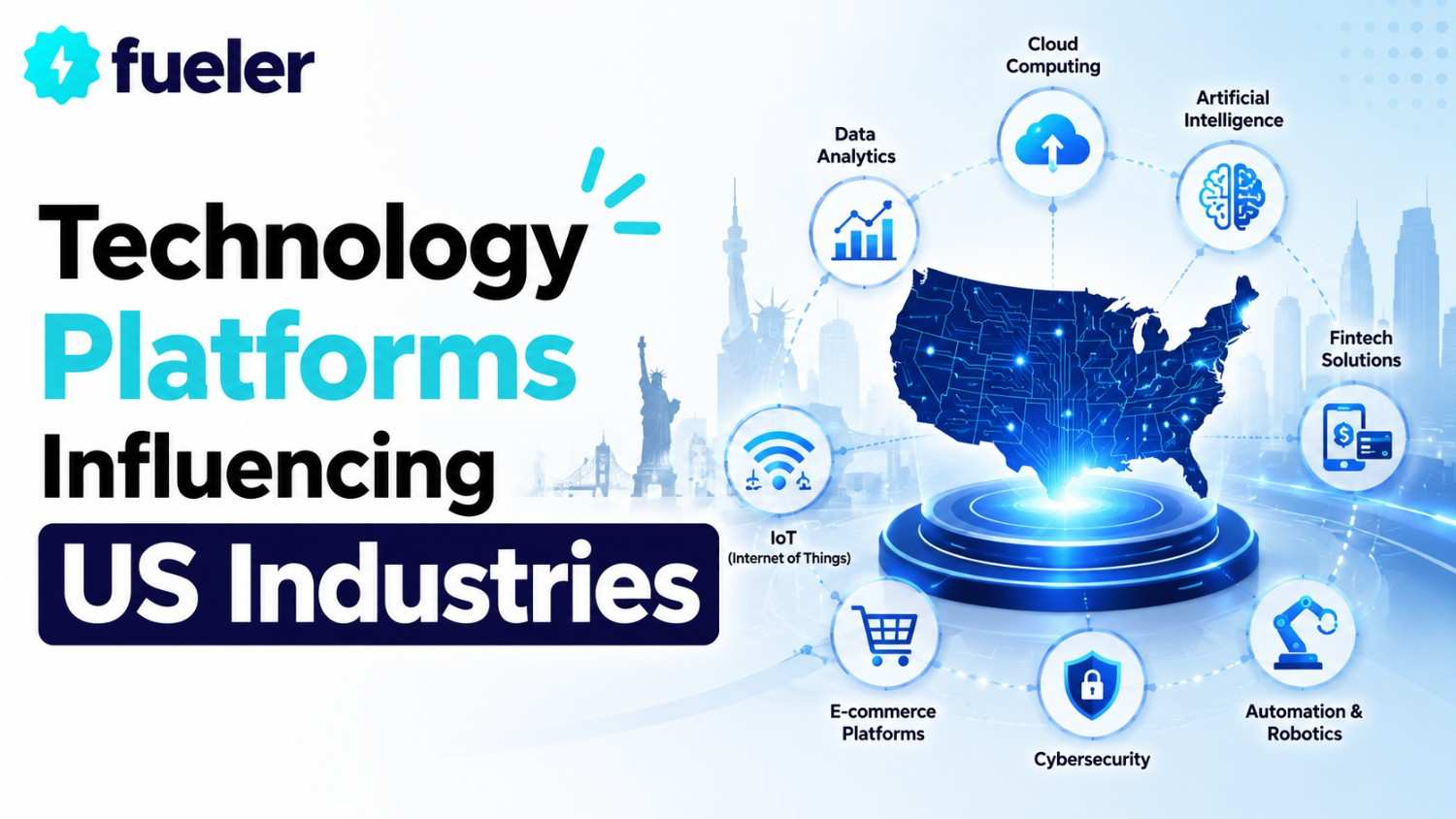
In 2026, the American industrial landscape is being re-engineered by platforms that do more than just store data; they actively "orchestrate" it. We have moved beyond the era of static software into an age of Platform Autonomy, where the systems used by US corporations are capable of self-healing, predictive logistics, and automated compliance. The following fifteen platforms are the specific "operating systems" of the modern US economy, determining how the largest American sectorsfrom healthcare to heavy manufacturingmaintain their global competitive edge.
I’m Riten, founder of Fueler, a skills-first portfolio platform that connects talented individuals with companies through assignments, portfolios, and projects, not just resumes/CVs. Think Dribbble/Behance for work samples + AngelList for hiring infrastructure.
1. ServiceNow: The AI Platform for Business Transformation
ServiceNow has evolved from a simple IT helpdesk tool into the "Platform of Platforms" for the American enterprise. In 2026, it acts as the central nervous system for US corporations, using generative AI to automate complex cross-departmental workflows that used to take weeks of manual coordination. By integrating HR, IT, and customer service into a single intelligent interface, it allows US businesses to eliminate the friction of "legacy silos," creating a seamless digital experience for both employees and customers that is essential for maintaining productivity in a hybrid work world.
- Generative AI Controller: This 2026 feature allows US firms to connect various LLMs directly into their business processes, enabling the platform to automatically draft emails, generate code, and summarize case histories without human intervention.
- Now Assist for Creator: ServiceNow has democratized software development within the US workforce by allowing non-technical employees to build powerful, compliant enterprise apps using natural language prompts instead of complex code.
- Strategic Portfolio Management (SPM): American executives use this module to align every project and dollar spent with the company's high-level strategic goals, providing real-time visibility into the ROI of digital transformation initiatives.
- ESG Management & Reporting: As US regulatory requirements tighten, ServiceNow provides a unified platform for tracking environmental, social, and governance metrics, ensuring that American firms stay compliant with evolving SEC disclosures.
- Industry-Specific Workflows: ServiceNow now offers "clean" versions of its platform specifically tailored for US industries like Telecommunications, Financial Services, and Healthcare, pre-configured with the necessary security and compliance standards.
Pricing:
- Standard Packages: Typically start around $100 per user/month for basic ITSM modules.
- Pro/Enterprise Tiers: Often range from $50 to $200 per user/month depending on the volume of "Now Assist" AI credits and advanced automation modules required by the US organization.
2. Snowflake: The Data Cloud and AI Data Cleanroom
Snowflake has redefined how the United States handles its most valuable asset: data. In 2026, it is no longer just a "data warehouse" but a global network that allows US companies to share and monetize data securely without ever moving the actual files. Its "Data Cleanroom" technology is particularly influential in the American advertising and healthcare sectors, where companies need to collaborate on sensitive information while strictly adhering to privacy laws like CCPA and HIPAA. It provides the "clean" data foundation that is absolutely required for any US firm looking to build or train its own specialized AI models.
- Secure Data Sharing & Exchange: Snowflake allows US organizations to give partners "read-only" access to specific data sets in real-time, eliminating the need for slow and risky data transfers via file exports or FTP.
- Cortex AI Services: This built-in AI layer allows American data analysts to run large language models directly on their data within Snowflake, making it easy to summarize millions of customer reviews or detect fraud patterns instantly.
- Snowflake Horizon Governance: A centralized tool for managing data privacy and security across an entire global organization, ensuring that all data usage follows strict US regulations and internal corporate policies.
- Snowpark for Developers: This feature allows American data scientists to write code in languages like Python or Java directly inside Snowflake, enabling complex machine learning models to run right next to the data they need.
- Native App Framework: US tech companies are now building and selling entire software applications directly on top of Snowflake, allowing customers to use these apps without their data ever leaving their secure Snowflake environment.
Pricing:
- Usage-Based Model: Snowflake uses a "Credit" system. Standard Edition starts at approximately $2.00 per credit (On-demand).
- Enterprise/Business Critical: These tiers cost between $3.75 and $4.00+ per credit, providing the high-level encryption and failover protection required by the US financial and government sectors.
3. Palantir Foundry: The Decision-Making OS
Palantir Foundry has become the "war room" for the American commercial sector, moving beyond its famous origins in the US government and defense. In 2026, Foundry is the platform of choice for US companies with complex physical operationslike airlines, manufacturers, and energy firmsthat need to create a "Digital Twin" of their entire business. Its Artificial Intelligence Platform (AIP) allows American executives to talk to their data, asking complex "What if?" questions about supply chain disruptions or pricing shifts and receiving actionable, logic-based answers that are grounded in the company's real-world constraints.
- AIP (Artificial Intelligence Platform): AIP integrates large language models directly into the Foundry ecosystem, allowing US users to build autonomous agents that can monitor supply chains and execute corrective actions without human oversight.
- Object-Oriented Data Modeling: Instead of looking at rows and columns, US professionals see their business as "Objects" like "Aircraft," "Part," or "Customer, "making it intuitive for non-technical managers to understand complex operational data.
- End-to-End Operational Visibility: Foundry connects data from every corner of a US enterprise, from the factory floor sensors to the accounting ledger, providing a "Single Source of Truth" for all high-level American decision-making.
- Scenario Modeling and Simulation: American logistics firms use Foundry to simulate the impact of weather events or geopolitical shifts on their operations, allowing them to build "resiliency" into their business models before a crisis hits.
- High-Security Data Integration: Built on a foundation of government-grade security, Foundry ensures that sensitive US corporate data is protected with granular access controls that track every single action taken within the platform.
Pricing:
- Commercial Entry: Palantir has moved toward more accessible pricing for the US market, but still typically involves contracts starting at $100,000+ per year for mid-sized firms.
- Enterprise/AIP: Large-scale deployments for Fortune 500 US companies often range into the multi-million dollar annual contracts.
4. NVIDIA Omniverse: The Industrial Metaverse
NVIDIA Omniverse is the platform that bridges the gap between digital code and physical reality for the American industrial sector. In 2026, it is the primary environment where US engineers and architects build and test "Digital Twins" of entire factories, cities, and climate systems. By providing a physics-accurate virtual space, Omniverse allows American companies to run millions of simulations to optimize a robot's path or a building's energy efficiency before a single brick is laid or a single motor is turned on, saving billions in potential real-world errors.
- USD (Universal Scene Description) Core: Omniverse uses the "OpenUSD" standard, allowing US teams using different 3D design tools (like Autodesk or Adobe) to collaborate in the same virtual space in real-time without file conversion.
- Physics-Accurate Simulation: The platform uses NVIDIA's advanced GPU tech to simulate gravity, light, and fluid dynamics with perfect accuracy, which is critical for US aerospace and automotive testing.
- Omniverse Replicator: This tool allows American AI developers to generate "Synthetic Data" by taking photos of virtual objects, which is then used to train the vision systems of US autonomous vehicles and robotic arms.
- Cloud-Native Collaboration: US teams can access Omniverse via the cloud, allowing a designer in San Francisco and an engineer in Detroit to walk through the same virtual engine model simultaneously using AR/VR.
- Enterprise-Scale Digital Twins: Large US retailers use Omniverse to simulate foot traffic and shelf placement in their stores, optimizing the layout for maximum sales and customer flow before committing to physical changes.
Pricing:
- Omniverse Enterprise: Subscription-based pricing typically starts at $9,000 - $10,000 per year for a workgroup.
- GPU-Based Cloud Usage: On-demand usage via Azure or AWS marketplaces is priced per GPU per hour, often starting around $2.50 - $5.00/hr for professional-grade instances.
5. Databricks: The Data Intelligence Platform
Databricks has become the leading "Lakehouse" platform for the American tech sector, combining the best features of data lakes and data warehouses. In 2026, its "Data Intelligence Platform" focuses on making AI accessible to every American company by using generative AI to simplify data management. For US firms that want to build their own proprietary AI models from scratch, Databricks provides the underlying infrastructure to process massive datasets and train models like "Dolly" or "Llama" in a private, secure environment that maintains total data ownership.
- Lakehouse Architecture: This unique structure allows US companies to store all their datastructured and unstructuredin one place, eliminating the cost and complexity of maintaining separate systems for BI and AI.
- Unity Catalog Governance: A unified governance layer that manages data and AI assets across the entire US enterprise, providing a consistent way to handle security, auditing, and lineage for all information.
- Mosaic AI Integration: Following its acquisition of MosaicML, Databricks now offers US firms a complete toolset for building, training, and deploying large-scale generative AI models using their own private data.
- Serverless Compute: Databricks SQL Serverless allows US data analysts to run queries without managing any underlying infrastructure, with the system automatically scaling up or down based on the American company's demand.
- Delta Live Tables (DLT): This feature simplifies the "data engineering" process for US teams, allowing them to build reliable and testable data pipelines that automatically handle errors and ensure high data quality.
Pricing:
- DBU (Databricks Unit) Model: Costs are based on "units" of compute. Standard SQL starts around $0.22/DBU.
- Enterprise/Serverless: High-end AI and serverless tiers typically range from $0.55 to $0.95/DBU, including the cost of the underlying US cloud infrastructure.
6. Salesforce: The Customer Relationship Operating System
Salesforce remains the dominant "Front-Office" platform for the United States, but in 2026, it has pivoted entirely to Agentic AI. Its "Einstein 1" platform allows American sales and service teams to deploy autonomous agents that can research leads, draft contracts, and solve customer issues without any human input. For the US economy, Salesforce is the engine that drives the "Customer Experience," providing every American business from a local real estate agency to a global bank with a 360-degree view of their clients.
- Agentforce (Autonomous Agents): Salesforce's 2026 flagship allows US businesses to build AI agents that can actually take actionlike booking a service appointment or processing a refundrather than just answering questions.
- Data Cloud Integration: This layer harmonizes all of a US company's data from external sources (like Amazon or Snowflake) directly into Salesforce, providing a real-time, unified profile for every American customer.
- Slack as the AI Interface: Salesforce has fully integrated Slack as the "operating system" for the US workforce, where AI agents provide summaries of sales deals and customer tickets directly within the chat interface.
- Tableau Pulse: This AI-powered analytics tool provides US managers with "pushed" insights, automatically identifying trends in their sales data and explaining them in plain English before the manager even asks.
- Industry Clouds: Salesforce offers specialized "Clouds" for US sectors like Life Sciences, Manufacturing, and Nonprofits, ensuring that the platform's data models are relevant to the specific needs of American professionals.
Pricing:
- Professional Edition: Starts around $80 - $100 per user/month.
- Unlimited/Einstein 1: The high-end AI-integrated plans for US enterprises typically cost $300 - $500 per user/month, which includes the full suite of autonomous agent capabilities.
7. Microsoft Azure: The Industrial Cloud
Microsoft Azure has moved beyond being just a "cloud provider" to become the primary Infrastructure for AI in the United States. In 2026, it is the exclusive home of the Azure OpenAI Service, which allows US developers to build applications using GPT-5 with enterprise-grade security. Its "Industry Cloud" strategy provides American firms in sectors like healthcare and finance with pre-configured, compliant cloud environments that meet all US federal regulations right out of the box, drastically reducing the "time-to-market" for new American digital products.
- Azure OpenAI Service: Provides US businesses with direct, secure access to the world’s most powerful AI models, allowing them to build "copilots" for their own employees within a secure Microsoft perimeter.
- Azure Arc (Hybrid Cloud): This tool allows American companies to manage their applications across their own on-premise servers and the Azure cloud simultaneously, which is essential for US firms with "Top Secret" data requirements.
- Sentinel Security AI: A cloud-native security platform that uses AI to analyze billions of signals across a US company's network, stopping cyberattacks and data breaches before they can cause damage to the American brand.
- Azure DevOps & GitHub: Azure provides the most comprehensive toolset for American software teams to plan, code, and deploy their applications, with "Copilot" assisting at every single step of the development cycle.
- Industry-Specific Compliance: Azure for Healthcare and Azure for Government provide US organizations with data residency and security controls that are specifically audited to meet American standards like FedRAMP and HIPAA.
Pricing:
- Pay-as-you-go: Highly variable based on usage. Standard virtual machines often start around $0.10 - $0.20 per hour.
- Enterprise Agreements (EA): Large US corporations typically negotiate custom, multi-year contracts that can range from $50,000 to tens of millions of dollars annually.
8. Stripe: The Global Financial Infrastructure
Stripe is no longer just a "checkout button"; it is the financial operating system for the American internet. In 2026, it provides the underlying plumbing for everything from "buy now, pay later" services to complex B2B marketplaces. For the US entrepreneur, Stripe has removed the complexity of global finance, allowing a startup in Austin to accept payments from 195 countries in minutes. Its "Treasury" and "Issuing" products allow American tech companies to offer their own banking services and credit cards, effectively turning any US software company into a fintech firm.
- Stripe Billing & Subscriptions: The 2026 version uses AI to automatically recover "failed" payments and optimize pricing models for US SaaS companies, ensuring maximum revenue retention for American startups.
- Stripe Treasury: This "Banking-as-a-Service" product allows US platforms like Shopify or DoorDash to provide their users with FDIC-insured bank accounts and instant access to their earnings.
- Stripe Issuing: American businesses can instantly create physical and virtual credit cards for their employees, with programmable spending limits and real-time expense tracking that integrates directly into their accounting software.
- Tax and Compliance Automation: Stripe Tax automatically calculates and collects the correct amount of sales tax for every transaction across thousands of US jurisdictions, saving American firms from massive administrative headaches.
- Adaptive Pricing: Stripe uses AI to present prices in the local currency and preferred payment method of the customer, which significantly increases conversion rates for US businesses selling to a global audience.
Pricing:
- Standard Payments: 2.9% + 30¢ per successful card charge (The classic US internet rate).
- Enterprise/Volume: For large US retailers, Stripe offers custom pricing packages that often drop the per-transaction fee significantly while charging for advanced features like Treasury or Tax.
9. Adobe Creative Cloud: The Generative Creative Suite
Adobe has successfully integrated generative AI into the professional creative workflow for the United States. In 2026, its "Firefly" model is the only major AI image generator that is "commercially safe," meaning it was trained on licensed content and won't put US brands at risk of copyright lawsuits. For the American marketing and design sectors, Adobe's tools have shifted from "manual editing" to "generative co-creation," allowing a single US designer to produce the volume of work that previously required an entire creative agency.
- Firefly Generative Fill: This tool allows US designers to add, remove, or expand content in an image using simple text prompts, all while maintaining the exact lighting and style of the original American brand asset.
- Adobe Express for Enterprise: A simplified, AI-powered design tool that allows non-designers in a US marketing department to create brand-approved social media posts and videos in seconds.
- Real-Time Video Generation: The 2026 Premiere Pro includes "Generative Extend," allowing US video editors to add frames to a clip to perfectly match the timing of a music beat or a transition.
- Content Authenticity Initiative: Adobe leads the US movement for "Content Credentials," attaching an invisible "digital nutrition label" to every AI-generated image to show how it was made and ensure trust in American media.
- Project Felix (3D Visualization): This platform allows US product designers to place 2D graphics onto 3D models with perfect perspective and lighting, accelerating the "time-to-market" for new American consumer goods.
Pricing:
- Creative Cloud All Apps: $59.99 per month for individuals in the US.
- Business/Enterprise: Typically starts at $89.99 per user/month, which includes centralized management, 1TB of storage, and "commercially safe" AI indemnification for the US brand.
10. Amazon Web Services (AWS): The Cloud Scalability Engine
AWS continues to be the largest cloud provider in the United States, but in 2026, it has pivoted to being the "Neutral Provider" of AI. Through its "Bedrock" service, AWS allows American companies to choose from a variety of different AI models (from Anthropic, Meta, or Amazon's own Titan) to find the best fit for their specific industrial task. For US startups, AWS is the "Scalability Engine" that allows them to start for free and grow to serve millions of customers without ever having to buy a single physical server.
- AWS Bedrock: The 2026 platform allows US firms to build and scale generative AI apps using a single API that connects to multiple "foundation models," providing the ultimate flexibility for the American tech sector.
- Amazon Q (AI Business Assistant): A generative AI-powered assistant that can answer questions about a US company's data, write code, and even troubleshoot complex network issues for American IT departments.
- Graviton4 Processors: Amazon's custom-designed chips provide US cloud users with better performance-per-watt than traditional processors, helping American firms reduce their cloud costs and their carbon footprint.
- AWS Supply Chain: This specialized platform uses AI to help US retailers predict stockouts and delivery delays before they happen, providing a "nerve center" for the modern American e-commerce economy.
- AWS Ground Station: This unique service allows US aerospace and defense companies to control satellite communications and process satellite data directly within the AWS cloud on a "pay-as-you-go" basis.
Pricing:
- Free Tier: Includes 12 months of limited access to over 100 AWS products for US startups.
- On-Demand: Highly granular pricing; for example, a standard "t3.medium" instance in the US-East region costs approximately $0.04 per hour.
11. Twilio: The Communications Infrastructure
Twilio is the platform that allows the American software world to "speak" to the physical world. In 2026, it powers the billions of automated text messages, phone calls, and emails that Americans receive every day from their favorite brands. Its "Segment" customer data platform has become particularly influential in the US, as it allows companies to track a customer's journey across every digital touchpoint and use that data to send highly personalized, AI-timed messages that actually get read.
- Twilio Segment (CDP): The leading customer data platform in the US, allowing brands to collect data from their website, app, and store to create a single, real-time profile for every American consumer.
- CustomerAI Personalization: Twilio uses AI to determine the "Next Best Action" for a customer, automatically sending a text or email at the exact moment a US consumer is most likely to engage.
- Twilio Flex (Contact Center): A fully programmable cloud contact center that allows US firms like Lyft and Airbnb to build their own custom support experiences with integrated AI chatbots and human agents.
- Verify & Identity APIs: These tools provide the "Two-Factor Authentication" (2FA) that protects millions of US accounts from hackers, using a global network of SMS and voice carriers.
- MessagingX Engine: A high-performance messaging platform that allows US companies to send millions of messages per second during major American events like the Super Bowl or Black Friday without delays.
Pricing:
- Pay-as-you-go: SMS starts at $0.0079 per message sent or received in the US.
- Segment CDP: Starts at approximately $120 per month for up to 10,000 monthly visitors, with custom enterprise tiers for large US retailers.
12. Atlassian (Jira/Confluence): The Collaborative Engine
Atlassian's platforms, particularly Jira and Confluence, are the "Work Management" standard for the American tech and engineering sectors. In 2026, "Atlassian Intelligence" has been woven through the entire suite, allowing US project managers to automatically generate status reports, identify "blockers" in a project timeline, and even search for information across the entire company using natural language. For the US knowledge worker, Atlassian is the "Digital Office" where work is planned, tracked, and documented.
- Atlassian Intelligence (AI): This 2026 layer can summarize long comment threads in Jira, draft project requirements in Confluence, and answer questions like "Who is working on the Chicago launch?" instantly.
- Jira Service Management (JSM): A high-speed service desk used by US IT and HR departments that uses AI to automatically categorize and route employee requests to the right person.
- Confluence Whiteboards: A digital canvas where US teams can brainstorm in real-time and then instantly turn their sticky notes into "Jira Issues" with a single click.
- Compass (Developer Portal): This tool helps US engineering teams manage their complex "Microservices" architecture, providing a central place to track the health and ownership of every piece of code in the American firm.
- Advanced Roadmaps: American product managers use this tool to visualize complex, multi-team projects, allowing them to adjust timelines and resources based on real-time data from their US developers.
Pricing:
- Standard Plan: Approximately $8 - $10 per user/month for Jira or Confluence.
- Premium/Enterprise: Ranges from $15 to $50+ per user/month, providing the advanced AI features, 24/7 support, and unlimited storage required by large US organizations.
13. Autodesk Construction Cloud: The Builder’s Interface
Autodesk has moved from being a 2D drafting tool to being the primary platform for the American "Built Environment." In 2026, the Autodesk Construction Cloud connects every stage of a US building's lifefrom the initial 3D design to the daily onsite management and final operations. It is the platform that allows American construction firms to reduce "rework" (fixing mistakes), which currently accounts for billions in losses in the US construction industry, by ensuring that every worker on the site is looking at the exact same 3D model on their tablet.
- Autodesk Build (Project Management): This mobile-first tool allows US site supervisors to manage photos, "RFI"s (Requests for Information), and safety checklists directly from the field, syncing instantly with the main US office.
- Revit & BIM 360: The gold standard for "Building Information Modeling" in the US, allowing architects to design 3D buildings that contain "intelligent" data about every pipe, wire, and structural beam.
- Generative Design for AEC: This AI tool allows US engineers to input their goals (like "maximize natural light" or "minimize steel usage"), and the software will generate thousands of optimal design options for the American building.
- Pipeliner (Pre-Construction): A tool that helps US contractors manage their "Bid Process," allowing them to find the best subcontractors and material prices across the United States.
- Operations & Maintenance Integration: Once a US building is finished, the platform hands over a "Digital Twin" to the owner, allowing them to manage the building's maintenance using the same data used to build it.
Pricing:
- Autodesk Build: Starts around $30 - $50 per user/month for basic field management.
- AEC Collection (Suite): Professional bundles for US architects and engineers cost approximately $3,000 - $4,000 per year per user.
14. Workday: The Human Capital Management System
Workday is the platform that manages the most important resource in the United States: people. In 2026, it is the primary "HR Operating System" for the Fortune 500, handling everything from payroll and benefits to "Skill-Based Hiring." Its AI engine focuses on "Talent Optimization," identifying which American employees have the skills to move into new roles and predicting which workers might be at risk of leaving the company before they even submit their resignation.
- Skills Cloud: A massive AI-powered database that identifies the specific skills of every worker in a US organization, allowing managers to staff projects based on "competence" rather than just "job title."
- Workday Financial Management: A cloud-native accounting platform that provides US CFOs with real-time visibility into their company's cash flow, eliminating the "monthly close" process through continuous automation.
- AI-Powered Recruiting: Workday uses AI to screen thousands of American resumes in seconds, identifying the top candidates who match a US company's specific "Success Profile" while minimizing human bias.
- Peakon Employee Voice: A real-time sentiment analysis tool that sends short, "pulse" surveys to US employees and uses AI to identify the underlying causes of low morale or high turnover.
- Workday Extend: This platform allows US IT teams to build their own custom apps on top of Workday, such as a specialized "Volunteer Tracking" app or a custom "Tuition Reimbursement" portal.
Pricing:
- Enterprise Quoted: Workday does not provide public "per-user" pricing, but typical US mid-market contracts start around $50,000 - $100,000 per year, scaling into the millions for large American corporations.
15. Veeva Systems: The Life Sciences Cloud
Veeva is the most influential technology platform that the average American has never heard of. It is the specialized cloud that powers the US pharmaceutical and biotech industries. In 2026, Veeva handles every stage of a drug's lifefrom managing the data of American clinical trials to ensuring that US drug advertisements are compliant with FDA regulations. Without Veeva, the speed of American medical innovationincluding the development of new vaccines and cancer treatmentswould be significantly slower.
- Veeva Vault Clinical: The platform that manages the massive amounts of data generated by US clinical trials, ensuring that the results are secure, auditable, and ready for FDA submission.
- Veeva CRM for MedTech: A specialized sales tool for American pharmaceutical reps that provides them with AI-powered insights into which doctors are the most likely to prescribe a new treatment.
- Veeva Vault Quality: A system that ensures American drug manufacturers are following all "Good Manufacturing Practices" (GMP), preventing contaminated batches from reaching US pharmacies.
- Veeva Vault MedInquiry: This tool allows US medical firms to quickly and accurately answer questions from doctors and patients about their drugs, ensuring that medical information in the US is consistent and safe.
- Veeva Crossix (Health Data): An analytics platform that allows US health brands to measure the impact of their marketing on actual American patient outcomes, while strictly maintaining patient privacy.
Pricing:
- Enterprise Specialized: Like Workday, Veeva uses a custom pricing model based on the number of "Vaults" and users. Annual US contracts typically start at $100,000+ and scale based on the complexity of the clinical or commercial deployment.
Final Thoughts
The common thread among these fifteen platforms is that they are no longer optional. In 2026, a US company that isn't built on a "Data Intelligence" platform like Databricks or a "Work Management" platform like Jira is effectively operating in the dark.
We are entering an era of "Agentic Commerce," where the systems themselves will handle the routine logic of American businessfrom reordering parts in a supply chain to filing taxes across 50 states. For the American professional, the most valuable skill is no longer knowing how to use one specific tool, but knowing how to orchestrate this entire stack. Success in the next US decade belongs to those who can bridge the gap between these platforms, using them as a unified engine to drive American innovation forward.
Frequently Asked Questions (FAQs)
1. Are these platforms too expensive for small American businesses?
While enterprise-level contracts for Palantir or Workday can reach millions, almost every platform on this list (including Salesforce, Snowflake, and Atlassian) offers "Self-Service" or "Professional" tiers that start at $10 - $50 per user. In 2026, a 5-person US startup can have the same high-level data processing power as a Fortune 500 company by using the usage-based "pay-as-you-go" models of AWS or Snowflake.
2. How do I know which platform to learn to stay relevant in the US job market?
If you are in Engineering, focus on GitHub and Azure. If you are in Operations, focus on ServiceNow and Palantir. If you are in Marketing/Sales, focus on Salesforce and Stripe. The key is to look at your specific US industry's "Vertical Cloud" (like Veeva for Healthcare or Autodesk for Construction) and master the specialized platform that powers that sector.
3. Do these platforms use my company's data to train their public AI models?
No. In 2026, all major enterprise platforms (including Microsoft, Salesforce, and Adobe) offer "Enterprise Data Privacy" guarantees. This means your US corporate data is "fenced off" in your own private instance; the AI can learn from your data to help you, but that information never leaves your secure environment to train the general public versions of the AI.
4. Why are so many US companies switching to "Usage-Based" pricing?
The old "flat-fee" model is dying in 2026 because it doesn't align with the value of AI. Usage-based pricing (like Snowflake's credits or Twilio's per-message fee) is becoming the US standard because it allows companies to pay only for the compute power they actually use. This is better for American firms because it turns a "Fixed Cost" into a "Variable Cost" that scales exactly with their business growth.
5. Can these platforms actually "talk" to each other?
Yes, this is the rise of "Composability." In 2026, the use of "Standardized APIs" means that a sale recorded in Stripe can automatically trigger a project update in Jira, which then updates a financial forecast in Workday. The American professional's job is to use "No-Code" tools like Zapier or ServiceNow’s Integration Hub to build these automated bridges between the 15 platforms.
What is Fueler Portfolio?
Fueler is a career portfolio platform that helps companies find the best talent for their organization based on their proof of work. You can create your portfolio on Fueler. Thousands of freelancers around the world use Fueler to create their professional-looking portfolios and become financially independent. Discover inspiration for your portfolio
Sign up for free on Fueler or get in touch to learn more.

What should you do next?
You've read the article. Now turn your skills into proof of work and unlock more opportunities.
Build your proof of work portfolio
Create a clean portfolio with projects, assignments, resumes, and AI stack details that companies actually want to see.
Create your Fueler portfolio →Apply through assignments, not resumes
Stand out by solving real tasks from companies hiring on Fueler.
Explore assignments →Get discovered by companies
Make your work public and let recruiters discover your skills through actual projects instead of keywords.
Get discovered →
