Top 15 Technology Platforms Driving US Innovation in 2026

Riten Debnath
15 Jan, 2026
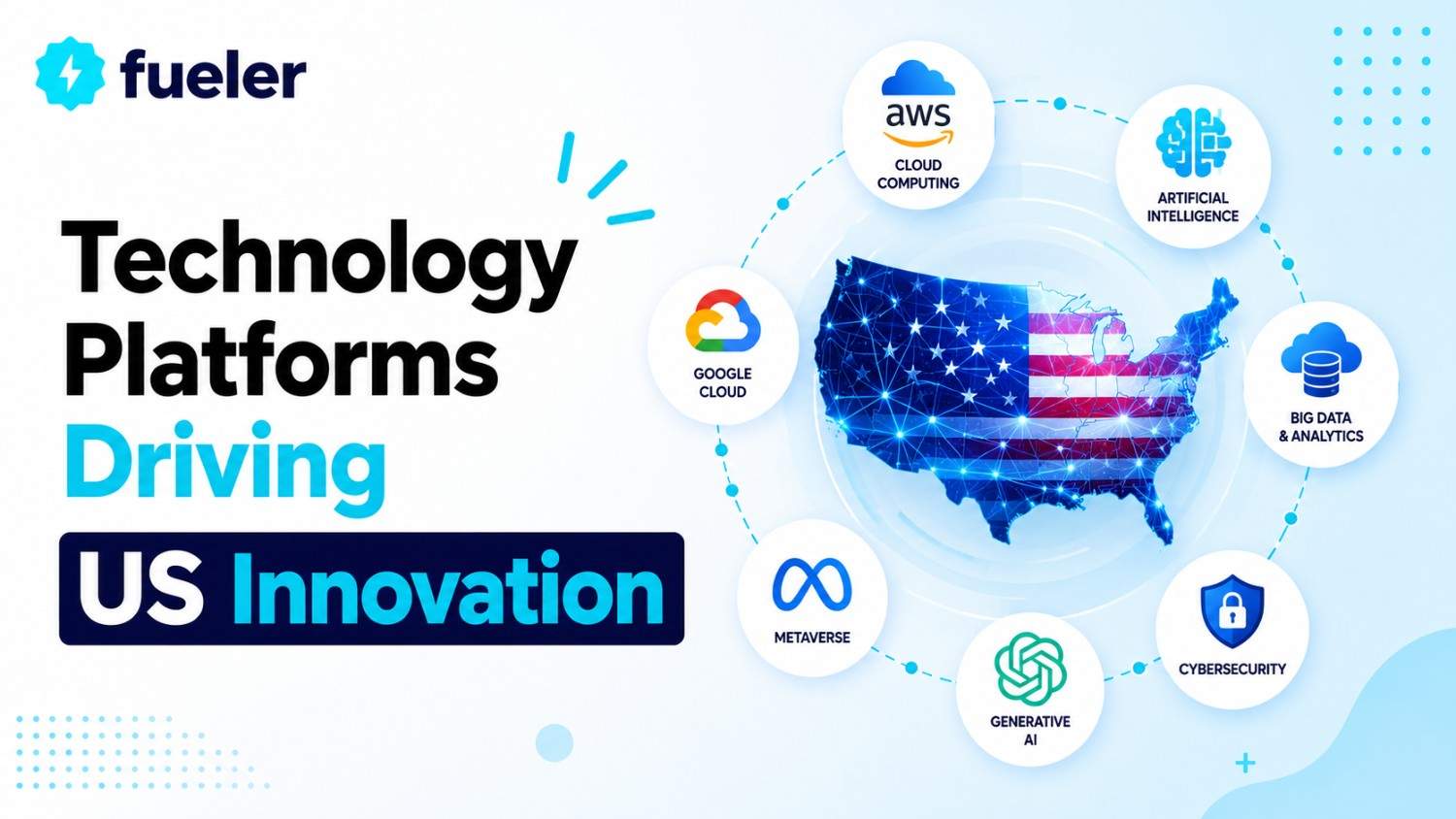
The pace of technological change in the United States has reached a fever pitch in 2026, moving far beyond simple automation and into the realm of truly intelligent, autonomous systems. For professionals and business leaders, innovation is no longer about just having a digital presence; it is about how effectively you can orchestrate a complex web of AI, cloud, and data platforms to create value. In this environment, the "innovation gap" is widening between those who use legacy software and those who have adopted agile, AI-native ecosystems. If you want to remain competitive in the US market today, you must understand the platforms that are currently rewriting the rules of industry, from healthcare to high finance.
I’m Riten, the founder of Fueler - a skills-first portfolio platform that connects talented individuals with companies through assignments, portfolios, and projects, not just resumes/CVs. Think Dribbble/Behance for work samples + AngelList for hiring infrastructure.
1. OpenAI (Agentic Intelligence & Sora)
OpenAI remains the primary engine of US innovation in 2026, having transitioned from a simple chatbot provider to a full-scale "Agentic AI" ecosystem. Professionals now use OpenAI to deploy autonomous agents that can navigate the web, manage complex schedules, and even conduct preliminary research without human supervision. The introduction of Sora has also revolutionized the creative industry, allowing for the instant generation of cinematic-quality video that was once the exclusive domain of high-budget production houses. It is the core platform for any business looking to integrate deep intelligence into their daily operations.
- Agentic Workflow Execution: Users can now assign "goals" to AI agents which then plan and execute multi-step tasks across different software applications, such as booking travel, filing expenses, or updating CRM records.
- Sora Pro Video Suite: This advanced tool allows marketing teams to create high-fidelity, 4K resolution videos from text prompts, enabling rapid prototyping of commercials and social media content at a fraction of traditional costs.
- Custom GPT Ecosystem: Businesses can build private, internal AI models trained on their own proprietary data, ensuring that the AI understands specific company jargon, policies, and historical project contexts.
- Multimodal Reasoning: The latest models can "see" and "hear" in real-time, allowing engineers to hold up a circuit board to a camera and receive instant debugging advice or translation of physical documents.
- Enterprise Privacy Shield: OpenAI offers dedicated "Sovereign Cloud" options for US government and healthcare sectors, ensuring that all data remains within specific geographic boundaries and is never used for external training.
Pricing: * Free: Access to basic GPT-4o models.
- Plus: $20 per month for individual power users.
- Team: $30 per user/month for collaborative workspaces and admin controls.
Why it matters: OpenAI provides the "brain" for modern US enterprises, allowing them to automate cognitive labor and focus human energy on high-level creativity. It is the most critical tool for scaling operations in a labor-tight economy where efficiency is the only way to grow.
2. NVIDIA (AI Infrastructure & Omniverse)
NVIDIA has become the literal foundation of the American tech stack, providing the hardware and software needed to run the AI models that define 2026. Beyond just manufacturing chips, NVIDIA’s "Omniverse" platform allows US manufacturers to create "Digital Twins" of entire factories, simulating every movement of a robot before it is ever built. This allows for massive innovation in logistics and manufacturing, as companies can test and optimize their physical operations in a perfectly accurate virtual world. It is the platform that bridges the gap between digital code and physical reality.
- Omniverse Digital Twins: Large-scale simulation environments where engineers can test factory layouts, autonomous vehicle sensors, and robotic arms in a physics-accurate virtual space to prevent real-world errors.
- NVIDIA AI Enterprise: A comprehensive suite of software tools that helps companies deploy and scale AI models on their own servers or in the cloud, including pre-trained models for specific industries.
- CUDA Development Toolkit: The industry-standard platform for developers to write high-performance software that takes full advantage of GPU acceleration for tasks like 3D rendering and scientific computing.
- Holoscan for Healthcare: A specialized platform that allows medical device companies to integrate real-time AI processing into surgical robots and diagnostic imaging tools, improving patient outcomes through faster data.
- Cloud-Native Supercomputing: NVIDIA offers "DGX Cloud," giving startups access to massive amounts of computing power on a subscription basis, democratizing the ability to train large-scale AI models.
Pricing: * NVIDIA Omniverse: Individual use is free; Enterprise starts at $9,000 per year per team.
- AI Enterprise: Subscription-based, typically starting around $4,500 per GPU/year.
- DGX Cloud: Custom enterprise pricing based on computing requirements.
Why it matters: Without NVIDIA, the current AI boom in the US would physically stop. It provides the essential "heavy lifting" infrastructure that allows every other software on this list to function, making it the most important hardware-software hybrid for innovation.
3. Microsoft Azure (The Industrial Cloud)
Microsoft Azure has moved beyond general cloud storage to become the leading "Industry Cloud" provider for the US professional market. In 2026, Azure offers specialized cloud environments for retail, finance, and manufacturing that come pre-configured with the necessary security and compliance tools. Because of its deep integration with the Microsoft 365 suite, it is the natural choice for large American corporations that need to combine their existing office tools with advanced AI and data analytics. It is currently the backbone for most "Fortune 500" digital transformation projects.
- Azure OpenAI Service: Provides businesses with direct, secure access to OpenAI’s models within the Azure environment, allowing them to build AI apps with enterprise-grade security and reliability.
- Industry-Specific Clouds: Pre-built cloud architectures for sectors like "Azure for Healthcare" which are designed to be HIPAA-compliant from day one, saving companies months of manual configuration work.
- Azure DevOps: A complete set of tools for software teams to plan, develop, test, and deliver code faster, including automated security scanning and integration with popular coding languages like Python and Rust.
- Sentinel Security AI: An intelligent security platform that uses AI to analyze billions of signals across a company’s network to stop cyberattacks and data breaches before they can cause damage.
- Edge Computing Integration: Azure allows companies to run their applications directly on local hardware (like a factory floor or a ship) while still managing everything from a central cloud dashboard.
Pricing: * Pay-As-You-Go: Rates based on storage and compute usage.
- Azure Free Account: $200 in credits for 30 days + 12 months of popular free services.
- Enterprise Agreements: Customized multi-year contracts for large organizations.
Why it matters: Azure is where American "Big Tech" meets traditional industry. It provides a safe, scalable, and highly regulated environment where the most sensitive and important business data in the world is processed and turned into actionable innovation.
4. Snowflake (Data Cloud & AI Data Cleanrooms)
Snowflake has redefined how US companies handle their data by creating a "Data Cloud" where information can be securely shared and analyzed without ever having to move it. In 2026, its "Data Cleanrooms" are a major driver of innovation, allowing different companies (like a retailer and a credit card company) to analyze their combined data for insights without actually seeing each other’s private customer files. This solves the massive problem of data silos and allows for a level of collaborative intelligence that was previously impossible due to privacy laws.
- Secure Data Sharing: Snowflake allows organizations to give partners "read-only" access to specific data sets in real-time, eliminating the need for slow and risky data transfers via file exports.
- Cortex AI: A built-in AI service that allows users to run large language models directly on their data within Snowflake, making it easy to summarize millions of customer reviews or detect fraud patterns.
- Data Cleanrooms: A secure environment where two or more parties can join their data for joint analysis while keeping their sensitive, personally identifiable information (PII) completely hidden from each other.
- Snowpark for Developers: Allows data scientists to write code in languages like Python or Java directly inside Snowflake, enabling complex machine learning models to run right next to the data they need.
- Horizon Governance: A centralized tool for managing data privacy, security, and compliance across an entire global organization, ensuring that all data usage follows strict US regulations like CCPA.
Pricing: * On-Demand: Usage-based pricing (Credit-based) starting roughly at $2 per credit.
- Business Critical: Higher tier for regulated industries with enhanced security features.
- Private Link: Custom pricing for dedicated, secure network connections.
Why it matters: Data is the fuel for innovation, but most companies struggle to use it because it is messy or locked away. Snowflake provides the "clean pipes" and "storage tanks" that make data usable, safe, and profitable for American businesses.
5. Salesforce (Einstein 1 Platform)
Salesforce has transformed from a simple customer database into the "Einstein 1" platform, a fully integrated AI system for managing every single customer interaction. In 2026, it uses "Data Cloud" to pull in information from every part of a businessmarketing, sales, and support and feeds it into an AI that predicts exactly what a customer will want next. For US professionals in sales and marketing, Salesforce is the primary tool for driving revenue because it takes the guesswork out of which leads to follow and how to close deals.
- Einstein Copilot: A conversational AI assistant that lives inside the Salesforce interface, helping sales reps draft emails, summarize meetings, and update deal statuses using simple natural language commands.
- Salesforce Data Cloud: This feature connects billions of data points from different systems into a single "Golden Record" for every customer, ensuring that everyone in the company sees the same information.
- Tableau Pulse: An AI-powered version of the popular data visualization tool that automatically "surfaces" important trends in a company's data, such as a sudden drop in sales in a specific US region.
- Slack Integration (Salesforce + Slack): Allows teams to manage their entire sales pipeline and customer support tickets directly from within Slack, reducing the time spent switching between different apps.
- Flow Builder Automation: A low-code tool that allows non-technical managers to create complex business workflows, such as automatically sending a discount code to a customer who has a late support ticket.
Pricing: * Starter Suite: $25 per user/month for small teams.
- Professional: $80 per user/month for complete CRM features.
- Enterprise (with AI): Starts at $165 per user/month for advanced customization and Einstein features.
Why it matters: In a crowded market, customer experience is the only differentiator. Salesforce allows US companies to provide a deeply personalized experience at a massive scale, ensuring that every customer feels like they are the company’s only priority.
6. Palantir (Foundry & AIP)
Palantir has become the "secret weapon" for the most complex organizations in the US, including the military, major airlines, and massive manufacturing firms. Their "AIP" (Artificial Intelligence Platform) allows organizations to plug large language models into their private networks to make real-time decisions about supply chains, disaster response, and energy distribution. Unlike other tools, Palantir is designed to handle "messy," high-stakes data that changes every second, making it essential for the US infrastructure and defense sectors.
- AIP (Artificial Intelligence Platform): Allows users to build AI-driven "decision engines" that can suggest the best course of action during a crisis, such as rerouting cargo ships during a port strike.
- Foundry Data Integration: A powerful tool that takes hundreds of disconnected data sources from sensors to spreadsheetsand weaves them into a single, interactive map of an entire business.
- Ontology Management: Palantir creates a digital "twin" of a company’s logic, meaning the software understands how a "part" relates to a "machine" which relates to a "customer" in a way that makes sense to humans.
- Forward-Deployed Engineering: Palantir often sends its own engineers to work directly with clients, ensuring that the software is perfectly tuned to the specific innovative goals of the organization.
- Granular Security Controls: Designed for the highest levels of government security, Palantir allows managers to control exactly who sees every single piece of data down to the individual cell level.
Pricing: * Commercial: Generally starts in the hundreds of thousands of dollars per year (high-entry).
- AIP Bootcamps: Short-term paid pilot programs for companies to test AI use cases.
- Government: Custom contracts based on federal and defense department requirements.
Why it matters: When the stakes are high and the data is chaotic, Palantir provides the clarity needed to lead. It is the platform driving innovation in the most foundational parts of the US economy, from the power grid to the battlefield.
7. Amazon Web Services (AWS Bedrock)
AWS is the largest cloud provider in the world, and in 2026, its "Bedrock" service has become the go-to platform for developers building the next generation of AI apps. Bedrock allows companies to choose from multiple different AI models (like those from Anthropic, Meta, and Amazon itself) through a single interface, giving them the flexibility to swap models as technology improves. For US startups, AWS is the "innovation playground" where they can build, test, and launch new products to millions of users in just a few days.
- AWS Bedrock: A fully managed service that offers a choice of high-performing foundation models via an API, allowing developers to build generative AI apps without managing any underlying hardware.
- SageMaker for Machine Learning: A complete environment for data scientists to build, train, and deploy their own custom machine learning models at a scale that can handle billions of requests per second.
- AWS Supply Chain: A specialized application that uses ML to provide real-time visibility into inventory levels, helping US retailers avoid stockouts and reduce the carbon footprint of their shipping.
- Lambda Serverless Computing: Allows developers to run code for their apps without ever thinking about "servers," meaning they only pay for the exact milliseconds that their code is actually running.
- Nitro System Security: A specialized set of hardware and software that protects customer data in the cloud with physical-level isolation, making it one of the most secure platforms for US financial firms.
Pricing: * AWS Free Tier: Includes various "Always Free" and "12 Months Free" services.
- Pay-As-You-Go: Costs are based on the specific services (compute, storage, data transfer) used.
- Bedrock Pricing: Based on the number of "tokens" processed by the specific AI model you choose.
Why it matters: AWS is the "Lego set" of the modern tech world. It provides all the individual pieces, storage, compute, and AI that US innovators need to build whatever they can imagine, from a simple app to a global social network.
8. Stripe (The Financial Operating System)
Stripe has moved beyond just "processing credit cards" to become the entire financial infrastructure for the American internet economy. In 2026, Stripe’s "Billing" and "Treasury" platforms allow companies to launch new business modelslike global subscriptions or complex marketplacesin a matter of minutes. By handling all the complex "back-office" work like taxes, fraud prevention, and currency conversion, Stripe allows US entrepreneurs to focus entirely on their product and their customers rather than paperwork.
- Stripe Billing: An automated system for managing recurring subscriptions and tiered pricing, allowing businesses to easily change their prices and offer discounts without writing new code.
- Stripe Radar (AI Fraud Detection): Uses machine learning trained on billions of data points across the entire Stripe network to block fraudulent payments before they occur, protecting US merchants from losses.
- Stripe Treasury: A "Banking-as-a-Service" platform that allows non-financial companies (like Shopify or DoorDash) to offer their own bank accounts and debit cards to their users.
- Stripe Tax: Automatically calculates and collects sales tax, VAT, and GST in over 40 countries, ensuring that US-based global sellers remain compliant with local laws without hiring a massive tax team.
- Connect for Marketplaces: The industry-standard tool for platforms that need to pay out money to thousands of different people (like Uber drivers or Etsy sellers) in multiple different currencies.
Pricing: * Integrated: 2.9% + 30¢ per successful card charge (standard for most businesses).
- Stripe Tax: 0.5% per transaction where tax is calculated.
- Custom: Tailored pricing for businesses with high transaction volumes or unique models.
Why it matters: Innovation cannot happen without a way to get paid. Stripe simplifies the most difficult part of business, moving money, and makes it as easy as writing a few lines of code, enabling a whole new generation of US-based digital businesses.
9. Adobe (Creative Cloud & Firefly)
Adobe has successfully integrated generative AI into the creative professional’s daily workflow through its "Firefly" model. In 2026, US designers and video editors no longer spend hours on manual tasks like removing backgrounds or color grading; instead, they use AI to generate entire scenes or "expand" an image with a single click. Adobe’s platform is unique because its AI is trained only on licensed content, making it the only "safe" choice for major US brands that are worried about copyright and legal issues with AI-generated art.
- Adobe Firefly Video Model: Allows video editors in Premiere Pro to generate B-roll footage or add objects to a scene simply by typing a text description, significantly speeding up the post-production process.
- Generative Fill in Photoshop: Designers can add, remove, or expand parts of an image using text prompts that match the lighting, perspective, and style of the original photo perfectly.
- Adobe Express (AI-Powered): A simple, web-based design tool that allows non-designers to create professional social media graphics and videos using AI templates and a massive library of stock assets.
- Content Authenticity Initiative: A system that adds "Content Credentials" to every AI-generated file, showing exactly how the image was made and providing transparency to combat "deepfakes" in the US media.
- Real-Time Collaboration (Frame.io): A specialized platform for video teams to share their work with clients for feedback, allowing for frame-by-frame comments and instant approvals from anywhere in the world.
Pricing: * Creative Cloud All Apps: $59.99 per month for individuals.
- Single App (e.g., Photoshop): $22.99 per month.
- Creative Cloud for Teams: $91.99 per license per month for advanced collaboration features.
Why it matters: Creative work is being transformed by AI, and Adobe is the platform that is making that transition professional and legal. It ensures that US creatives can work at the "speed of thought" without sacrificing the quality or security that their clients demand.
10. ServiceNow (The AI Platform for Business Transformation)
ServiceNow has become the "OS for the Enterprise" by creating a single platform that connects IT, HR, and Customer Service workflows. In 2026, their "Now Assist" AI acts as a universal helper that can solve an employee’s IT problem, approve a vacation request, and update a customer’s billing info all through one chat box. For large US organizations that are drowning in different software and manual processes, ServiceNow is the platform that finally brings everything together and makes the business run smoothly.
- Now Assist for Employees: An AI-powered "Self-Service" portal where employees can get instant answers to HR or IT questions, reducing the workload on internal support teams.
- Workflow Automation (App Engine): A low-code platform that allows different departments to build their own custom apps to automate specific business processes without needing to hire a team of developers.
- AIOps (AI for Operations): Uses machine learning to monitor a company’s entire IT infrastructure and predict when a server or software might fail, allowing the team to fix it before it affects the business.
- Customer Service Management (CSM): Connects customer support directly to the other departments that need to solve the problem, ensuring that a customer’s issue is tracked and resolved as fast as possible.
- ESG (Environmental, Social, and Governance) Tracker: A specialized tool that helps US companies track their carbon footprint and social impact goals, ensuring they meet the new regulatory requirements for 2026.
Pricing: * Enterprise: Custom pricing based on the number of "users" or "nodes" being managed (typically starts at $50k+).
- Starter: Modular pricing based on which specific workflows (IT, HR, or CSM) you choose to activate.
- Professional/Ultra: Higher tiers that include more advanced AI and predictive analytics features.
Why it matters: Large companies are often slowed down by their own size. ServiceNow uses AI to cut through the bureaucracy and "legacy" mess, allowing the biggest US firms to move with the speed and agility of a small startup.
11. Google Cloud (Vertex AI)
Google Cloud has established itself as the leader in "Data-Driven Innovation" by offering the most advanced tools for analyzing massive amounts of information. In 2026, its "Vertex AI" platform is where the world’s most advanced research and development happens, as it gives users access to Google’s most powerful "Gemini" models. For US professionals in data science and biotech, Google Cloud is the essential platform for running "heavy" simulations and discovering new patterns in everything from genetic code to global weather patterns.
- Vertex AI Platform: A unified platform for building and deploying AI models that includes "Model Garden," a library of hundreds of pre-trained models that can be customized for any business use case.
- BigQuery Data Warehouse: A specialized tool that allows companies to analyze petabytes of data in seconds using simple SQL, making it the fastest way for US firms to get insights from their customer behavior.
- Gemini for Google Workspace: Integrates advanced AI directly into Google Docs, Sheets, and Gmail, helping professionals write reports, organize data, and summarize long email chains instantly.
- Looker (BI and Analytics): A powerful data visualization platform that allows everyone in a companynot just data scientists, to create interactive dashboards and explore their own data in real-time.
- Google Distributed Cloud: Allows US companies to run Google’s powerful AI and data tools in their own private data centers or "at the edge," satisfying strict data privacy and security requirements.
Pricing: * Free Trial: $300 in credits for new customers to explore the platform.
- Pay-As-You-Go: Usage-based pricing for individual services like storage and AI compute time.
- Workspace AI: $20 to $30 per user/month as an add-on to the standard Google Workspace plan.
Why it matters: Innovation today is a "data game," and Google Cloud has the best tools to win that game. It allows US companies to turn their "raw data" into "raw intelligence," giving them a massive head start over competitors who are still guessing.
12. Databricks (Data Intelligence Platform)
Databricks is the pioneer of the "Lakehouse" architecture, which combines the best parts of a data lake and a data warehouse into one system. In 2026, it is the platform of choice for US companies that need to run "Real-Time AI," such as fraud detection in banking or personalized recommendations in e-commerce. By making data "intelligent," Databricks allows companies to move from just "looking at the past" to "predicting the future" with a level of accuracy that was previously impossible.
- Data Lakehouse Architecture: Allows companies to store all their data (both structured like spreadsheets and unstructured like videos) in one place and analyze it all with the same set of tools.
- Mosaic AI: A specialized suite for building and training custom generative AI models that are specifically tuned to a company's private data, ensuring the highest level of accuracy and security.
- Unity Catalog: A centralized tool for managing the security and "lineage" of a company's data, showing exactly where every piece of information came from and who is allowed to see it.
- Delta Live Tables: Allows engineers to build "real-time" data pipelines that update automatically as new information comes in, which is crucial for things like monitoring stock market fluctuations.
- MLflow for MLOps: The industry-standard tool for managing the entire lifecycle of a machine learning model, from the first experiment to running it at scale for millions of users.
Pricing: * Community Edition: Free for individuals and students to learn the platform.
- Standard/Premium: Usage-based pricing (DBUs) starting around $0.07 to $0.40 per unit, depending on the compute power.
- Enterprise: Custom pricing for large organizations requiring dedicated security and 24/7 support.
Why it matters: As AI becomes more common, the only way to win is to have "Better AI" that is trained on better data. Databricks provides the infrastructure for US companies to build truly unique and intelligent AI systems that their competitors can’t copy.
13. Atlassian (Jira & Confluence Cloud)
Atlassian is the "backbone of the engineering world," providing the tools that US software teams use to plan, track, and ship their products. In 2026, "Atlassian Intelligence" was integrated across Jira and Confluence, helping teams automatically generate project status reports and find the right technical documentation instantly. It is the platform that keeps the complex "gears" of a tech company moving, ensuring that thousands of developers can work together on the same product without everything falling apart.
- Jira Product Discovery: A new tool that helps product managers gather ideas from across the company and prioritize them based on their potential impact and the effort required to build them.
- Atlassian Intelligence (AI): A built-in assistant that can summarize long project threads, draft technical documentation, and even "translate" complex Jira tickets into simple English for non-technical managers.
- Confluence Whiteboards: An integrated digital whiteboard that allows teams to brainstorm visually and then instantly turn their sticky notes into real Jira tasks with a single click.
- Compass for Microservices: A specialized dashboard that helps software engineers track all the different "pieces" of their app, showing who owns each part and whether it is currently running correctly.
- Bitbucket Code Management: A git-based system for teams to store their code and collaborate on changes, including built-in security testing and automated "CI/CD" pipelines.
Pricing: * Free: Up to 10 users for basic versions of Jira and Confluence.
- Standard: $8.15 per user/month for Jira; $6.05 per user/month for Confluence.
- Premium: $16 per user/month for Jira; $11.50 per user/month for Confluence (includes advanced roadmaps and AI).
Why it matters: Software is never "finished"; it is always being built and updated. Atlassian provides the essential management tools that allow the US tech industry to ship high-quality code at a massive scale, day after day.
14. Figma (The Design Collaborative Cloud)
Figma has completely changed how digital products are designed by moving the entire process from a solo designer’s desktop to a collaborative cloud environment. In 2026, it is used by almost every major US tech firm to design their websites, apps, and internal software. With the addition of AI-powered "Dev Mode," it has also bridged the gap between designers and developers, allowing teams to go from a "sketch" to a "finished app" faster than ever before in history.
- Figma AI (Design Generator): Designers can describe a new app screen or a set of icons in text, and Figma will generate several high-quality design options that the designer can then customize and refine.
- Dev Mode Interface: A specialized view for developers that automatically translates design elements into clean code (CSS, Swift, React), significantly reducing the friction during the "handoff" process.
- Variables and Design Systems: Allows companies to create a "Single Source of Truth" for their colors, fonts, and icons, ensuring that their brand looks exactly the same across every device and platform.
- FigJam AI Whiteboarding: An intelligent digital whiteboard that can automatically organize sticky notes from a brainstorming session into a structured project plan or a user journey map.
- Real-Time Multiplayer Editing: Dozens of users can work in the same file at the same time, making it the perfect tool for remote US teams to collaborate during live "design sprints."
Pricing: * Starter: Free for 3 files and limited features.
- Professional: $15 per editor/month for unlimited files and advanced sharing.
- Organization: $45 per editor/month for centralized design systems and enterprise-wide security.
Why it matters: In 2026, a bad user experience (UX) is the fastest way to lose a customer. Figma allows US teams to iterate on their designs instantly and test them with real users before writing a single line of code, ensuring that every product is a success.
15. Zoom (Workplace AI Platform)
Zoom has successfully evolved from a simple "video call app" into a comprehensive "AI Workplace Platform" that manages all forms of professional communication. In 2026, the "Zoom AI Companion" is a standard feature for US professionals, providing them with meeting summaries, drafted emails, and real-time coaching for their presentations. It is the platform that enables the "Remote-First" innovation culture that has allowed US companies to hire the best talent from across the country without needing a physical office.
- Zoom AI Companion: A 100% free-to-use AI assistant (with paid plans) that summarizes meetings you missed, drafts follow-up tasks, and highlights the key decisions made during a call.
- Zoom Contact Center: An AI-powered customer support platform that helps agents solve problems faster by suggesting the best answers and summarizing the customer’s entire history in real-time.
- Zoom Phone and Huddles: A modern replacement for office phone systems that allows teams to jump into quick audio or video "huddles" for spontaneous collaboration that feels like being in a real office.
- Virtual Event Platform: Allows US companies to host massive online conferences and webinars for up to 50,000 people, including live polling, networking rooms, and AI-generated subtitles.
- Zoom Whiteboard: A persistent digital canvas that teams can use before, during, and after a meeting to map out ideas, with all changes saved automatically and accessible from any device.
Pricing: * Basic: Free for 40-minute meetings and up to 100 participants.
- Pro: $15.99 per user/month for unlimited meeting time and cloud recording.
- Business: $21.99 per user/month for up to 300 participants and company branding.
Why it matters: Innovation is a team sport, and Zoom provides the "stadium" where that team plays. By making virtual communication feel as natural as being in person, it has unlocked a new level of productivity and collaboration for the modern US workforce.
Showcase Your Innovation Proof with Fueler
As you master these 15 powerful platforms, the biggest challenge you will face is proving your expertise to the world. Most traditional resumes are too static to show how you used Palantir to optimize a supply chain or how you designed a viral app in Figma. This is where Fueler becomes your most valuable asset. Fueler allows you to create a dynamic, skills-first portfolio where you can host your actual project files, design prototypes, and case studies. By showing your "Proof of Work" rather than just a list of skills, you allow US companies to see the real value you bring, making you the obvious choice in a sea of generic applications.
Final Thoughts
Innovation in 2026 is no longer about the "lone genius" working in a garage; it is about the professional who knows how to leverage the right platforms to amplify their own abilities. From the raw computing power of NVIDIA and AWS to the creative freedom of Adobe and Figma, the tools listed here are the true drivers of the American economy. By integrating these platforms into your daily workflow and showcasing those results on Fueleryou aren't just keeping up with the future, you are actively building it. The most successful people of this era will be those who view these tools not as distractions, but as the essential infrastructure for their own personal and professional growth.
Frequently Asked Questions (FAQs)
What are the most essential technology platforms for US startups in 2026?
For a startup looking to innovate quickly, the most essential tools are AWS for scalable infrastructure, Stripe for global payments, and OpenAI for integrating intelligence into your product. These platforms allow a small team to handle massive amounts of work with very little manual effort, effectively leveling the playing field against much larger established competitors.
Is it expensive for a small US business to adopt these innovation tools?
Actually, many of these platforms offer very generous "Free Tiers" or "Startup Programs" that provide thousands of dollars in credits to help you get started. Tools like Zoom, Notion, and Figma are free for small teams, while AWS and Google Cloud offer substantial credits for new companies. This means you can build a world-class tech stack without a massive upfront investment.
Which platforms are leading the way in ethical and safe AI in the US?
Adobe and Microsoft are currently at the forefront of ethical AI. Adobe’s Firefly is trained only on licensed content to protect creators, and Microsoft Azure offers "Confidential Computing" to ensure that your private data is never exposed during AI processing. These platforms are the best choice for professionals who need to maintain high standards of privacy and legal compliance.
How do these platforms help US companies become more sustainable?
In 2026, platforms like Google Cloud and AWS are investing heavily in "Green Computing," allowing you to run your digital operations with almost zero carbon emissions. Additionally, tools like ServiceNow and Palantir help companies track their supply chains and energy usage, identifying areas where they can reduce waste and operate more efficiently, which is both good for the planet and for their profits.
What is the best way to stay updated on new professional tech tools?
The tech landscape moves fast, so the best way to stay updated is to follow industry-leading blogs and join communities of "Early Adopters." Many of these platforms have their own "Beta" programs where you can test new features before they are released to the public. Additionally, keeping an eye on the "Proof of Work" being shared on platforms like Fueler will show you exactly which new tools the top professionals are using to get hired today.
What is Fueler Portfolio?
Fueler is a career portfolio platform that helps companies find the best talent for their organization based on their proof of work. You can create your portfolio on Fueler. Thousands of freelancers around the world use Fueler to create their professional-looking portfolios and become financially independent. Discover inspiration for your portfolio
Sign up for free on Fueler or get in touch to learn more.

What should you do next?
You've read the article. Now turn your skills into proof of work and unlock more opportunities.
Build your proof of work portfolio
Create a clean portfolio with projects, assignments, resumes, and AI stack details that companies actually want to see.
Create your Fueler portfolio →Apply through assignments, not resumes
Stand out by solving real tasks from companies hiring on Fueler.
Explore assignments →Get discovered by companies
Make your work public and let recruiters discover your skills through actual projects instead of keywords.
Get discovered →
