Top 15 Startup and Entrepreneurship Courses in 2026

Riten Debnath
17 Feb, 2026
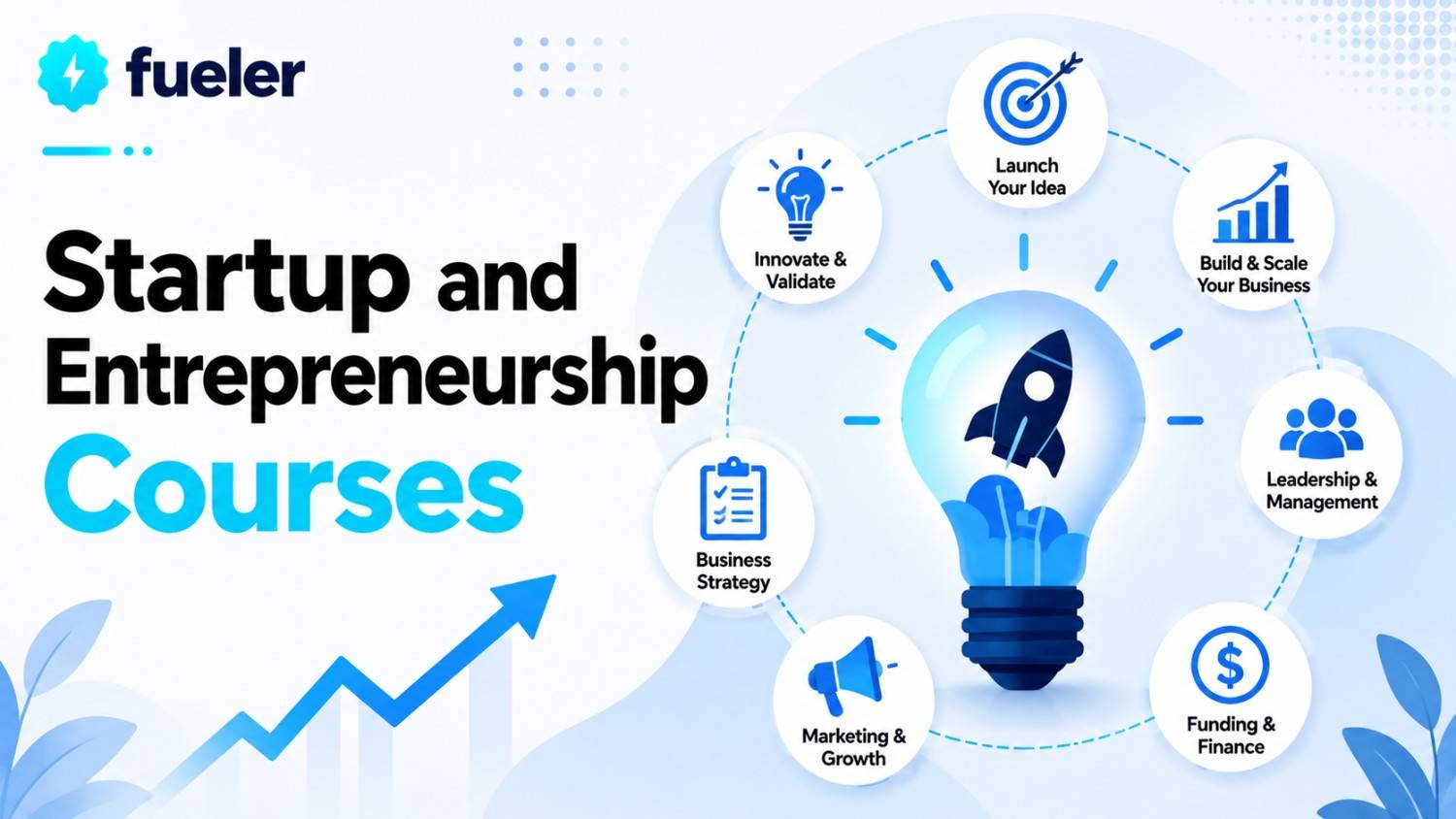
The venture landscape in 2026 has transitioned from a period of "blitzscaling" at any cost to a new era of Resilient Innovation. With capital markets demanding faster paths to profitability and generative AI disrupting traditional business models, founders now need a specialized education that blends rapid experimentation with disciplined financial management. The following courses are curated from the world's most prestigious institutions and accelerators, offering the updated frameworks required to build and scale a defensible global venture in today's high-stakes economy.
I’m Riten, founder of Fueler, a skills-first portfolio platform that connects talented individuals with companies through assignments, portfolios, and projects, not just resumes/CVs. Think Dribbble/Behance for work samples + AngelList for hiring infrastructure.
1. Startup School (Y Combinator)
Y Combinator’s Startup School remains the undisputed gold standard for early-stage education, specifically designed for founders who are in the pre-seed or seed stages of development. In 2026, the curriculum has been overhauled to prioritize AI-Defensibility, teaching you how to build proprietary value beyond simple API wrappers. This free, 8-week program provides the same high-intensity advice given to unicorn companies like Airbnb and Dropbox, focusing on moving fast and talking to users.
- The program centers on the Product-Market Fit framework, utilizing real-world data from thousands of YC alumni to teach you how to iterate your product based on actual user behavior rather than theoretical market research that often leads to building unwanted features.
- You gain access to weekly Group Office Hours sessions where you can pitch your current progress to seasoned YC partners and receive the kind of surgical, unfiltered feedback that is typically reserved for the top 1% of funded startups in their active batches.
- Participants receive over $30,000 in Founder Perks, including massive credits for essential infrastructure like AWS, Stripe, and Google Cloud, which are critical for extending your initial runway and reducing burn rates in a competitive, high-interest-rate market.
- You will learn the rigorous Weekly Update discipline, which involves tracking a single North Star metric such as weekly active users or revenue to ensure your team remains obsessively focused on growth and survival rather than vanity metrics that don't drive business value.
- The 2026 version features an AI-First Operations track where founders of multi-billion dollar companies break down their technical stacks and early-stage hiring strategies, showing you how to leverage automation to keep your team lean and your overhead incredibly low.
Why it matters: In the 2026 startup ecosystem, the cost of being "wrong" about your market is higher than ever due to increased competition. This course matters because it forces you to validate your assumptions immediately, saving you years of building a product that nobody actually wants or is willing to pay for.
2. Stanford Ignite (Stanford Graduate School of Business)
Stanford Ignite is a high-intensity, certificate-based program specifically engineered for non-business professionals such as engineers, scientists, and PhDswho want to commercialize technical innovations. Based in the heart of Silicon Valley, this program distills the core business skills of an MBA into a condensed, immersive format that lasts four weeks full-time. It is the premier choice for those looking to bridge the gap between deep-tech research and the professional venture capital world.
- You will participate in a Team Venture Project where you and a group of fellow innovators commercialize a real-world business idea, receiving direct, high-stakes feedback from active Silicon Valley VCs and angel investors who evaluate your plan as a potential investment opportunity.
- The curriculum provides academically rigorous training in the Foundations of Business, including detailed modules on accounting, venture finance, operations, and marketing, all specifically tailored for the fast-paced and unpredictable nature of new venture creation rather than corporate management.
- You will undergo a daylong Communications Bootcamp designed to sharpen your elevator pitch and executive presence, ensuring you can present complex technical concepts to non-technical investors with total clarity and the confidence required to secure large-scale funding rounds.
- The program offers unparalleled networking opportunities, allowing you to build deep relationships with Stanford GSB’s world-class faculty and a cohort of high-achieving peers from diverse industries across the globe, creating a support network that lasts your entire career.
- You will master the Venture Finance Essentials module, which demystifies the fundraising process, teaches you how to read complex term sheets, and explains how to manage ownership dilution effectively as your company scales from seed to Series A and beyond.
Why it matters: Technical brilliance does not always translate to business success, and many great inventions fail due to poor commercialization. This course matters because it provides the "Missing Business Link" for innovators, teaching them how to build a scalable, profitable company around their invention.
3. Entrepreneurship Essentials (Harvard Business School Online)
Harvard’s online offering uses the legendary HBS "Case Method" to introduce learners to the reality of the entrepreneurial journey through the eyes of successful founders. This 4-week program focuses on a proven frameworkPeople, Opportunity, Context, Deal which has been refined over 30 years and taught to thousands of MBA students. In 2026, it serves as the premier foundational course for those who need to understand the structural mechanics of how a startup is financed and governed.
- The program utilizes Interactive Case Studies where you step into the shoes of a real-life founder during critical moments, helping you develop the decision-making intuition needed to lead a team through the high-stress environments typical of early-stage startups.
- You will learn the POCD Framework to evaluate any business opportunity systematically, analyzing the team’s capability, the market timing, and the specific legal terms of the deal to determine if an idea is truly viable before committing your life to it.
- The course provides a deep dive into Start-up Finance, teaching you how to read cap tables, understand venture capital structures, and articulate your financial "ask" to potential investors with professional confidence and technical accuracy that commands respect.
- Participants engage in a Global Peer Review system, where you exchange ideas and feedback with thousands of other aspiring entrepreneurs, building a diverse network that spans every continent and industry, providing a truly global perspective on business innovation.
- You will learn how founders run structured experiments to validate ideas and refine business strategies, moving away from "gut feelings" and toward a rigorous, data-driven approach to product development that maximizes your chances of success in any market.
Why it matters: Many founders fail because they don't understand the "rules of the game" regarding equity and governance. This course matters because it provides a professional-grade foundation in the mechanics of entrepreneurship, ensuring you are never at a disadvantage when sitting across from experienced investors.
4. Disciplined Entrepreneurship Bootcamp (MIT Bootcamps)
Based on the methodology developed by Bill Aulet at MIT, this 5-day high-intensity bootcamp is designed to help science-based and deep-tech companies move from the laboratory to the market. The program is rooted in the practices of MIT's startup ecosystem, which has produced over 15,000 successful companies. In 2026, the bootcamp emphasizes "Market-Ready Experimentation," forcing founders to build, test, and iterate quickly based on direct feedback from potential customers.
- You will master the 24 Steps to a Successful Startup methodology, a rigorous, step-by-step framework that covers everything from initial market segmentation and beachhead strategy to defining your core value proposition and competitive "moat" in detail.
- The program focuses on Customer Discovery Mastery, teaching you how to conduct high-value interviews that uncover meaningful challenges that organizations are willing to pay significant amounts of money to solve, rather than just solving minor inconveniences that don't scale.
- You receive world-class mentorship from international trainers and MIT faculty who have led investments in several deep-tech startups, providing you with a strategic approach to scaling your technical innovation globally and navigating international trade and patent laws.
- The bootcamp includes an intensive focus on Team Dynamics, teaching you how to manage different personalities and behavioral styles to ensure your founding team remains cohesive, efficient, and resilient during high-pressure periods that often break less disciplined groups.
- Participants gain access to a global network of mentors and a framework used by the world's leading deep-tech startups, allowing you to leverage a support system that provides ongoing advice and partnership opportunities long after the bootcamp concludes.
Why it matters: Deep-tech startups often face longer development cycles and higher risks than pure software plays. This course matters because it provides a "Disciplined Road Map" that reduces risk and ensures that your scientific breakthrough actually finds a profitable home in the commercial market.
5. Entrepreneurship Certificate (Wharton Online)
Wharton Online’s Entrepreneurship Certificate is a multi-course, self-paced program designed to help professionals turn ideas into actionable ventures using evidence-based frameworks. The curriculum is built around three distinct stages: Inspiration, Identification, and Implementationaimed at demystifying the complex startup process. In 2026, this certificate is ideal for professionals navigating career transitions or those looking to drive innovation from within large, established organizations.
- You will explore Becoming Entrepreneurial, a course that reframes entrepreneurship as value creation through innovation and helps you identify which of the seven distinct entrepreneurial pathways aligns best with your personal skills, risk tolerance, and long-term goals.
- The Opportunity Identification module equips you with structured methods like "Innovation Tournaments" and the "Triple Diamond Model" to distinguish promising high-potential opportunities from distracting but low-value ideas that often waste a founder's most precious resource: time.
- You will learn Venture Implementation strategies, focusing on how to build and lead high-performance teams, manage effective boards of directors, and engage investors for sustainable, long-term business growth rather than just chasing short-term valuation spikes.
- The program emphasizes disciplined thinking and experimentation over anecdotal advice, using decades of Wharton research to provide you with tools that are proven to work in diverse economic climates and across various industries, from retail to biotech.
- You will develop a comprehensive Launch Plan as part of the capstone project, allowing you to apply everything you've learned to your own business idea and receive academic validation that your strategy is sound and ready for real-world execution.
Why it matters: Corporate innovation (intrapreneurship) is becoming a critical survival skill for established companies. This course matters because it provides a world-class framework for both independent founders and corporate leaders to drive growth through systematic, repeatable innovation strategies.
6. The Lean Startup Strategy (Columbia Business School - Executive Education)
This program is designed for founders and corporate innovators who need to apply the scientific method to business building. In 2026, when capital efficiency is the most important metric, Columbia’s curriculum focuses on the "Build-Measure-Learn" feedback loop to minimize waste. It teaches you how to design rigorous experiments that validate your riskiest assumptions before you commit significant capital to a full-scale launch.
- You will master the Pivot vs. Persevere decision framework, which utilizes real-time data analytics to determine whether your current business model is gaining genuine traction or if you need to fundamentally change your strategic direction to survive.
- The curriculum provides deep-dive training into Minimum Viable Product (MVP) Engineering, showing you how to build functional prototypes with no-code tools that test core value propositions without the high costs of a finished, polished software product.
- You will learn Validated Learning techniques, which involve setting up automated systems to track user behavior and engagement metrics, ensuring that every feature you build is backed by a demonstrated need from your target market rather than a founder's whim.
- The program includes a specialized module on Innovation Accounting, a disciplined approach to measuring progress in the early stages of a startup when traditional financial statements like P&L or balance sheets are not yet relevant or helpful for growth.
- Participants engage in high-level peer coaching sessions where you analyze the failures and successes of other startups in the cohort, helping you develop a broader perspective on the common pitfalls and hidden opportunities in the modern entrepreneurial journey.
Why it matters: In the 2026 economy, investors no longer fund "ideas," they fund "evidence." This course matters because it gives you the tools to gather that evidence quickly and cheaply, ensuring you don't spend months building something that the market eventually rejects.
7. Oxford Fintech Programme (Saïd Business School, University of Oxford)
As financial technology remains the backbone of the 2026 startup world, Oxford’s Fintech Programme provides the essential framework for understanding the intersection of finance, technology, and regulation. This course is vital for entrepreneurs building in the DeFi, payments, or neobanking sectors who need to navigate the complex legal landscapes of the global economy. It combines historical context with forward-looking projections on how AI and blockchain are reshaping money.
- You will explore the fundamentals of Fintech innovations, including blockchain, artificial intelligence, and open banking, gaining a strategic understanding of how these technologies are actively reshaping the competitive landscape of the global financial services industry today.
- The curriculum investigates Regulatory Perspectives globally, helping you understand the differing legal requirements in the USA, EU, and Asia, which is critical for any founder aiming to build a cross-border financial product in a highly regulated environment.
- You will delve into Entrepreneur Perspectives, analyzing case studies of successful fintech startups to understand how they navigated early-stage challenges like customer acquisition, trust-building, and securing partnerships with traditional banking institutions that often resist disruption.
- The program provides an Incumbent Perspective, teaching you how traditional banks are collaborating with or competing against startups, giving you the strategic insight needed to position your company as a valuable partner or a formidable disruptor.
- You will gain insight from Investor and Academic Perspectives, looking at fintech through the lens of those who fund and research the sector, helping you anticipate future trends in capital flow and technological breakthroughs before they hit the mainstream.
Why it matters: Fintech is one of the hardest industries to break into due to the high barrier of regulation and trust. This course matters because it provides the "Global Regulatory Roadmap" and technical foundation required to build a fintech startup that is both innovative and fully compliant.
8. Hero Training (Draper University)
Draper University, founded by legendary VC Tim Draper, offers "Hero Training," a 5-week intensive program in Silicon Valley designed to "un-train" traditional thinking. It is famous for its unconventional methods, including a survival week with Navy SEALs, and its focus on radical disruption and "10x" thinking. In 2026, this course is the premier destination for founders who want to immerse themselves in the high-energy, high-risk culture of the world's most famous startup hub.
- You will experience extreme out-of-the-box thinking exercises designed to break your fear of failure and encourage you to tackle massive, global problems that most people think are impossible, fostering a mindset of radical, world-changing innovation.
- The program features daily talks from iconic Silicon Valley figures, including billionaire investors and founders of unicorn companies, providing you with raw, unfiltered insights into the reality of building a global empire from a single idea.
- You will participate in a one-week survival course led by U.S. Navy SEALs, which is designed to test your mental and physical resilience, teaching you the leadership and teamwork skills required to survive the "dark days" of a startup's lifecycle.
- The curriculum includes a high-stakes Pitch Day to Tim Draper and a panel of other elite investors, giving you a real-world opportunity to secure funding and mentorship from some of the most successful venture capitalists in history.
- You gain access to a vibrant, lifelong community of "Draper Heroes" spanning over 100 countries, providing you with a global network of partners, co-founders, and friends who share your radical approach to business and life.
Why it matters: Most startups fail not because of a bad product, but because the founder lacks the mental resilience to keep going when things get tough. This course matters because it builds "Founder Fortitude," preparing you for the psychological warfare of high-growth entrepreneurship.
9. Launching New Ventures (UC Berkeley Haas)
UC Berkeley Haas offers this experiential course that focuses on the "Lean Launchpad" methodology. In 2026, the program is unique because it integrates Berkeley's leadership in social impact and environmental sustainability into the core startup process. It is ideal for founders who want to build "Benefit Corporations" or startups that solve major planetary challenges while still achieving massive commercial scale and profitability.
- You will use the Business Model Canvas to map out and test every component of your company in real-time, moving away from static business plans and toward a dynamic, living document that evolves based on direct market feedback.
- The course emphasizes experiential learning through "Startup Lab," where you work alongside engineering and design students to build actual products, ensuring your business strategy is grounded in technical reality and feasible product timelines.
- You will master the art of Social Lean Launchpad, a specialized track that teaches you how to measure and scale social impact alongside financial returns, which is increasingly a requirement for modern ESG-focused venture capital funds.
- Participants engage in intensive customer discovery sessions, where you are required to "get out of the building" and talk to hundreds of potential users, ensuring your product solves a "hair on fire" problem for a specific, identifiable niche.
- The program leverages Berkeley's Skydeck business accelerator, providing a direct path for the most promising student startups to receive funding, workspace, and elite mentorship from one of the world's top university-affiliated incubators.
Why it matters: The 2026 consumer cares about more than just a product; they care about a company's "Why." This course matters because it teaches you how to build a mission-driven startup that attracts top talent and loyal customers by solving the world's most urgent problems.
10. Corporate Venturing and Innovation (INSEAD)
For those looking to innovate within large organizations or build startups that partner with "Big Tech," INSEAD’s Corporate Venturing program is the global leader. In 2026, as large corporations increasingly act like VCs, this 5-day program in Fontainebleau or Singapore teaches you how to bridge the gap between "Startup Agility" and "Corporate Scale." It is essential for B2B founders and corporate innovation officers who need to navigate complex partnerships.
- You will learn how to build a game-changing portfolio of investments in new companies, understanding the strategic and financial considerations that large corporations use when deciding which startups to acquire, partner with, or fund.
- The curriculum focuses on Driving Innovation through Corporate-Startup Collaboration, showing you how to design "win-win" structures that allow startups to access corporate resources without being smothered by corporate bureaucracy and slow decision-making processes.
- You will master Resilience and Agility frameworks, learning how to pivot large-scale organizations toward new technologies like AI and blockchain before they are disrupted by smaller, faster competitors in the open market.
- The program provides training in Developing Advanced Value Propositions, teaching you how to articulate the value of an innovative technology in a way that resonates with corporate C-suite executives who prioritize stability and risk mitigation.
- Participants gain a global perspective on innovation, networking with senior leaders from the world's largest companies and learning how different cultures and regulatory environments affect the success of corporate ventures and internal startup programs.
Why it matters: The biggest exit for most startups is an acquisition by a larger company. This course matters because it teaches you how "Big Business" thinks about innovation, allowing you to position your startup as an irresistible acquisition target or a strategic partner.
11. Product Management – Strategy and Innovation (London Business School)
Entrepreneurship in 2026 is often synonymous with great Product Management. This LBS program focuses on the "blended" role of the modern founder-as-product-leader. It teaches you how to use design thinking and emerging technologies to transform raw ideas into MVPs and eventually into market-leading products. It is the best course for technical founders who need to develop a "Product-First" business strategy that scales globally.
- You will learn to transform abstract ideas into high-fidelity MVPs using design thinking and no-code tools, ensuring that your initial product release is both technically sound and deeply aligned with the aesthetic and functional expectations of your target audience.
- The curriculum provides training in Growth Strategies for Fast-Changing Markets, showing you how to use product-led growth (PLG) tactics to acquire and retain users without the massive marketing budgets required by traditional sales models.
- You will discover the delicate balance between short-term experiments and long-term value, learning how to prioritize your product roadmap so that you are meeting current customer needs while building a defensible, long-term technological "moat."
- The program utilizes a blended learning journey with world-leading faculty and guest speakers from top tech companies, providing a mix of academic theory and practical, "front-line" advice on managing high-growth product teams in a global environment.
- You will master AI Product Development, learning the ethical, legal, and regulatory considerations of building AI-driven products, which is a critical skill for any founder launching a technology company in the 2026 market.
Why it matters: In a world of infinite software choices, the best product wins. This course matters because it teaches you how to build a product that "sells itself," reducing your customer acquisition costs and building a sustainable, defensible advantage over your competitors.
12. Master of Science in Management in Entrepreneurial Leadership (Babson College)
Babson has been ranked #1 for entrepreneurship for decades. Their MSEL program is designed specifically for recent graduates and early-career professionals who want to lead in a world defined by change. In 2026, Babson's focus is on "Entrepreneurial Thought & Action (ET&A)," a method that encourages starting with the resources you have and taking small, calculated steps toward a larger vision.
- You will learn the Entrepreneurial Thought & Action (ET&A) methodology, a unique Babson framework that prioritizes "Action" over "Analysis," teaching you how to move your project forward even when you have limited information or uncertain market conditions.
- The curriculum includes a deep dive into New Venture Creation, where you will write, articulate, and present a complete execution plan for a new business, receiving feedback from a faculty that consists almost entirely of successful former entrepreneurs.
- You will participate in Managing a Growing Business, a case-based course that focuses on the "Scale-Up" phase of a startup, teaching you how to build a professional organization that can sustain growth as the competitive environment shifts.
- The program offers a specialized module on M&A for Entrepreneurs, teaching you how to navigate the strategies of acquisitions and divestitures for companies in the $10 million to $500 million revenue range, which is the "Sweet Spot" for many founders.
- Participants gain access to the Foundations of Family Entrepreneurship, recognizing that many global startups are actually family-owned, and providing the specific leadership skills needed to manage the unique dynamics of a family-run business.
Why it matters: Most business schools teach you how to "manage" a company that already exists. Babson matters because it teaches you how to "create" a company from nothing, giving you the practical, "street-smart" skills that are the hallmark of successful founders.
13. FI Core Program (Founder Institute)
The Founder Institute is the world's largest pre-seed accelerator, with a presence in over 200 cities. Their "Core Program" is famous for its rigorless than 30% of founders who actually graduate. In 2026, the program is purely focused on building the Business, not just learning about it. It is designed for founders who are still in their full-time jobs and need a structured, after-hours path to launching their company with a solid legal and financial foundation.
- You will build your business through a proven, structured process that has helped over 6,000 companies raise more than $2 billion in funding, ensuring that you aren't skipping critical steps in the legal, financial, or operational setup of your venture.
- The program features weekly Feedback Sessions where you pitch your strategy and progress to a panel of "Local Leaders" and "Mentors," receiving the kind of harsh, realistic critique that is necessary to survive the first year of business.
- You will master Customer Development, learning how to analyze feedback and interpret user signals to validate your key assumptions and ensure you are pursuing a truly scalable business model that solves an actionable problem.
- The curriculum includes a Legal & Equity module, where startup lawyers and experienced CEOs explain cap tables, intellectual property protection, and various legal agreements in detail, ensuring your startup is "Investor-Ready" from day one.
- Participants join a Global Network of Graduates, providing you with a lifelong support system and "Peer Advisory Board" of other founders who have survived the program and are now scaling their own companies in diverse markets around the world.
Why it matters: Founder Institute is a "Proving Ground." This program matters because it weeds out the hobbyists from the true entrepreneurs, providing you with a "Certified" stamp of approval that signals to investors that you have the discipline and knowledge to lead a company.
14. Hero Training 2026 (Draper University / IT Park / Astana Hub)
In 2026, Draper University expanded its "Hero Training" to a specialized 5-week intensive specifically aimed at startups from emerging tech hubs (Uzbekistan, Kazakhstan, etc.) looking to enter the U.S. market. This program is a masterclass in global scaling, combining Silicon Valley’s "Move Fast" culture with specific tactical training on U.S. immigration, legal entity setup, and American venture capital expectations.
- You will receive expert guidance on developing international growth strategies, learning how to adapt your product and business model for the highly competitive and culturally distinct U.S. market while maintaining your core competitive advantage.
- The program provides intensive training in Pitching to American Investors, focusing on the "Silicon Valley Style" of communication that emphasizes big vision, rapid scale, and bold claims a style that often differs significantly from other global regions.
- You will have access to over 40 experts, speakers, and mentors who specialize in international market entry, providing you with a "Quick-Start" network of legal, financial, and technical advisors who can help you navigate the complexities of a U.S. launch.
- The curriculum includes specialized workshops on U.S. Immigration and Legal Matters, teaching you how to structure your company as a "Delaware C-Corp" and manage visa requirements for yourself and your key team members as you scale your presence in the States.
- Participants enjoy on-campus co-living and shared accommodations in Silicon Valley, fostering a high-intensity "Living Lab" environment where you are constantly networking and collaborating with other international founders who share your global ambitions.
Why it matters: For a global startup, the U.S. market is the ultimate prize but also the hardest to win. This course matters because it provides a "Safe Bridge" to Silicon Valley, reducing the massive risk and cost associated with trying to launch in the USA without a local network and specific tactical knowledge.
15. Singularity Executive Program (Singularity University)
Singularity University focuses on "Exponential Technologies", those that are growing at a rate where they will fundamentally change the world in the next 3 to 10 years (AI, Biotech, Quantum). Their 5-day Executive Program in 2026 is designed for founders who want to build the "Future-Proof" startups of tomorrow. It is less about business basics and more about "Mindset Expansion," teaching you how to spot the next massive technological wave before it hits.
- You will learn to re-frame your perspective using "Exponential Thinking," a cognitive framework that helps you understand how technologies like AI, robotics, and biotechnology are accelerating and converging to create entirely new, multi-billion dollar industries.
- The program features technology deep-dives and workshops led by field experts, giving you a hands-on understanding of the current state of automated decision-making, digital biology, and the future of smart cities and global mobility.
- You will master the "AI Policy Playbook," learning about the current landscape of AI governance and regulation worldwide, which is essential for any founder building a technology that interacts with sensitive data or critical infrastructure in 2026.
- The curriculum includes a Future of Food and Biotech showcase, allowing you to see and test the actual products and prototypes that are currently being developed in laboratories, giving you a 5-to-10-year head start on market trends.
- Participants join a diverse cohort of mission-aligned leaders, creating a unique environment where you can brainstorm world-changing solutions with executives, scientists, and activists who are all focused on using technology to solve humanity's greatest challenges.
Why it matters: In a world of rapid technological change, being "linear" is a death sentence for a startup. This course matters because it gives you "Exponential Vision," allowing you to see where the world is going and build a company that is positioned for the future, not just the present.
Showcase Your Entrepreneurial Proof-of-Work on Fueler
Launching a startup or completing these elite courses is an incredible feat, but in a world of "noise," you need a way to prove your skills. This is why we built Fueler. Instead of just listing these courses on a resume, you can use Fueler to document your actual assignments like your YC Weekly Updates, your Stanford pitch decks, or your Wharton business models. By building a "Proof-of-Work" portfolio on Fueler, you show potential investors, partners, and employees exactly how you think and execute, giving you the credibility needed to lead a high-stakes venture.
Final Thoughts
The path of an entrepreneur in 2026 is no longer a "luck-based" mission; it is a disciplined profession. Whether you choose the high-energy "Hero Training" of Draper or the academic rigor of Harvard and Stanford, the most successful founders will be those who never stop learning. By mastering these frameworks, you aren't just building a company; you are building the resilience and the technical skill set required to lead the next generation of global innovation.
Frequently Asked Questions (FAQs)
Which startup course is best for someone with zero business background?
Stanford Ignite is specifically designed for technical professionals (engineers, scientists) who have zero business training. It distills the most important elements of an MBA into a few weeks, making it the perfect bridge for non-business founders.
Are free courses like YC's Startup School as good as paid ones?
Yes, YC Startup School is widely considered better than many paid MBA programs because the advice comes directly from people who have built and funded multi-billion dollar companies. However, paid programs often offer more personalized mentorship and a more exclusive networking cohort.
Can I get an investment directly from these courses?
Some programs like Draper University and Y Combinator are directly tied to investment funds. Others, like Founder Institute and MIT Bootcamps, have "Demo Days" where you pitch to external investors, but the investment is not guaranteed as part of the course.
How much time do these courses take in 2026?
They vary significantly. Startup School is 8 weeks of part-time work, while MIT Bootcamps and Hero Training are "full-immersion" programs that require your 100% focus for 1 to 5 weeks. Always check the "Time Commitment" section before applying.
Is it worth doing an online entrepreneurship course?
In 2026, online courses from Harvard and Wharton are highly respected and use advanced interactive tech to simulate the classroom experience. They are worth it if you need the knowledge and the credential but cannot relocate to a physical campus for several weeks.
How do I use my coursework to get a job in a startup?
Don't just mention the course; show the work. Use a platform like Fueler to publish the actual pitch decks, market research, or code you created during the course. This "Proof of Work" is much more valuable to a startup founder than a certificate or a line on a resume.
What is Fueler Portfolio?
Fueler is a career portfolio platform that helps companies find the best talent for their organization based on their proof of work. You can create your portfolio on Fueler. Thousands of freelancers around the world use Fueler to create their professional-looking portfolios and become financially independent. Discover inspiration for your portfolio
Sign up for free on Fueler or get in touch to learn more.

What should you do next?
You've read the article. Now turn your skills into proof of work and unlock more opportunities.
Build your proof of work portfolio
Create a clean portfolio with projects, assignments, resumes, and AI stack details that companies actually want to see.
Create your Fueler portfolio →Apply through assignments, not resumes
Stand out by solving real tasks from companies hiring on Fueler.
Explore assignments →Get discovered by companies
Make your work public and let recruiters discover your skills through actual projects instead of keywords.
Get discovered →
