Top 12 Skills US Companies Are Hiring for in 2026

Riten Debnath
21 Jan, 2026
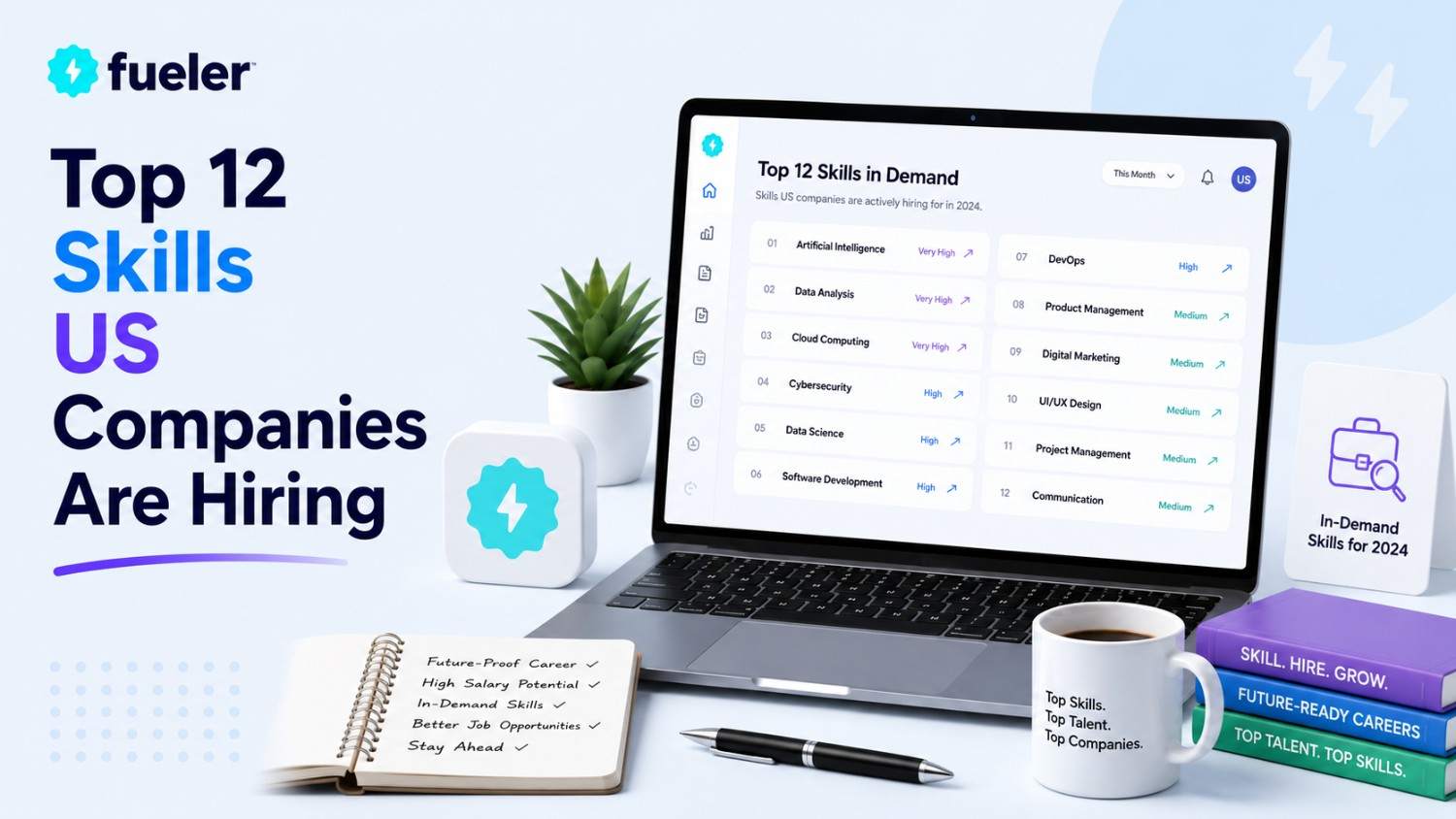
The "Great Reskilling" is no longer a prediction; it is the current reality for every US professional in 2026. If you’re still banking on technical expertise alone to carry your career, you’re playing a dangerous game. In a market where agentic AI can handle the "execution" of tasks in seconds, the value of a human employee has shifted from what you can do to how you direct the machines and manage the people. Companies like OpenAI, NVIDIA, and Stripe are no longer looking for "doers"; they are hunting for "orchestrators," individuals who can bridge the gap between high-level strategy and automated execution. These twelve skills are the high-value pillars that define the most successful hires in the United States this year.
I’m Riten, founder of Fueler, a skills-first portfolio platform that connects talented individuals with companies through assignments, portfolios, and projects, not just resumes/CVs. Think Dribbble/Behance for work samples + AngelList for hiring infrastructure
1. AI Orchestration and Agentic Logic
By 2026, simple "prompt engineering" has become a basic literacy, much like typing. The high-value skill that US companies are aggressively hiring for is AI Orchestration, the ability to design and manage "agents" that perform multi-step tasks autonomously. This involves understanding how to chain different AI models together, set up "guardrails" for their output, and integrate them into existing company workflows to replace manual, repetitive processes.
- Designing Autonomous Workflows: Instead of just asking an AI to write a blog post, an orchestrator builds a system where one agent researches the topic, another drafts the copy, a third checks for brand consistency, and a fourth schedules the post all triggered by a single human command.
- Model Selection and Optimization: You must know which specific AI model (e.g., Claude for nuance, GPT for logic, or a local Llama model for security) is best suited for a particular business problem, ensuring the company gets the highest quality output for the lowest computational cost.
- Managing AI "Hallucinations" and Logic: A key part of this role is building verification loops into automated systems to catch errors before they reach the client, requiring a deep understanding of how to use "retrieval-augmented generation" (RAG) to keep AI outputs grounded in company facts.
- Agentic Troubleshooting: When an automated system breaks or enters a "logic loop," the orchestrator is the one who can dive into the agent's decision tree, identify the point of failure, and rewrite the underlying logic to prevent future errors.
- Human-in-the-Loop Integration: Companies need experts who can identify exactly where a human should intervene in an automated process, such as final creative approval or high-stakes ethical decision-making, to ensure that the AI remains a tool rather than a liability.
2. Quantitative Strategic Decision-Making
In 2026, every department is a data department. US companies are hiring professionals who can look at massive, AI-synthesized datasets and extract "the narrative." It’s no longer enough to just present a chart; you must be able to explain why the numbers are moving and propose a concrete business strategy based on those insights. This skill combines traditional data analysis with high-level business intuition and the ability to act decisively in a fast-moving market.
- AI-Assisted Data Synthesis: You need to be proficient in using tools like Perplexity or specialized internal AI dashboards to query millions of data points using natural language, turning raw numbers into actionable executive summaries in minutes.
- Predictive Market Modeling: Hiring managers are looking for people who can use data to look forward rather than backward, using current trends to build "what-if" scenarios that help the company prepare for potential economic shifts or changes in consumer behavior.
- Communicating Data Narratives: This skill involves taking complex technical findings and translating them into a compelling story that stakeholders and board members can understand, using data to justify budgets, new product launches, or strategic pivots.
- Risk Assessment in Real-Time: In the high-velocity world of 2026, you must be able to weigh the risks of a new strategy against the data-backed rewards, making high-stakes decisions with confidence even when the data is incomplete or conflicting.
- Data Ethics and Governance: As data privacy laws tighten across the US, companies need strategists who understand the legal and ethical boundaries of how data is collected and used, ensuring that strategic growth doesn't come at the cost of a lawsuit or a PR disaster.
3. High-Fidelity Asynchronous Communication
With the majority of high-growth US startups moving to a "remote-first" or "distributed" model, the ability to communicate clearly without a live meeting is a top-tier skill. This isn't just about writing good emails; it's about mastering "video-syncs," structured documentation, and "thread-first" thinking. Companies are hiring people who can move a project forward using tools like Slack, Notion, and Loom, reducing the need for time-wasting Zoom calls that drain productivity.
- Mastery of Video Demos (Loom): You must be able to record a 2-minute video that explains a 20-page document, using screen-sharing and clear narration to provide context that text alone can't convey, making it easy for your teammates to catch up on their own time.
- Structured Documentation in Notion: Modern hires are expected to be "documentation-first," meaning they record their decisions, processes, and meeting notes in a shared workspace so that any teammate can understand the project's status without asking a single question.
- "Thread-First" Thinking on Slack: This involves knowing how to format complex updates into readable, bulleted threads with clear "call-to-actions," ensuring that important information doesn't get lost in the noise of a busy chat channel.
- Asynchronous Conflict Resolution: In a remote environment, you need the emotional intelligence to resolve misunderstandings through written or recorded communication, knowing when to take a conversation "offline" and when a quick video clip can clear the air.
- Cultural Context and Tone Control: As US teams become more diverse, the ability to adjust your tone for different cultures and personality types via text is essential for maintaining morale and preventing "remote-work isolation" among team members.
4. Full-Stack Adaptability (The "T-Shaped" Professional)
The era of the hyper-specialist is fading. US companies in 2026 are looking for "T-shaped" individuals who have deep expertise in one core area (like marketing) but possess enough "functional literacy" in coding, design, and finance to execute a project from start to finish. This adaptability allows a company to remain lean, as one "adaptable" hire can often do the work that previously required three disconnected specialists.
- Basic Front-End Literacy: A modern marketer or designer is expected to understand enough HTML/CSS and "no-code" logic (like Webflow or Framer) to make minor changes to a website or landing page without waiting for a developer's help.
- Financial Literacy for Non-Finance Roles: Companies want product managers and creatives who understand "Unit Economics" and "Burn Rate," allowing them to make decisions that are not just creative but also financially sustainable for the startup.
- Cross-Functional Project Management: This involves the ability to step into a different department’s shoes, such as a developer understanding a salesperson’s pain points to build tools and processes that actually solve the company's internal bottlenecks.
- Rapid Skill Acquisition: The most valuable hire is the one who can learn a new software tool or a new AI framework in a weekend and implement it on Monday, showing a "growth mindset" that keeps the company competitive as technology evolves.
- Interdisciplinary Problem Solving: Hiring managers value people who can pull ideas from different industries, like applying a "gaming" retention strategy to a "fintech" app to create innovative solutions that a traditional specialist would never think of.
5. Emotional Intelligence and Human-Centric Leadership
As AI takes over the "logic" and "data" tasks, the "human" parts of work, empathy, mentorship, and conflict resolution have become significantly more valuable. Companies are hiring leaders who can maintain team culture in a digital environment and support the mental well-being of their employees. In 2026, "leadership" is less about giving orders and more about creating an environment where high-performers feel seen, valued, and motivated.
- Empathetic Feedback Loops: You must be able to give critical feedback in a way that encourages growth rather than resentment, especially in a remote setting where tone is easily misinterpreted and the "human connection" is harder to maintain.
- Managing "AI Anxiety": A key leadership skill in 2026 is helping your team understand how to use AI to enhance their roles rather than fearing it will replace them, acting as a coach who guides the team through the technological transition.
- Mental Health Advocacy: Leaders are now expected to be proactive about preventing burnout, recognizing the signs of "digital fatigue," and encouraging a healthy work-life balance to ensure long-term retention of the company’s best talent.
- Culture Building in Distributed Teams: This involves creating "digital watercoolers" and virtual traditions that make remote employees feel like they are part of a cohesive mission, preventing the high turnover rates often seen in disconnected remote teams.
- Conflict De-escalation: With the high-pressure environment of 2026 startups, the ability to remain calm and mediate disputes between stressed team members is a critical skill for any manager looking to move up the corporate ladder.
6. Prompt Engineering and LLM Fine-Tuning
While general AI use is common, the ability to deeply "fine-tune" a Large Language Model (LLM) for a specific business use case is a high-salary skill in 2026. This goes beyond simple prompts; it involves "chain-of-thought" prompting, building "custom instructions," and understanding how to structure "few-shot" examples to get the AI to perform complex, niche tasks with 99% accuracy.
- Advanced Multi-Shot Prompting: You can provide the AI with five perfect examples of a complex task (like a legal contract review) to ensure that its subsequent work matches the company’s specific legal and stylistic requirements exactly.
- Building Custom "GPTs" and Bots: Companies are hiring people who can build internal AI tools like a "Brand Voice Bot" or a "Coding Assistant"that are trained on the company’s private data and style guides to ensure consistency across the entire organization.
- Iterative Prompt Refinement: This involves the "scientific method" of testing different prompt versions, analyzing the failure points in the AI’s logic, and refining the instructions until the output is consistently "production-ready" without human editing.
- Understanding AI Model Constraints: A high-value hire knows the "token limits" and "context windows" of different models, ensuring that they don't give the AI a task that is too large or too complex for it to handle accurately in a single pass.
- Prompt Version Control: As AI models update, prompts that used to work may break; the ability to manage and update a library of "company prompts" is a critical operational role for maintaining automated systems in 2026.
7. Cybersecurity Literacy for Every Role
In 2026, cybersecurity is no longer just "the IT guy's job." With the rise of AI-driven phishing and deepfake scams, every US employee is now a potential entry point for a cyberattack. Companies are prioritizing hires who have a "security-first" mindset, understanding how to protect sensitive company data, identify sophisticated social engineering attacks, and use multi-factor authentication (MFA) correctly across all their tools.
- Identifying AI-Generated Scams: You must be able to recognize the subtle signs of "Deepfake" audio or "AI-cloned" emails from your CEO, which are becoming the primary way that hackers target high-growth startups in 2026.
- Data Hygiene and "Least Privilege": This involves the habit of only accessing the data you need for a specific task and ensuring that sensitive client information is never pasted into "Public" AI models that might use that data for future training.
- Secure Remote Work Practices: Hiring managers look for professionals who understand how to use VPNs, encrypted messaging apps (like Signal), and hardware security keys (like Yubikeys) to keep the company's "digital office" safe from hackers.
- Incident Response Awareness: You should know exactly what to do if you suspect a breach to notify, which passwords to change, and how to preserve evidence to minimize the damage and help the company recover as quickly as possible.
- Privacy Compliance (GDPR/CCPA): Even in non-legal roles, understanding the basics of data privacy laws is essential for ensuring that your marketing campaigns or product features don't accidentally put the company at risk of massive fines.
8. Creative Problem Solving in a Fixed Framework
As many creative tasks become "templated" by AI, the real value lies in the person who can solve problems that don't have a template. US companies are hiring for "first-principles thinking, "the ability to break a problem down to its most basic parts and build a unique solution from the ground up, rather than just copying what worked for a competitor.
- Breaking Through "AI Genericness": As everyone starts using the same AI tools, the market is becoming flooded with average content. Companies need creators who can use AI to do the "boring" parts but add a unique, human spark that makes the final product stand out.
- Constraint-Based Innovation: In the lean startup world of 2026, you must be able to solve massive problems with small budgets, using creative "hacks" and clever tool integrations to achieve results that traditionally required millions of dollars.
- Connecting Disconnected Ideas: This skill involves "lateral thinking," the ability to take a solution from a completely different field (like biology or architecture) and apply its logic to a modern software or marketing problem.
- Root-Cause Analysis: When a project fails, a creative problem solver doesn't just fix the surface issue; they use "The 5 Whys" to find the underlying process error and design a new system that prevents the problem from ever happening again.
- Rapid Prototyping Mindset: You should be able to build a "Minimum Viable Product" (MVP) of an idea in a single day using no-code tools, allowing the company to test a hypothesis and "fail fast" before investing significant time and money.
9. Personal Brand and "Proof-of-Work" Management
In 2026, your "reputation" is your most valuable financial asset. US companies are increasingly hiring people based on their "Proof-of-Work", a public record of what they have actually built, written, or designed. Managing your professional identity through a platform like Fueler or LinkedIn is now a core skill, as it allows you to bypass traditional gatekeepers and prove your value to a hiring manager before they even see your resume.
- Curating a "Living" Portfolio: You must be able to consistently document your project wins, the lessons you've learned from failures, and the specific skills you used to achieve a result, keeping your professional "evidence locker" updated in real-time.
- Thought Leadership and Networking: This involves sharing your insights on industry trends on platforms like X (Twitter) or LinkedIn, building a following of peers and recruiters who see you as a "subject matter expert" in your specific niche.
- Digital Footprint Optimization: You need to ensure that when a recruiter Googles your name, they find a professional, cohesive narrative that highlights your skills, your personality, and your most recent "Proof-of-Work" successes.
- Leveraging Testimonials as Trust: A key part of brand management in 2026 is collecting and showcasing "social proof" from past clients and teammates, using their words to validate your expertise and your work ethic.
- Storytelling Your Career Journey: You must be able to explain the "why" behind your career pivots and project choices, creating a narrative that makes you look like a strategic, intentional professional rather than someone just jumping from job to job.
10. Financial Forecasting and "Burn" Awareness
With the high cost of capital in 2026, every employee is expected to have an "Owner Mindset" when it comes to the company's money. US startups are hiring people who understand the basics of a P&L (Profit and Loss) statement and can calculate the ROI (Return on Investment) of their own time and the tools they use. Being "fiscally literate" makes you a more strategic hire because you understand how your work directly impacts the company’s survival.
- Calculating Project ROI: Before starting a new initiative, you should be able to estimate the potential revenue it will generate versus the cost of the team's time and the software tools required to build it.
- Managing "SaaS Bloat": A valuable operational skill is the ability to audit the company's software stack, identify duplicate tools, and identify where the company can save thousands of dollars a month by consolidating its tech.
- Understanding Startup Funding: You should know the basics of Seed, Series A, and Series B funding rounds, helping you understand the company’s current priorities, whether they are focusing on "Growth" or "Profitability," and adjusting your work accordingly.
- Budgeting for AI Compute: As AI costs become a major part of a startup's overhead, companies need people who can manage "API credits" and optimize AI usage to ensure the company isn't wasting money on unnecessary "over-prompting."
- Resource Allocation Logic: This involves the ability to say "no" to low-impact projects that drain the company's limited resources, ensuring that the team's focus remains on the "needle-moving" tasks that drive revenue.
11. Cross-Cultural and Global Collaboration
The US talent market is now truly global. In 2026, you might be managed by someone in London, collaborating with a developer in Bangalore, and designing for a client in Tokyo. The ability to navigate different cultural norms, holiday schedules, and communication styles is a "soft skill" that has a massive "hard" impact on a company's efficiency and global reach.
- Managing Time-Zone Asynchronicity: You must be a master of "hand-off" documentation, ensuring that when you finish your workday in New York, your teammate in Singapore has everything they need to pick up the project without a single question.
- Cultural Sensitivity in Design and Copy: Hiring managers value marketers and designers who understand that a color or a phrase that works in the US might be offensive or confusing in another market, helping the company "go global" safely.
- Navigating International Labor Laws: For HR and Operations roles, a basic understanding of how to hire and pay contractors in different countries using tools like Rippling or Dell is an incredibly high-demand skill in 2026.
- Language Agility with AI: While you don't need to be bilingual, you should know how to use AI translation and "cultural adjustment" tools to communicate professionally with international partners and clients in their native languages.
- Building a Global Network: The most successful professionals are those who have friends and collaborators in every major tech hub, giving them a "ground-level" view of global market trends that they can bring back to their US-based company.
12. Ethical AI Implementation and Compliance
As the "Wild West" era of AI comes to an end in 2026, companies are terrified of the legal and ethical consequences of "bad AI." They are hiring for "AI Ethics Officers"or simply people in every role who understand the risks of bias, copyright infringement, and data misuse. Being the "voice of reason" when it comes to AI implementation makes you an indispensable asset to any company's legal and executive teams.
- Auditing for AI Bias: You should know how to test an AI-driven tool (like a hiring filter or a loan approval bot) to ensure it isn't making discriminatory decisions based on race, gender, or age, which could lead to a massive lawsuit.
- Managing Copyright and Intellectual Property: In a world where AI-generated work is in a legal "gray area," you need to know which tools offer "commercial indemnity" and how to ensure your company’s creative assets are legally protected.
- Setting Internal AI Policies: Companies need help writing "Acceptable Use Policies" for AI, defining which tools are allowed for which tasks, and ensuring that employees aren't accidentally leaking trade secrets into public models.
- Transparency in AI Communication: This involves knowing how and when to disclose to customers that they are interacting with an AI, building trust through transparency rather than trying to "trick" users into thinking a machine is a human.
- Staying Updated on AI Legislation: As new laws (like the EU AI Act or US Executive Orders) go into effect, you must be the person who understands how these regulations impact your company's product roadmap and data storage practices.
Final Thoughts
The common thread through all these skills in 2026 is agency. Companies no longer want passive employees who wait for instructions; they want proactive "operators" who can use the latest tools to solve problems, save money, and drive growth. The shift from "doing the work" to "orchestrating the work" is the defining career move of this decade. By mastering these twelve pillars and documenting your progress through "Proof-of-Work," you aren't just looking for a job, you are making yourself the most valuable asset in the modern economy.
FAQs
Do I need a college degree to prove these skills in 2026?
While degrees still have value in specialized fields like Medicine or Law, the majority of US tech and creative companies now prioritize "Proof-of-Work" over credentials. A portfolio on Fueler showing that you have successfully orchestrated an AI workflow or managed a global team is often more persuasive than a diploma. In 2026, what you have done matters significantly more than where you went.
How can I learn "AI Orchestration" if I'm not a developer?
You don't need to be a coder to be an AI Orchestrator. Most orchestration in 2026 happens through "no-code" or "low-code" platforms like Zapier Central, Relevance AI, or even through sophisticated "Custom GPTs" within OpenAI. The skill is about logic and process design, not just writing syntax. Start by automating your own personal workflows, and then document those "proof-of-work" samples to show potential employers.
Is "Emotional Intelligence" really a skill I can list on a resume?
You shouldn't just "list" it; you should prove it. Instead of writing "I have high EQ," your Fueler portfolio should include a case study of a time you resolved a team conflict, mentored a junior employee to a promotion, or maintained team morale during a difficult pivot. Human-centric leadership is a "hard" skill in the sense that it has a measurable impact on company retention and productivity.
How do I stay updated on all these skills without getting overwhelmed?
The best way is to focus on "Just-in-Time Learning." Instead of trying to master everything at once, pick one skill that solves a problem you are currently facing at work. Master it, document the result on Fueler, and then move on to the next. By 2026, the most successful people will be those who have a "habit of learning" rather than a "list of knowledge."
Will AI eventually take over these "high-level" skills too?
AI will continue to advance, but the roles of "Strategic Decision-Maker" and "Empathetic Leader" are fundamentally human. AI can provide the data, but humans must provide the intent and the ethics. In 2026, the goal is not to "beat" the AI, but to be the person who knows how to use it most effectively to solve human problems.
What is Fueler Portfolio?
Fueler is a career portfolio platform that helps companies find the best talent for their organization based on their proof of work. You can create your portfolio on Fueler. Thousands of freelancers around the world use Fueler to create their professional-looking portfolios and become financially independent. Discover inspiration for your portfolio
Sign up for free on Fueler or get in touch to learn more.

What should you do next?
You've read the article. Now turn your skills into proof of work and unlock more opportunities.
Build your proof of work portfolio
Create a clean portfolio with projects, assignments, resumes, and AI stack details that companies actually want to see.
Create your Fueler portfolio →Apply through assignments, not resumes
Stand out by solving real tasks from companies hiring on Fueler.
Explore assignments →Get discovered by companies
Make your work public and let recruiters discover your skills through actual projects instead of keywords.
Get discovered →
