Top Productivity Tools for Freelancers in 2026

Riten Debnath
15 May, 2025
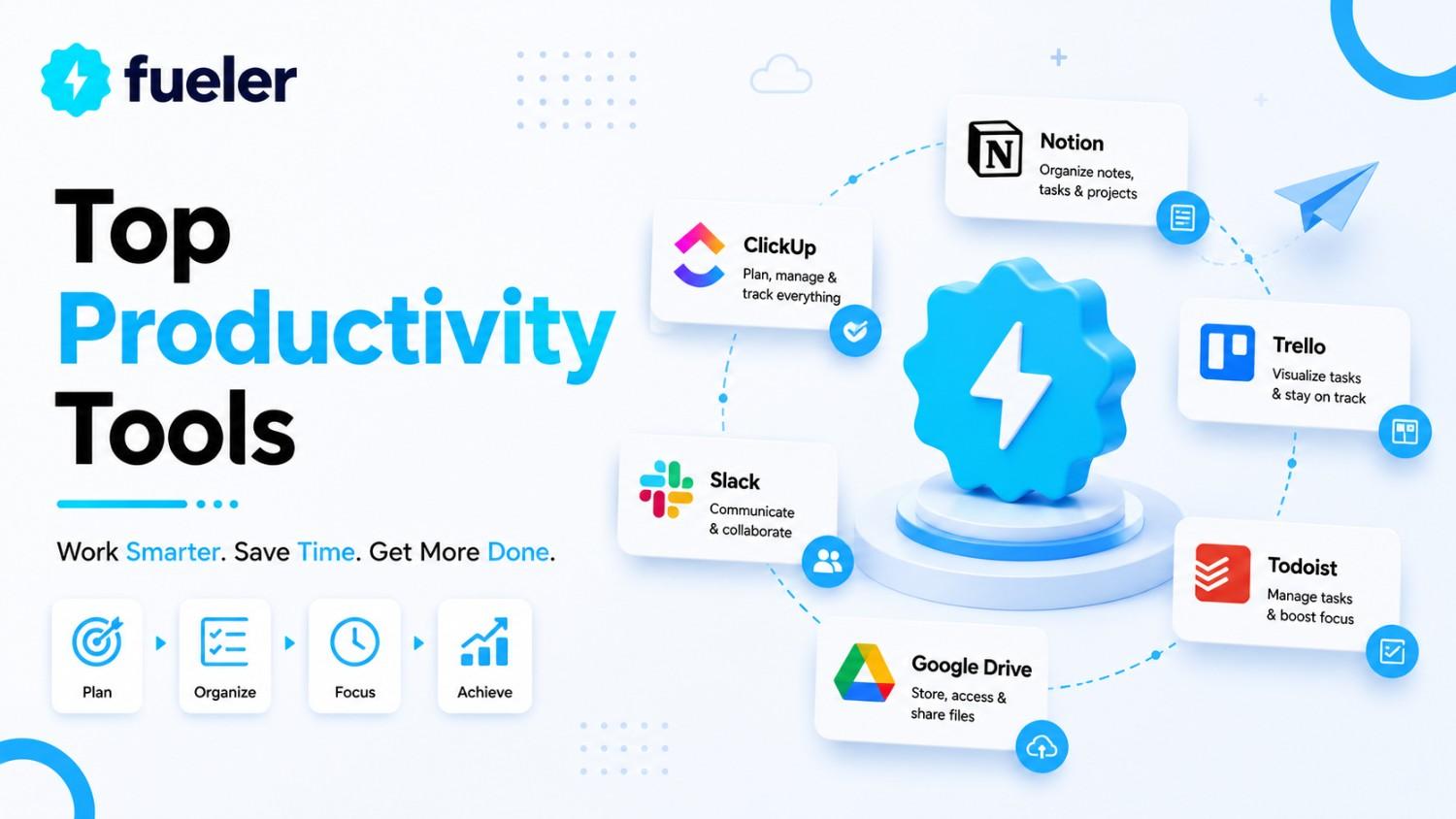
Last updated: September 2026
Freelancing in 2026 offers unparalleled flexibility and opportunities. However, with this freedom comes the challenge of managing time, tasks, and client expectations effectively. The key to thriving in this environment lies in leveraging productivity tools that streamline operations and enhance efficiency.
I’m Riten, founder of Fueler, a skills-first portfolio platform building the career infrastructure for 100 million creative professionals. Fueler connects talented individuals with companies through assignments, portfolios, and projects, not just resumes or CVs. Think of it as Dribbble/Behance for work samples combined with AngelList for hiring infrastructure.
In this article, I'll walk you through the top productivity tools for freelancers in 2026. Remember, beyond mastering skills, presenting your work smartly is crucial. Your portfolio isn't just a collection of projects; it's your proof of skill, credibility, and a shortcut to trust.
At a glance: Comparing the Top Productivity Tools for Freelancers
1. Notion
Best For: Custom Knowledge Base & All-In-One Workspace. Best suited for freelancers who want total control over building customized client portals, content hubs, and dynamic databases.
Notion is a powerful all-in-one tool that helps you take notes, manage projects, and collaborate with others. Many freelancers use it to keep their ideas, tasks, and documents in one place. It’s simple to customize and great for organizing your workflow.
Features:
- Create notes, to-do lists, and databases
- Use templates for project tracking, client management, and more
- Collaborate with others in real time
- Integrates with Slack, Google Drive, Trello, and more
Pricing:
- Free for personal use
- Pro: $4/month
- Team: $8/user/month
- Enterprise: Custom pricing
Pros:
- Easy to customize for any kind of work
- Great for organizing large amounts of information
- Excellent for both solo and team use
Cons:
- Can feel overwhelming for beginners
- Needs regular upkeep to avoid clutter
2. Trello
Best For: Simple Visual Task & Pipeline Tracking. Ideal for solo freelancers or small teams who want a zero-friction, drag-and-drop Kanban view to manage progress.
Trello is a visual task management tool based on boards, lists, and cards. It’s perfect for freelancers who like to plan their work in a simple and flexible way. You can track deadlines, to-dos, and client tasks with ease.
Features:
- Drag-and-drop interface using cards and boards
- Assign due dates, checklists, attachments, and comments
- Automate workflows using Trello’s Butler feature
- Integrates with apps like Google Drive, Slack, and Evernote
Pricing:
- Free forever plan
- Standard: $5/user/month
- Premium: $10/user/month
- Enterprise: Custom pricing
Pros:
- Very easy to use and visually clean
- Ideal for tracking small and large projects
- Works great for remote work and collaborations
Cons:
- Lacks detailed reporting features
- Free version has limited advanced options
3. Slack
Best For: Real-Time Client & Team Communication. Best for freelancers collaborating continuously with agencies, remote teams, or active clients.
Slack is a team communication tool that keeps all your conversations organized. It replaces emails and makes real-time messaging smooth and simple. Freelancers use it to talk with clients and teams, all in one app.
Features:
- Chat in public channels, private groups, or DMs
- Share files and documents instantly
- Make voice or video calls
- Connect with 2,000+ apps including Google Drive, Zoom, and Trello
Pricing:
- Free plan with limited features
- Pro: $6.67/user/month
- Business+: $12.50/user/month
- Enterprise: Custom pricing
Pros:
- Speeds up communication and decision-making
- Keeps all work chats in one place
- Good for quick file sharing and updates
Cons:
- Can be distracting due to constant notifications
- Limited message history on the free plan
4. Calendly
Best For: Automated Client Meeting Scheduling. Best for consultants, coaches, and freelancers who spend too much time scheduling discovery calls or client updates.
Calendly helps you schedule meetings without the back-and-forth emails. You just set your availability, and clients or collaborators can book slots. It’s a lifesaver for freelancers who manage calls and deadlines with multiple people.
Features:
- Automatically syncs with your calendar
- Share a custom link to let people book with you
- Set buffer times, meeting durations, and reminders
- Connects with Zoom, Google Meet, and other tools
Pricing:
- Free plan available
- Essentials: $8/month
- Professional: $12/month
- Teams: $16/month
Pros:
- Saves time by avoiding email chains
- Helps manage your schedule professionally
- Great for global clients with automatic time zone adjustment
Cons:
- Some features only in paid plans
- Custom branding options are limited in basic version
5. Grammarly
Best For: Professional Writing & Communication Polishing. Essential for copywriters, non-native English speakers, and any freelancer sending proposal emails or reports.
Grammarly is a writing assistant that helps fix grammar, spelling, and tone. Whether you’re writing emails, blogs, or proposals, Grammarly makes sure your writing looks professional. It's a must-have for freelancers who rely on clear communication.
Features:
- Corrects spelling, grammar, and punctuation in real time
- Gives suggestions for tone, clarity, and vocabulary
- Detects plagiarism
- Works on Google Docs, email, and web apps
Pricing:
- Free basic version
- Premium: $12/month
- Business: $12.50/user/month
Pros:
- Makes your writing more clear and professional
- Easy to use on all devices
- Helpful for non-native English speakers
Cons:
- Premium version is needed for full features
- Doesn’t always understand creative or technical writing
6. ClickUp
Best For: Complex Project & Time Management. Ideal for freelancers running multi-phase projects with precise time tracking, subtasks, and milestone dependencies.
ClickUp is a full project management platform designed to help you plan, track, and complete work. It combines task lists, docs, goals, and chats in one app. Freelancers love it for managing multiple clients and complex projects.
Features:
- Create tasks, subtasks, and checklists
- Track time spent on tasks
- Write docs and chat with collaborators
- Build custom dashboards to monitor progress
Pricing:
- Free plan with generous limits
- Unlimited: $5/user/month
- Business: $12/user/month
- Enterprise: Custom pricing
Pros:
- All-in-one solution for productivity
- Very flexible and customizable
- Works for solo freelancers and teams
Cons:
- Steep learning curve at first
- Some features may be too complex for simple needs
7. QuickBooks
Best For: Freelance Accounting, Invoicing & Tax Preparation. Best for established freelancers needing compliant financial reporting, expense categorization, and streamlined quarterly tax estimation.
QuickBooks is accounting software that makes invoicing and tracking money easy. Freelancers use it to send invoices, track expenses, and get ready for tax season. It helps you stay financially organized.
Features:
- Create and send professional invoices
- Track income, expenses, and tax deductions
- Connect to bank accounts and credit cards
- Generate financial reports easily
Pricing:
- Simple Start: $25/month
- Essentials: $50/month
- Plus: $80/month
- Advanced: $180/month
Pros:
- Saves time on bookkeeping
- Keeps all financial data in one place
- Useful for taxes and client payments
Cons:
- Can be pricey for new freelancers
- Takes time to learn the full software
One thing all these tools have in common is they help you work better and show your work better. But productivity tools alone aren’t enough. You need a strong portfolio that proves your skills. That’s why I built Fueler, a portfolio platform that helps companies hire through assignments. Whether you're a writer, designer, developer, or marketer, Fueler helps you turn your completed tasks into opportunities.
FAQs
1. What are the best productivity tools for freelancers in 2026?
Top tools include Notion, Trello, ClickUp, Canva, Grammarly, Slack, and Google Workspace. They help with organization, writing, communication, and project tracking.
2. Which free tools can freelancers use to boost productivity?
Notion, Trello, Canva, and Google Workspace all offer free versions that are powerful enough for solo freelancers.
3. How can I manage multiple clients as a freelancer?
Use tools like ClickUp or Trello to keep client tasks organized. Scheduling apps like Calendly and time trackers also help.
4. What tool helps with creating a freelancer portfolio?
Fueler is an excellent platform to build a proof-based portfolio that shows real work samples and gets you hired faster.
5. Are paid productivity tools worth it for freelancers?
Yes, if they save time, reduce mistakes, or help you win more work. Start with free versions, and upgrade when it adds value.
Why 100,000+ professionals use Fueler
Fueler helps professionals showcase proof of work through projects, assignments, case studies, and achievements.
- Thousands of professionals use Fueler to create their digital portfolio
- Thousands of projects are published on Fueler. Check here
- Startups and Companies hire through proof of work on Fueler
- Used by freelancers, creators, marketers, video editors, writers, designers, and product managers
Our mission is to help the next 100 million professionals build a verified professional identity through proof of work

What should you do next?
You've read the article. Now turn your skills into proof of work and unlock more opportunities.
Build your proof of work portfolio
Create a clean portfolio with projects, assignments, resumes, and AI stack details that companies actually want to see.
Create your Fueler portfolio →Apply through assignments, not resumes
Stand out by solving real tasks from companies hiring on Fueler.
Explore assignments →Get discovered by companies
Make your work public and let recruiters discover your skills through actual projects instead of keywords.
Get discovered →
