Top 10 Portfolio Platforms Recruiters Actually Check in 2026

Riten Debnath
30 Dec, 2025
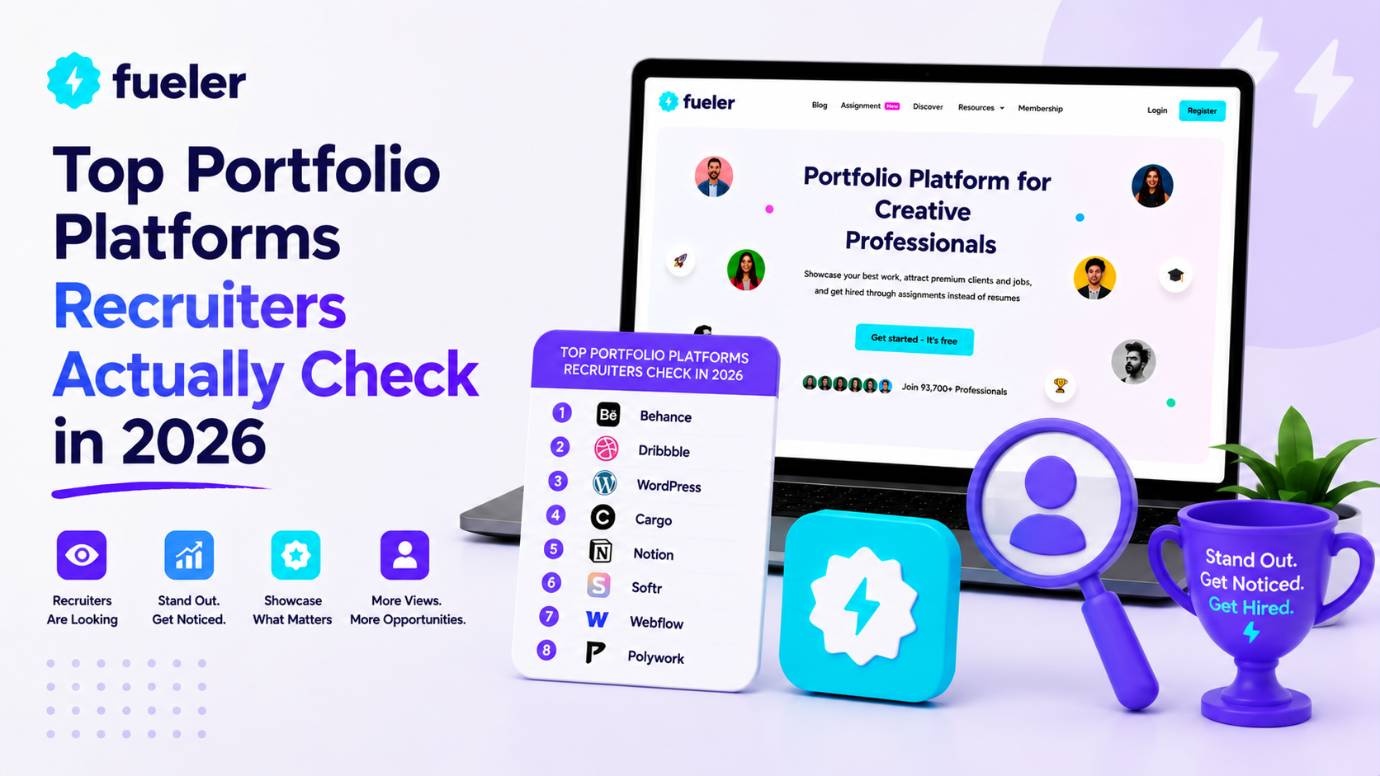
The recruitment landscape has shifted from "Who you are" to "What you have shipped." In 2026, a static PDF resume is often discarded in favor of interactive proof-of-work hubs that allow hiring managers to verify skills in real time. Recruiters are no longer scrolling through long lists of bullet points; they are clicking through live prototypes, reading case studies, and viewing verified project timelines. The following platforms are the high-traffic ecosystems where the modern distributed workforce is vetted and hired.
I’m Riten, founder of Fueler, a skills-first portfolio platform building the career infrastructure for 100 million creative professionals. Fueler connects talented individuals with companies through assignments, portfolios, and projects, not just resumes or CVs. Think of it as Dribbble/Behance for work samples combined with AngelList for hiring infrastructure.
Here are the Top 10 Portfolio Platforms Recruiters Actually Check
1. Fueler
Fueler emerged as the premier "Proof of Work" platform in 2026, moving beyond a simple gallery to become a comprehensive career dashboard. It is specifically built for individuals who want to document their professional journey through tangible projects rather than job titles. Recruiters favor Fueler because it organizes work into "Stacks," allowing them to see a candidate’s progression from early assignments to high-impact leadership roles.
Verified Project Stacks for Deep Vetting: Users can cluster their diverse work samples into thematic stacks, such as "SaaS Content Strategy" or "FinTech UX," which allows recruiters to filter through specific expertise without getting lost in unrelated projects.
Direct Assignment and Challenge Hubs: The platform hosts live company-sponsored assignments that allow candidates to complete real-world tasks which are then reviewed and verified directly by hiring companies to ensure authenticity.
Integrated Recruiter Interaction Tools: High-growth startups use Fueler to skip the "LinkedIn noise" by using direct messaging features and integrated booking links that move a candidate from project review to a discovery call in seconds.
Proof of Work Analytics Tracking: Creators get a transparent view of recruiter engagement, seeing exactly which project blocks be it a $2Cr case study or a niche technical guide are capturing the most attention from top-tier hiring managers.
AI-Powered Skill Matching: Fueler’s internal engine analyzes your uploaded work samples to match your specific output with e-commerce, tech, and creative companies that are actively looking for those exact results.
2. Wellfound (formerly AngelList)
Wellfound remains the essential platform for the startup ecosystem, where recruiters look for "sovereign individuals" who can thrive in high-growth, remote-first environments. In 2026, it is the primary source for roles that offer significant equity, as it requires companies to disclose salary and ownership ranges upfront. The portfolio aspect is integrated directly into the application, focusing on "Impact Tags" that highlight a candidate’s specific contributions to past companies.
Radical Compensation Transparency: Recruiters use the platform’s forced disclosure of salary and equity ranges to pre-qualify candidates based on budget alignment, ensuring no time is wasted on mismatched expectations.
One-Click Proof-of-Work Applications: Candidates apply with a unified profile that emphasizes startup-specific "Impact Tags" and project links over traditional corporate job descriptions and long-winded objective statements.
Direct Founder and Lead Engineer Access: The platform facilitates direct, peer-to-peer communication between applicants and company leadership, effectively bypassing traditional HR gatekeepers for a faster hiring cycle.
Startup Stage and Sector Filtering: Recruiters can filter talent based on their previous experience with specific company stages from "Seed" to "Series E" ensuring the candidate understands the unique pressures of that environment.
Verified Project-Based Skill Mapping: Each work entry allows for detailed tagging of the specific tools, frameworks, and methodologies used, creating a searchable map of a candidate’s real-world technical stack.
3. GitHub
For technical roles, GitHub is no longer just a code repository; it is a live laboratory where recruiters monitor a developer's consistency, collaboration style, and problem-solving logic. In 2026, a "Green Square" contribution graph is the first thing a technical recruiter checks to gauge a candidate's discipline and passion for continuous learning.
Live Code Quality and Documentation Review: Technical hiring managers ignore the resume to dive straight into your repositories, checking your coding style, your approach to version control, and how clearly you document your logic in README files.
Contribution History and Collaborative Proof: By examining your pull requests and issues on open-source projects, recruiters can see exactly how you communicate with other developers and handle feedback in a team environment.
Automated Workflow Proficiency via Actions: Recruiters look for candidates who use GitHub Actions to automate testing and deployment, as this demonstrates a professional-grade understanding of modern CI/CD pipelines and DevOps practices.
Project README Case Studies: Modern GitHub profiles use the README as a visual case study, complete with GIFs of the app in action, architecture diagrams, and a breakdown of the specific business problems the code solved.
GitHub Insights and Profile Stats: Recruiters use profile stats like the number of stars on a repo or your most-used languages to quickly verify if your technical "claims" align with your actual historical output.
4. Behance
Owned by Adobe, Behance is the undisputed visual archive where recruiters from the world’s top creative agencies source their design, motion, and branding talent. In 2026, it integrated deeply with AI creative tools, allowing recruiters to see the "Process Behind the Work" through time-lapse videos and layer breakdowns.
Adobe Creative Cloud Live Syncing: The platform allows recruiters to see a designer’s latest work the moment it’s saved in Photoshop or Illustrator, providing a real-time window into their current creative level.
Detailed Case Study Narratives: Top recruiters spend an average of 18 minutes on Behance pages that include full case studies, covering everything from the initial mood board to the final interactive prototype and user testing results.
Community Validation and Appreciation Metrics: While "likes" are vanity metrics, recruiters look for "Featured" badges from Behance curators as a secondary layer of professional validation from industry experts.
Niche Moodboard Discovery: Recruiters use the "Moodboard" feature to find designers who have a specific aesthetic or specialized style that matches a high-stakes client’s brand vision.
Interactive Prototype Embedding: Designers can embed live Figma or Adobe XD prototypes directly into their projects, allowing recruiters to test the user flow and interactions without ever leaving the portfolio page.
5. Polywork
Polywork has replaced the linear LinkedIn profile for professionals who have "multihyphenate" careers, those who are part developers, part writers, and part community builders. In 2026, recruiters will use Polywork to see a chronological timeline of "Activities" rather than just a list of job titles and dates.
Activity-Based Professional Timelines: Instead of a static job title like "Marketer," recruiters see a live feed of you "Launching a newsletter," "Speaking at a conference," or "Consulting for a Web3 startup."
Verified Collaboration Badges: When you work on a project with someone else, you can tag them, and they can verify your contribution, providing recruiters with an "on-chain" style of social proof.
Opportunity Prefencing for Recruiters: Candidates can set specific "badges" for the types of work they are open to, such as "Alpha testing products" or "Advising startups," which helps recruiters target them for niche roles.
Cross-Platform Content Integration: Polywork acts as a central hub that pulls in your latest GitHub commits, Medium posts, and Dribbble shots into one cohesive, automated professional story.
Non-Linear Career Storytelling: Recruiters find this platform invaluable for identifying "Hidden Superstars" who might have a traditional day job but spend their nights building high-impact side projects.
Okay, let's continue with the remaining five portfolio platforms, maintaining the detailed, long-bullet format and avoiding specific pricing or figures.
6. Dribbble
Dribbble remains the quintessential platform for product designers, UI/UX experts, and illustrators to showcase their "shots" small, high-impact snapshots of their work. In 2026, recruiters from top tech companies scour Dribbble not just for aesthetic appeal but for designers who understand modern design systems and interactive prototyping. It functions as both a portfolio and a powerful community for peer feedback, making it a critical hub for high-end digital design talent.
Pixel-Perfect Visual Showcases: Designers use Dribbble to highlight their mastery of UI details, micro-interactions, and visual craftsmanship through small, impactful "shots" that demonstrate their aesthetic and technical precision.
Industry-Leading Talent Sourcing: Recruiters from companies like Google, Meta, and innovative startups specifically use Dribbble’s advanced filters to find designers based on their style, tools (e.g., Figma, Framer), and expertise in areas like mobile UI, web design, or illustration.
Interactive Prototype and Animation Integration: Designers embed short videos or animated GIFs of their user interfaces in action, allowing recruiters to experience the intended flow and responsiveness of a digital product directly within the portfolio.
Community Engagement and Peer Validation: Active participation through comments, "likes," and curated "collections" demonstrates a designer’s engagement with the industry and their ability to receive and apply constructive feedback from peers.
Team and Project Collaboration Insights: Many design agencies and in-house teams maintain collective Dribbble profiles, allowing recruiters to see how individual designers contribute to larger, complex projects within a collaborative environment.
7. Medium
While primarily a blogging platform, Medium has evolved into a powerful "Thought Leadership Portfolio" for writers, content strategists, and subject matter experts. In 2026, recruiters for content-driven companies prioritize candidates who can articulate complex ideas, demonstrate a unique voice, and build an audience. A strong Medium presence proves a candidate's ability to not only write but also to think critically and influence.
Long-Form Thought Leadership Showcase: Recruiters assess a candidate’s ability to structure arguments, analyze industry trends, and present complex ideas in a clear, engaging narrative through well-written articles and essays.
Audience Engagement Metrics: While not always direct, evidence of readership (claps, comments, shares) indicates a writer’s ability to connect with an audience and produce content that resonates and performs.
Diverse Content Formats: Beyond articles, candidates can showcase different writing styles from technical guides to personal essays, demonstrating versatility across various content needs.
SEO and Keyword Understanding: Recruiters often look at how writers title and tag their articles, assessing their implicit understanding of search engine optimization and discoverability for content roles.
Direct Content Samples: Instead of relying on vague descriptions in a resume, recruiters can click directly through to published work, immediately assessing the quality, tone, and depth of a candidate's writing.
8. Stack Overflow (Developer Profile)
For backend developers, data engineers, and technical architects, Stack Overflow serves as a unique "Problem-Solving Portfolio." In 2026, recruiters for highly technical roles often scrutinize a candidate’s reputation score, quality of answers, and participation in specific technical tags to gauge their practical expertise and willingness to help their peers.
Demonstrated Problem-Solving Acumen: Recruiters analyze the quality and depth of a candidate's answers to technical questions, directly assessing their ability to break down complex problems and provide clear, effective solutions.
Reputation Score as a Trust Metric: A high reputation score, earned through helpful contributions, acts as a quantitative measure of a developer’s expertise and their standing within the global coding community.
Active Participation in Niche Tags: Engagement within specific programming language or framework tags (e.g., Python, Kubernetes, Rust) proves a developer’s specialized knowledge and continuous learning in critical areas.
Collaborative Learning and Mentorship: Providing well-explained answers and editing others' posts showcases a developer's ability to share knowledge and contribute to a collaborative learning environment, a key soft skill for remote teams.
Direct Code Snippets and Explanations: Recruiters can quickly review actual code examples and the accompanying explanations, getting a direct insight into a developer’s coding style, efficiency, and clarity of thought.
9. Medium (for Thought Leadership)
While we previously mentioned Medium for writers, it also serves as a powerful "Thought Leadership Portfolio" for any professional looking to showcase strategic thinking, industry insights, and the ability to articulate complex ideas. Recruiters seeking roles in strategy, product management, or executive leadership in 2026 often check a candidate's published articles to gauge their intellectual depth and influence.
Strategic Insights and Industry Commentary: Recruiters evaluate articles for original thought, the ability to synthesize complex information, and the capacity to offer unique perspectives on industry trends or business challenges.
Clarity and Persuasiveness of Argument: A well-structured Medium article demonstrates strong communication skills vital for leadership roles proving a candidate can convey their vision and persuade stakeholders effectively.
Personal Brand Building: For executive and leadership positions, a consistent presence on Medium showcases a candidate’s commitment to continuous learning and their desire to contribute to the broader professional discourse.
Demonstrated Research and Analytical Skills: Articles that are backed by data, case studies, or well-referenced sources prove a candidate’s thoroughness and their ability to support their claims with evidence.
Versatility in Communication: Recruiters can assess if a candidate can adapt their writing style for different audiences and purposes, from a technical deep-dive to a more accessible thought piece for a general business audience.
10. Coroflot
Coroflot is a specialized portfolio platform that caters specifically to industrial designers, product designers, and architectural professionals. In 2026, recruiters in manufacturing, automotive, and consumer electronics industries use Coroflot to find talent that combines aesthetic sensibility with practical engineering and user experience understanding.
Multi-Disciplinary Design Showcases: Designers can upload projects that feature sketches, CAD renderings, material studies, and physical prototypes, demonstrating a holistic approach to product development.
Emphasis on Process and Problem Solving: Recruiters look for detailed project breakdowns that articulate the design challenges, the iterative process, and the specific solutions implemented, going beyond just the final visual.
Material and Manufacturing Expertise: Portfolios often highlight a designer's understanding of different materials, production methods, and supply chain considerations, which is crucial for roles in physical product development.
Industry-Specific Filtering: Recruiters can filter talent based on niche expertise, such as "Footwear Design," "Medical Devices," or "Automotive Interiors," ensuring a precise match for highly specialized roles.
Integrated Resume and Contact Information: While project-focused, Coroflot allows for easy access to a candidate’s professional background and contact details, streamlining the transition from portfolio review to initial outreach.
Final Thoughts
The era of "telling" a recruiter what you can do is over; we are firmly in the era of "showing." Whether you are a developer on GitHub or a marketer on Fueler, your goal in 2026 is to reduce the "Proof Gap", the distance between a recruiter seeing your name and them seeing your work in action. By maintaining an active presence on these platforms, you turn your professional history into a living, breathing asset that works for you even when you aren't actively applying.
Frequently Asked Questions
1. Is a personal website better than these platforms?
A personal website offers the most control, but platforms like Fueler or Behance provide built-in "discovery engines" where recruiters are already searching for talent. Most successful professionals in 2026 use a hybrid approach: a central personal site that links out to their specialized, high-traffic platform profiles.
2. How many projects should I have in my portfolio?
Recruiters typically only check the top 2-3 projects before making a decision, so prioritize quality over quantity. It is better to have three deeply documented case studies that show your problem-solving process than twenty shallow screenshots with no context.
3. Do recruiters really care about my "process" or just the final result?
In 2026, the "process" is often more important because it proves you didn't just use an AI to generate the final result. Showing sketches, failed iterations, and logic diagrams proves that you have the critical thinking skills to handle complex, unpredictable remote tasks.
4. How often should I update my portfolio?
Recruiters look for "Freshness Signals," so you should aim to add a small update or a new project at least once every quarter. Platforms like Polywork make this easier by allowing you to post small "milestones" rather than waiting until a massive project is 100% finished.
5. Should I include personal projects or only professional work?
If you are transitioning careers or are a junior professional, personal projects are essential "Proof of Work" that demonstrate your initiative and self-learning ability. Recruiters value high-quality personal projects almost as much as client work if they solve real problems and show technical depth.
Why 100,000+ professionals use Fueler
Fueler helps professionals showcase proof of work through projects, assignments, case studies, and achievements.
Thousands of professionals use Fueler to create their digital portfolio
Thousands of projects are published on Fueler. Check here
Startups and Companies hire through proof of work on Fueler
Used by freelancers, creators, marketers, video editors, writers, designers, and product managers
Our mission is to help the next 100 million professionals build a verified professional identity through proof of work

What should you do next?
You've read the article. Now turn your skills into proof of work and unlock more opportunities.
Build your proof of work portfolio
Create a clean portfolio with projects, assignments, resumes, and AI stack details that companies actually want to see.
Create your Fueler portfolio →Apply through assignments, not resumes
Stand out by solving real tasks from companies hiring on Fueler.
Explore assignments →Get discovered by companies
Make your work public and let recruiters discover your skills through actual projects instead of keywords.
Get discovered →
