Top 10 Portfolio Mistakes US Job Seekers Must Avoid

Riten Debnath
31 Dec, 2025
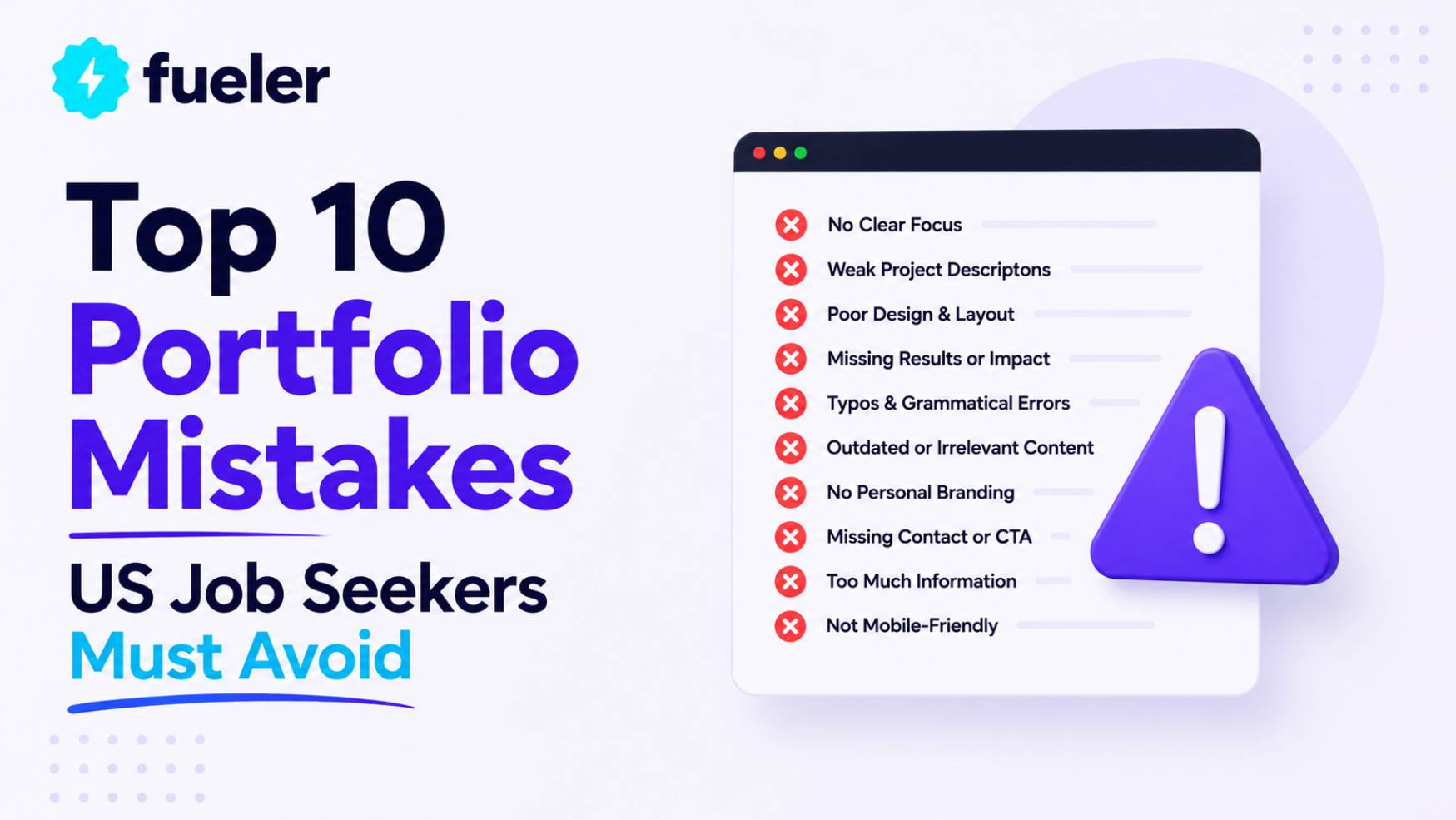
In the hyper-competitive American job market of 2026, your portfolio is often the first and only chance you have to make a lasting impression on a hiring manager. Whether you are applying to a fast-paced startup in Austin or a Fortune 500 company in New York, a single error in how you present your work can lead to an immediate rejection. Recruiters today spend less than a minute reviewing a candidate’s digital presence before deciding whether to move them to the next round. Understanding the common pitfalls that disqualify talented individuals is just as important as knowing how to showcase your successes. Avoiding these critical mistakes ensures that your "proof of work" remains the focus and that your professional brand is seen as polished, reliable, and ready for the challenges of a US-based role.
I’m Riten, founder of Fueler - a skills-first portfolio platform that connects talented individuals with companies through assignments, portfolios, and projects, not just resumes/CVs. Think Dribbble/Behance for work samples + AngelList for hiring infrastructure.
1. Choosing Quantity Over Quality (The "Dump" Effect)
One of the most frequent mistakes made by US job seekers is the belief that "more is better" when it comes to project samples. Many candidates fill their portfolios with every single task they have completed since college, including minor assignments, outdated school projects, and low-stakes volunteer work. This creates a "cluttered" experience that forces a busy recruiter to dig through mediocre work to find the gems. In the American professional world, you are judged by your weakest piece of work, so including low-quality samples actually lowers your perceived value. A winning portfolio should be a curated selection of your absolute best work that directly relates to the specific job you are targeting.
- Dilution of Talent: Including too many projects makes it difficult for a hiring manager to identify your core area of expertise, leading to confusion about what you actually specialize in.
- Recruiter Fatigue: Decision-makers have very limited time, and forcing them to scroll through dozens of irrelevant projects increases the likelihood that they will close your tab and move to the next candidate.
- Outdated Skillsets: Keeping old projects from years ago can make you look like you haven't kept up with modern industry standards, tools, or best practices in the US market.
- Lack of Focus: A portfolio that tries to show "everything" often ends up showing "nothing," as it fails to tell a cohesive story about your unique professional value proposition.
- Reduced Professionalism: A curated, high-quality selection shows that you have the good judgment to evaluate your own work and present only the highest standards of excellence.
Why it matters
US recruiters are looking for specialists who can solve specific problems, not generalists who do a little bit of everything poorly. By curating your work, you prove that you understand the needs of the business and that you respect the recruiter's time. It demonstrates a level of professional maturity and self-awareness that is highly sought after by managers at top-tier companies.
2. Neglecting the "Process" Behind the Result
Many portfolios show a beautiful final product like a finished logo, a live website, or a successful marketing chart but fail to explain how the candidate got there. In the US, hiring managers care deeply about your problem-solving methodology and your ability to navigate challenges. If you only show the "After" without the "Before" and the "During," you are essentially asking the recruiter to take a leap of faith regarding your skills. Failing to document your process makes it look like your success might have been an accident or that you can’t replicate the results in a new environment.
- Invisible Logic: Without a process breakdown, the recruiter cannot see the strategic thinking, research, or testing that went into your final decision-making.
- Missing Soft Skills: A process narrative is where you prove your ability to collaborate, handle feedback, and manage timelines, all of which are critical for US corporate culture.
- Lack of Context: A beautiful design or a clean piece of code is meaningless if the viewer doesn't understand the specific business problem you were trying to solve.
- Plagiarism Concerns: Portfolios that only show final assets without sketches or drafts can sometimes raise "red flags" about whether the work was truly created by the candidate.
- Unproven Versatility: Showing your process proves that you can adapt your skills to different constraints and requirements, making you a more attractive hire for diverse roles.
Why it matters
The US tech and creative industries are built on "Iterative Thinking," where the journey to a solution is just as important as the solution itself. Documenting your process turns you from a "worker" into a "thinker," which justifies a higher salary and more senior responsibilities. It provides the "intellectual proof" that you are a reliable asset who can solve complex, non-linear problems.
3. Ignoring the "Impact" and Business Results
A common mistake among freelancers and job seekers is describing their responsibilities instead of their achievements. For example, a candidate might write "I managed social media accounts" instead of "I grew the Instagram following by 40% and generated 500 new leads." US companies are results-oriented and want to see the "Return on Investment" (ROI) of hiring you. If your portfolio doesn't mention numbers, percentages, or specific business outcomes, it lacks the "teeth" needed to win a high-stakes job offer in a data-driven economy.
- Lack of Measurability: Without data, your claims of being "experienced" or "successful" are just opinions that cannot be verified by a potential employer.
- Weak Value Proposition: Hiring managers need to justify the cost of your salary, and showing the revenue you’ve generated or the time you’ve saved makes that decision easy.
- Missing Competitive Edge: Other candidates will be using hard numbers to prove their worth; if you don't, you will appear less competent by comparison.
- Vague Descriptions: Using "fluff" words like "passionate" or "hardworking" instead of "delivered 15% growth" makes your professional brand feel amateur and unsubstantiated.
- Disconnected Strategy: Failing to link your work to business goals suggests that you don't understand the "Big Picture" of how a company operates and grows.
Why it matters
In the US, business is a game of metrics, and a portfolio that speaks the language of data will always win. Showing impact proves that you are a "Growth Driver" who takes responsibility for the bottom line, rather than just a "Task Taker" who waits for instructions. It transforms your portfolio from a gallery of work into a powerful business proposal.
4. Poor Navigation and User Experience (UX)
If a hiring manager can’t find your work samples within two clicks, they will likely leave your site. Many job seekers build over-designed portfolios with confusing menus, broken links, or "coming soon" pages that frustrate the user. A portfolio is, in itself, a demonstration of your ability to present information clearly. If your personal site is hard to navigate, a recruiter will assume that the work you do for their company will also be disorganized and difficult to manage.
- High Bounce Rates: Confusing layouts lead to visitors leaving your site immediately, meaning your best work never even gets a chance to be seen by the recruiter.
- Broken Professionalism: Links that lead to 404 errors or images that don't load signal a lack of attention to detail, which is a "deal-breaker" for many US roles.
- Accessibility Issues: Portfolios that are not mobile-responsive or are hard to read for people with visual impairments exclude a large portion of potential hiring managers.
- Hidden Contact Info: If a recruiter has to search for your email or LinkedIn profile, you are making it harder for them to hire you, which is a major strategic error.
- Over-Engineering: Using heavy animations or complex coding that makes the site slow to load will annoy users who are trying to review multiple candidates quickly.
Why it matters
In the American workplace, "User Experience" is a core value across all departments, not just design. A seamless, fast, and intuitive portfolio proves that you care about the person on the other side of the screen. It shows that you can organize complex information into a simple, digestible format skill that is essential for effective communication in any corporate setting.
5. Failing to Tailor the Portfolio to the US Market
Each country has its own professional "vibe," and the USA prioritizes directness, confidence, and clarity. Some international job seekers make the mistake of using overly formal language, including personal information (like age or photos) that isn't standard in the US, or using "local" jargon that doesn't translate. A portfolio that isn't localized for the American market can make you seem like a "cultural misfit," even if your technical skills are perfect. You must ensure your tone, your terminology, and your presentation style match the expectations of a US-based hiring team.
- Inappropriate Personal Info: Including details like your marital status, date of birth, or a headshot (for non-acting roles) can be seen as unprofessional and can create legal awkwardness for US HR teams.
- Soft Language: Using "we" too much or being overly humble can make American recruiters think you didn't actually do the work; you must be bold about your individual contributions.
- Language Barriers: Small typos or the use of non-standard English can suggest a lack of communication skills, which is a high-priority requirement for American companies.
- Irrelevant Certifications: Highlighting local certifications that are not recognized in the US while ignoring global standards like AWS, Google, or HubSpot can hurt your credibility.
- Format Mismatch: Using A4 page sizes for downloadable resumes instead of the standard US Letter size (8.5" x 11") shows a lack of attention to regional standards.
Why it matters
Culture-fit is a huge part of the "hiring scorecard" in the USA. A portfolio that feels "American" in its directness and professionalism tells the recruiter that you will be able to hit the ground running without a long adjustment period. It builds an immediate sense of familiarity and trust, making the hiring process much smoother for everyone involved.
6. Using Generic or Cliché Templates
With millions of people using the same free templates from popular builders, many portfolios end up looking identical. If your site looks exactly like every other applicant's, you become "unmemorable." A generic template often limits how you can display your "Proof of Work," forcing your unique projects into boxes that don't fit. While you don't need to be a web designer, your portfolio should have enough "personal flair" to stand out in a stack of a hundred other digital resumes.
- Lack of Brand Identity: Using a default template makes it look like you didn't put much effort into your professional presentation, suggesting a lack of passion for your career.
- Inflexible Layouts: Cliché templates often prevent you from showing the specific "data charts" or "code snippets" that would actually prove your value to a recruiter.
- "Template Blindness": Recruiters see the same layouts so often that they start to "tune out," making it harder for your individual projects to grab their limited attention.
- Poor Performance: Some generic templates are poorly coded and slow, which can lead to your portfolio failing to load correctly on different browsers or devices.
- Missing Features: Standard templates often lack the "SEO" and "Analytics" tools needed to help your portfolio rank well and track who is visiting your site.
Why it matters
Standing out is the first step to getting hired in the USA. A customized (but clean) portfolio proves that you have an "owner's mindset" and that you care about your personal brand. It shows that you are willing to go the extra mile to present your work in the best possible light, which is a trait that employers look for in their best hires.
7. No Clear "Call to Action" (CTA)
A portfolio without a clear "Next Step" is a missed opportunity. Many job seekers show their work but don't tell the recruiter what to do next. Do you want them to email you? Book a call? Download your resume? Connect on LinkedIn? If the visitor has to think about how to reach you, you have already lost. In the US business world, "Directness" is king. Your portfolio should guide the recruiter toward a specific goal, making it as easy as possible for them to take the next step in the hiring process.
- Lost Leads: Without a prominent "Contact Me" button, a recruiter who loves your work might just move on to the next candidate because they couldn't find a quick way to reach out.
- Passive Presentation: A lack of CTA makes your portfolio feel like a "static archive" rather than an "active resume" that is seeking new professional opportunities.
- Confused Journey: If you provide too many links (socials, email, phone, calendly) without prioritizing one, the user may experience "decision paralysis" and take no action at all.
- Missing Resume Link: Many US recruiters still want a traditional PDF resume for their internal systems; failing to provide a clear download link is a major oversight.
- Unclear Availability: If your portfolio doesn't state whether you are looking for full-time work, freelance contracts, or speaking engagements, you might miss out on the right type of offers.
Why it matters
A Call to Action proves that you are a "Closer" who understands the importance of moving a business relationship forward. It shows that you are proactive and organized, qualities that are highly valued in American sales, marketing, and leadership roles. It turns your portfolio into a functional tool for career growth rather than just a digital art gallery.
8. Including Sensitive or Confidential Information
In their rush to prove their skills, some job seekers accidentally include "Internal Only" data, private client names, or sensitive financial information from their previous employers. This is a massive "Red Flag" for US hiring managers, as it suggests that you cannot be trusted with the company’s own confidential information. Violating a Non-Disclosure Agreement (NDA) in your public portfolio is one of the fastest ways to get disqualified from a job, as it proves a lack of professional ethics and legal awareness.
- Trust Issues: A recruiter will assume that if you shared your previous employer's secrets, you will eventually share their company secrets with someone else in the future.
- Legal Liability: US companies are very litigious, and hiring someone who is currently violating an NDA could put the new company at legal risk, making you a "toxic hire."
- Damage to Reputation: Once you are known for being indiscreet with data, it becomes very difficult to find high-level roles in industries like Finance, Healthcare, or Tech.
- Distorted Data: If you use real numbers without permission, you may be forced to take the portfolio down suddenly, leaving you with no "Proof of Work" during an active job hunt.
- Ethical Red Flags: It signals to the hiring team that you prioritize your own career advancement over the safety and privacy of the businesses you have worked for in the past.
Why it matters
Integrity is a non-negotiable requirement for high-level roles in the USA. By "Anonymizing" your data (using "Client X" instead of a real name or using percentages instead of raw dollar amounts), you prove that you are a professional who respects legal boundaries. It shows that you can be a "Strategic Partner" who protects the company’s most valuable assets.
9. Neglecting Mobile Optimization
In 2025, many US recruiters and executives do their initial "candidate screening" on their smartphones while traveling or between meetings. If your portfolio looks like a mess on a mobile screen with tiny text, overlapping images, or buttons that are too small to click you will be instantly dismissed. A "Desktop-Only" mindset is a relic of the past. Your work must be accessible and beautiful on every device, showing that you are a modern professional who understands the "Mobile-First" reality of the American workforce.
- Poor First Impressions: A broken mobile site suggests that you are out of touch with modern technology and that you don't care about the user's experience.
- High Bounce Rates: Users will not struggle to read your site; if it’s not mobile-friendly, they will simply close the browser within seconds of opening it.
- Search Engine Penalties: Google and other search engines penalize sites that are not mobile-optimized, meaning your portfolio won't even show up when a recruiter searches your name.
- Fragmented Branding: If your LinkedIn looks great on mobile but your portfolio looks terrible, it creates a "disjointed" professional brand that feels uncoordinated and sloppy.
- Limited Reach: You miss out on the chance for your portfolio to be "shared" via text or mobile messaging apps among hiring teams who are discussing candidates on the go.
Why it matters
Mobile optimization is a "Baseline Expectation" in the US tech and corporate world. Providing a perfect mobile experience proves that you are attentive to detail and that you understand the "On-the-Go" nature of modern business. It ensures that your "Proof of Work" is always ready to be viewed, no matter where or when a hiring manager discovers you.
10. Lack of Personality and "Social Proof"
A portfolio that is 100% "Business" and 0% "Human" can feel cold and unapproachable. US companies hire people, not just machines, and they want to see a bit of your personality and hear what others have to say about you. Failing to include a short "About Me" section or "Testimonials" from past clients and colleagues is a major mistake. Without social proof, your claims about your skills are just your own words; with testimonials, they become verified facts that build immediate trust with a new employer.
- Missing Connection: A recruiter is more likely to hire someone they feel they "know" and would enjoy working with in a high-pressure office or remote environment.
- Unverified Claims: Without testimonials or "Proof of Collaboration," there is no third-party evidence that you are actually as good as you say you are on your portfolio pages.
- Dry Narrative: A portfolio that only lists technical specs can be boring to read, making it harder for the hiring manager to stay engaged with your professional story.
- Isolation: Failing to mention your team-based work or your "Soft Skills" suggests that you might be a "Lone Wolf" who struggles to work within a modern, collaborative team.
- Forgettable Brand: Without a personal touch like a short story about why you love your craft you are just another name in a database rather than a memorable individual.
Why it matters
"Social Proof" is the most powerful psychological trigger in the hiring process. In the USA, a recommendation from a former boss or a happy client carries more weight than any degree or certification. By humanizing your portfolio, you build the emotional bridge needed to turn a "Stranger" (the recruiter) into a "Supporter" who wants to see you join their team.
How Fueler Helps You Avoid These Critical Mistakes
Creating a perfect portfolio is hard, which is why Fueler was built to handle the heavy lifting for you. Fueler's platform is designed with a "Mobile-First" and "SEO-Friendly" architecture, ensuring that your work looks professional on any device. By focusing on "Proof of Work" and "Verified Stacks," Fueler forces you to show the impact of your projects, helping you avoid the mistake of "Quantity over Quality." You can easily add testimonials, link to live code, and document your process in a clean, structured way that American hiring managers love. Fueler acts as a "Guardian" for your professional brand, ensuring that you present your skills with the clarity and authority needed to land your dream job in the US market.
Final Thoughts
Your portfolio is a "Living Document" that should evolve alongside your career. Avoiding these ten mistakes will immediately put you in the top 5% of all job seekers applying for US roles. Focus on being clear, being data-driven, and being human. Remember that the goal of your portfolio is not just to show what you have done, but to prove what you can do for your next employer. Keep it clean, keep it updated, and always lead with your strongest "Proof of Work."
FAQs
1. How many projects should I include in my portfolio for a US job?
For most roles, three to five high-quality, deep-dive projects are better than ten superficial ones. You want to show "Depth" rather than just "Breadth." Focus on the projects that had the biggest business impact or were the most technically challenging.
2. Is it okay to use a free portfolio builder for a senior role?
Yes, as long as the builder produces a professional, clean, and fast-loading site. Tools like Fueler, Notion, or Behance are widely accepted by US recruiters for even the most senior roles, provided the content of the portfolio is high-level and data-backed.
3. Should I include a photo of myself in my portfolio?
In the US, it is generally better to avoid photos on your resume/CV to prevent unconscious bias, but they are acceptable on the "About" page of a personal portfolio website. It helps humanize your brand and makes you more memorable to the hiring team.
4. How do I show proof of work if my previous job was under a strict NDA?
You can use "Abstracted Case Studies." Describe the problem, the tools you used, and the percentage of improvement you achieved without naming the specific client or showing "Trade Secret" code or designs. Focus on the process and the logic of your solution.
5. What is the most important part of a portfolio for a US recruiter?
The most important part is the "Impact." US recruiters want to know: "What was the result of your work?" If you can prove that your work saved money, made money, or saved time, you will be a top candidate for any position.
What is Fueler Portfolio?
Fueler is a career portfolio platform that helps companies find the best talent for their organization based on their proof of work.
You can create your portfolio on Fueler, thousands of freelancers around the world use Fueler to create their professional-looking portfolios and become financially independent. Discover inspiration for your portfolio
Sign up for free on Fueler or get in touch to learn more.
What should you do next?
You've read the article. Now turn your skills into proof of work and unlock more opportunities.
Build your proof of work portfolio
Create a clean portfolio with projects, assignments, resumes, and AI stack details that companies actually want to see.
Create your Fueler portfolio →Apply through assignments, not resumes
Stand out by solving real tasks from companies hiring on Fueler.
Explore assignments →Get discovered by companies
Make your work public and let recruiters discover your skills through actual projects instead of keywords.
Get discovered →
