Top 13 Online Learning Platforms Used in the USA in 2026

Riten Debnath
17 Jan, 2026
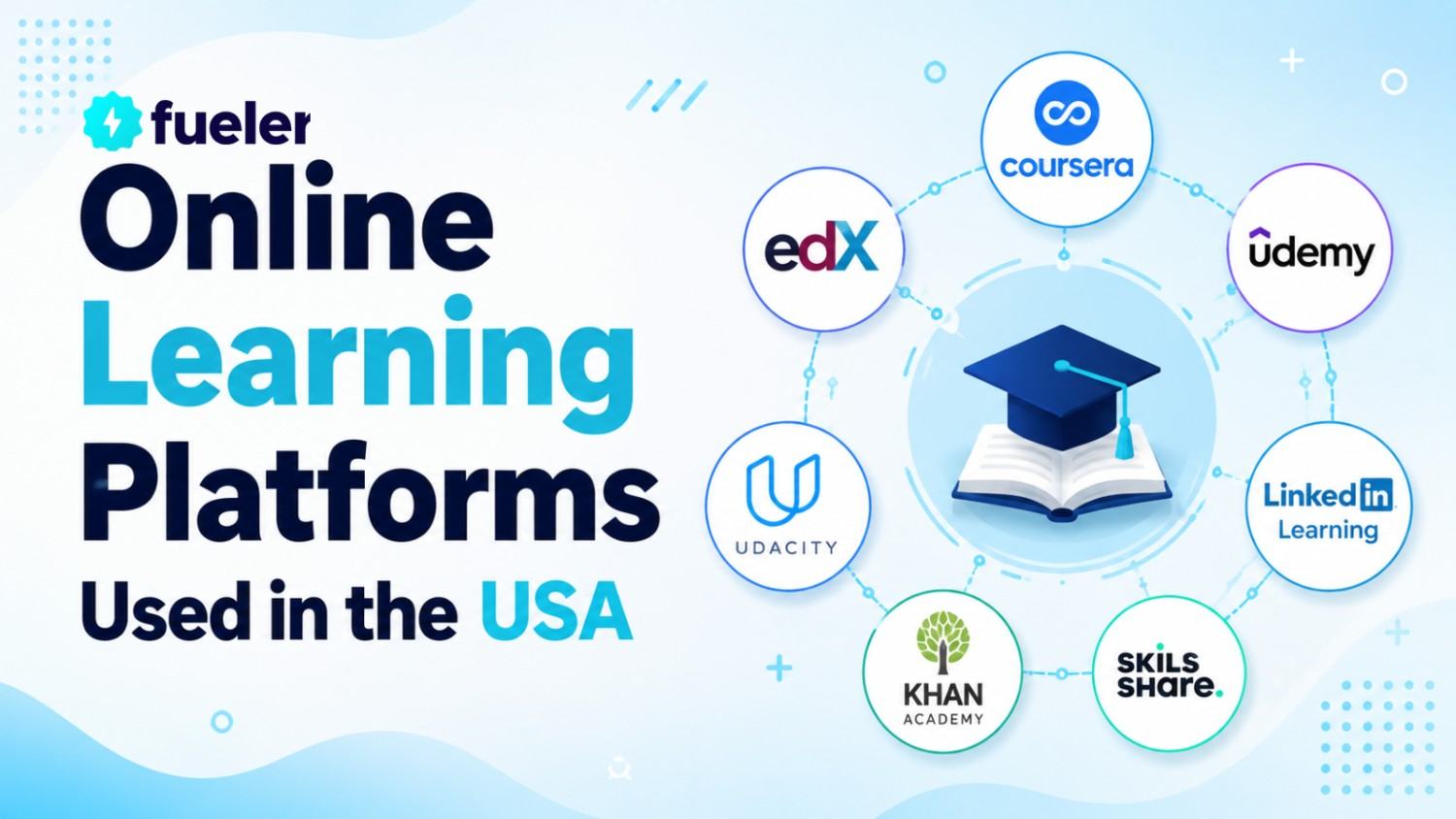
The American educational landscape in 2026 is defined by a "skills-first" economy where traditional degrees are increasingly supplemented or even replaced by specialized digital credentials. For both the Gen Z student entering the workforce and the mid-career professional looking to pivot, these 12 platforms have become the vital infrastructure for modern success. In the USA, "popularity" is currently measured by how effectively a platform integrates AI-driven personalization, provides accredited university partnerships, and facilitates immediate career application.
I’m Riten, founder of Fueler, a skills-first portfolio platform that connects talented individuals with companies through assignments, portfolio, and projects, not just resumes/CVs. Think Dribbble/Behance for work samples + AngelList for hiring infrastructure.
1. Coursera (Best for Academic Credibility)
Coursera remains the gold standard for learners seeking the prestige of Ivy League and elite institutions without the astronomical costs of on-campus residency. By 2026, its partnership network will have expanded to include nearly 300 universities, offering everything from "Professional Certificates" to full, master ’s-level degrees that carry the same weight as their physical counterparts. The platform’s biggest shift this year is the widespread integration of "Coursera Coach," an AI assistant that provides real-time tutoring and summarizes complex lecture modules into digestible study guides. It is the primary choice for Americans seeking to bridge the gap between self-paced learning and formal academic recognition.
- Professional Certificate Ecosystem: Students can earn specialized credentials from industry giants like Google, IBM, and Meta that are directly recognized by 2026 US hiring managers.
- University-Backed Degrees: Offers fully online undergraduate and graduate degrees from top-tier institutions like the University of Illinois and Stanford at a fraction of traditional costs.
- Guided Project Labs: Features "Cloud Desktops" that allow students to practice coding or data analysis in real-world environments without installing complex software on their personal devices.
- Coursera Coach AI: A generative AI tutor that helps students understand difficult concepts by providing personalized explanations and mock interview practice based on course content.
- Stackable Credentials: Credits earned in individual certificates can often be "stacked" and applied toward a future full degree, providing a flexible path for lifelong learners.
- Pricing: Free to audit most courses; Coursera Plus is approximately $59/month or $399/year; degrees range from $9,000 to $45,000.
2. Udemy (Best for Practical & Diverse Skills)
Udemy is the world's largest marketplace for skills, acting as the "Amazon of education" where independent experts teach everything from advanced prompt engineering to artisanal bread baking. In 2026, it is the go-to resource for "just-in-time" learning, where professionals spend a few hours mastering a specific software update or management technique to solve an immediate workplace problem. The platform’s sheer scale ensures that whenever a new technology emerges, a high-quality Udemy course is usually available within days. For US freelancers, Udemy is an essential tool for keeping their technical toolkit updated in an era of rapid technological disruption.
- Massive Course Library: Features over 210,000 courses covering niche topics that academic platforms often ignore, such as specific AWS configurations or creative writing.
- Expert Practitioners: Courses are taught by real-world professionals and "top earners" who bring practical, hands-on experience rather than purely theoretical academic knowledge.
- Lifetime Access Model: Once a course is purchased, learners have permanent access to all future updates, making it a valuable long-term reference library for technical skills.
- Udemy Business Tier: Thousands of US corporations use the curated "Business" collection to provide their employees with unlimited access to top-rated professional development content.
- Interactive Learning Tools: Includes coding exercises, quizzes, and community Q&A sections where students can get direct feedback from the instructor and fellow learners.
- Pricing: Individual courses often range from $12.99 to $199.99; Udemy Personal Plan subscription is roughly $30/month.
3. LinkedIn Learning (Best for Career Growth & Networking)
LinkedIn Learning is the only platform that seamlessly bridges the gap between acquiring a skill and getting hired for it. By analyzing the data of millions of American professionals, the platform suggests specific courses based on the "skills gap" it identifies in your current industry or desired job title. In 2026, the value of LinkedIn Learning lies in its "Skill Badges," which appear directly on your profile and are verified by the platform, making them a primary search filter for recruiters. It has become the standard for "soft skills" training, such as leadership, emotional intelligence, and cross-functional team management.
- Recruiter Integration: Completed certificates and mastered skills are automatically featured on your LinkedIn profile, making you more visible to headhunters and hiring teams.
- Personalized Career Paths: The AI-driven engine suggests "Learning Paths" that guide you through a sequence of courses needed to transition into a new role or industry.
- Professional Quality: All instructors are vetted by LinkedIn, ensuring high production value and accurate, high-quality instruction across its 20,000+ course library.
- Offline and Mobile Learning: The app is designed for the busy US professional, allowing users to listen to course audio like a podcast during commutes or download videos for offline viewing.
- Enterprise Adoption: Many US employees receive this for free through their company’s LinkedIn "Premium" or "Learning" enterprise subscription, making it highly accessible.
- Pricing: Included with LinkedIn Premium (approx. $39.99/month); standalone subscriptions are about $26.99/month when billed annually.
4. edX (Best for Executive & Scientific Learning)
Founded by Harvard and MIT, edX is the preferred platform for serious learners who want the highest level of academic rigor and specialized scientific training. In 2026, it has carved out a massive niche in "Executive Education" and "MicroMasters," providing high-density programs for leaders in fields like AI ethics, sustainability, and global finance. The platform's commitment to open-source learning means much of its content is accessible to anyone, though the path to a verified credential remains challenging and highly respected. It is frequently used by US professionals to gain credentials that bridge the gap between a bachelor's degree and a full MBA.
- MicroMasters Credentials: Graduate-level programs that offer a pathway to an accelerated master’s degree, providing deep expertise in high-demand technical and business fields.
- Elite University Network: Features exclusive content from the world's top institutions, including Oxford, Cambridge, and Berkeley, alongside Harvard and MIT.
- Executive Education: Offers high-touch, cohort-based programs for senior leaders that include live sessions, networking with peers, and personalized faculty feedback.
- Open edX Platform: The underlying technology is open-source, allowing for a highly customizable and interactive learning environment that supports complex scientific simulations.
- Career-Oriented Bootcamps: In 2026, edX's intensive 12-to-24-week bootcamps in coding and cybersecurity are leading the charge in rapid US workforce reskilling.
- Pricing: Free to audit; Verified Certificates usually cost $50 to $300; Professional/Executive programs range from $500 to $3,500.
5. Khan Academy (Best Free K-12 & College Prep)
Khan Academy is the non-profit powerhouse that serves as the backbone of the American K-12 educational system. While it began as a collection of math videos, in 2026, it has evolved into a comprehensive, mastery-based learning ecosystem that covers everything from early literacy to organic chemistry. Its most revolutionary update is "Khanmigo," a Socratic AI tutor that guides students through problems without ever giving the answer away. For US students, it remains the essential tool for SAT, LSAT, and Praxis preparation, offering high-level coaching that was previously only available to those who could afford private tutors.
- Mastery-Based Learning: The platform uses a data-driven approach to ensure students truly understand a concept before allowing them to progress to more difficult material.
- Khanmigo AI Tutor: A sophisticated AI guide that acts as a 24/7 personal tutor, helping students with everything from math problems to drafting a college entrance essay.
- Official Test Prep: Partners directly with the College Board to provide free, personalized SAT practice that has been proven to significantly increase student scores.
- Teacher & Parent Dashboards: Provides adults with detailed analytics on student progress, allowing for targeted interventions and a "flipped classroom" approach to education.
- Completely Non-Profit: The platform remains free of ads and subscription walls for its core content, supported by philanthropic donations and school district partnerships.
- Pricing: 100% Free for core content; Khanmigo AI access typically costs $4/month or $44/year to support the non-profit mission.
6. Skillshare (Best for Creative Professionals)
Skillshare is the primary community for the "Creator Economy" in the USA, focusing on design, photography, illustration, and creative entrepreneurship. In 2026, it has moved toward a "learning by doing" model, where every course requires the completion of a physical or digital project that students can add to their portfolios. It is the preferred choice for US-based designers and social media managers who need to stay current with the latest Adobe updates or TikTok trends. The platform’s community-driven feedback loops make it more of a professional guild than a traditional school.
- Project-Based Learning: Every course is centered around a tangible project, ensuring that students walk away with a portfolio piece rather than just a certificate of completion.
- Industry-Leading Instructors: Classes are taught by iconic creatives and successful entrepreneurs, providing "behind the scenes" looks at their professional workflows and tools.
- Creative Community: Features robust discussion boards and "Groups" where students can share their work, receive peer critiques, and network with other creatives.
- Skillshare Live: Offers regular live workshops and "Ask Me Anything" sessions with top instructors, providing a high-intensity, interactive learning experience.
- Bite-Sized Content: Most classes are divided into short, 5-to-10-minute lessons, making it easy for busy creatives to fit learning into their daily production schedules.
- Pricing: Limited free classes available; Premium Membership is approximately $165/year (roughly $13.75/month).
7. Udacity (Best for Tech Nanodegrees)
Udacity is the leading platform for "audacious" tech workers who want to master the most cutting-edge fields like Autonomous Systems, Quantum Computing, and Generative AI. Its "Nanodegree" programs are built in direct partnership with companies like NVIDIA and AWS, ensuring that the curriculum matches exactly what these firms are looking for in new hires. In 2026, Udacity is renowned for its intensive "Human-in-the-loop" project reviews, where every student's work is graded by a real professional who provides detailed, technical feedback.
- Nanodegree Programs: Specialized, 3-to-6-month programs designed to take a learner from "zero to job-ready" in highly technical fields like Data Engineering or Cloud DevOps.
- Expert Project Reviews: Every project submitted is reviewed by an industry expert who provides actionable feedback, simulating the "code review" process of a real tech job.
- Career Services: Includes resume reviews, LinkedIn profile optimization, and interview preparation specifically tailored for the high-stakes US tech job market.
- Industry Partnerships: Curriculum is co-created with the world's leading tech companies, ensuring that students are learning the exact tools and frameworks used in production today.
- Hands-On Workspaces: Provides integrated cloud environments and GPU-powered workspaces, allowing students to train machine learning models without expensive hardware.
- Pricing: Individual Nanodegrees typically cost $399/month (pay-as-you-go) or around $1,200 for a 4-month bundle.
8. MasterClass (Best for Inspiration & Soft Skills)
MasterClass has redefined educational entertainment by giving American learners a "front row seat" with the world's most successful people, from Serena Williams to James Cameron. In 2026, it is no longer just for inspiration; it has added " Sessions," which are structured, 30-day programs where students follow a specific curriculum to produce a finished product. It is the premier platform for learning the "intangibles" of successleadership, negotiation, storytelling, and creative process from those who have reached the absolute pinnacle of their careers. Readers weighing the annual subscription often compare it against similar expert-led platforms before committing.
- Cinematic Quality: The production value of MasterClass is unparalleled, using high-definition video and professional lighting to create a deeply engaging, immersive experience.
- Legendary Instructors: Only the most recognizable names in their respective fields are invited to teach, providing insights that are often unavailable in any other format.
- MasterClass Sessions: Cohort-based, 30-day programs that provide a structured schedule and community interaction to help students complete a specific creative project.
- Workbooks & Resources: Each class comes with a comprehensive downloadable workbook that includes lesson summaries, reading lists, and supplemental assignments.
- Broad Subject Matter: Covers a unique range of topics, including cooking, sports, business, science, and the arts, making it a versatile "lifestyle" learning platform.
- Pricing: Annual Membership starts at $120/year (approximately $10/month) for the Standard plan.
9. Pluralsight (Best for Enterprise IT & Developer Skills)
Pluralsight is the "technical command center" for American IT departments and software engineering teams. In 2026, its "Iris" AI engine is its greatest asset, providing "Skill IQ" and "Role IQ" assessments that accurately measure exactly where an engineer stands compared to their global peers. It is the primary tool used by US Fortune 500 companies to manage their technical talent, allowing CTOs to identify skill gaps and assign targeted learning paths to their developers. The platform’s focus is entirely on professional-grade technology, covering everything from cybersecurity to cloud architecture.
- Skill IQ & Role IQ: Proprietary assessment tools that provide a quantified score of a learner’s proficiency in specific technologies, helping to identify exactly what they need to learn next.
- Vast Tech Library: Over 7,000 courses focusing exclusively on IT, software development, data science, and cybersecurity, with new content added daily to match tech releases.
- Pathways & Channels: Curated sequences of courses that take a learner from beginner to advanced in a specific tech stack, ensuring a logical and comprehensive learning journey.
- Interactive Labs: Allows students to practice in safe, sandboxed environments that mimic real-world servers and cloud infrastructures without any risk to actual production systems.
- Enterprise Analytics: Provides managers with detailed dashboards showing the "technical health" of their teams and the progress of their upskilling initiatives.
- Pricing: Standard Plan is $29/month or $299/year; Premium Plan (including labs and exams) is $449/year.
10. Teachable (Best for Independent Knowledge Entrepreneurs)
Teachable is the engine behind the "knowledge creator" boom in the USA, providing the infrastructure for independent experts to build and sell their own digital academies. In 2026, it is used by over 100,000 creators to deliver everything from high-end business consulting programs to niche hobbyist courses. Unlike marketplaces like Udemy, Teachable gives creators full control over their branding, student data, and pricing, making it the preferred choice for those who want to build a long-term educational business. It is a vital platform for "authority figures" in the US who want to monetize their expertise.
- Complete Brand Control: Creators can build a fully customized, professional-looking website for their courses that integrates seamlessly with their existing personal brand.
- Integrated E-commerce: Handles all the complexities of payment processing, tax collection (including US sales tax), and affiliate management, allowing creators to focus on teaching.
- Flexible Product Types: Supports not only standard video courses but also live workshops, one-to-one coaching sessions, and digital downloads like eBooks or templates.
- Student Engagement Tools: Includes built-in quizzes, certificates of completion, and student comments to foster an interactive and supportive learning environment.
- Robust Analytics: Provides creators with deep insights into student behavior, sales trends, and marketing performance to help them grow their educational business.
- Pricing: Free plan available (plus transaction fees); Basic plan is $39/month; Pro plan is $119/month.
11. Codecademy (Best for Interactive Coding Mastery)
Codecademy has maintained its position as the most effective "first step" for Americans wanting to learn how to code. Its unique "learn-in-browser" interface removes the technical barriers that often stop beginners, allowing them to start writing Python, JavaScript, or SQL code within seconds of signing up. In 2026, it expanded its "Pro" offerings to include professional certifications and career paths that are specifically tailored to the current US tech hiring market. It is the go-to resource for non-technical professionals who need to gain "technical literacy" to communicate with engineering teams.
- Interactive Coding Environment: Students write and run code directly in their web browser with instant feedback, eliminating the need to set up complex local development environments.
- Career Paths: Guided curricula that take a learner from absolute beginner to a specialized role, such as "Full-Stack Engineer" or "Data Scientist," with a focus on job-ready skills.
- Real-World Projects: Includes hundreds of portfolio-ready projects that challenge students to apply what they’ve learned to solve actual business and technical problems.
- Professional Certifications: Offers verified certificates for completed paths that are recognized by major US tech employers as proof of technical proficiency.
- Codecademy for Teams: Used by US organizations to provide non-engineering staff with the technical skills needed to understand and manage digital products.
- Pricing: Free basic courses; Codecademy Pro for individuals is roughly $20/month (billed annually).
12. Duolingo (Best for Language & Literacy)
Duolingo has transcended language learning to become a broader "micro-learning" platform, now offering math and music courses alongside over 40 languages. In 2026, its "Duolingo Max" tier uses GPT-4 level AI to provide "Roleplay" scenarios where students can practice real-world conversations with AI characters. It is arguably the most "habit-forming" educational tool in the USA, using gamification, streaks, and a friendly mascot to ensure that millions of users spend a few minutes every day improving their skills. For US travelers and global business professionals, it is the essential "daily vitamin" for linguistic and cultural competency.
- Hyper-Gamified Learning: Uses a system of hearts, experience points (XP), and global leaderboards to make the difficult process of learning a new language feel like a video game.
- Duolingo Max (AI Features): Includes "Explain My Answer," which provides a detailed breakdown of grammar mistakes, and "Roleplay," which allows for realistic conversational practice.
- Expanding Subject Matter: In 2026, the platform includes dedicated tracks for elementary mathematics and music theory, using the same successful gamified formula.
- Duolingo English Test (DET): A high-stakes, AI-proctored English proficiency test that is now accepted by thousands of US universities as an alternative to the TOEFL or IELTS.
- Bite-Sized Lessons: Every lesson is designed to be completed in under 5 minutes, making it the perfect tool for learning during a commute or a coffee break.
- Pricing: Free (ad-supported); Super Duolingo (ad-free) is about $7/month; Duolingo Max (AI features) is roughly $14/month.
13. Promova:
Promova offers both AI-based self-study and live human instruction, unlike most gamified language apps. For instance, some apps encourage habitual learning through daily goals but do not focus on speaking. Promova includes structured bite-sized lessons (A1 to B2), AI conversations, and AI role-play scenarios. It also provides certified one-on-one tutors, small group interactive classes (up to 6), and a free weekly conversation club.
Few competitors offer an accessible dyslexia mode at this price. Promova has over 46 million lessons completed and a 4.7 rating from 23+ million downloads in the iTunes App Store. It provides the critical human feedback loop that is missing from self-study apps for learners who want to make their vocabulary more colloquial.
- AI Conversation Practice: The AI Tutor offers voice-style speaking practice for various roles such as job interviews, travel, casual conversations, and workplace dialogues.
- Bite-Sized Lessons: Lessons are built for short daily sessions, making the platform practical for learners who need consistency but do not have time for long classes.
- Personalized Learning Paths: Lessons tailored to the learner’s level, goals, and study behavior, helping learners get started on the right foot.
- Real-Life Language Focus: 80+ real-life scenarios and 400+ topic areas to practice the words and phrases you would actually use in a conversation, in real-life situations.
- Accessible Learning Features: Inclusive learning with Dyslexia Mode, White Noise, ASL lessons, and supports people with neurodiverse conditions in language learning.
- Pricing: The core app is free, and all advanced AI functionality is available with the Promova Premium subscription, which starts at $9.99 per month after the free trial.
Final Thoughts
The top 12 online learning platforms in the USA for 2026 represent a diverse and powerful ecosystem that caters to every stage of a person’s career and life. Whether you are a high school student using Khan Academy to prepare for college, a developer using Pluralsight to master the cloud, or an entrepreneur building a business on Teachable, the tools for success are more accessible than ever before. As you navigate these platforms and gain new skills, remember that the most successful individuals in the future will be those who not only learn but also use platforms like Fueler to document their journey and prove their worth to the world.
FAQ’s
Why should I choose Coursera over Udemy if I'm looking for a job
The main reason is institutional trust and accreditation. In 2026, most US hiring managers prioritize Coursera or edX because their certificates are issued by name-brand universities like Yale, Stanford, or Google, which act as a verified stamp of quality. Udemy is a marketplace where anyone can teach, meaning that while you can find amazing niche skills there, the "certificate" carries significantly less weight on a resume than a university-backed credential.
How does the 2026 AI shift actually help me learn faster?
AI on these platforms has moved past basic chatbots to "Agentic AI" tutors like Khanmigo or Coursera Coach. Instead of you just watching a video, these AI agents monitor your progress in real-time, identify exactly where your logic is failing, and pivot the lesson difficulty instantly. This personalized feedback loop cuts down "learning drag" by ensuring you don't waste time on concepts you’ve already mastered while giving you immediate help the second you get stuck.
Is LinkedIn Learning worth the monthly subscription cost?
It depends on whether you are a "Premium" user or a job seeker. If you already pay for LinkedIn Premium, the platform is essentially free and is the best way to keep your "Skills" section updated for recruiters. However, for deep technical mastery (like becoming a Senior DevOps Engineer), it often lacks the project-based depth of Udacity or Pluralsight. It is the best tool for "soft skills" and keeping your professional profile active in front of headhunters.
Can I actually get a college degree through these platforms in 2026?
Yes, and it is becoming the standard for working adults in the US. Platforms like Coursera and edX host full Master’s and Bachelor’s degree programs from accredited institutions at roughly 25% to 50% of the cost of on-campus tuition. The degree you receive is identical to the one earned by on-campus students; it does not say "Online" on the diploma, making it a powerful tool for academic advancement without the debt.
What is the best way to prove I have these skills if I don’t have a degree?
The "Skills-First" economy of 2026 relies on Proof of Work. While certificates are a good start, the most successful learners use platforms like Fueler to document the actual projects, assignments, and code they produced during their courses. A hiring manager in 2026 would rather see a live portfolio of five real-world projects you built during a Udacity Nanodegree than a single PDF certificate with no evidence of your capabilities.
What should you do next?
You've read the article. Now turn your skills into proof of work and unlock more opportunities.
Build your proof of work portfolio
Create a clean portfolio with projects, assignments, resumes, and AI stack details that companies actually want to see.
Create your Fueler portfolio →Apply through assignments, not resumes
Stand out by solving real tasks from companies hiring on Fueler.
Explore assignments →Get discovered by companies
Make your work public and let recruiters discover your skills through actual projects instead of keywords.
Get discovered →
