Top 5 Human Skills That AI Can't Replace

Riten Debnath
23 Jul, 2026
Last updated: July 2026
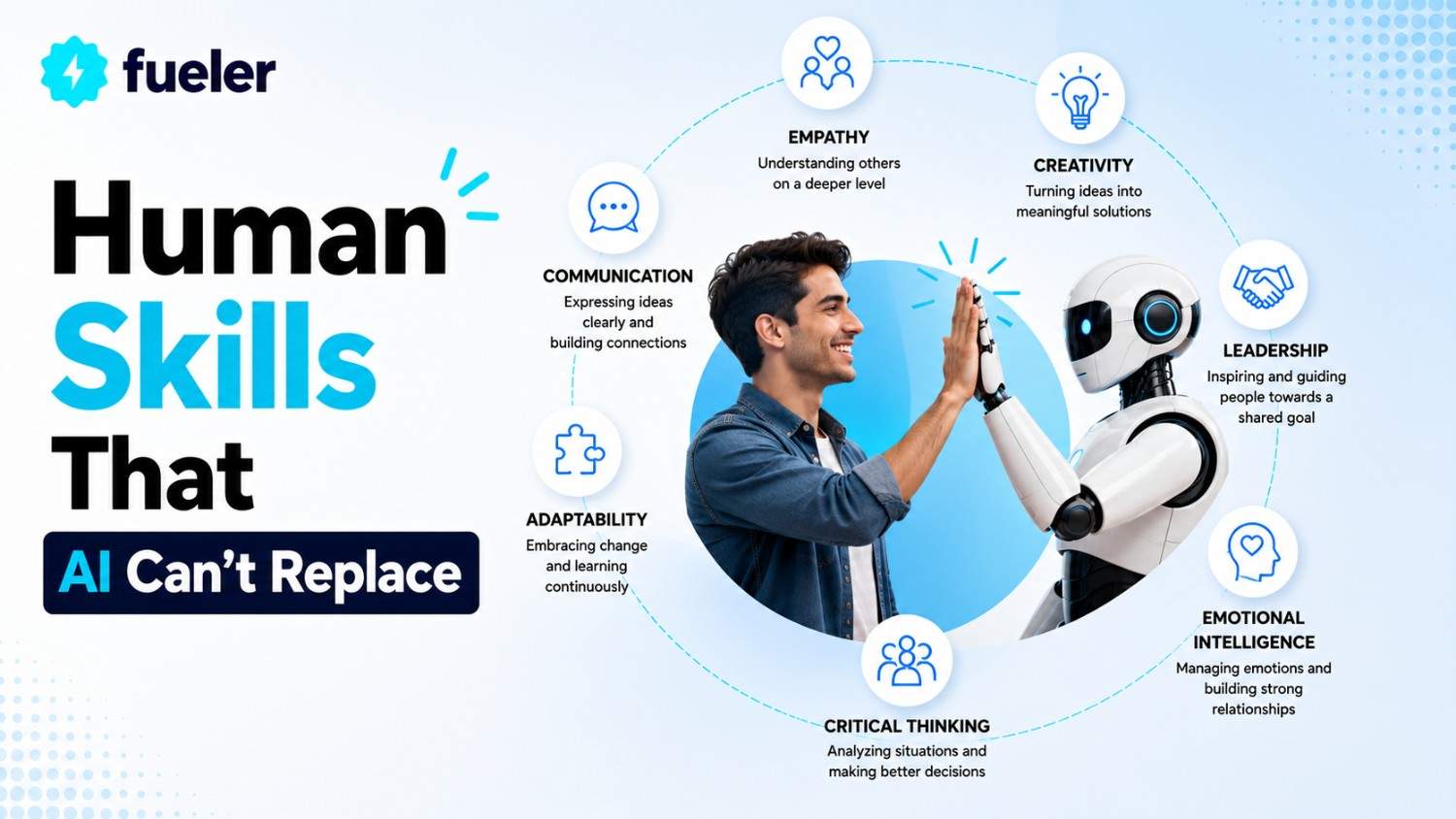
Every time a new artificial intelligence model launches, the internet floods with the same prediction: human skills are becoming obsolete. Entire job categories are shifting overnight, basic tasks are automated in seconds, and algorithms produce work at a scale no person can match. It is easy to look at this wave of technology and wonder where human workers actually fit in.
I’m Riten, founder of Fueler, a skills-first portfolio platform building the career infrastructure for 100 million creative professionals. Fueler connects talented individuals with companies through assignments, portfolios, and projects, not just resumes or CVs. Think of it as Dribbble/Behance for work samples combined with AngelList for hiring infrastructure.
Recent labor market research from the World Economic Forum indicates that while technological shifts displace millions of routine roles, they simultaneously create over 170 million new positions focused heavily on human-centric execution. Algorithms excel at pattern recognition, statistical prediction, and speed, but they lack human context, true empathy, and ethical reasoning. Developing these 5 non-automatable skills is how you build long-term career security.

1. Contextual Decision-Making in High-Ambiguity Environments
Algorithms process historical data efficiently, but real business crises rarely happen in neat, predictable environments where past formulas apply. Leaders must make strategic choices when metrics conflict, context is missing, and software offers no clear precedent.
Contextual decision-making requires evaluating real-world trade-offs, calculating organizational risks, and reading subtle room dynamics that spreadsheets completely ignore. Human operators look beyond raw data summaries to protect long-term brand equity and guide teams through unprecedented market shifts.
- Strategic thinkers analyze ambiguous market signals to make high-stakes operational choices when historical company data offers no clear precedent or reliable guidance for forward action.
- High-performing operators weigh subtle organizational trade-offs carefully to safeguard company health, protect team retention, and maintain steady revenue during sudden, unexpected industry disruptions.
- Evaluating hidden human motivations during complex client negotiations helps business leaders resolve high-value deals that automated statistical models cannot accurately predict or manage.
- Experienced human judgment fills critical operational gaps when raw analytical metrics directly contradict real-world feedback coming from boots-on-the-ground sales and customer success teams.
- Knowing precisely when to break standard operating protocols allows experienced managers to resolve unique customer edge cases, prevent high-profile client churn, and preserve long-term trust.
Why It Matters
Data without human interpretation leads to flawed business strategy. Companies relying purely on algorithmic predictions run into massive blind spots because software treats the world as a static formula. Mastering contextual decision-making ensures you remain the go-to problem solver when standard playbooks fail.
2. Deep Empathy and Interpersonal Influence
Software can construct polite email responses, but it cannot feel human emotion, build deep personal trust, or navigate complex office dynamics. Real organizational influence relies on empathy, the ability to read non-verbal cues and understand unspoken needs.
Interpersonal influence is about inspiring teams to achieve shared business goals rather than simply managing task dashboards. While software assigns work, human leaders motivate stressed employees, resolve team friction, and build lasting loyalty across cross-functional departments.
- Reading non-verbal hesitation and subtle shifts in tone during team syncs allows proactive project managers to spot hidden risks before minor delays turn into major public project failures.
- Navigating delicate interpersonal workplace conflicts with genuine tact keeps cross-functional initiatives moving forward smoothly without damaging long-term department morale or trust.
- Active listening during initial client discovery calls reveals deep emotional pain points and organizational fears hiding behind routine technical software requirement lists.
- Building genuine, trust-based working relationships across executive departments creates strong operational alignment that automated task trackers and notification bots can never enforce.
- Tailoring communication approaches to fit unique employee personality types turns resistant team members into eager, proactive supporters of high-priority company initiatives.
Why It Matters
Businesses are human systems powered by relationships, not just digital code. Technical software skills earn you a seat at the table, but emotional intelligence determines whether complex projects succeed. Cultivating deep empathy positions you as an irreplaceable anchor inside any organization.
3. Original Creative Synthesis and Conceptual Innovation
Generative tools construct designs, text, and code at high speeds, but they rely entirely on statistical recombination of past data. Algorithms predict patterns based on what already exists; they cannot invent genuinely new paradigms or conceptual leaps.
Original synthesis happens when a person connects two completely unrelated industries to solve a real-world friction point. True innovation stems from lived human experiences, intuitive leaps, and emotional insight elements that automated systems trained on historical web records cannot replicate.
- Connecting disparate concepts from completely unrelated industries yields groundbreaking product strategies that traditional market research reports miss entirely during standard planning cycles.
- Reframing persistent operational challenges into entirely new logical questions unlocks simpler, faster, and far more cost-effective paths toward sustainable business growth.
- Applying intuitive human observation catches subtle cultural shifts and emerging consumer habits months before those trends register inside commercial data tracking dashboards.
- Challenging default industry assumptions helps forward-thinking founders construct distinct business models that successfully disrupt slow-moving incumbent platforms and industry leaders.
- Combining authentic human storytelling with technical product specifications creates deeply compelling brand narratives that build lasting customer loyalty and market differentiation.
Why It Matters
When every company relies on the same digital tools, marketing campaigns, product designs, and copy start looking identical. Original human creativity remains the primary engine of brand differentiation. Bringing fresh, non-linear thinking to your projects instantly sets you apart from generic automated outputs.
4. Ethical Judgment and Value-Based Governance
Artificial intelligence models lack moral frameworks, personal values, and legal accountability. They generate outputs based on mathematical probabilities, meaning they can output biased recommendations, hallucinate inaccurate data, or violate consumer privacy without hesitation.
Ethical judgment requires asking whether an action should be taken, not just whether a software script can execute it. Human oversight is essential to audit automated workflows, protect customer privacy, and ensure business practices stay aligned with long-term trust and legal compliance.
- Auditing automated data processing pipelines identifies subtle algorithmic bias early, preventing discriminatory hiring practices, unfair credit scoring, or severe brand reputation damage.
- Establishing clear corporate governance policies protects sensitive customer data privacy as new third-party automated tools get integrated into company software stacks.
- Evaluating the long-term societal and psychological impacts of new product features keeps fast-growing technology companies aligned with consumer safety and ethical industry standards.
- Rejecting short-term operational shortcuts that compromise user trust preserves sustainable brand equity, customer retention, and positive public perception over decades.
- Balancing aggressive corporate profitability targets with fair, ethical labor standards ensures responsible organizational scaling without burning out core team members or creating toxic work cultures.
Why It Matters
When an automated system makes a high-profile mistake, the software provider does not face regulatory fines; the business implementing it does. Employers pay a premium for operators who understand legal compliance, ethics, and risk management. Demonstrating sound ethical judgment builds total executive trust.
5. Complex Physical Dexterity and Unstructured Adaptation
While digital knowledge work automates rapidly, navigating unpredictable physical environments remains extremely challenging for robotics. Tasks requiring fine motor skills, spatial awareness, and real-time physical adaptations demand human dexterity.
Unstructured physical environments present a massive hurdle for automation, whether it involves a technician troubleshooting custom wiring in an old building or an engineer making emergency field repairs. Processing sensory inputs and adjusting to physical constraints on the fly requires irreplaceable human adaptability.
- Navigating unique physical constraints during complex on-site infrastructure installations prevents structural damage, avoids costly delays, and ensures strict workplace safety compliance.
- Adjusting specialized mechanical techniques in real time resolves unexpected equipment failures during critical field operations when standard repair manuals offer no immediate guidance.
- Combining fine visual inspection with precise tactile feedback helps specialized technicians identify microscopic hardware flaws that automated sensors routinely miss during quality checks.
- Managing chaotic emergency response logistics during sudden natural weather events keeps field workers safe while restoring vital community infrastructure and communication channels quickly.
- Executing custom hands-on craftsmanship ensures high-end manufacturing meets exact quality specifications that automated assembly lines fail to replicate consistently.
Why It Matters
The physical world is messy, unpredictable, and constantly changing. Occupations that combine spatial intelligence, hands-on skill, and real-time problem-solving are among the most resilient against technological displacement. Mastering real-world execution secures long-term career stability.
How Does This Connect to Building a Strong Career or Portfolio?
Understanding which skills resist automation is vital, but simply listing them on a resume is no longer enough. Modern hiring managers want clear, verifiable proof of your judgment, creative problem-solving, and execution capability. You must make your human edge visible through documented projects, detailed case studies, and real-world assignments. Showcasing your practical outcomes on a portfolio platform like Fueler lets employers evaluate how you think, adapt, and solve complex problems before scheduling an interview.
Final Thoughts
The rise of artificial intelligence is not the end of human talent; it is a redefinition of what makes human work valuable. As software automates routine data handling, capabilities rooted in empathy, creative synthesis, and ethical judgment become your strongest assets. Focus on documenting your real-world work, refining your non-automatable skills, and staying adaptable. The future belongs to professionals who leverage technology for speed while bringing irreplaceable human insight to every project.

Frequently Asked Questions
Which human skills are safest from AI replacement?
Critical thinking, emotional intelligence, ethical governance, original creativity, and complex physical dexterity in unstructured environments are safest. These demand real-world context, lived experience, and adaptive reasoning that software cannot replicate.
Can AI eventually learn genuine empathy?
No, software can only simulate polite responses using statistical language patterns. True empathy requires real human consciousness, shared emotional experiences, and non-verbal understanding, which code cannot possess.
Why does AI struggle with creative innovation?
Generative tools create outputs by analyzing and recombining past internet data. They lack intuition and cannot challenge underlying industry paradigms or synthesize original concepts outside their existing training data.
How do I demonstrate these human skills to employers?
Instead of listing soft skills on a resume, present verifiable proof of work. Share documented project breakdowns, case studies, and assignments that demonstrate how you resolved complex, ambiguous challenges.
Will AI make entry-level roles disappear completely?
No, but entry-level roles are shifting rapidly away from repetitive data entry toward operational execution. Early-career professionals who combine tool fluency with sound human judgment remain in high demand.
Why 100,000+ professionals use Fueler
Fueler helps professionals showcase proof of work through projects, assignments, case studies, and achievements.
- Thousands of professionals use Fueler to create their digital portfolio
- Thousands of projects are published on Fueler. Check here
- Startups and Companies hire through proof of work on Fueler
- Used by freelancers, creators, marketers, video editors, writers, designers, and product managers
Our mission is to help the next 100 million professionals build a verified professional identity through proof of work
What should you do next?
You've read the article. Now turn your skills into proof of work and unlock more opportunities.
Build your proof of work portfolio
Create a clean portfolio with projects, assignments, resumes, and AI stack details that companies actually want to see.
Create your Fueler portfolio →Apply through assignments, not resumes
Stand out by solving real tasks from companies hiring on Fueler.
Explore assignments →Get discovered by companies
Make your work public and let recruiters discover your skills through actual projects instead of keywords.
Get discovered →
