Top 20 High-Income Skills in Demand in the US for 2026

Riten Debnath
31 Dec, 2025
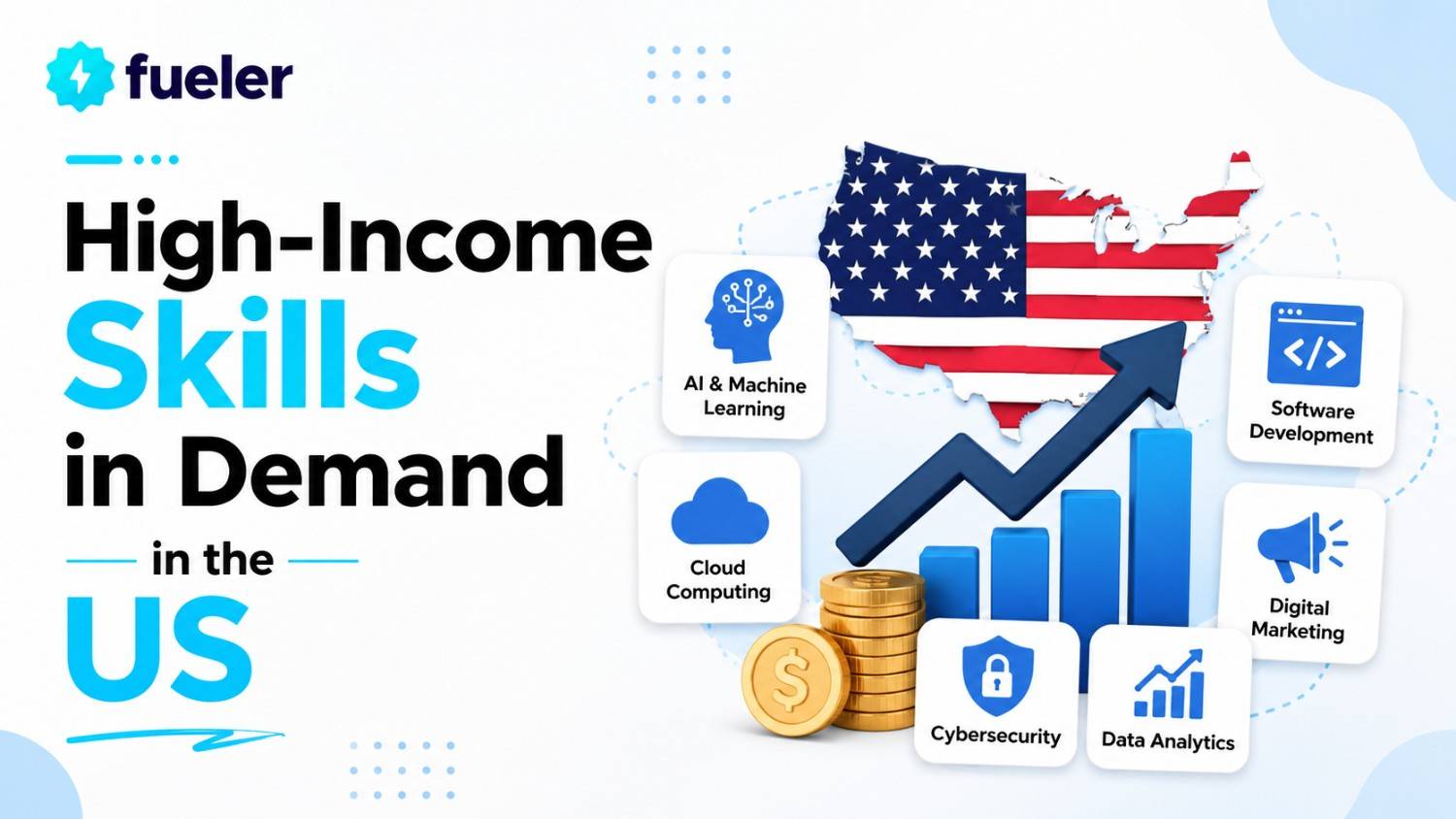
The definition of a "stable career" has shifted. In the US market of 2026, high-income skills are no longer just about specialized degrees; they are about high-leverage abilities that artificial intelligence cannot easily replicate or that directly control the AI itself. Companies are increasingly moving toward a "skills-first" hiring model, where your ability to solve a complex, six-figure problem matters more than a line on a resume. To thrive, professionals must stack technical depth with human-centric "power skills" like strategic judgment and ethical reasoning.
I’m Riten, founder of Fueler - a skills-first portfolio platform that connects talented individuals with companies through assignments, portfolios, and projects, not just resumes/CVs. Think Dribbble/Behance for work samples + AngelList for hiring infrastructure.
1. Generative AI Engineering & Orchestration
This isn't just about writing prompts for a chatbot; it is about building the infrastructure that allows AI to function within a business. Engineers in 2026 are designing "Retrieval-Augmented Generation" (RAG) systems that allow companies to talk to their own private data. This skill sits at the intersection of software development and data science, making it one of the most lucrative technical paths available today.
- LLM Fine-Tuning and Optimization: Training open-source models on specific industry datasets to improve accuracy and reduce "hallucinations" in specialized fields like law, finance, or medicine.
- Vector Database Management and Indexing: Organizing and indexing massive amounts of company information so that AI models can retrieve the correct facts in milliseconds without high compute costs.
- Agentic Workflow Design: Building autonomous "AI Agents" that can complete multi-step tasks independently, such as handling a full customer return process from logistics to refund.
- AI Security and Red Teaming: Testing AI systems for vulnerabilities to ensure they cannot be tricked into revealing sensitive company secrets or violating user privacy through "prompt injection."
- Prompt Chain Development: Using frameworks like LangChain to connect multiple AI actions together into a single, seamless business process that requires minimal human intervention.
Pricing: * Full-time salaries: $160,000 to $280,000 per year.
- Consulting rates: $250 to $600 per hour depending on the complexity of the AI architecture.
Why it matters: AI is the new electricity for American business. This skill matters because companies that cannot integrate AI into their core operations will be out-competed by those that can automate their workflows and scale their creative output at near-zero marginal cost.
2. Cybersecurity Strategy & Ethical Hacking
As AI makes it easier for "bad actors" to launch sophisticated, automated attacks, the demand for cybersecurity experts has reached a fever pitch. In 2026, security is no longer just the job of one department; it must be built into every line of code a company writes. Professionals who can identify "zero-day" vulnerabilities and protect a company's digital perimeter are the "bodyguards" of the modern global economy.
- Cloud Security Architecture: Designing and maintaining secure environments on AWS, Azure, or Google Cloud to prevent data leaks in highly regulated industries like banking and healthcare.
- Identity and Access Management (IAM): Implementing advanced "Zero Trust" systems that verify the identity of every user and device trying to access a network, regardless of their location.
- Incident Response and Disaster Recovery: Developing and executing "battle plans" for when a company gets hit by ransomware, ensuring they can get back online quickly without losing customer data.
- Secure Software Development: Teaching and implementing practices that allow development teams to write code that is resistant to common attacks like SQL injection or cross-site scripting.
- Penetration Testing and Red Teaming: Conducting authorized "hacks" on a company's own systems to find weak points before real criminals do, providing detailed reports for remediation.
Pricing: * Full-time salaries: $145,000 to $230,000 per year.
- Freelance security audits: $5,000 to $25,000 per project depending on the size of the infrastructure.
Why it matters: One major data breach can bankrupt a mid-sized US company or destroy a large brand's reputation forever. This skill matters because trust is the foundation of the digital world, and cybersecurity is the only way to protect that trust from evolving threats.
3. Data Engineering & Real-Time Analytics
Data is often called the "new oil," but oil is useless if it is dirty and trapped in the ground. Data Engineers are the "refiners" who build the pipelines to move and clean data so that business leaders can actually use it for strategy. In 2026, the focus has shifted from just "collecting" data to "real-time processing," allowing US companies to make decisions in seconds rather than weeks.
- ETL and ELT Pipeline Development: Building automated systems that Extract, Transform, and Load data from dozens of different sources into a single, clean "Source of Truth" for analysis.
- Cloud Data Warehousing Management: Managing massive datasets in modern platforms like Snowflake, BigQuery, or Databricks to ensure they are searchable, secure, and cost-effective.
- Streaming Data Processing: Using tools like Apache Kafka to analyze data the moment it is generated, such as detecting a fraudulent credit card transaction or a sudden spike in server traffic.
- Data Governance and Compliance: Creating rules and automated checks to ensure that the data being used for AI models is accurate, unbiased, and follows privacy laws like California’s CCPA.
- Machine Learning Operations (MLOps): Bridging the gap between data science and production by ensuring that machine learning models are deployed and updated reliably across the company.
Pricing: * Full-time salaries: $135,000 to $195,000 per year.
- Contract roles: $90 to $150 per hour for specialized pipeline construction.
Why it matters: AI is only as good as the data it is fed. This skill matters because clean, structured, and fast-moving data is the "fuel" that powers every other high-income skill, from marketing automation to financial forecasting.
4. Full-Stack Development with AI-Native Design
The modern web developer is no longer just building pages; they are building "AI-native" applications where the interface adapts to the user. This requires a deep understanding of both front-end user experience and back-end logic, combined with the ability to integrate APIs seamlessly. In the US, companies are looking for "T-shaped" developers who can own a feature from the database layer to the final pixel on the screen.
- API Integration and Management: Connecting modern applications to powerful third-party services like OpenAI, Stripe, and Twilio to add advanced features without building them from scratch.
- Responsive and Adaptive UI/UX: Creating interfaces that work perfectly on every device while using AI to personalize the content for each individual user in real-time.
- Serverless Architecture Deployment: Using tools like Vercel or AWS Lambda to build apps that scale automatically as more people use them, reducing costs and maintenance time for the company.
- Database Schema Design: Architecting how information is stored and retrieved to ensure that applications remain fast and reliable even as the company grows to millions of users.
- Version Control and CI/CD: Using Git and automated testing pipelines to ensure that new features can be launched several times a day without breaking the existing software.
Pricing: * Full-time salaries: $120,000 to $185,000 per year.
- Freelance project rates: $10,000 to $50,000+ for building custom SaaS MVPs (Minimum Viable Products).
Why it matters: The internet is the storefront of the 21st century. This skill matters because software is how modern US companies interact with their customers, and the ability to build and ship software quickly is a massive competitive advantage.
5. High-Stakes Copywriting & Psychological Persuasion
As AI floods the internet with "average" content, the value of high-stakes, human-driven copywriting has skyrocketed. This is the skill of using words to trigger an emotional response and drive a specific action, such as buying a product or signing up for a service. In 2026, "persuasion" is about understanding human psychology and empathy, something that AI can mimic but never truly feel or fully understand.
- Conversion Rate Optimization (CRO): Writing and testing headlines, emails, and landing pages to ensure that a higher percentage of visitors turn into paying customers for the business.
- Direct Response Marketing: Crafting ads for social media and search engines that have a clear "Call to Action" and generate an immediate, measurable return on investment.
- Brand Voice Development: Creating a unique "personality" for a company through words, ensuring that every piece of content sounds consistent and builds a deep connection with the audience.
- Long-Form Sales Storytelling: Writing deep-dive sales pages and email sequences that guide a potential customer through a logical and emotional journey to overcome their objections.
- Micro-Copy for User Experience: Designing the small bits of textlike buttons and error messagesthat make an app feel intuitive, friendly, and easy to use for the customer.
Pricing: * In-house roles: $90,000 to $160,000 per year.
- Freelance "Revenue Share": Often a base fee of $5,000+ plus a percentage of the sales generated by the copy.
Why it matters: You can have the best product in the world, but if you can't explain why people should care, you won't sell anything. This skill matters because words are the primary way we communicate value and build the "desire" that leads to growth.
6. Strategic Product Management
A Product Manager (PM) is often called the "mini-CEO" of a specific feature or product. Their job is to stand at the intersection of business, technology, and user experience to decide what should be built and why. In 2026, the most successful PMs in the USA are those who can balance the rapid pace of AI development with the real, unchanging needs of the human user.
- Product Roadmap Development: Creating a long-term plan for how a product will evolve, ensuring that every new feature aligns with the company's overall business goals and vision.
- User Research and Empathy Mapping: Talking to actual customers to understand their "pain points" and hidden needs, translating those into technical requirements for the engineering team.
- Agile Methodology Leadership: Running "sprints" and managing the daily workflow of designers and developers to ensure that high-quality work is shipped on time and within budget.
- Market and Competitor Analysis: Constantly monitoring the US tech landscape to identify new opportunities and threats, ensuring the product stays ahead of the curve.
- Data-Driven Decision Making: Using analytics tools to track how people are using the product and making "pivot or persevere" decisions based on hard evidence rather than guesses.
Pricing: * Full-time salaries: $130,000 to $210,000 per year.
- Consulting for startups: $150 to $300 per hour to help founders find "Product-Market Fit."
Why it matters: Most products fail not because they are built poorly, but because they are the "wrong" thing to build. This skill matters because a great PM ensures that a company’s resources are focused on the ideas that will drive the most growth.
7. Cloud Architecture & Infrastructure Management
In 2026, almost every major US company runs on the cloud. A Cloud Architect is responsible for designing the "digital foundation" where all of a company's software and data live. This requires a deep knowledge of how to make systems "scalable" (so they don't crash when millions of people visit) and "cost-optimized" (so the company doesn't spend a fortune on server bills).
- Multi-Cloud Strategy Design: Building systems that can run on multiple platforms (like AWS and Azure) at once, so the company isn't dependent on just one provider for their survival.
- Infrastructure as Code (IaC): Using tools like Terraform to write "scripts" that automatically set up servers and networks, making the process faster and less prone to human error.
- Cost Management and FinOps: Monitoring cloud usage and implementing technical changes to ensure the company is getting the most "bang for their buck" on their infrastructure spend.
- High Availability and Load Balancing: Designing systems that stay online 24/7/365, even if a major data center goes offline or if there is a massive, unexpected surge in traffic.
- Serverless and Container Orchestration: Using Kubernetes or Docker to package software so it can run anywhere, making it easier for developers to build and deploy new features.
Pricing: * Full-time salaries: $150,000 to $240,000 per year.
- Freelance architecture audits: $10,000 to $30,000 per project to optimize existing cloud setups.
Why it matters: If the cloud goes down, the business stops. This skill matters because it provides the reliability and "infinite scale" that modern US SaaS companies need to serve a global audience without interruption.
8. UX/UI Design & Human-Computer Interaction
Design in 2026 has moved beyond "making things look pretty." It is now about "interaction design"understanding how humans and AI work together. A great designer knows how to make complex technology feel simple and "invisible." In the US market, companies are paying a premium for designers who understand psychology, accessibility, and the emotional impact of a digital interface.
- Interactive Prototyping: Building high-fidelity "mockups" of an app that look and feel like the real thing, allowing the team to test ideas before spending money on development.
- Accessibility and Inclusive Design: Ensuring that websites and apps are easy to use for everyone, including people with disabilities, which is both a legal requirement and a moral imperative in the US.
- User Journey Mapping: Visualizing every single step a customer takes from the moment they hear about a brand to the moment they make a purchase, identifying and fixing points of friction.
- Design Systems Management: Creating a library of reusable "components" (like buttons and menus) so that the product looks consistent and the development team can work faster.
- Usability Testing and Iteration: Watching real people use a design and making continuous improvements based on where they get confused or frustrated, leading to a better final product.
Pricing: * Full-time salaries: $110,000 to $175,000 per year.
- Freelance brand/app design: $5,000 to $20,000 per project.
Why it matters: In a world of infinite choices, users will leave an app in seconds if it is hard to use. This skill matters because great design reduces "cognitive load" and makes people feel good about using your software, which is the key to retention.
9. Growth Marketing & Performance Analytics
Growth marketing is the "scientific" side of marketing. It’s not about big TV ads; it’s about running small experiments every day to find the cheapest way to get new customers. In 2026, growth marketers in the USA use AI to analyze data and find "hidden" patterns that humans might miss. They are responsible for the entire "funnel," from getting a stranger's attention to turning them into a loyal brand advocate.
- A/B Testing and Experimentation: Running simultaneous versions of an ad or a webpage to see which one performs better, then using the "winner" to drive more sales for the company.
- Paid Acquisition Management: Spending money strategically on platforms like Google, Meta, and TikTok to ensure that every dollar spent brings in more than a dollar in profit.
- Search Engine Optimization (SEO): Optimizing content so that it ranks at the top of search results, providing a "free" and consistent flow of new customers to the website over time.
- Retention and Lifecycle Marketing: Using email, SMS, and push notifications to keep existing customers engaged and encourage them to buy again and again.
- Viral Loop and Referral Design: Building "social" features into a product that encourage current users to invite their friends, creating a natural and "free" growth engine for the brand.
Pricing: * Full-time salaries: $100,000 to $180,000 per year.
- Freelance "Growth Audits": $3,000 to $10,000 to find "leaks" in a company's marketing funnel.
Why it matters: Growth is the "lifeblood" of any US company. This skill matters because it turns marketing from a "cost" into an "investment," allowing a company to scale its revenue predictably and profitably.
10. Financial Modeling & Strategic Operations
Numbers are the language of business. A professional who can build a complex financial model or optimize a company's operations is invaluable to a CEO. In 2026, this isn't just about accounting; it's about "predictive finance"using data to see the future. These professionals help companies decide whether to raise money, launch a new product, or hire more people based on the math, not just intuition.
- SaaS Metrics Analysis: Tracking and improving key "health" numbers like Customer Acquisition Cost (CAC), Lifetime Value (LTV), and Churn Rate to ensure long-term profitability.
- Scenario Planning and Forecasting: Building models that show what the company's bank account will look like in 12 months under different conditions, like a market crash or a sudden growth spurt.
- Capital Allocation Strategy: Helping the leadership team decide where to spend their money to get the highest possible return, whether that is in R&D, marketing, or acquisitions.
- Operational Efficiency Auditing: Finding ways to reduce waste and "friction" in how the company runs, such as automating the hiring process or renegotiating vendor contracts.
- Investor Relations and Fundraising: Preparing the data and "pitch decks" needed to convince venture capitalists or banks to invest millions of dollars into the company’s growth.
Pricing: * Full-time salaries: $130,000 to $220,000 per year.
- Fractional CFO services: $3,000 to $10,000 per month for small businesses.
Why it matters: Many great companies fail because they "run out of cash." This skill matters because it provides the "financial steering wheel" that allows a company to navigate through good times and bad without crashing.
11. B2B Sales & High-Ticket Negotiation
Despite all the AI in the world, million-dollar deals in the USA are still closed through human conversation. High-ticket sales is the art of building a relationship and solving a "pain point" for another business. It requires deep listening, emotional intelligence, and the ability to navigate complex organizations where multiple people have to say "yes" before a contract is signed.
- Consultative Selling: Acting as a "trusted advisor" rather than a "pusher," helping the customer identify their problems and showing how your product is the perfect solution.
- Pipeline and CRM Management: Using tools like Salesforce to track hundreds of potential deals at once, ensuring that no prospect is forgotten and every "follow-up" happens on time.
- Social Selling and Thought Leadership: Building a personal brand on LinkedIn to attract high-value leads naturally, rather than relying on "cold calling" which is becoming less effective.
- Contract Negotiation and Closing: Finding "win-win" solutions during the final stages of a deal, ensuring that both the company and the customer feel good about the price and terms.
- Account Management and Expansion: Working with existing customers to ensure they are happy and finding opportunities to sell them more products or services over time.
Pricing: * Base salaries: $80,000 to $150,000 per year.
- Total Compensation (with commission): Often $200,000 to $500,000+ for top performers.
Why it matters: Sales is the only department that directly brings "new money" into the company. This skill matters because it bridges the gap between a great product and a profitable business, especially in the high-stakes US B2B market.
12. Ethical AI Governance & Compliance
As the US government begins to regulate AI more strictly, a new role has emerged: the AI Compliance Officer. This professional ensures that a company’s AI models are not biased, are not stealing data, and are following the latest laws. It is a hybrid skill that combines a knowledge of law, ethics, and computer science, and it is becoming mandatory for any large company using AI in 2026.
- AI Bias Auditing: Testing algorithms to ensure they don't discriminate against people based on race, gender, or age, which is both a legal and a brand risk.
- Algorithmic Transparency Reporting: Documenting exactly how an AI makes decisions so that the company can explain its actions to regulators and customers if something goes wrong.
- Privacy Impact Assessments: Reviewing how AI uses customer data to ensure it complies with the latest privacy protections and doesn't "leak" sensitive personal information.
- Regulatory Liaison: Acting as the bridge between the company and government agencies, staying updated on new AI laws and ensuring the business is always "ahead of the curve."
- Ethical Framework Development: Creating a "Code of Ethics" for how the company will and will not use AI, ensuring that technology serves human values rather than undermining them.
Pricing: * Full-time salaries: $140,000 to $210,000 per year.
- Specialized consulting: $300 to $500 per hour for high-level ethical audits.
Why it matters: An "unethical" AI can lead to massive lawsuits and a total loss of public trust. This skill matters because it provides the "brakes" for a company's AI engine, ensuring they don't move so fast that they crash into legal or social trouble.
13. Advanced Technical Writing & Documentation
In a world of complex software, the person who can explain how it works is a hero. Technical writers create the manuals, help centers, and API guides that allow other people to use a product. In 2026, this isn't just about "writing"; it's about "information architecture"organizing knowledge so that it is easy for both humans and AI models to find and understand.
- API and Developer Documentation: Writing clear, accurate guides that show software engineers how to connect their apps to your product, which is the key to SaaS growth.
- Knowledge Base Management: Creating and updating thousands of "Help Articles" so that customers can solve their own problems without calling the support team.
- Internal Process Documentation: Capturing the "hidden knowledge" of a company’s best employees and writing it down so that new hires can learn the job faster.
- Video Scripting for Tutorials: Turning complex technical steps into simple, easy-to-follow video scripts that guide users through a product visually.
- Micro-Copy and Tooltips: Writing the small "hints" inside a software interface that explain what a button does, reducing confusion and frustration for the user.
Pricing: * Full-time salaries: $95,000 to $155,000 per year.
- Freelance "Docs-as-Code" setups: $5,000 to $15,000 per project.
Why it matters: Bad documentation leads to unhappy customers and overwhelmed support teams. This skill matters because clear information is the "lubricant" that makes a complex product feel easy and enjoyable to use.
14. Blockchain & Smart Contract Development
While the "hype" around crypto has faded, the underlying technologyBlockchainis being used by US banks and supply chain companies to create "trustless" systems. A Smart Contract developer writes code that automatically executes an agreement (like a payment or a title transfer) when certain conditions are met, without needing a middleman like a lawyer or a bank.
- Solidity and Rust Programming: Mastering the specialized languages used to write secure code on platforms like Ethereum, Solana, and Hyperledger.
- Decentralized Finance (DeFi) Architecture: Building systems for lending, borrowing, and trading that run entirely on code, reducing costs and increasing speed for financial institutions.
- Supply Chain Transparency: Using blockchain to track a product's journey from the factory to the customer, proving its authenticity and "Ethical Sourcing" credentials.
- Smart Contract Auditing: Reviewing other people's blockchain code to find "bugs" or security holes that could lead to millions of dollars being stolen by hackers.
- Tokenomics and Incentive Design: Creating the economic rules for a digital system to ensure that all participants are incentivized to act in the best interest of the network.
Pricing: * Full-time salaries: $150,000 to $250,000+ per year.
- Project-based contract audits: Often $10,000 to $50,000 per audit.
Why it matters: Blockchain removes the "middleman" from global commerce. This skill matters because it allows for faster, cheaper, and more secure transactions that don't depend on the "honesty" of a central authority.
15. Video Production & Visual Storytelling
In 2026, every US company is effectively a "media company." Video is the #1 way people consume information, and the ability to produce high-quality video content is a massive growth driver. This skill involves everything from "directing" AI-generated video to traditional cinematography and editing, all with the goal of capturing attention in a busy digital world.
- Short-Form Content Strategy: Creating highly engaging videos for TikTok, Reels, and Shorts that "hook" the viewer in the first 3 seconds and drive them to take action.
- AI-Enhanced Post-Production: Using the latest AI tools to automate the boring parts of editing (like color grading and sound mixing) so you can focus on the creative story.
- Scriptwriting and Storyboarding: Planning out a video's visual and narrative "arc" before filming starts to ensure the final product is professional and persuasive.
- Motion Graphics and Visual Effects: Adding digital animations and titles that help explain complex ideas visually and keep the audience's eyes on the screen.
- Live Stream Production: Managing the technical and creative side of live video events, which are becoming a major way for SaaS brands to launch new products and engage with fans.
Pricing: * In-house Video Leads: $100,000 to $170,000 per year.
- Freelance "Day Rate": $800 to $2,500 depending on the equipment and expertise provided.
Why it matters: Video has the highest "Return on Attention" of any content type. This skill matters because it allows a brand to "show, not tell" their value, creating a much stronger emotional bond with their US audience than text alone.
16. Talent Acquisition & Human Capital Strategy
As the "War for Talent" continues in the USA, the person who can find and hire the best people is a strategic asset. Modern recruiters don't just "post jobs"; they use data to find "passive candidates" who aren't even looking for a move. They are also responsible for "Employer Branding"making the company look like the best place in the world to work.
- Strategic Headhunting: Using advanced search techniques and personal networks to find "top 1%" talent for high-level roles in AI, engineering, and leadership.
- Candidate Experience Design: Ensuring that the interview process is fast, fair, and friendly, so that even people who don't get the job still have a positive view of the brand.
- Diversity and Inclusion (DEI) Strategy: Building systems to ensure the company reaches a wide range of talent, which has been proven to lead to better innovation and higher profits.
- Workforce Planning and Analytics: Using data to predict how many people the company will need to hire in 6-12 months and identifying "skill gaps" in the current team.
- Employer Brand Marketing: Working with the marketing team to share "behind-the-scenes" content that shows off the company's culture and values to potential hires.
Pricing: * Full-time salaries: $90,000 to $165,000 per year.
- External "Placement Fees": Often 15% to 25% of the new hire's first-year salary.
Why it matters: A company is just a collection of people. This skill matters because the quality of your "Team" is the single biggest predictor of whether a startup will become a billion-dollar company or disappear.
17. Prompt Engineering & AI Workflows
While basic prompting is easy, "High-End" prompt engineering is a specialized skill. It involves understanding the "math" behind how AI thinks to get it to produce complex, perfect results every time. In 2026, companies are hiring "Prompt Engineers" to build the "instructions" that their internal AI tools use to generate marketing copy, code, and customer emails.
- Few-Shot and Chain-of-Thought Prompting: Using advanced techniques to "teach" the AI a complex task by giving it examples and telling it to "think out loud" step-by-step.
- Instructional Design for AI: Writing long, detailed "System Prompts" that give an AI a specific personality, set of rules, and a clear goal for its interactions with users.
- Prompt Versioning and Testing: Systematically testing different versions of a prompt to see which one produces the best data, similar to how a developer tests code.
- Integration of Multimodal Inputs: Designing prompts that combine text, images, and data files to get the AI to perform complex analysis or creative work.
- AI Output Quality Control: Building "Human-in-the-loop" systems to review and grade AI results, ensuring that only high-quality work ever reaches the customer.
Pricing: * Full-time salaries: $120,000 to $190,000 per year.
- Specialized prompt audits: $200 to $400 per hour for enterprise optimization.
Why it matters: AI is like a powerful engineit only goes where the driver steers it. This skill matters because it ensures that a company’s AI tools actually produce useful, high-quality work rather than "generic" or "wrong" answers.
18. Community Management & Social Ecosystems
In 2026, "Community" is a brand's greatest asset. A Community Manager is the person who builds and protects that asset. They are responsible for the "vibes" of the brand, making sure that fans feel heard and that the brand's private groups (like Discord or Slack) are safe, active, and helpful. In the USA, this is now a strategic role that directly impacts "Customer Lifetime Value."
- Community Strategy and Growth: Planning how to attract the right kind of members to a brand's private group and keeping them engaged for months or years.
- Moderation and Safety Management: Creating and enforcing rules to ensure that the community remains a positive space, free from spam, harassment, and misinformation.
- Event and Ritual Design: Hosting regular "Live Q&As," "Virtual Meetups," or "Community Challenges" that give members a reason to keep coming back to the group.
- Brand Ambassador Programs: Identifying and empowering "super-fans" to help lead the community, act as "unpaid" advocates, and provide feedback on new products.
- Customer Voice Integration: Acting as the bridge between the community and the product team, ensuring that user feedback is actually used to improve the company.
Pricing: * Full-time salaries: $85,000 to $145,000 per year.
- Freelance community setup: $3,000 to $10,000 depending on the size of the audience.
Why it matters: People buy products, but they join communities. This skill matters because a strong community creates a "defensive moat" around a brand, making it much harder for a competitor to steal your customers away.
19. Search Engine Marketing (SEM) & Paid Media
While SEO is the "long game," SEM is the "fast game." This is the skill of using money to buy your way to the top of Google and social media feeds. In 2026, this requires a deep knowledge of "Programmatic Advertising"using AI to buy ads in real-time across millions of websites. For US companies, this is the most predictable way to turn $1 into $3 of revenue.
- Keyword Strategy and Bidding: Researching exactly what people are typing into Google and deciding how much to pay for each "click" to ensure the company makes a profit.
- Ad Copy and Creative Testing: Writing dozens of different ad versions and using AI to automatically show the "winner" to more people, maximizing the company's budget.
- Retargeting and Remarketing: Designing campaigns that "follow" people who have visited the website but didn't buy, gently reminding them to come back and finish their purchase.
- Conversion Tracking and Attribution: Using technical tools to prove exactly which ad led to which sale, ensuring that the marketing budget isn't being wasted on "vanity" metrics.
- Social Media Ad Management: Navigating the complex ad platforms of Meta, TikTok, and LinkedIn to reach specific "target audiences" with high precision.
Pricing: * Full-time salaries: $95,000 to $160,000 per year.
- Agency/Freelance fees: Often a base fee plus 10-20% of the total "Ad Spend" managed.
Why it matters: In the crowded US market, organic reach is dying. This skill matters because it gives a brand the ability to "turn on a faucet" of new customers whenever they need to grow, providing total control over their sales volume.
20. Public Relations & Crisis Communication
In the age of social media, a brand's reputation can be destroyed in 24 hours. A PR professional is the "Guardian" of that reputation. Their job is to tell the brand's story to the media and to act as a "cool head" during a crisis. In 2026, this requires an understanding of "Sentiment Analysis"using AI to monitor what millions of people are saying about a brand in real-time.
- Media Relations and Story Pitching: Building relationships with journalists at major US news outlets to secure positive "earned media" coverage for the brand.
- Crisis Management and Rapid Response: Drafting the "official statements" and managing the fallout when a company makes a mistake or gets hit by a scandal.
- Executive Thought Leadership: Helping the CEO and other leaders build their personal brands through guest articles, podcast appearances, and speaking at major conferences.
- Brand Narrative Development: Creating the "Primary Story" that a company tells the world, ensuring it is consistent, inspiring, and differentiates the brand from its rivals.
- Social Monitoring and Sentiment Tracking: Using AI tools to listen to the "digital conversation" and identifying potential PR problems before they turn into full-blown crises.
Pricing: * In-house PR Leads: $110,000 to $190,000 per year.
- Monthly Agency "Retainers": $5,000 to $25,000+ per month depending on the level of coverage.
Why it matters: Reputation is the "multiplier" for everything else a company does. This skill matters because it builds the "authority" and "credibility" that make customers feel safe and proud to buy from your brand.
Final Thoughts
The "Great Career Reset" of 2026 is here. The skills on this list are the ones that will define the winners of the next decade. Success isn't about being the "best at everything"; it's about picking 2 or 3 of these high-leverage skills and mastering them until you are "Uniquely Valuable." Remember that the most important skill of all is the ability to Keep Learning. The market will continue to change, but if you have a portfolio of real work and a commitment to growth, you will always be in demand.
Frequently Asked Questions
Which skill should I learn first in 2026?
If you are technical, start with Generative AI Engineering. If you are non-technical, start with High-Stakes Copywriting or B2B Sales. These are "Foundation Skills" that make every other skill on this list easier to learn and more valuable to a company.
Do I need a college degree to earn a high income in 2026?
In many fields like Coding, Marketing, and Design, a degree is becoming less important than your "Proof of Work." However, for highly regulated fields like Cybersecurity or Financial Modeling, a degree or a specialized certification can still help you get your foot in the door.
How often should I update my skills?
In the US tech market, you should aim to learn something "New and Significant" every 6 months. The pace of change in AI is so fast that even a "Senior" professional can become outdated in a year if they stop learning and experimenting with new tools.
What is the best way to "prove" my skills to an employer?
The best way is to create a "Work Sample." If you are a marketer, write a sample campaign. If you are a developer, build a small app. Upload these samples to a platform like Fueler so that a hiring manager can see exactly what you are capable of doing, not just what you say you can do.
Are "Soft Skills" still important in 2026?
They are more important than ever! As AI takes over the "Logical" tasks, the "Human" tasks like Empathy, Negotiation, and Leadership are the ones that command the highest prices. In 2026, the most successful people are those who can "Speak AI" but "Connect Human."
What is Fueler Portfolio?
Fueler is a career portfolio platform that helps companies find the best talent for their organization based on their proof of work.
You can create your portfolio on Fueler, thousands of freelancers around the world use Fueler to create their professional-looking portfolios and become financially independent. Discover inspiration for your portfolio
Sign up for free on Fueler or get in touch to learn more.
What should you do next?
You've read the article. Now turn your skills into proof of work and unlock more opportunities.
Build your proof of work portfolio
Create a clean portfolio with projects, assignments, resumes, and AI stack details that companies actually want to see.
Create your Fueler portfolio →Apply through assignments, not resumes
Stand out by solving real tasks from companies hiring on Fueler.
Explore assignments →Get discovered by companies
Make your work public and let recruiters discover your skills through actual projects instead of keywords.
Get discovered →
