Top Growth Opportunities for Digital Professionals in 2026

Riten Debnath
28 Dec, 2025
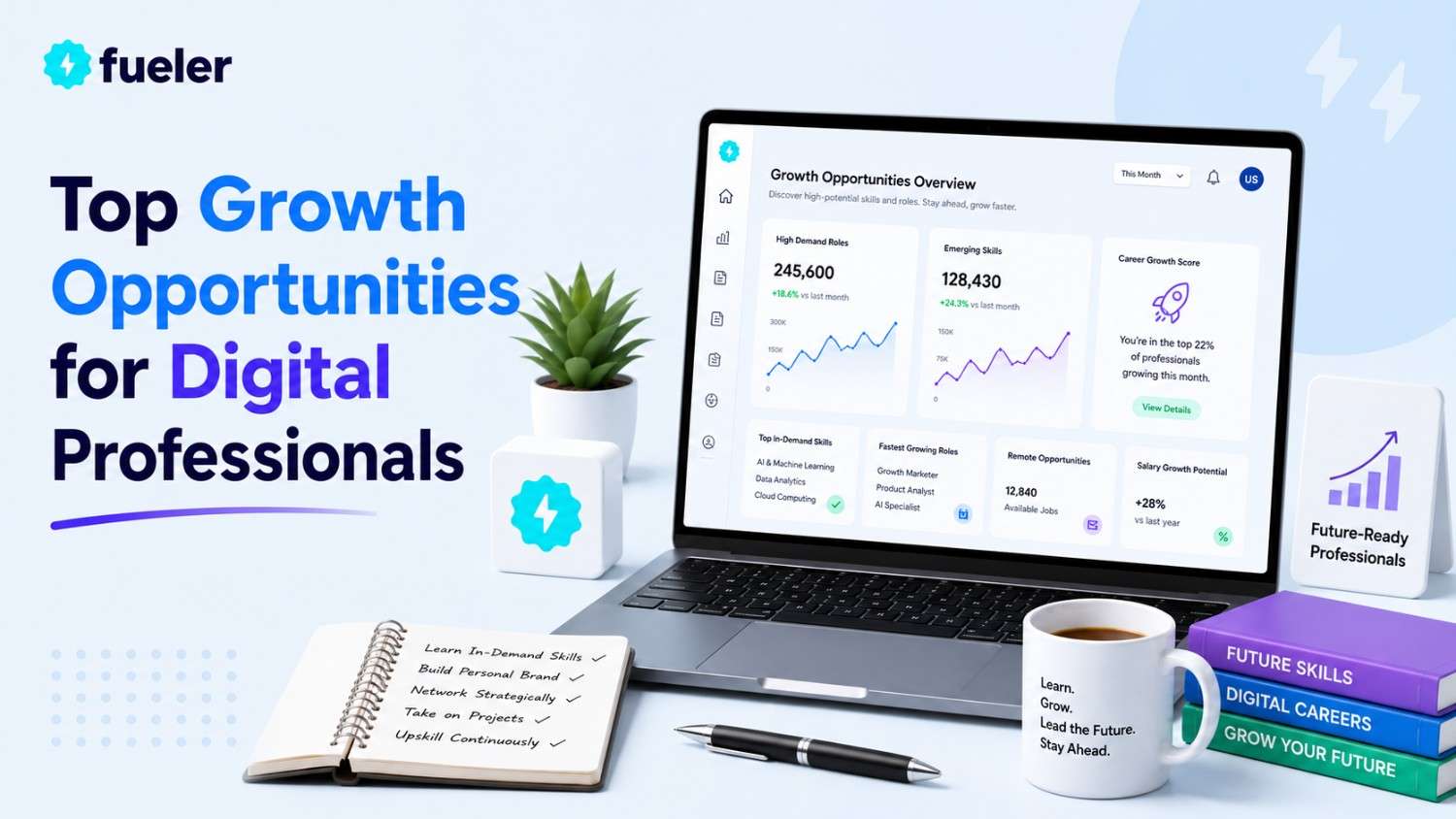
The professional landscape has shifted from a "digital-first" mindset to an "AI-native" reality, where the most valuable assets are no longer just technical skills, but the ability to orchestrate complex, intelligent systems. By 2026, the global workforce is seeing a massive surge in demand for specialized roles that bridge the gap between raw data and strategic execution. Success in this era belongs to those who view technology as a collaborator, using it to amplify uniquely human strengths in creativity, ethics, and high-level strategy.
I’m Riten, founder of Fueler - a skills-first portfolio platform that connects talented individuals with companies through assignments, portfolios, and projects, not just resumes/CVs. Think Dribbble/Behance for work samples + AngelList for hiring infrastructure.
AI Orchestration and Agentic Systems
The focus of artificial intelligence has moved beyond simple chatbots toward "Agentic AI" autonomous systems capable of planning, executing, and optimizing complex workflows with minimal human intervention. Organizations are now scrambling to hire professionals who can design and manage these "agent ecosystems" to handle everything from supply chain logistics to customer lifecycle management.
- Key Growth Area: AI Operations (AIOps) and Agentic Workflow Design. This involves creating a "mesh" where different AI agents communicate with one another to complete end-to-end business processes such as a sales agent identifying a lead, a research agent qualifying them, and an outreach agent drafting the email all without manual triggers.
- Essential Skills & Tools: Mastery of Python is mandatory, alongside specialized frameworks like LangChain, CrewAI, or AutoGPT for agent orchestration. You must understand RAG (Retrieval-Augmented Generation) architectures to give agents access to private company data and be proficient in orchestrating multiple LLM APIs like OpenAI, Anthropic, and Gemini simultaneously.
- Average Salary Expectations: In the 2026 market, AI Orchestrators and Engineers command base salaries between $120,000 and $190,000. Senior AI Architects who can build custom enterprise-grade agentic frameworks are seeing total compensation packages exceeding $275,000 in high-demand hubs like Bengaluru, San Francisco, and London.
- Pricing for Professional Upskilling: Specialized certifications in Agentic AI and Generative AI systems range from $500 to $2,500. For example, Simplilearn’s "AI & Machine Learning" 6-month program starts at $4,300, while boutique technical bootcamps focusing on agentic workflows often charge between $1,200 and $1,800 for intensive 8-week cohorts.
- The Industry "Why": As businesses move from "experimenting" with AI to "scaling" it, they need architects who can ensure these autonomous agents are safe, reliable, and high-performing. Companies are shifting budgets from general labor to specialized AI talent that can automate 40-60% of traditional middle-management tasks through these intelligent systems.
Advanced Cybersecurity and Identity Governance
With the rise of AI-driven attacks and synthetic identity threats, cybersecurity has evolved into a multi-dimensional battleground. The traditional perimeter-based security model is obsolete; in 2026, the focus is on "Zero-Trust" frameworks and securing the "digital identities" that connect a web of global SaaS applications and autonomous agents.
- Key Growth Area: Identity and Access Management (IAM) and Cloud Security Architecture. Professionals in this space are moving beyond simple passwords to manage "machine identities" (the credentials used by AI agents) and protecting organizations against sophisticated deepfake-based social engineering attacks that bypass traditional MFA.
- Essential Skills & Tools: Expert-level knowledge of Zero-Trust architecture, cloud-native security tools (AWS Security Hub, Azure Sentinel), and Quantum-Safe Cryptography. You must be able to design "Assume-Compromise" models where the system is built to contain damage even if a specific entry point like a human employee is successfully breached.
- Average Salary Expectations: Security Architects earn an average of $135,000 – $215,000. Because the stakes are so high, specialists in "Incident Response" or "Digital Forensics" often command additional "on-call" bonuses that can push their total take-home pay 20-30% higher than the industry baseline.
- Pricing for Professional Upskilling: The "gold standard" CISSP certification exam costs roughly $749, but the preparatory training can cost between $2,000 and $3,500. More offensive-focused certifications like the OSCP (Offensive Security) for penetration testing are priced at $1,600 to $2,500, depending on the duration of lab access.
- The Industry "Why": A single breach in 2026 can cost a global company millions in ransom payments and lost equity, making security professionals the ultimate "insurance policy." As cybercriminals use AI to launch attacks 100 times faster than humanly possible, the demand for "Defensive AI" experts has reached an all-time high.
Data Engineering and MLOps (Machine Learning Operations)
AI is only as good as the data that feeds it, making Data Engineering the "backbone" of the 2026 economy. These professionals build the high-speed, real-time pipelines that clean and move massive datasets into AI models. MLOps is the specific discipline that ensures these models stay accurate, updated, and efficient once they are deployed into production.
- Key Growth Area: Automated Data Pipelines and Model Reliability Engineering. Organizations are moving away from batch processing to "Streaming Data," requiring engineers who can manage real-time data flows using technologies that prevent model "hallucinations" by providing fresh, high-quality context to LLMs.
- Essential Skills & Tools: Mastery of SQL and Python is the baseline; you must also be proficient in Snowflake or BigQuery for data warehousing, and dbt for transformation. For the "Ops" side, skills in Docker, Kubernetes, and "Vector Databases" (like Pinecone or Weaviate) are essential for managing the long-term memory of modern AI systems.
- Average Salary Expectations: MLOps Engineers typically earn $115,000 – $200,000. Senior Data Engineers with experience in "Data Mesh" or "Data Fabric" architectures decentralized ways of managing data across massive global enterprises are currently among the top 5% of earners in the digital tech sector.
- Pricing for Professional Upskilling: Specialized MLOps bootcamps or PG Diplomas (like those from IIT Madras or MIT xPRO) range from $1,500 to $5,000. For a more self-paced approach, Udacity’s "MLOps Nanodegree" typically costs around $399 per month, usually taking 3-4 months to complete a full portfolio-ready project.
- The Industry "Why": Only 5% of companies that build an AI model actually manage to deploy it successfully at scale; MLOps is the missing link that solves this problem. Data is now considered a "product" rather than just a byproduct of business, and those who can manufacture high-quality data are the new factory owners of the digital age.
AI Product Management and UX Strategy
As technology becomes more complex, the need for "translators" who can turn technical capabilities into user-friendly products is at an all-time high. Product Managers in 2026 are defining how humans interact with AI, moving from "click-based" interfaces to "conversation-based" and "proactive" user experiences.
- Key Growth Area: AI-First Product Strategy and Behavioral UX Design. This involves managing the lifecycle of AI products, from defining the "intent" of a model to ensuring the user interface can handle the non-linear way humans interact with intelligent agents, often anticipating user needs before they are explicitly typed.
- Essential Skills & Tools: Deep understanding of Agile and Scrum is still required, but it must be paired with knowledge of "Model Evaluation" and user behavioral psychology. You'll use tools like Productboard for roadmapping and specialized AI analytics platforms to track how users are actually "talking" to your product.
- Average Salary Expectations: AI Product Managers earn between $110,000 and $185,000. In Big Tech companies (like Google or Meta), experienced Lead PMs can reach total compensation of $300,000+ when including restricted stock units (RSUs) and performance-linked bonuses.
- Pricing for Professional Upskilling: Executive Product Management programs (such as those from ISB, IIM, or Kellogg) cost between $1,400 and $3,500. Shorter, intensive certifications from the Product School or Reforge focusing on AI growth strategy typically range from $1,000 to $2,000.
- The Industry "Why": In a world where everyone has access to the same AI models, the "User Experience" (UX) is the only remaining competitive advantage. Companies need PMs who can navigate the "uncanny valley" of AI, making sure products feel helpful and human rather than intrusive, creepy, or overly robotic.
Quantum Computing Readiness and Algorithms
While still an emerging field, 2026 has seen a surge in "Quantum-Ready" roles within the financial and pharmaceutical sectors. Companies are hiring specialists who can prepare their algorithms for the quantum transition, ensuring that their optimization problems like drug discovery or risk modeling can leverage the massive processing power of quantum bits (qubits).
- Key Growth Area: Quantum Algorithm Development and Cryptographic Migration. This niche focuses on translating classical mathematical problems into quantum circuits and helping enterprises migrate their encryption standards to be resistant to quantum-based hacking attempts.
- Essential Skills & Tools: Strong background in linear algebra and quantum mechanics, along with proficiency in Qiskit (IBM), Cirq (Google), or Bracket (Amazon). You must be able to work with hybrid classical-quantum algorithms that combine the best of both computing worlds.
- Average Salary Expectations: Because the talent pool is so small, Quantum Research Scientists and Engineers often see starting salaries of $160,000 – $240,000. Those with a PhD or specialized postdoctoral research can frequently command total packages exceeding $400,000 in private industry.
- Pricing for Professional Upskilling: Most high-level training in this field is through academic institutions, but platforms like Coursera offer "Quantum Computing Specializations" for around $49 per month. Advanced enterprise training from IBM or Microsoft can cost between $2,000 and $5,000 for intensive certification paths.
- The Industry "Why": Quantum computing represents a "Sputnik moment" for global industry. The first companies to master quantum-enhanced optimization will gain a decade-long lead in product development and logistical efficiency, making these specialized engineers highly coveted strategic assets.
Sustainable Tech and Green Software Engineering
With carbon taxes and environmental regulations tightening globally, 2026 has introduced the role of the "Green Software Engineer." These professionals focus on writing efficient code that consumes less energy and optimizing cloud infrastructure to reduce the carbon footprint of massive AI training clusters and data centers.
- Key Growth Area: Carbon-Aware Computing and Energy-Efficient Code Optimization. This involves designing systems that schedule high-intensity processing tasks during times when the local power grid is using the highest percentage of renewable energy (e.g., solar or wind).
- Essential Skills & Tools: Proficiency in languages known for energy efficiency (like C++ or Rust), cloud resource management, and familiarity with carbon-tracking tools like the "Cloud Carbon Footprint" open-source tool. You must understand the "Green Software Foundation" principles for building sustainable applications.
- Average Salary Expectations: Sustainability-focused Engineers typically earn between $105,000 and $170,000. While the base pay is similar to general software engineering, many companies offer "ESG Bonuses" to employees who successfully reduce the infrastructure's carbon output.
- Pricing for Professional Upskilling: The Green Software Foundation offers various training modules, many of which are Free or under $200. More comprehensive "Sustainable Technology Management" certifications from top universities can range from $1,500 to $3,500.
- The Industry "Why": Sustainability is no longer a PR move; it is a financial necessity. As data centers consume a growing percentage of the world's electricity, companies that can run their digital operations with 20-30% less energy will save millions in operating costs and avoid heavy carbon penalties.
Bio-Digital Interface and Health-Tech Integration
The intersection of technology and biology is expanding rapidly as wearable devices and biosensors move beyond simple step-counting into real-time medical monitoring. In 2026, digital professionals who can handle "Bio-Data" while maintaining strict privacy standards are seeing a massive boom in the health-tech sector.
- Key Growth Area: Wearable Data Analytics and Remote Patient Monitoring (RPM) Systems. This requires building secure systems that can interpret complex biological signals like glucose levels or neural activity and turn them into actionable health insights for both patients and doctors.
- Essential Skills & Tools: HIPAA/GDPR compliance expertise, signal processing, time-series data analysis, and experience with "Edge Computing" (processing data on the device itself rather than in the cloud). Familiarity with FHIR (Fast Healthcare Interoperability Resources) standards is a major plus.
- Average Salary Expectations: Health-Tech Data Scientists and Engineers earn between $125,000 and $190,000. Professionals with a dual background in biology and computer science are particularly valuable, often fetching a 15-20% premium on their base salary.
- Pricing for Professional Upskilling: Specialized "Health Informatics" or "Bio-Tech for Engineers" courses range from $1,000 to $4,000. Professional development in healthcare-specific data standards (like HL7) usually costs around $500 to $800 per certification module.
- The Industry "Why": The global healthcare system is shifting from "reactive" care to "predictive" care. Those who can build the pipes and the brains for this transition are working on the most impactful technology of our generation, saving lives through early detection and personalized medicine.
Showcasing Your Growth on Fueler
The year 2026 has made one thing clear: your degree is your history, but your portfolio is your future. In these high-growth fields, recruiters don't have time to read through long resumes; they want to see "Proof of Work." They want to see the AI agent you built, the security audit you performed, or the energy-efficient pipeline you optimized.
This is why Fueler is the most important tool in your career arsenal. As you learn these new skills and complete assignments, document them on Fueler. Build a skills-first portfolio that shows the world you aren't just a "candidate," but a practitioner who is ready for the high-stakes world of 2026. By highlighting your actual output, you stand out to the global companies that are aggressively hiring for these high-paying, high-impact roles.
Final Thoughts
The year 2026 is rewarding those who can "co-create" with machines rather than compete against them. Whether you are securing the cloud, engineering the data that fuels intelligence, or managing the next generation of AI-driven products, the goal is to remain in a state of continuous adaptation. The "Digital Premium" , the extra salary paid to those with these specialized skills, is only growing as the supply of talent fails to meet the exponential demand. Position yourself now, build your portfolio of proof, and take your place at the forefront of the new, agentic economy.
Frequently Asked Questions
Which skill has the highest starting salary for beginners in 2026?
AI and Machine Learning roles currently offer the highest entry-level packages, often starting at $85,000. However, Cybersecurity is a close second due to the critical nature of the work and the extreme shortage of qualified junior talent.
Are expensive certifications really worth the investment?
Yes, but only if they are paired with hands-on projects. In 2026, a certification like CISSP or a PG Diploma in AI acts as a "gatekeeper" that gets your resume past the AI filters, but your Fueler portfolio is what actually closes the deal during the interview.
Can I transition into these roles from a non-technical background?
Absolutely. Roles like AI Product Manager or AI Ethics Officer require strong communication, empathy, and strategic thinking. You can start by taking foundational courses (priced at $200–$500) and then specializing in the "human" side of technical implementation.
How often should I update my skills to stay relevant?
In the current landscape, the "half-life" of a technical skill is about 18 months. You should set aside a small budget (approx. $50–$100/month) for continuous learning through platforms like Coursera, LinkedIn Learning, or specialized niche communities to stay ahead of the curve.
What is the most "recession-proof" digital career in 2026?
Cybersecurity remains the most recession-proof field because security is not an "optional" expense for businesses; it is a mandatory requirement for survival. Regardless of the economic climate, companies must protect their data and maintain compliance, ensuring steady demand for security experts.
What is Fueler Portfolio?
Fueler is a career portfolio platform that helps companies find the best talent for their organization based on their proof of work.
You can create your portfolio on Fueler, thousands of freelancers around the world use Fueler to create their professional-looking portfolios and become financially independent. Discover inspiration for your portfolio
Sign up for free on Fueler or get in touch to learn more.
What should you do next?
You've read the article. Now turn your skills into proof of work and unlock more opportunities.
Build your proof of work portfolio
Create a clean portfolio with projects, assignments, resumes, and AI stack details that companies actually want to see.
Create your Fueler portfolio →Apply through assignments, not resumes
Stand out by solving real tasks from companies hiring on Fueler.
Explore assignments →Get discovered by companies
Make your work public and let recruiters discover your skills through actual projects instead of keywords.
Get discovered →
