The Snapdeal Mafia: How Ex-Snapdeal Employees Built Some of India's Biggest Companies

Riten Debnath
06 Jul, 2026
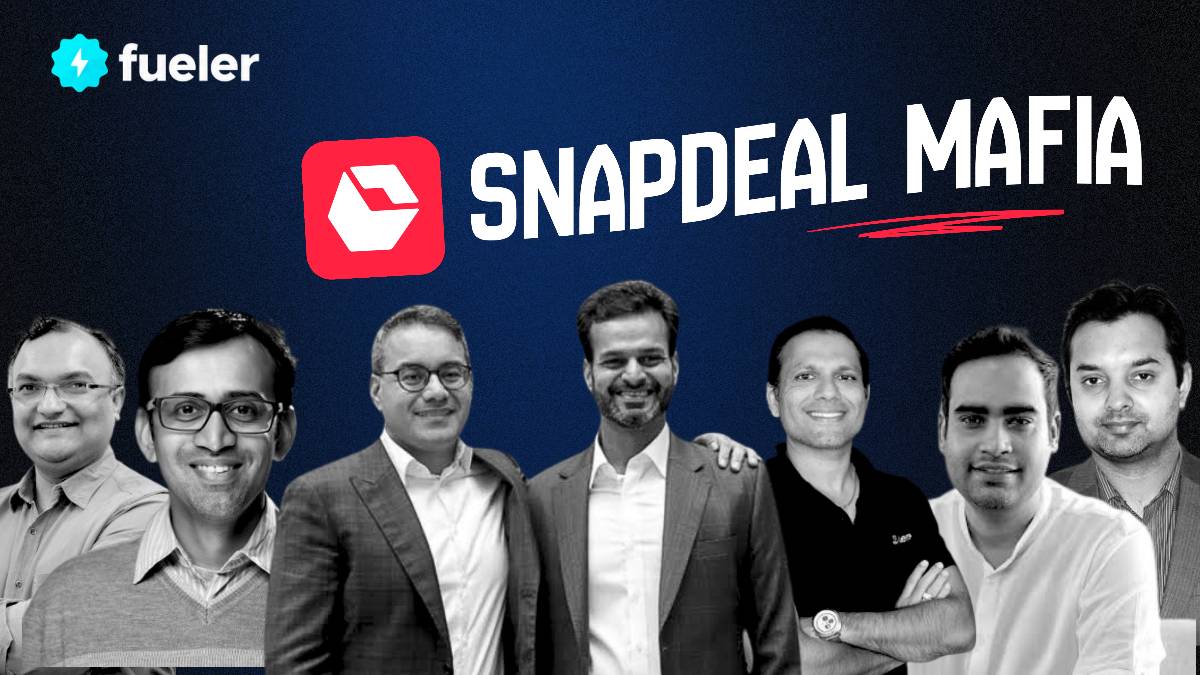
Every big startup leaves behind more than a product. It leaves behind people. People who learned how to build, scale, break things, and rebuild them under real pressure. When those people leave and start their own companies, you get what the tech world calls a "mafia."
The PayPal Mafia gave us Tesla, LinkedIn, YouTube, and Palantir. India has quietly been building its own versions. Flipkart has one. Freecharge has one. And Snapdeal, a company many people wrote off after its near-merger with Flipkart collapsed in 2017, has one of the most underrated alumni networks in the Indian startup ecosystem.
I'm Riten, founder of Fueler, a portfolio platform that helps professionals get hired through assignments, proof of work, and projects instead of just resumes. I spend a lot of time studying how operators turn experience into outcomes, and the Snapdeal story is a masterclass in exactly that.
In this article, you will learn who the key members of the Snapdeal Mafia are, what they built after leaving, how those companies are performing in 2026, and what patterns you can borrow as a founder, operator, or creator. Every number here is pulled from public sources and cross-checked, so you can quote it with confidence.
What Is the Snapdeal Mafia and Why It Matters
Snapdeal Mafia
The "Snapdeal Mafia" refers to the founders and early employees of Snapdeal who went on to build or fund significant companies of their own. The term borrows from the "PayPal Mafia," where a single startup's talent seeded an entire generation of businesses.
Snapdeal was founded in February 2010 by Kunal Bahl and Rohit Bansal. It grew into one of India's largest value e-commerce marketplaces, raised roughly $1.7 billion from backers like SoftBank, Alibaba, and Foxconn, then survived a brutal near-collapse. That pressure cooker produced unusually sharp operators.
- The alumni span almost every important category in Indian tech, from B2B commerce and fintech lending to D2C fashion, travel tech, SaaS, and venture capital. This range shows Snapdeal was not a one-trick e-commerce shop but a training ground for builders across business models.
- Several members did not just start companies. They built profitable, revenue-heavy businesses like OfBusiness and Oxyzo, which stands out in an ecosystem where many unicorns still burn cash chasing growth without a clear path to profit.
- The mafia includes both founders who quit to build from scratch and the original Snapdeal founders themselves, who reinvented the parent company and became two of India's most active early-stage investors through Titan Capital.
- Many of these founders carried forward a specific Snapdeal skill: reaching value-conscious customers in Tier 2 and Tier 3 India. That distribution muscle shaped ventures in raw materials, ethnic fashion, and SME procurement.
- The network matters for hiring and career signals too. When you see "ex-Snapdeal" on a founder profile, it now carries weight, because the track record of what that experience produced is public and verifiable.
This story matters because it proves a point every operator should internalize. A company can "fail" at its original mission and still create enormous downstream value through the people it trained. For founders and job seekers, the lesson is that the skills and proof you build inside a company outlast the company's own headlines.
The Snapdeal Mafia at a Glance
Here is the full map of the Snapdeal Mafia in one view. The figures below are updated to 2026 using public sources, so a few numbers differ from older internal lists that mixed up company revenues or IPO details.
OfBusiness: The B2B Commerce Giant With a Snapdeal Engineer at Its Core
OfBusiness is the crown jewel of the Snapdeal Mafia by sheer scale. Founded in 2015, it is a B2B platform that helps small and medium manufacturers buy raw materials like steel, polymers, chemicals, and agri-commodities, while also lending them working capital.
Bhuvan Gupta, who was Vice President of Engineering at Snapdeal, is a co-founder and the Chief Technology Officer of OfBusiness. He built the tech backbone alongside a founding team that includes CEO Asish Mohapatra and CFO Ruchi Kalra.
The company took the exact opposite path of most consumer unicorns. Instead of burning cash, it turned profitable early and kept compounding.
- OfBusiness reported operating revenue of around 19,296 crore rupees in FY24 with a net profit of 603 crore rupees, and its consolidated revenue crossed roughly 22,241 crore rupees in FY25. These are numbers most Indian tech startups never reach, and OfBusiness hit them while staying profitable.
- The business runs on a margin-stacked model. It earns a thin trading margin on raw material sales, then layers financing revenue on top through its lending arm, so each customer relationship produces more than one income stream.
- OfBusiness has raised more than 776 million dollars from investors including Alpha Wave Global, Tiger Global, and SoftBank, and carries a private valuation of around 5 billion dollars, making it one of India's most valuable B2B companies.
- The company has been preparing a large IPO of roughly 750 million to 1 billion dollars, targeting a valuation between 6 and 9 billion dollars. The timeline has slipped more than once, and as of 2026 the listing is still awaited rather than completed.
- Bhuvan Gupta's engineering leadership shows how a strong technical hire from one company becomes a company builder at the next. He has also been involved in related ventures like Nexizo and BidAssist that sit inside the OfBusiness universe.
For anyone studying Indian startups, OfBusiness matters because it rewrites the growth playbook. It shows that unglamorous, infrastructure-heavy B2B businesses can outgrow flashy consumer apps, and that a Snapdeal-trained engineer can help build a multi-billion-dollar company by solving boring but massive problems for SMEs.
Oxyzo: The Profitable Fintech Lender Born Inside OfBusiness
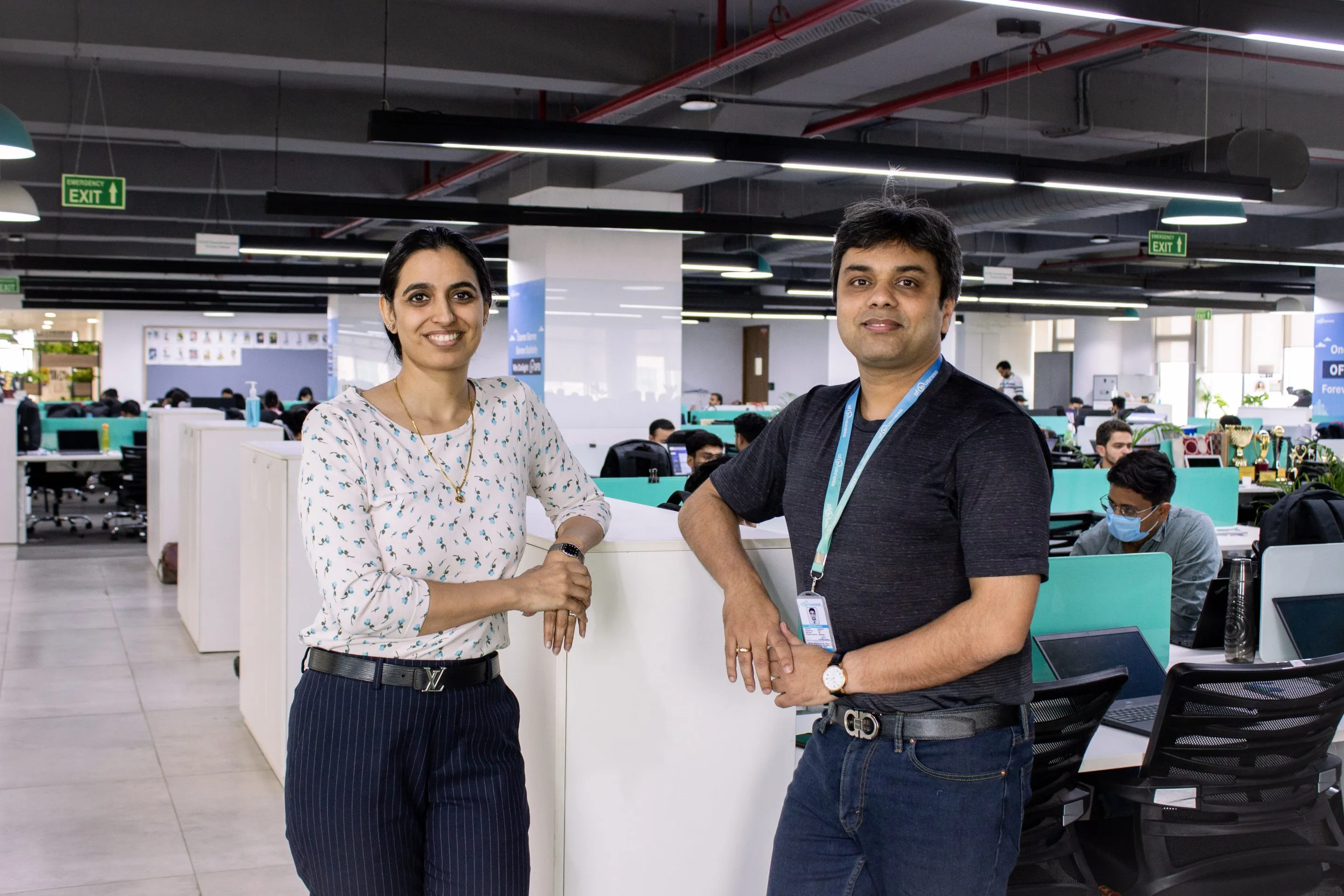
Oxyzo Founders
Oxyzo is proof that a good idea inside a company can grow into its own giant. It began in 2016 as the lending engine of OfBusiness and later became a full-fledged, profitable non-banking financial company (NBFC) serving small and medium enterprises.
It shares DNA and founders with OfBusiness, including Bhuvan Gupta from Snapdeal, and is led by Ruchi Kalra as CEO. Oxyzo lends working capital to SMEs so they can buy raw materials, fund tenders, and manage cash flow.
What makes Oxyzo remarkable is that it is a lender that actually makes money, in a sector where many NBFCs struggle.
- Oxyzo posted operating revenue of 1,207 crore rupees in FY25, up about 34 percent year on year, with a net profit of 339 crore rupees, up roughly 16.5 percent. Its total assets stood at around 9,236 crore rupees, showing a large and healthy balance sheet.
- The company became a unicorn in 2022 after raising 200 million dollars in its first external round, co-led by Alpha Wave Global and Tiger Global. That single round validated the idea that SME lending, done with good underwriting, could be both profitable and scalable.
- Oxyzo keeps risk tight, with the majority of its loan book secured and a low share of overdue unsecured loans. This discipline is why credit rating agencies expect steady loan book growth over the medium term.
- The company has expanded beyond plain lending. It acquired GoldenPi Technologies to enter retail fixed income, and in 2025 it launched Oxyzo Credit Fund I, moving into fund management and structured credit for mid-sized companies.
- OfBusiness owns roughly 70 percent of Oxyzo, which means the two businesses reinforce each other. A customer buying steel on OfBusiness can also borrow from Oxyzo, creating a tight loop of commerce and credit.
Oxyzo matters because it demonstrates the power of building a financial layer on top of a commerce business. For founders, it is a template for how to spin an internal capability into a standalone, profitable company. It also strengthens the case that the Snapdeal Mafia produced operators who understand unit economics, not just growth charts.
Amitabh Misra: From Snapdeal CTO to Gofro Founder to Sprinklr CTO
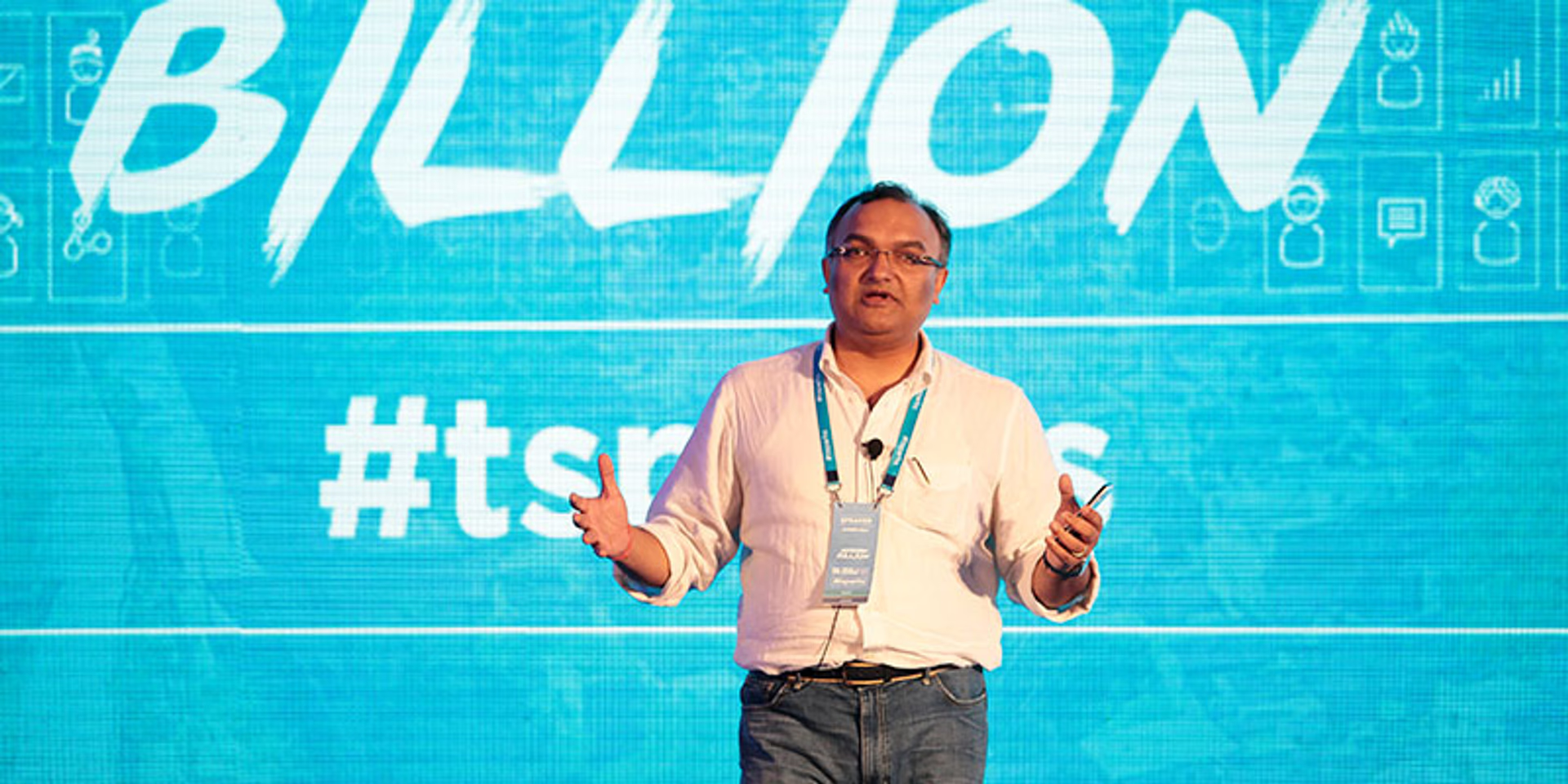
Not every mafia story is about building a unicorn. Some are about a career arc that keeps climbing. Amitabh Misra is one of Snapdeal's most senior technical alumni, and his journey shows how deep engineering experience opens doors for decades.
At Snapdeal, Misra served as CTO, Chief Architect, and Head of Engineering. He built one of India's largest online marketplace platforms and a tech team of more than 600 people in a short window while the business scaled at a rapid pace.
After Snapdeal, he became a founder himself before returning to large-scale product leadership.
- Misra founded and led Gofro, an online marketplace for international holiday packages and itinerary planning, through his company Bona Vita Technologies. He raised over 10 million dollars in venture capital and built a network of hundreds of destination experts and global suppliers.
- Gofro attracted strategic backing, and travel major MakeMyTrip took a majority stake in Bona Vita Technologies. The travel venture eventually wound down, which is a reminder that even skilled founders face startup mortality, especially in the tough online travel category.
- After his founder chapter, Misra joined Adobe as Vice President of Engineering, where he led a global research and development organization for the Adobe Experience Cloud platform across India, Europe, and the United States.
- In 2024, Misra became Chief Technology Officer of Sprinklr, the New York listed customer experience software company (NYSE: CXM). He now leads global product and engineering teams for an enterprise AI platform used by major brands.
- His path from Snapdeal to Adobe to Sprinklr shows that a strong technical reputation compounds. The platform he built at Snapdeal became a credential that carried him into some of the most senior engineering roles in global software.
Misra's story matters because it reframes what a "mafia win" looks like. Success is not only about founding a billion-dollar company. It is also about turning hard-earned experience into a durable, high-impact career. For engineers and operators, his arc is a lesson in how visible, provable work becomes long-term leverage.
Aachho: The Bootstrapped D2C Fashion Brand From Jaipur
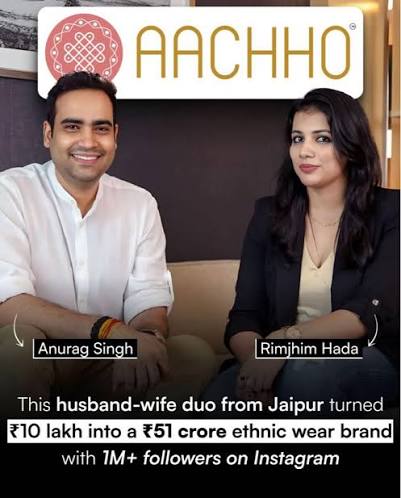
Aachho Founders
Aachho is one of the most charming stories in the Snapdeal Mafia because it is not a tech-heavy venture at all. It is a direct-to-consumer (D2C) ethnic fashion brand for women, built largely without outside funding, from Jaipur.
Anurag Singh Khangarot spent years at Snapdeal in business development and alliances roles, including as a senior manager handling national alliances and corporate sales in the West region. Worried about his future around the failed Flipkart merger talks, he quit and started Aachho in 2018 with his wife, Rimjhim Hada.
The brand focuses on handcrafted, hand-block ethnic wear, tapping into Rajasthan's rich textile heritage.
- Aachho grew from a tiny setup with a single sewing machine into a brand that closed FY22 with a turnover of around 40 crore rupees. Its revenue climbed from about 1 crore in FY19 to 3 crore, then 19 crore, then 40 crore, a steep bootstrapped ramp.
- The brand built its audience through Instagram and Facebook, turning social content into a direct sales channel. It has served several lakh customers and sells through both its own website and marketplaces like Nykaa, showing strong D2C distribution instincts.
- Aachho's product range covers kurta sets, lehengas, shararas, ghagra-cholis, sarees, and matching accessories, priced to sit in an accessible premium band. This breadth lets it capture repeat purchases across occasions rather than one-off buys.
- The company moved from online-only into physical retail, opening its first offline store in Delhi and planning more in metros. That omnichannel step reflects a mature understanding that ethnic wear buyers often want to feel the fabric before purchase.
- Khangarot carried a very Snapdeal-shaped skill into Aachho: reaching value-conscious Indian shoppers and building alliances. His e-commerce and payments background, including time at Freecharge, gave the couple an edge in running a lean online-first brand.
Aachho matters because it proves the mafia effect is not limited to engineers and MBAs building tech. A business development leader used marketplace know-how to build a profitable consumer brand with almost no external capital. For creators and small founders, it is a reminder that distribution skill plus a real product can beat a big funding round.
Anand Chandrasekaran: Snapdeal's Product Chief Turned Investor
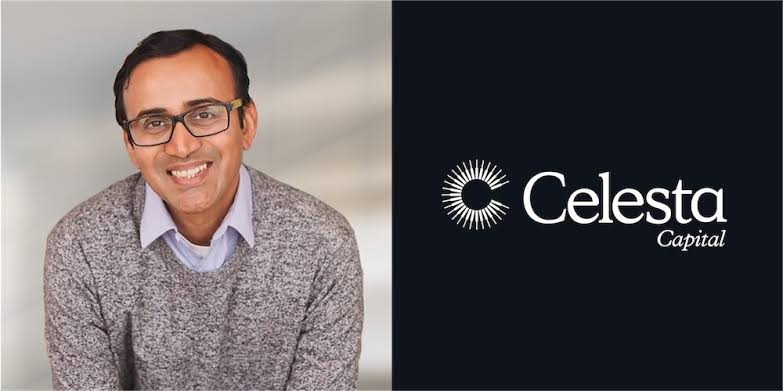
Anand Chandrasekaran
Anand Chandrasekaran represents a different kind of mafia output: the operator who becomes one of the most respected investors and company builders in the India to United States corridor. His Snapdeal chapter was short, but his overall trajectory is one of the most decorated in this group.
He served as Chief Product Officer at Snapdeal and was associated with its payments arm, FreeCharge. Before and after that, he held senior product roles at Bharti Airtel, Meta (Messenger), Yahoo, and Five9.
After his operating years, he turned into a prolific angel investor and eventually a venture capitalist.
- Chandrasekaran has been recognized as the number one seed investor focused on the India to United States corridor by the Hurun India report for three years running, from 2022 to 2024. That is a rare, repeated ranking that signals genuine picking skill.
- His personal portfolio spans dozens of startups across AI, SaaS, fintech, and consumer tech, including names like Fynd, NoBroker, MoEngage, Yulu, ToneTag, SignEasy, and Innov8. Several of these have grown into large or category-leading companies.
- He co-founded Crescendo, an AI-native contact center company incubated within General Catalyst, which he helped grow to significant revenue and a valuation reported around 500 million dollars in a short time. He also co-founded HiOctave.
- In late 2024, he joined deep tech venture firm Celesta Capital as a Managing Partner, after serving as a Partner at General Catalyst where he helped build the firm's India to US investing practice. This moved him from angel investing into institutional venture capital.
- His profile shows how product leadership converts into investing edge. Having shipped products for hundreds of millions of users, he can evaluate founders and products with an operator's eye rather than only a spreadsheet.
Chandrasekaran matters because he closes the loop of a healthy startup ecosystem. Operators who learn inside companies like Snapdeal later fund and mentor the next wave of founders. For anyone building a career, his path is a strong example of how visible operating wins become the foundation for a second act in investing.
DealBerg: The Niche B2B Procurement Startup by Abhishek Emmanuel
DealBerg is a smaller but genuine part of the Snapdeal Mafia, and it shows that not every alumni venture becomes a giant. Some carve out focused niches and keep grinding. Founded in 2016 in Bengaluru, DealBerg is a B2B procurement marketplace for offices and businesses.
Abhishek Emmanuel led the enterprise and B2B business at Snapdeal before starting DealBerg. He built the company with co-founders including Suma PV and later Sree Krishna Seelam, targeting corporate buyers who need office supplies, general merchandise, electronics, and reward or gifting solutions.
The company positioned itself as an invite-only procurement platform for companies, especially those in smaller cities.
- DealBerg raised around 1 million dollars from high net worth investors and used part of that to acqui-hire a year-old startup called WeAreGadgets in 2016. This early consolidation move gave it a team and product boost while it was still finding its feet.
- Its product suite went beyond simple buying. It included procurement tools plus reward and recognition offerings for SMEs, aiming to serve corporates on both employee purchasing and internal gifting in one place.
- The company deliberately focused on Tier 2 and Tier 3 businesses that struggle to access genuine, warranty-backed products from big brands. This is a very Snapdeal-style bet on serving underserved, value-conscious buyers.
- Compared with the mafia's larger names, DealBerg has stayed a lean, niche operator rather than a heavily funded scale-up, competing in a crowded B2B procurement space alongside players like Moglix, Udaan, and Solv.
- Emmanuel's long background in enterprise sales, including roles beyond Snapdeal, shaped a relationship-led approach. His story reflects the reality that alumni ventures come in all sizes, and steady niche businesses are part of the picture too.
DealBerg matters because it adds honesty to the mafia narrative. Not every ex-Snapdeal founder builds a unicorn, and that is fine. For founders, it is a grounded example of using insider category knowledge to serve a specific customer, even without a blockbuster funding story.
Titan Capital: Kunal Bahl and Rohit Bansal's Quiet Venture Engine
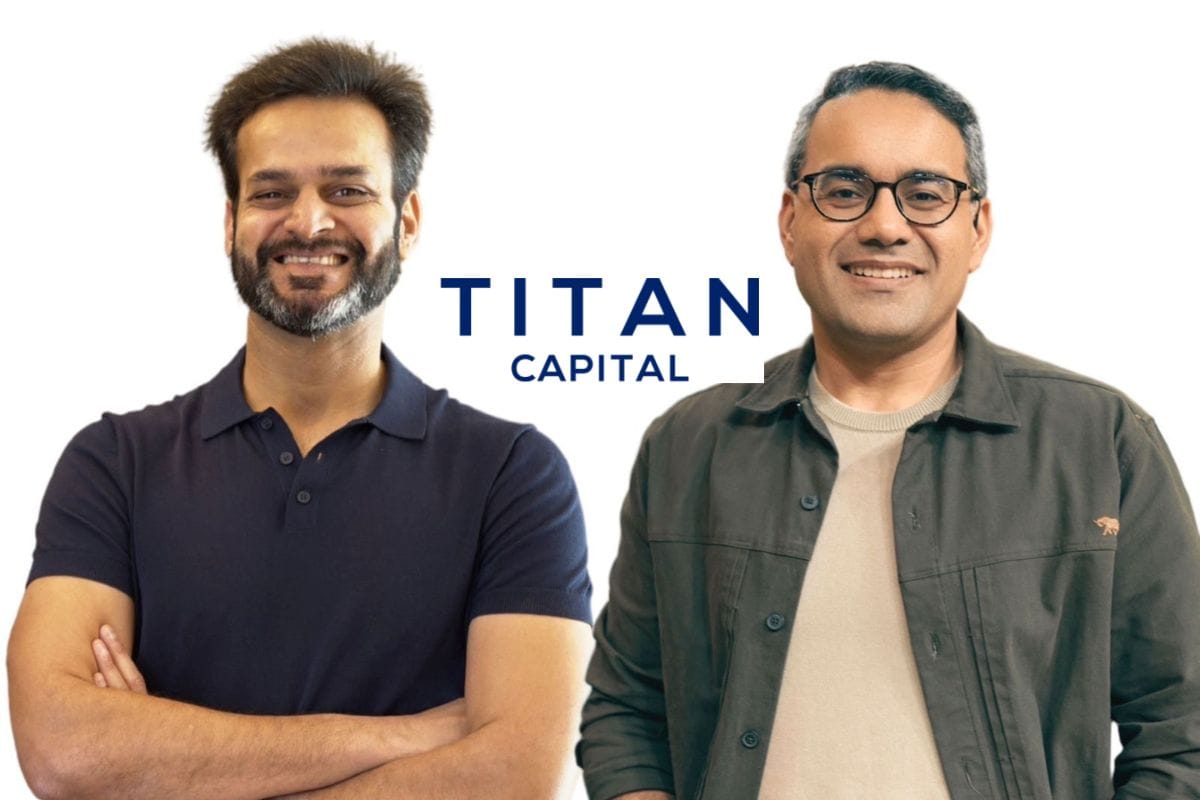
Titan Capital Founders
The Snapdeal Mafia is not only made of people who left. It is also driven by the two founders who stayed and reinvented themselves. Kunal Bahl and Rohit Bansal turned their operating scars into one of India's sharpest early-stage investment firms, Titan Capital.
Titan Capital, which they started around 2011, invests their personal money into seed and pre-seed startups. It has backed more than 250 companies over the years, long before "operator angel" became a fashionable label in India.
Their portfolio reads like a roll call of modern Indian tech.
- Titan Capital's investments include Ola, Urban Company, Mamaearth, Razorpay, Shadowfax, OfBusiness, Credgenics, Giva, and Unicommerce. This spread across mobility, home services, beauty, fintech, and logistics shows a broad, high-conviction thesis on India's consumer and SaaS growth.
- The firm is known for outsized returns, reportedly generating more than 100 times its investment on early bets like Ola, Urban Company, and Mamaearth. Those outcomes cemented Bahl and Bansal's reputation as founders who can also pick winners.
- In 2024, they launched the Titan Capital Winners Fund, a SEBI-registered Category II Alternative Investment Fund with a target corpus of 200 crore rupees. It focuses on follow-on investments in breakout companies from their seed portfolio.
- The duo blends capital with real operating help. Having built and nearly lost Snapdeal, they mentor founders through the messy early stages, offering pattern recognition that pure financial investors often lack.
- Kunal Bahl also joined the investor panel of Shark Tank India, extending their mentor-investor brand to a mainstream audience and reinforcing the founder-turned-backer identity at the heart of the Snapdeal Mafia.
Titan Capital matters because it shows how founders can recycle hard-won lessons into ecosystem-wide impact. Instead of disappearing after Snapdeal's turbulence, Bahl and Bansal became engines of the next generation. For operators, it is proof that your network and judgment can become an asset class of their own.
AceVector and Unicommerce: Snapdeal's Own Comeback and SaaS IPO
The final piece of the story is Snapdeal itself, or rather what it became. In 2022, the parent company rebranded to AceVector Group, an umbrella that houses multiple businesses built by Kunal Bahl and Rohit Bansal after the Flipkart merger fell through.
AceVector Group brings together Snapdeal, the value e-commerce marketplace, Unicommerce, an e-commerce software company, and Stellaro Brands, a house of value-focused consumer brands. This structure turned a single struggling marketplace into a small portfolio of tech-enabled retail businesses.
The standout success here is Unicommerce, which delivered one of the most talked-about SaaS listings of 2024.
- Unicommerce is described as India's largest e-commerce enablement SaaS platform. It helps brands, sellers, and logistics firms manage warehousing, inventory, multi-channel orders, and post-purchase operations, acting as a nerve center for online retail operations.
- Unicommerce went public in August 2024. Its roughly 277 crore rupee issue was subscribed about 168 times, and the stock listed on the NSE and BSE at around 235 rupees against an issue price of 108 rupees, a listing gain of roughly 117 percent.
- The SaaS business has stayed profitable and growing. It reported total income of around 322 crore rupees in FY25, and for the first nine months of FY26 it posted a net profit of about 38.69 crore rupees, showing continued momentum after listing.
- AceVector, the Snapdeal parent, has itself been working toward an IPO. It refiled its draft papers and received regulatory approval, with a listing expected in the second half of 2026, and it has sharply narrowed its losses on rising revenue.
- This reinvention is the ultimate mafia flex. A company that nearly shut down not only survived through a value commerce pivot but also spun a separate SaaS business into a highly subscribed public company, all under the same founding duo.
AceVector and Unicommerce matter because they show resilience as a strategy. The founders did not chase their old dream of beating Flipkart head-on. They built adjacent, healthier businesses and let one of them reach the public markets. For founders, it is a lesson in patience, adaptability, and knowing when to change the game you are playing.
What the Snapdeal Mafia Teaches Founders, Operators, and Creators
Zoom out from the individual companies and a few clear patterns emerge. These are the transferable lessons that make the Snapdeal Mafia worth studying, not just admiring.
The common thread is not luck. It is skill built under pressure, then redeployed with intent. That is a repeatable model, not a one-time miracle.
- Distribution skill travels. Snapdeal taught people how to reach value-conscious buyers across India, and that muscle powered ventures as different as OfBusiness, Aachho, and DealBerg. Learn how to reach a specific customer deeply, and you can carry that edge anywhere.
- Profitability is a competitive advantage, not a constraint. OfBusiness and Oxyzo grew huge while making money, standing apart from cash-burning peers. Building sustainable unit economics early gives you options, including the option to ignore fickle funding cycles.
- Experience compounds into credibility. Amitabh Misra's Snapdeal platform work became a passport to Adobe and Sprinklr, and Anand Chandrasekaran's product record became investing authority. Visible, provable work is the asset that keeps paying off.
- Adjacent bets beat ego bets. Bahl and Bansal stopped trying to win the old war and built Titan Capital, Unicommerce, and Stellaro instead. Sometimes the smartest move is to change the arena rather than fight the same losing battle.
- Alumni networks are real infrastructure. The Snapdeal name now opens doors because its people delivered outcomes. Your former colleagues and your track record together form a network that can fund, hire, and vouch for you for years.
This section matters because it turns a set of company stories into a practical framework. Whether you are starting up, switching jobs, or building a personal brand, the Snapdeal Mafia shows that what you learn and prove inside one chapter becomes the launchpad for the next.
How This Connects to Building a Strong Career or Portfolio
The most important lesson from the Snapdeal Mafia is subtle. None of these people were hired or funded because of a fancy resume line. They were trusted because of what they had visibly built and shipped. Proof of work, not paperwork, moved their careers.
Bhuvan Gupta's engineering systems, Amitabh Misra's platform, Anand Chandrasekaran's product launches, and Anurag Khangarot's brand were all tangible outputs. When these outputs are visible, hiring managers, investors, and partners can judge real ability instead of guessing from titles.
- Execution visibility is what converts experience into opportunity. If your best work sits hidden inside a company, the market cannot reward it. Documenting what you built and how you built it is the difference between being overlooked and being sought out.
- Proof of work compresses trust. A recruiter or founder can look at a real project and skip weeks of doubt. That is exactly how mafia members kept getting bigger roles, funding, and partnerships after leaving a company that itself had a rocky ride.
- Documenting your process, tools, and thinking is a career asset. Companies love seeing how you work, not just the final result. A clear record of your decisions signals judgment, which is the rarest and most valuable trait in any hire.
- Modern hiring increasingly values outcomes over resumes. The best opportunities now go to people who can show what they have done. This is the entire reason I built Fueler, a portfolio platform where professionals showcase assignments, projects, and proof of work to get hired.
This connection matters because the Snapdeal story is really a proof-of-work story in disguise. The company's headlines were mixed, yet its people thrived because their work spoke for them. Build in public, document your projects, and your track record becomes a moat that no single company's fate can take away.
Final Thoughts
The Snapdeal Mafia is a reminder that companies are more than their valuations and exit headlines. They are talent factories. Snapdeal did not become the Amazon of India, but it seeded profitable giants, a listed SaaS company, respected investors, and a wave of founders who are still building. The next decade of Indian tech will keep drawing from alumni networks like this one, so watching where these operators go next is a smart way to spot what is coming. If there is one thing to take away, it is this: focus on the skills you build and the proof you leave behind, because those outlast any single company's story.
FAQs
What is the Snapdeal Mafia?
The Snapdeal Mafia is the group of former Snapdeal founders and employees who went on to build or fund major companies. Similar to the PayPal Mafia, it includes ventures like OfBusiness and Oxyzo, D2C brand Aachho, investor Anand Chandrasekaran, and the founders' own firms Titan Capital and Unicommerce. The term highlights how one startup's talent seeded businesses across B2B commerce, fintech, fashion, SaaS, and venture capital in India.
Which is the biggest company started by ex-Snapdeal people?
OfBusiness is the largest. Co-founded by former Snapdeal VP of Engineering Bhuvan Gupta along with Asish Mohapatra and Ruchi Kalra, it reported consolidated revenue of roughly 22,241 crore rupees in FY25 and carries a private valuation of around 5 billion dollars. It has been preparing a large IPO targeting a 6 to 9 billion dollar valuation, though the listing was still pending as of 2026.
Did Snapdeal or its parent company go public?
Unicommerce, the e-commerce SaaS company under Snapdeal's parent AceVector Group, went public in August 2024 and was subscribed around 168 times, listing at a strong premium. AceVector itself, which houses Snapdeal, has been working toward its own IPO, with a listing expected in the second half of 2026. So the SaaS arm has listed, while the main group's IPO is still awaited.
Who are the key members of the Snapdeal Mafia?
Notable members include Bhuvan Gupta of OfBusiness and Oxyzo, Amitabh Misra who founded Gofro and is now CTO of Sprinklr, Anurag Singh Khangarot of D2C brand Aachho, Anand Chandrasekaran who is now a Managing Partner at Celesta Capital, and Abhishek Emmanuel of DealBerg. Snapdeal co-founders Kunal Bahl and Rohit Bansal also drive the ecosystem through Titan Capital, Unicommerce, and AceVector.
Why do so many big founders come from companies like Snapdeal?
Fast-scaling startups train people to build, sell, and solve hard problems under real pressure. Snapdeal specifically taught its people how to reach value-conscious customers across India, a skill that powered later ventures in raw materials, fashion, and procurement. The mix of operating experience, strong networks, and visible proof of work makes alumni of such companies credible enough to raise funding and attract talent for their own businesses.
Why 100,000+ professionals use Fueler
Fueler helps professionals showcase proof of work through projects, assignments, case studies, and achievements.
- Thousands of professionals use Fueler to create their digital portfolio
- Thousands of projects are published on Fueler. Check here
- Startups and Companies hire through proof of work on Fueler
- Used by freelancers, creators, marketers, video editors, writers, designers, and product managers
Our mission is to help the next 100 million professionals build a verified professional identity through proof of work
What should you do next?
You've read the article. Now turn your skills into proof of work and unlock more opportunities.
Build your proof of work portfolio
Create a clean portfolio with projects, assignments, resumes, and AI stack details that companies actually want to see.
Create your Fueler portfolio →Apply through assignments, not resumes
Stand out by solving real tasks from companies hiring on Fueler.
Explore assignments →Get discovered by companies
Make your work public and let recruiters discover your skills through actual projects instead of keywords.
Get discovered →
