The Ola Mafia: How Ola Alumni Built Some of India's Biggest Startups

Riten Debnath
06 Jul, 2026

Ola is one of the most influential companies India's startup ecosystem has ever produced. In fifteen years, it scaled ride-hailing, payments, financial services, and logistics across the country, and put thousands of ambitious people through some of the hardest operating problems in tech.
And that's the part of the story most people miss. Beyond the cabs and the headlines, Ola quietly built something rarer and that’s the founders.
According to a mapping built on Crustdata's people and funding data, Ola has produced 900+ founders who have collectively raised over $1.3 billion. Some of them now run companies far more profitable than Ola itself. That is the strange, underrated story of the Ola Mafia.
I'm Riten, founder of Fueler, a portfolio platform that helps professionals get hired through assignments, proof of work, and real projects instead of just resumes. I've watched this "alumni network becomes founder factory" pattern up close during India's startup boom, and Ola is one of the clearest examples of it.
In this article, you'll learn who the biggest Ola Mafia founders are, what they built, how much they've raised as of 2026, and why so many operators walked out of one loss-making company and went on to build winners. More importantly, you'll see the one career lesson underneath all of it: skill and proof travel further than logos.
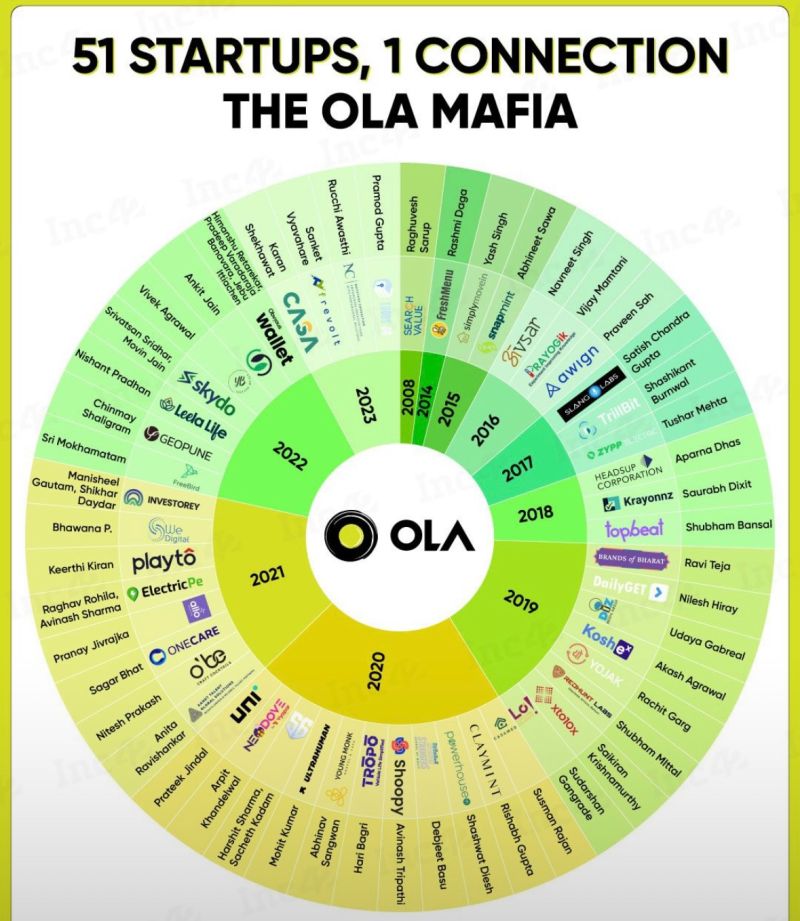
What Is the Ola Mafia?
The "Ola Mafia" is the informal name for the network of former Ola employees who left to start their own companies. It borrows from the "PayPal Mafia," the group of early PayPal staff who later built Tesla, LinkedIn, YouTube, and Palantir.
A startup mafia isn't about scandal. It's about density. When one company packs enough ambitious, capable people into a high-pressure environment, a surprising number of them go on to found the next wave of businesses.
Ola fits that description almost too well. A 2024 PrivateCircle report identified 46 analysable startups founded by Ola alumni, spanning fintech, logistics, health tech, insurance, and enterprise software. The Crustdata mapping pushes the founder count past 900.
Here's why the label sticks:
- It's a talent concentration, not luck: Ola scaled fast across payments, mobility, logistics, and financial services, which meant hundreds of operators learned to run real businesses under real constraints. That density is exactly what turns a company into a founder pipeline rather than a one-off success.
- The alumni tag carries fundraising weight: Investors read "ex-Ola operator who scaled payments to $1B" as pre-vetted risk. That credibility shortens the trust-building phase and helps first-time founders raise seed and Series A rounds faster than an unknown builder could.
- Alumni back and hire each other: Startup mafias compound because former colleagues co-found, invest in, and refer talent to each other's companies. This informal network effect is often worth more than the money itself, because it moves faster than any formal channel.
- The companies span sectors, not one niche: Ola alumni didn't just do another ride-hailing. They built agritech, credit cards, trucking insurance, wearables, and route-optimisation APIs, which shows the transferable skill was operating ability, not domain knowledge tied to cabs.
- The pattern is global, not just India-based: Some of the strongest Ola alumni companies are headquartered in San Francisco and Singapore. That international spread signals the training these operators got was genuinely portable across markets and regulatory environments.
Why it matters: Understanding the Ola Mafia reframes what a "failed" or loss-making company actually produces. Ola's own financials are shaky, yet its alumni output is one of the richest in India. For anyone thinking about where to work, this is the real signal: the value of a job is often the operating skill and network you walk out with, not the employer's valuation on the day you leave.
Why Ola Produced So Many Founders
Most companies hire people to fill roles. Fast-scaling startups like Ola hired people and then handed them problems far bigger than their job title.
That gap between "your role" and "the actual problem" is where founders are made. When you're forced to figure out payments, logistics, or pricing with incomplete information and a deadline, you're basically running a startup inside a startup.
Ola gave a lot of people that experience early, and it left a mark.
- It threw people into scale immediately: Operators managed millions of rides, large payment volumes, and city-level P&Ls within a few years. Living through that kind of scale teaches decision-making under pressure, which is the single hardest skill to fake when you later build your own company.
- It trusted people with ownership: Many Ola leaders ran entire business lines (payments, marketplace, financial services) rather than narrow functions. That ownership mindset carries directly into founding, where nobody hands you a scoped ticket and outcomes are the only thing that count.
- It operated in constant experimentation: Ola launched, killed, and rebuilt products at speed. Working inside that churn trains you to ship fast, cut losses, and iterate, which is exactly the muscle early-stage founders need when they have limited runway and no proven playbook.
- It attracted ambitious, restless people: Startups that grow fast pull in people who want more than a stable job. Put enough of those people in one building and a chunk of them eventually leave to build, because the environment normalises risk-taking and starting something of your own.
- It built a network that outlived the roles: Colleagues from the same team later became co-founders, first hires, and investors for each other. That web of relationships is the quiet engine of every startup mafia, and it keeps producing new companies long after people move on.
Why it matters: This section is the heart of the Ola Mafia story. The companies below aren't lucky accidents. They're the output of a specific kind of training, high ownership, high speed, high stakes. For operators reading this, the takeaway is direct: the environments that stretch you the most are the ones that make you employable and fundable later. Comfort rarely builds founders.
The Biggest Companies Built by Ola Alumni in 2026
This is where the story gets concrete. Below are the flagship Ola Mafia companies, with each founder's actual Ola role and the most current funding data available in 2026. These are the ones where the Ola connection is clearly documented, not inferred.
Ninjacart: Ashutosh Vikram
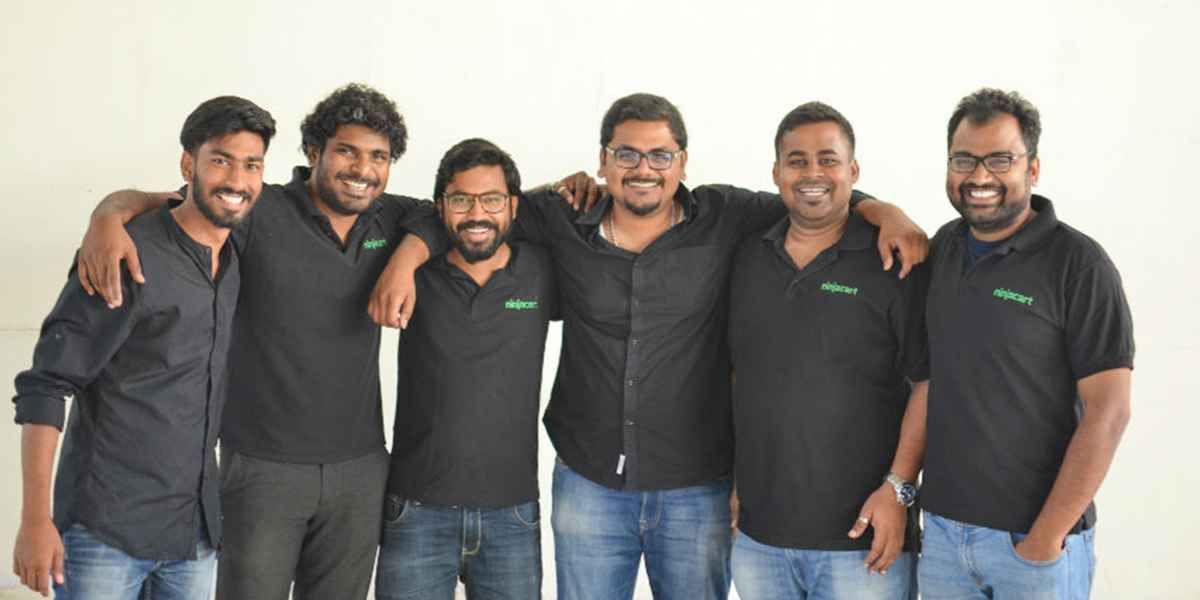
Ninjacart is India's largest fresh-produce B2B supply chain platform, connecting farmers directly with retailers and restaurants. Co-founder Ashutosh Vikram was an Associate Product Manager at Ola before starting up, and three other co-founders came from TaxiForSure, which Ola acquired in 2015. The company has raised more than $350 million and was last valued around $815 million, making it the biggest name on this list by capital raised. It moves over 1,400 tonnes of produce daily and remains one of the most-watched agritech companies in the country.
Snapmint: Abhineet Sawa
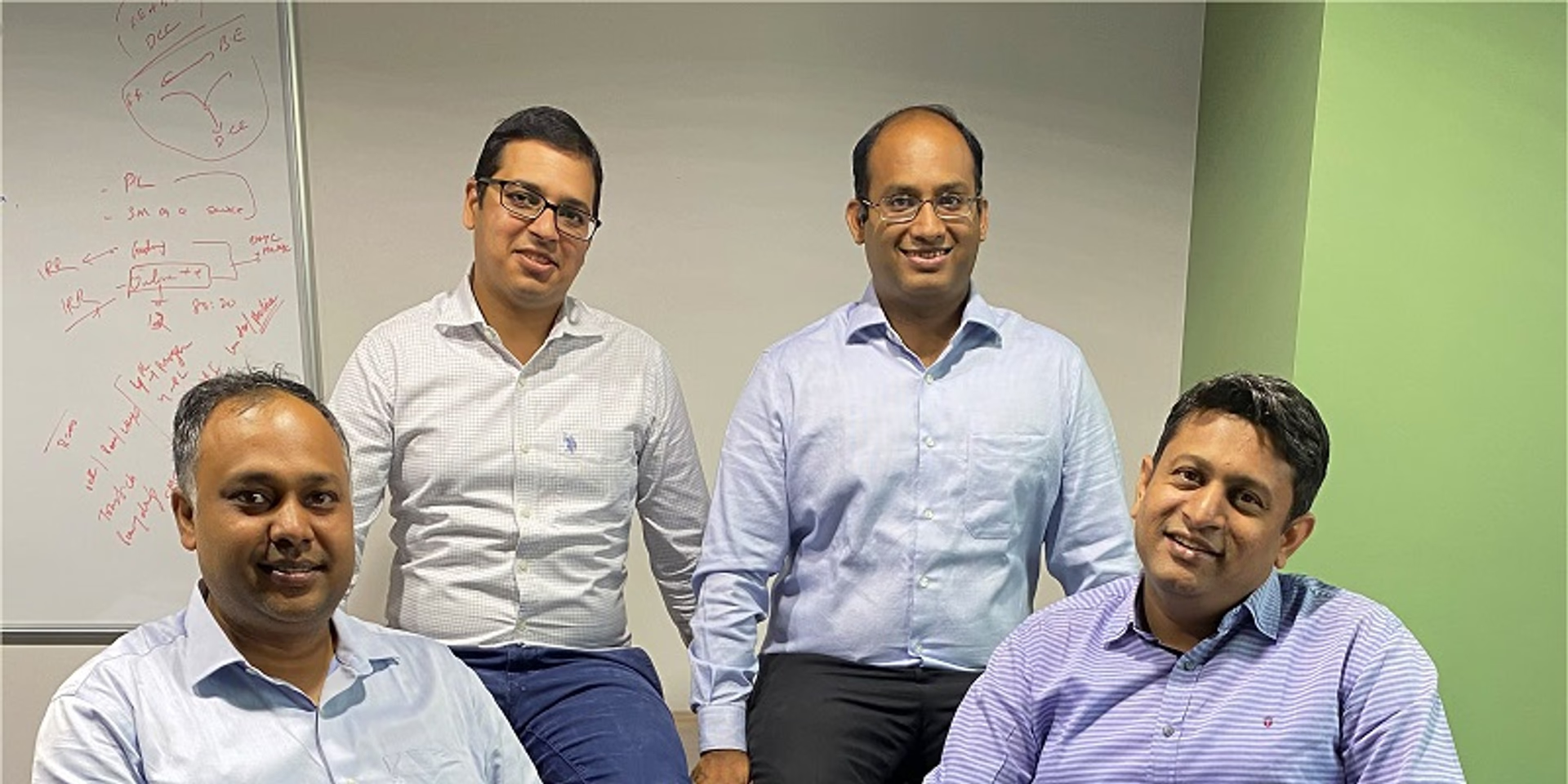
Snapmint offers no-credit-card EMI financing for online shoppers, a growing slice of India's consumer-credit market. Co-founder Abhineet Sawa led pricing at Ola as Senior Director before building it. As of 2026, Snapmint has raised roughly $181 million (per Tracxn), climbing steadily as buy-now-pay-later demand deepens in smaller Indian cities. It's a clean example of an Ola pricing leader turning fintech instinct into a lending business.
Nirvana Insurance: Rushil Goel
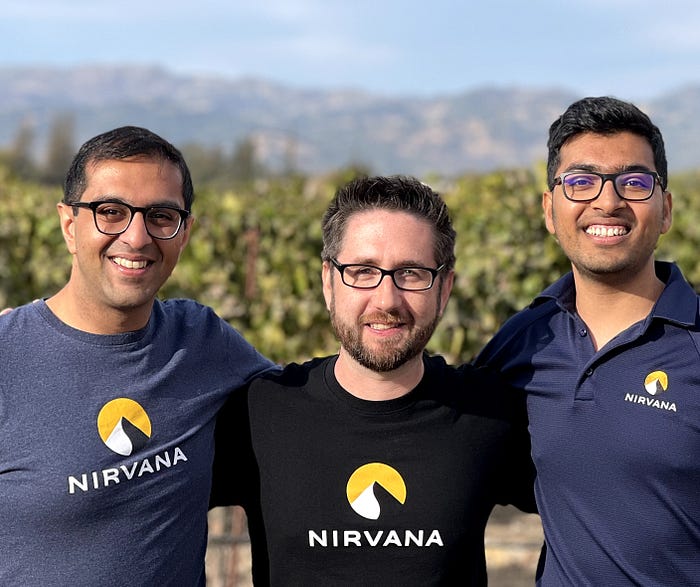
Nirvana is a San Francisco-based, AI-driven commercial trucking insurer that uses telematics to price risk and speed up claims. Before founding it, Rushil Goel was GM of Ola Money, where he launched and scaled payments to $1 billion in volume. In March 2025, Nirvana raised an $80 million round at an $830 million valuation, taking total funding well past $170 million. It's proof the Ola Mafia isn't only an India story, some of its biggest bets are being placed in the US market.
Ultrahuman: Mohit Kumar

Ultrahuman is a health-tech company known for its smart ring, continuous glucose monitors, and blood-testing services. Mohit Kumar was a Senior Product Manager at Olacabs early in his career before co-founding it. The company has raised over $100 million total, including a Series C of roughly $48 million (about ₹400 crore) in early 2026, as it pushes back into the US market after a patent fight with Oura. Ultrahuman is now positioning itself as a data company, not just a wearable brand.
Uni Cards: Nitin Gupta and Prateek Jindal
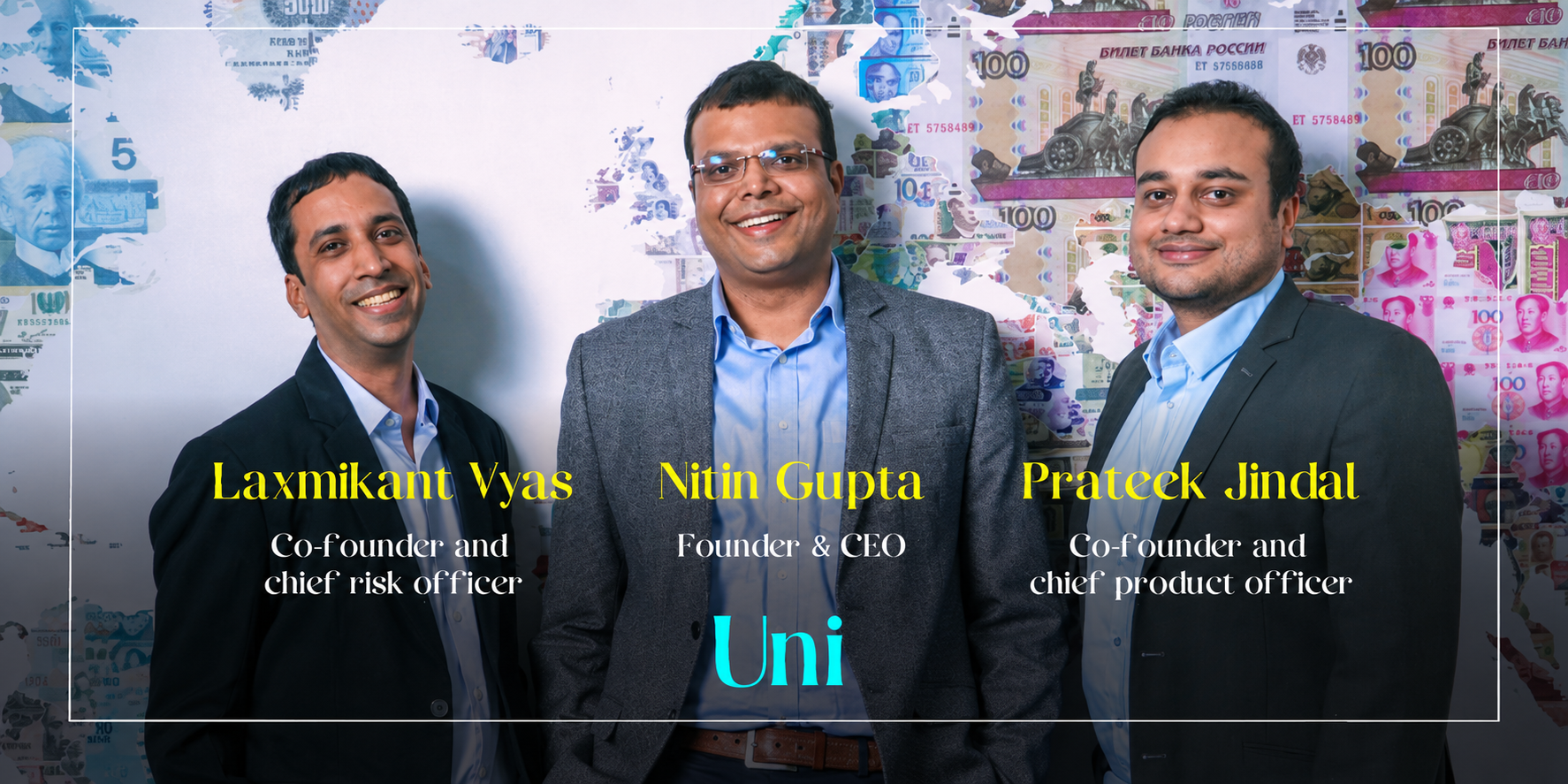
Uni Cards builds consumer credit products, most notably its gold-rewards and pay-later cards. The Ola link here is unusually deep: Nitin Gupta was CEO of Ola Financial Services, and Prateek Jindal built OlaMoney Postpaid. Uni has raised around $104 million as of 2026. Worth noting, Prateek Jindal has since moved on to found PowerUp Money, so the Ola Mafia is already spawning a second generation of ventures from within its own ranks.
Zypp Electric: Tushar Mehta

Zypp is an EV-as-a-service platform powering last-mile delivery for the likes of Zomato, Swiggy, Zepto, and Flipkart. Co-founder and COO Tushar Mehta came from Ola Cabs and Cars24. Zypp has raised roughly $76 million, crossed about $55 million in FY25 revenue, and is publicly targeting EBITDA profitability ahead of a possible IPO by the end of 2026. It's one of the few Ola-linked companies chasing the public markets directly.
Why it matters: These six companies show the range of what Ola's operators built, agritech, consumer credit, insurance, wearables, and EV logistics. Each founder took a hard-won skill from Ola (pricing, payments, marketplace, product) and rebuilt it as a business. For hiring managers and job seekers, that's the real lesson: transferable operating skill is the asset, and it shows up as measurable outcomes, not job titles.
The Ola Alumni Building Global and Exit-Stage Companies
Not every Ola Mafia company is still private and fundraising. A few have already hit meaningful milestones, including a full acquisition, which is often the clearest sign a startup mafia has matured.
The most notable 2026 update is NextBillion.ai. Founded by Gaurav Bubna, who was a founding member and product head of Ola Play (Ola's connected-car platform), NextBillion built enterprise mapping and route-optimization APIs. It raised about $34 million and was fully acquired by Velocitor Solutions in late 2025. That's a real exit, not just a paper valuation.
Alongside it, the Crustdata mapping surfaces several more Ola-linked companies with strong funding:
- qlub ($72M): Arun Sharma: A pay-at-table payments platform operating largely in the Middle East. It sits in the same fintech-meets-real-world-payments lane that so many Ola alumni gravitate toward, reflecting the payments and operations exposure Ola gave its teams.
- ZipGo ($52M): Pritesh Gupta: An app-based bus and shuttle mobility service. The overlap with Ola's core domain is obvious, and it's a reminder that some alumni stayed close to mobility while applying a sharper operating playbook to a different segment.
- Nodle ($36M): Garrett Kinsman: A decentralized wireless and IoT connectivity network. It's one of the more experimental companies on the list, showing that the Ola alumni footprint reaches into frontier tech, not just consumer apps and fintech.
- SPRY PT ($25M): Brijraj Bhuptani: A physical-therapy and healthcare software platform. It reflects the wider health-tech pull among Ola alumni, a sector where operating discipline and workflow design matter as much as clinical knowledge.
- Skeps ($25M): Prerit Srivastava: A point-of-sale lending and financing infrastructure company. Like Snapmint and Uni, it lands squarely in the consumer-credit space, underlining how much fintech talent Ola's financial-services arm quietly trained.
Why it matters: An acquisition like NextBillion.ai's changes how you should read the whole list. Startup mafias are usually judged years later, once companies exit, merge, or scale into category leaders. Ola's alumni are now entering that phase. For anyone tracking where India's next operators and angel investors will come from, this cohort is a strong leading indicator, exits create the capital and confidence that fund the next generation.
The Operators and Ecosystem Builders Who Came From Ola
Founders get the headlines, but startup mafias also produce something quieter and just as valuable: senior operators who help other companies scale, and in Ola's case, even its own co-founder starting again.
The standout example is Amnic. According to Tracxn, Amnic (a cloud cost-management platform, roughly $14M raised) was founded by Ankit Bhati, Ola's own co-founder. When the person who helped build the original company goes back to zero and starts again, it's the purest signal of a builder's mindset you can find.
Then there's xto10x, co-founded by Saikiran Krishnamurthy, who was Head of Marketplace at Ola. xto10x (around $25M raised) builds tools and playbooks that help other startups scale their organizations, essentially productizing the scaling lessons its founders learned at companies like Ola and Flipkart.
A few more Ola-linked names round out the picture, based on the same public mapping:
- FreshMenu ($32M): Rashmi Daga: Rashmi managed corporate sales at Ola before founding the full-stack food brand FreshMenu. After a near-death funding crunch, the company staged a comeback to roughly ₹121 crore in revenue, a rare survival-and-recovery story in Indian food tech.
- 56 Secure ($13M): Harshit Sharma and Troels Licht: A security and safety-services business. It's one of the larger employers among Ola alumni companies, showing the mafia's impact isn't only in valuations but in the jobs these ventures create.
- Officebanao ($14M): Akshay Kumar: A tech-enabled office interiors and workspace-fit-out platform. It applies an operations-heavy, execution-first approach to a traditionally offline industry, a very Ola way of attacking a messy market.
- Inamo ($11M): Sumit Anand: An early-stage venture from the Ola alumni network, still building out its footprint. It rounds out how wide the mapping goes, well beyond the household names.
What the Ola Mafia Teaches About Careers and Hiring in 2026
Remove the funding numbers and one pattern remains: almost every person in this story got their next opportunity because of what they had built and shipped, not because of a line on a resume.
Nitin Gupta didn't raise for Uni because he "worked at Ola." He raised because he had scaled Ola Financial Services into a real credit business with real numbers. Rushil Goel didn't get backed by top US VCs on his logo. He got backed because he had scaled payments to $1 billion in volume.
That's the shift worth checking out.
- Outcomes beat titles: Investors and employers in 2026 want evidence, what you scaled, shipped, fixed, or grew. The Ola Mafia founders all had concrete outcomes to point to, which is why capital and trust followed them into brand-new sectors where their old job title meant nothing.
- Proof of work compounds: Each shipped project becomes leverage for the next one. A documented track record of building lets you skip the "prove you're capable" phase, whether you're raising a round, changing industries, or hiring your first team.
- Skill is portable; logos are not: Ola alumni succeeded in agritech, insurance, and wearables, fields unrelated to cabs. What transferred was operating ability. Betting your career on skills you can demonstrate is safer than betting it on the fortunes of any single employer.
- Networks form around builders: The people who ship become the people others want to co-found with, invest in, and hire. Visible work is what puts you inside that network, because people back what they can actually see you do.
- Credibility is now measurable: In a world of AI-written resumes, claims are cheap and easy to fake. Demonstrated work, projects, case studies, and real results, is the thing that still can't be faked, and it's increasingly what hiring decisions turn on.
Why it matters: The Ola Mafia is a live case study in proof-of-work careers. Every founder here is essentially a walking portfolio of what they built. As hiring keeps shifting away from resume keywords toward demonstrated ability, the professionals who win will be the ones who can show their work clearly, whether they're chasing a job, a raise, or their own company.
How This Connects to Building a Strong Career or Portfolio
The uncomfortable truth in the Ola Mafia story is that none of these founders would have raised a rupee on their Ola job title alone. They raised because their execution was visible and verifiable.
That's the same principle reshaping hiring for everyone else. Recruiters increasingly trust a link to real work over a polished CV, because a portfolio shows how you think, what tools you used, and what actually shipped. A resume just claims it happened.
If you want to be found and hired the way strong operators are, the move is simple: document your work as you do it. Write up your process, show the messy middle, and let outcomes speak. That's exactly why platforms like Fueler exist, to help you turn assignments, projects, and proof of work into a portfolio that does the convincing for you. Build the evidence once, and it works for you for years.
Final Thoughts on the Ola Mafia
Ola's balance sheet tells one story. Its alumni tell a better one. A company that has struggled to make money still trained a generation of operators who went on to build profitable, category-leading businesses across India and the world. Years from now, Ola may be remembered less for its cabs and more for being a launchpad. The deeper lesson holds for all of us: the skills you build and the work you can prove will outlast any single job. Build things worth pointing to, and the opportunities tend to follow.
FAQs About the Ola Mafia
1. What is the Ola Mafia?
The Ola Mafia is the network of former Ola employees who left to start their own companies, similar to the PayPal Mafia. According to a Crustdata-based mapping, Ola has produced 900+ founders who have collectively raised over $1.3 billion. Their companies span fintech, logistics, insurance, agritech, and health tech, and include names like Ninjacart, Snapmint, Nirvana Insurance, Ultrahuman, and Uni Cards.
2. Which is the biggest company started by an Ola alumnus?
By total capital raised, Ninjacart is the largest. Co-founded by former Ola product manager Ashutosh Vikram, the agritech supply-chain platform has raised more than $350 million and was last valued around $815 million. Other heavily funded Ola Mafia companies include Snapmint (~$181M), Nirvana Insurance ($170M+), Ultrahuman ($100M+), and Uni Cards (~$104M) as of 2026.
3. Did any Ola Mafia company get acquired?
Yes. NextBillion.ai, a mapping and route-optimization startup co-founded by former Ola Play product head Gaurav Bubna, was fully acquired by Velocitor Solutions in late 2025 after raising about $34 million. Exits like this are often the clearest sign that a startup alumni network, or "mafia," has matured into a lasting force.
4. Why did so many founders come out of Ola? Ola scaled fast and handed employees ownership over big problems like payments, pricing, marketplace, and logistics, often earlier than a normal job would. That high-ownership, high-pressure environment trained operators to make decisions with limited information and ship quickly. Combined with an ambitious talent pool and a strong internal network, it became a natural pipeline for future founders.
5. What can professionals learn from the Ola Mafia? The core lesson is that proof of work beats job titles. Ola alumni raised funding and switched industries because they had demonstrable outcomes, scaling payments to $1B, building a credit business, or growing a marketplace. In 2026's hiring market, documenting and showcasing your real work through a portfolio is one of the most reliable ways to build credibility and get opportunities.
Why 100,000+ professionals use Fueler
Fueler helps professionals showcase proof of work through projects, assignments, case studies, and achievements.
- Thousands of professionals use Fueler to create their digital portfolio
- Thousands of projects are published on Fueler. Check here
- Startups and Companies hire through proof of work on Fueler
- Used by freelancers, creators, marketers, video editors, writers, designers, and product managers
Our mission is to help the next 100 million professionals build a verified professional identity through proof of work

What should you do next?
You've read the article. Now turn your skills into proof of work and unlock more opportunities.
Build your proof of work portfolio
Create a clean portfolio with projects, assignments, resumes, and AI stack details that companies actually want to see.
Create your Fueler portfolio →Apply through assignments, not resumes
Stand out by solving real tasks from companies hiring on Fueler.
Explore assignments →Get discovered by companies
Make your work public and let recruiters discover your skills through actual projects instead of keywords.
Get discovered →
