The Flipkart Mafia: How Ex-Flipkart Employees Built India's Biggest Startups

Riten Debnath
06 Jul, 2026
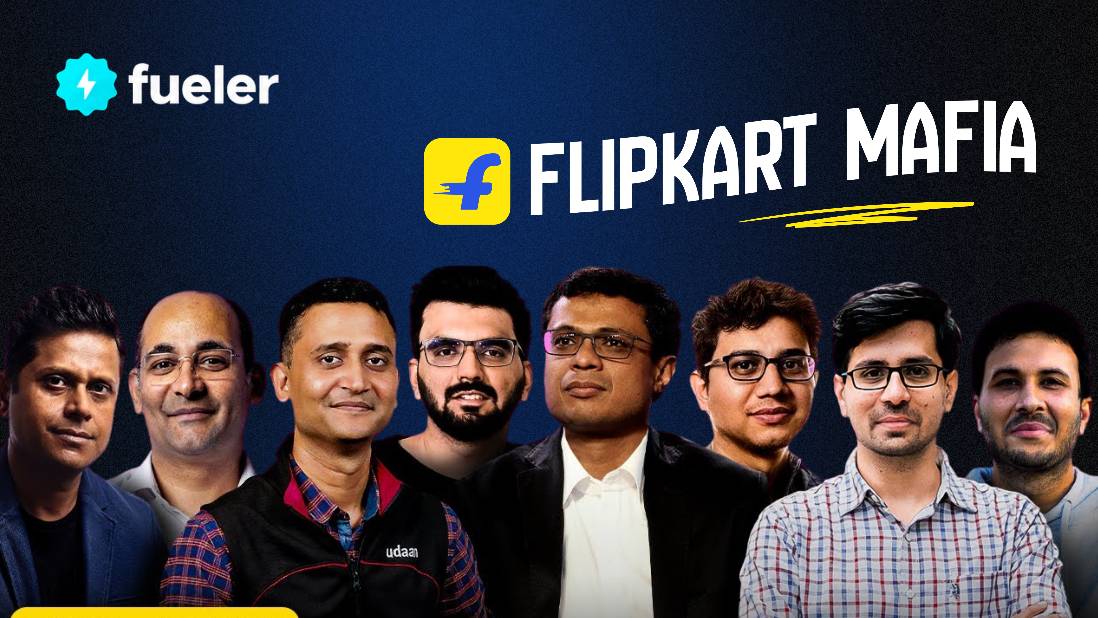
When Walmart bought Flipkart in 2018 for around $16 billion, most people saw one big exit. What they missed was the second-order effect. Hundreds of early Flipkart employees walked away with capital, conviction, and hard operating scars from building India's first homegrown e-commerce giant. A large chunk of them did not retire. They started companies. Today the term "Flipkart Mafia" describes this network of ex-Flipkart founders and operators who now run some of India's most valuable startups, from PhonePe to Groww to Udaan.
This matters in 2026 more than ever. A big share of India's IPOs, unicorns, and startup exits can be traced back to people who once shared the same office floors in Bengaluru.
I'm Riten, founder of Fueler, a portfolio platform that helps professionals get hired through assignments, proof of work, and projects instead of just resumes.
In this article you will learn who the key members of the Flipkart Mafia are, what they built after leaving, their current 2026 valuations and IPO status, and the career lessons hiding inside this story. By the end you will see why proof of work, not pedigree alone, is what actually compounds into outsized outcomes.
What the Flipkart Mafia Really Means in 2026
The "Flipkart Mafia" is not a company or a fund. It is a talent network. It refers to former Flipkart employees who left to start or lead their own ventures, many of which are now unicorns, listed companies, or acquisition targets.
The pattern mirrors the famous PayPal Mafia in the US. A single high-pressure company trained a generation of operators, and that talent later spread across the ecosystem and built the next wave of category leaders.
- The network spans fintech, B2B commerce, mobility, healthtech, and quick commerce, which shows that Flipkart trained generalist operators who could rebuild entire supply chains and payment rails, not just run a single e-commerce playbook they learned once.
- Many members held senior roles such as CTO, President, VP, and Chief Business Officer, meaning they left with real profit-and-loss ownership experience, not just line-level exposure, which is why so many of their ventures scaled fast.
- Capital access became easier because investors already trusted the Flipkart pedigree, so founders raised early rounds on reputation and could spend their energy on product and distribution instead of endless cold pitching to skeptical funds.
- The alumni actively back each other through angel cheques, board seats, and hiring referrals, creating a compounding flywheel where one exit funds the next ten startups and shortens the path from idea to first institutional round.
- The output is measurable in 2026 valuations, with several ex-Flipkart ventures crossing the billion-dollar mark, proving this is a durable talent engine and not a one-time lucky cohort tied to a single market cycle.
Why it matters: The Flipkart Mafia shows how one company can shape an entire startup economy for a decade. For founders and professionals, it is proof that where you build your skills early can define the opportunities you unlock later. It also reframes career growth around network effects, operating exposure, and reputation, which are the real currencies behind India's fastest scaling companies.
PhonePe: The Biggest Fintech Bet From the Flipkart Network
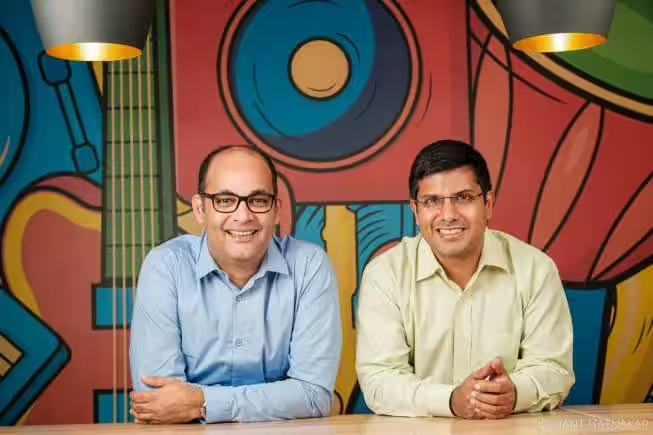
PhonePe Founders
PhonePe was founded in December 2015 by Sameer Nigam, Rahul Chari, and Burzin Engineer, all of whom came out of the Flipkart ecosystem. Flipkart acquired PhonePe early, and it was later demerged in December 2022 under Walmart's ownership.
Today PhonePe is one of India's most used payment apps, with more than 650 million registered users and close to 46 to 47 percent share of UPI transaction volume. It has expanded into lending, insurance, stock broking, and an app store.
- PhonePe filed its draft prospectus in September 2025 and received SEBI approval in January 2026, positioning it as one of the most closely watched Indian fintech IPOs and a direct barometer of investor appetite for large, loss-making consumer platforms.
- The company initially targeted a valuation near $15 billion, then revised it down to roughly $9 billion to $10.5 billion in March 2026 as global markets turned volatile, showing how public-market pricing can reset even the strongest private brand overnight.
- On 16 March 2026 PhonePe temporarily paused its listing due to geopolitical tension and unstable markets, with founder Sameer Nigam reaffirming the plan to list in India once conditions stabilise, a reminder that timing risk is as real as execution risk.
- The IPO was structured largely as an offer for sale, meaning early backers such as Walmart, Tiger Global, and Microsoft planned partial or full exits, which tells you the round was built around liquidity for investors more than fresh growth capital.
- PhonePe still faces a core challenge of thin UPI margins, since Indian regulation blocks transaction fees on UPI, forcing the company to monetise through lending, insurance, and distribution rather than the payments rails that drive its scale.
Why it matters: PhonePe proves that Flipkart alumni did not just build another store, they built financial infrastructure used by hundreds of millions daily. For anyone studying startup growth, it is a live case study on scale, regulation, and IPO timing. Its journey also shows that valuation is not fixed, and that even category leaders must earn their public-market price through discipline and profitability, not brand alone.
Groww: The Ex-Flipkart Founders Who Built a Listed Fintech Giant
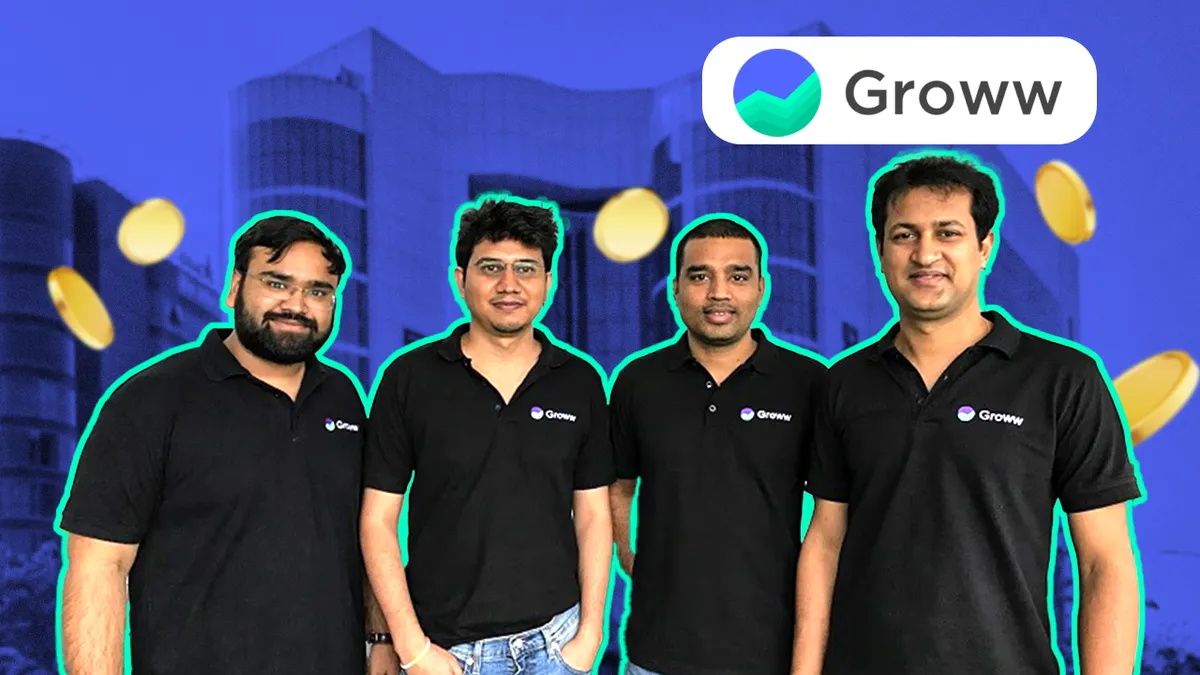
Groww Founders
Groww is one of the big Flipkart Mafia success stories because it has already reached the finish line most startups only dream about, a strong public listing. It was founded by Lalit Keshre, Harsh Jain, Neeraj Singh, and Ishan Bansal, four former Flipkart product and operations leaders.
The company started as a mutual fund app and grew into a full-stack investing platform covering stocks, ETFs, IPOs, and more. By active traders, Groww became India's largest broker with a large and sticky retail user base.
- Groww listed on the NSE and BSE on 12 November 2025 at an issue price of 100 rupees per share, and the stock rallied sharply within days, pushing the company's market capitalisation past the one lakh crore rupee mark, a landmark for a new-age Indian fintech.
- The blockbuster debut turned co-founder and CEO Lalit Keshre into a dollar billionaire on paper, with his roughly 9 percent stake valued near 9,400 crore rupees, a striking outcome for a farmer's son from a small town in Madhya Pradesh.
- Groww was widely described as one of the most profitable new-age Indian startups to go public, which matters because it broke the usual pattern of consumer tech companies listing while still burning heavy cash to buy growth.
- The founding team's combined holdings jumped into the multi-thousand-crore range post listing, showing how equity ownership, not salary, is where real wealth is created for operators who take the founder path after a big company.
- The company keeps expanding beyond broking into wealth, asset management, and payments, signalling that Groww wants to be a full financial platform rather than a single-product app vulnerable to competition and pricing pressure.
Why it matters: Groww is the rare Flipkart Mafia venture that completed the full cycle from idea to profitable IPO. It shows investors and founders that disciplined, product-led fintech can list on Indian exchanges and reward its team. For professionals, it is a reminder that the strongest career outcomes often come from building ownership in something, not just holding a title.
Navi and the Sachin Bansal Comeback Story
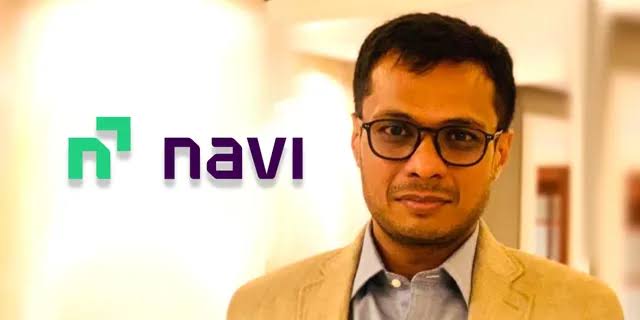
Sachin Bansal of Navi
No Flipkart Mafia is complete without Sachin Bansal, who co-founded Flipkart with Binny Bansal in 2007. After exiting Flipkart, Sachin poured his capital into a new bet, Navi Technologies, founded in 2018 with Ankit Agarwal.
Navi is a digital-first financial services platform spanning personal loans, home loans, UPI payments, insurance, and mutual funds. Instead of building slowly, Bansal used acquisitions to gather licences and enter regulated markets fast.
- Navi carries a valuation around $1.7 billion, and in mid-2026 it was reported to be in talks to raise 250 to 300 million dollars at a valuation near $1.8 billion to $2 billion, with investors such as Prosus and Accel reportedly in the mix.
- Sachin Bansal moved into the role of Executive Chairman while Rajiv Naresh took over as CEO, a governance shift that signals Navi is trying to move from a founder-dependent structure toward a more institutional, scalable leadership model ahead of any future listing.
- Bansal reportedly invested a very large portion of his own Flipkart exit wealth into Navi, which gives investors unusual founder alignment, but also concentrates key-man risk in a single individual whose reputation is tied to the company's outcome.
- Navi built one of India's larger UPI apps alongside its lending business, using payments as a low-cost acquisition channel to then cross-sell higher-margin credit and insurance products to the same users inside one ecosystem.
- The company weathered a temporary RBI lending pause and regulatory scrutiny, then resumed operations, showing that surviving compliance shocks is now a core skill for any fintech that wants to operate at national scale in India.
Meanwhile, co-founder Binny Bansal stepped away from Flipkart's board and launched a new venture, OppDoor, focused on helping e-commerce companies expand globally, while staying active as an angel investor across dozens of startups.
Why it matters: Sachin and Binny Bansal show that the Flipkart story did not end with one exit. Both reinvested capital, credibility, and experience into new bets. For founders, their journeys highlight how conviction and capital can compound across decades, and how the hardest lesson, surviving regulation and rebuilding trust, often matters more than the first big idea.
Udaan: How Ex-Flipkart Leaders Built India's Largest B2B Commerce Platform
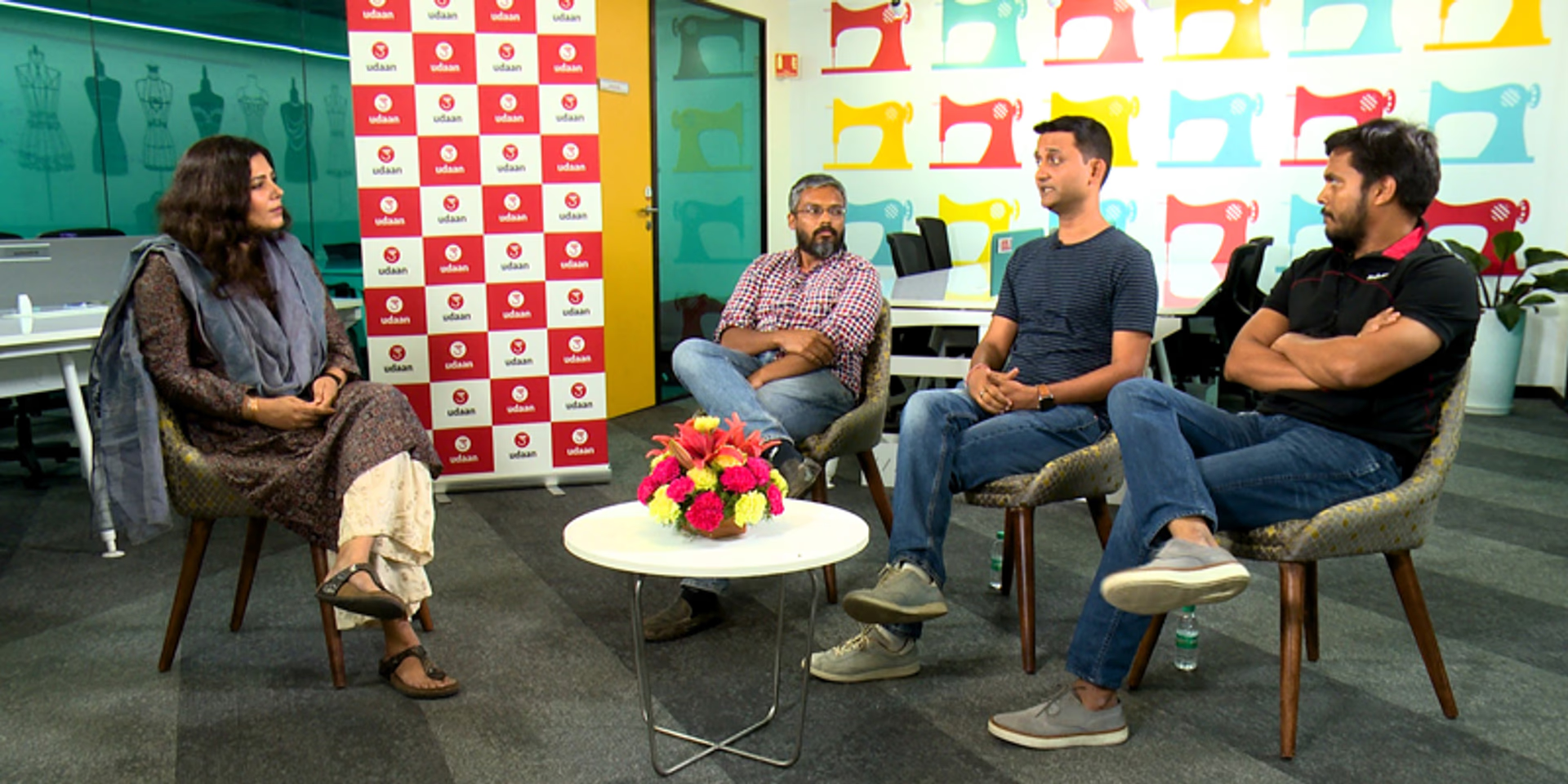
Udaan Founders
Udaan is the B2B answer to Flipkart's B2C legacy. It was founded in 2016 by Sujeet Kumar, Amod Malviya, and Vaibhav Gupta, three senior Flipkart leaders including Flipkart's former CTO Amod Malviya. They spotted that India's wholesale trade was fragmented and offline, and built a platform to fix it.
Udaan connects millions of retailers with suppliers and brands across FMCG, staples, fresh produce, pharma, and general merchandise. It also runs a lending arm to solve working capital gaps for small businesses.
- Udaan holds a valuation of roughly $1.8 billion and raised a $114 million Series G round in 2025 led by M&G Investments and Lightspeed, capital aimed squarely at reaching profitability and preparing the company for a public listing.
- Co-founder Vaibhav Gupta serves as CEO and has guided the company through aggressive cost discipline, cutting its cash burn sharply while targeting group-level operating profitability, which is the gate it must clear before a credible IPO.
- The company is preparing for an IPO in an 18 to 24 month window, positioning it as one of the larger B2B commerce listings India could see across 2026 and 2027 if it sustains its improved unit economics.
- Udaan acquired retail-tech startup ShopKirana in 2025 to strengthen its distribution reach into smaller cities, showing that consolidation, not just organic growth, is now central to winning India's fragmented B2B commerce market.
- Its bet is on Bharat, meaning tier-two towns and rural retail, where the company believes the largest untapped trade volume sits, a thesis that directly extends the small-town expansion muscle its founders built at Flipkart.
Why it matters: Udaan proves the Flipkart playbook works beyond consumer shopping. The same operators who scaled B2C logistics rebuilt B2B trade infrastructure for millions of small shops. For founders, it is a lesson in transferring hard-won operating skills into a new market, and in the patience required to fix real supply chains rather than chase easy consumer growth.
Cult.fit and the Mukesh Bansal, Ankit Nagori Playbook

Cultfit Founders
Cult.fit, earlier known as Cure.fit, is the Flipkart Mafia's biggest bet on health and fitness. It was founded in 2016 by Mukesh Bansal, the Myntra founder who joined Flipkart after the acquisition, and Ankit Nagori, Flipkart's former Chief Business Officer.
The company built India's largest organised fitness chain, blending physical gyms with a digital app, healthy meals, mental wellness, and a sports apparel brand. It scaled to hundreds of centres across the country.
- Cult.fit is preparing a public listing, with reports of a draft prospectus for an IPO worth roughly 3,500 to 4,000 crore rupees and a target valuation near $2 billion, backed by marquee investors such as Zomato, Tata Digital, Temasek, and Accel.
- Leadership evolved as Naresh Krishnaswamy became CEO while Mukesh Bansal moved to Chairman, a structure that lets the company focus on operating profitability and a cleaner cap table story ahead of the scrutiny of public markets.
- The business runs a diversified model spanning fitness subscriptions, D2C apparel under Cultsport, meals under Eat.fit, and mental wellness under Mind.fit, which reduces dependence on any single revenue line but also demands sharp execution across many verticals.
- Cult.fit reported around one million paid subscribers across 75 plus cities in FY26, with fitness services driving roughly 70 percent of revenue, showing a real recurring base rather than one-time transactions that vanish after discounts end.
- The company shifted toward an asset-light franchise model to expand faster with less capital, a strategic move that improves margins but requires strict quality control so the premium brand experience does not erode across locations.
Why it matters: Cult.fit shows Flipkart operators can build category-defining brands in offline-heavy, capital-intensive sectors, not just pure software. Its IPO journey is a test of whether Indian consumers will value branded wellness at scale. For founders, it highlights the discipline needed to turn a growth-first consumer brand into a profitable business the public market will actually pay for.
The Acquired and Emerging Ventures Powering the Flipkart Mafia
Beyond the giants, the Flipkart Mafia includes a long tail of ventures that have exited through acquisition or are scaling fast right now. These stories show the depth of the network, since success is spread across many founders rather than concentrated in a few names.
Some were bought by larger players, while others are freshly funded startups riding current market trends such as quick commerce and applied AI.
- Rapido, the bike-taxi and mobility platform co-founded by ex-Flipkart operator Aravind Sanka, hit a $3 billion valuation in May 2026 after a $240 million round led by Prosus, nearly tripling its worth in under a year as it expanded across 400 plus cities.
- FirstClub, founded by former Flipkart executive Ayyappan R, raised a $55 million Series B in June 2026 led by Peak XV Partners and Sofina, doubling its valuation to $255 million with a quality-first grocery model rather than the usual race to fastest delivery.
- Exotel, the cloud telephony firm built by ex-Flipkart VP Shivakumar Ganesan, grew into a profitable bootstrapped SaaS business, while Punit Soni, Flipkart's former Chief Product Officer, went on to build Suki, a US-based clinical AI assistant valued near $500 million after raising roughly $168 million.
- RentoMojo, the furniture and appliance rental platform linked to Geetansh Bamania, is preparing an IPO around FY27, targeting a raise in the 5,000 to 7,000 crore rupee range as India's rental and subscription economy matures beyond metros.
- Several ventures exited through acquisition, including Playment bought by TELUS International, Runnr absorbed by Zomato, Crio.do acquired by Skill-Lync, Sellerworx by Capillary, and Pianta by GO-JEK, though the network also has hard stories, such as Arzooo, whose assets were bought by Moksha Group in a distress sale in early 2026.
Why it matters: This long tail is the real proof of a healthy talent mafia. When success spreads across mobility, SaaS, quick commerce, and AI, it signals a repeatable engine, not luck. Arzooo is the honest counterweight, a reminder that a Flipkart badge does not guarantee survival. For professionals, it shows there is no single path, and that acquisitions, bootstrapping, and even failure are all part of a real founder journey.
The Complete Flipkart Mafia List: Founders, Ventures, and 2026 Status
Here is the full list of ex-Flipkart founders and operators covered in this piece, with their role at Flipkart, the venture they built or lead, and where it stands in 2026. Use this as a quick reference for the entire Flipkart alumni network at a glance.
Beyond this core list, Inc42's wider Flipkart Mafia map connects dozens more companies to the network across 2014 to 2023, including names such as Jumbotail, Spinny, VOGO, Awign, OkCredit, GoKwik, Zingbus, Mokobara, Pocket FM, Ayu Health, SmartStaff, Credgenics, Headfone, and Yellow Metal. The list keeps growing every year, which is exactly what makes this alumni network so powerful.
Why it matters: Seeing every venture in one view makes the scale obvious. This is not two or three lucky exits. It is a broad, repeatable engine spanning fintech, commerce, mobility, healthtech, and SaaS. For founders and professionals, the pattern is the lesson. Strong operating experience plus a trusted network keeps producing new companies, new exits, and new opportunities year after year.
What the Flipkart Mafia Teaches About Building a High-Growth Career
The most useful part of the Flipkart Mafia story is not the valuations. It is the pattern behind them. These founders did not succeed only because they worked at Flipkart. They succeeded because of what they learned there and how they proved it afterwards.
The lesson applies to anyone building a career in 2026, whether you want to start up, join early-stage teams, or grow inside a company.
- Operating exposure beats titles, because the Flipkart alumni who scaled the biggest ventures had owned real problems such as payments, logistics, and category profit-and-loss, which gave them proof they could execute under pressure rather than just manage from a distance.
- Networks compound quietly, since these founders hired each other, invested in each other, and vouched for each other, which shortened fundraising and hiring cycles and shows that relationships built during hard work outlast any single job or company.
- Reputation is portable capital, because investors funded ex-Flipkart founders partly on track record, proving that a visible history of shipping and scaling real outcomes can be worth more than a polished pitch or a prestigious degree alone.
- Skills transfer across sectors, as the same people moved from e-commerce into fintech, mobility, and health, which tells you that deep operating fundamentals like distribution and unit economics matter far more than staying loyal to one industry forever.
- Timing and survival matter, since many of these ventures faced regulation, funding winters, and valuation resets, and the winners were the ones who adapted and stayed in the game long enough for their compounding advantages to pay off.
Why it matters: This section connects the whole story to your own path. The Flipkart Mafia is a blueprint for how skills, proof, and relationships turn into outsized opportunities over time. Whether or not you ever start a company, the same principles decide how fast you grow, how much you earn, and how easily you get hired in a market that rewards demonstrated ability.
How This Connects to Building a Strong Career or Portfolio
Here is the uncomfortable truth hiding inside the Flipkart Mafia story. Most of these founders became fundable and hireable because people could see what they had built. Their work was visible, verifiable, and specific. That visibility is what turned experience into opportunity.
Modern hiring is moving the same way. Companies increasingly care less about where you worked and more about what you actually shipped, how you thought through problems, and the outcomes you drove.
- Execution visibility matters because decision-makers cannot trust what they cannot see, and a clear record of projects, results, and process removes doubt far faster than a list of past employers ever could during a hiring or funding conversation.
- Proof of work matters because it turns vague claims into evidence, letting you show the exact problem you solved, the tools you used, and the measurable impact, which is exactly how the strongest Flipkart alumni signalled they could build again.
- Documenting your process builds credibility because it reveals how you think, not just what you finished, and thoughtful documentation of tradeoffs and learnings is often more convincing to smart evaluators than a shiny final result with no context.
- Outcomes now outrank resumes because the market has enough talent and not enough proof, so professionals who can point to real work, live projects, and clear results consistently win over candidates relying only on titles and years of experience.
- Owning a body of work compounds because every project you make visible adds to a portfolio that keeps working for you, attracting jobs, clients, and opportunities long after the work itself is done, much like an operator's track record.
This is exactly why I built Fueler, a portfolio platform that helps professionals get hired through assignments, proof of work, and projects instead of just resumes.
Why it matters: The Flipkart Mafia won because their work spoke for them. You can apply the same principle without a billion-dollar exit. Build real things, document them clearly, and make them easy to verify. That habit is what converts skill into reputation, and reputation into the kind of opportunities that quietly compound across an entire career.
Final Thoughts
The Flipkart Mafia is a reminder that talent networks outlast single companies. One hard-charging startup trained a generation of operators who then reshaped Indian fintech, commerce, mobility, and health. In 2026 their ventures are listing, raising, and getting acquired at scale. The deeper takeaway is simple. Skills, proof, and relationships compound over time, and the people who make their work visible are the ones who keep unlocking bigger opportunities. Your Flipkart may not be Flipkart. But the principles are yours to use.
Frequently Asked Questions
1. What is the Flipkart Mafia?
The Flipkart Mafia refers to the network of former Flipkart employees who left to start or lead their own companies. Many of these ex-Flipkart founders now run some of India's most valuable startups, including PhonePe, Groww, Udaan, Cult.fit, and Navi. The term is inspired by the PayPal Mafia in the US, where one company produced a wave of successful founders. It highlights how Flipkart trained a generation of operators who spread across fintech, B2B commerce, mobility, and healthtech, and continue to back each other through investments, hiring, and mentorship across the wider Indian startup ecosystem.
2. Which companies were founded by ex-Flipkart employees?
Several major Indian startups were founded by former Flipkart employees. PhonePe was started by Sameer Nigam, Rahul Chari, and Burzin Engineer. Groww was founded by Lalit Keshre, Harsh Jain, Neeraj Singh, and Ishan Bansal. Udaan came from Sujeet Kumar, Amod Malviya, and Vaibhav Gupta. Cult.fit was built by Mukesh Bansal and Ankit Nagori, and Navi by Sachin Bansal. Others include Rapido, FirstClub, Exotel, and RentoMojo. These ventures span fintech, wholesale commerce, mobility, cloud telephony, and quick commerce, showing how widely the Flipkart talent network has spread across India's economy.
3. Is PhonePe going public in 2026?
PhonePe filed for its IPO in September 2025 and received SEBI approval in January 2026. It initially targeted a valuation near $15 billion, then revised it to roughly $9 billion to $10.5 billion in March 2026 as global markets turned volatile. On 16 March 2026 the company temporarily paused its listing due to geopolitical tension and unstable market conditions. Founder Sameer Nigam confirmed PhonePe still intends to list in India once markets stabilise. The IPO is structured largely as an offer for sale, giving early investors such as Walmart, Tiger Global, and Microsoft an exit. Timelines can shift, so check current updates before relying on any date.
4. Who is the most successful founder from the Flipkart Mafia?
Success can be measured in different ways, so there is no single answer. By completed public listing, Groww stands out, since it listed strongly in November 2025 and made co-founder Lalit Keshre a billionaire on paper. By scale of impact, PhonePe is arguably the biggest, serving over 650 million users and handling a large share of India's UPI transactions. Sachin Bansal remains iconic as a Flipkart co-founder who reinvested his exit wealth into Navi. Each represents a different kind of success, whether that is a profitable IPO, financial infrastructure at national scale, or a high-conviction second act.
5. Why do so many successful founders come from Flipkart?
Flipkart gave early employees rare operating exposure while building India's first large homegrown e-commerce company. They owned hard problems across payments, logistics, and profit-and-loss, which built genuine execution skill rather than just titles. The Walmart deal also created capital and liquidity that many reinvested into new ventures. On top of that, the Flipkart pedigree earned investor trust, making early fundraising easier for alumni. The network then reinforced itself through angel investments, board seats, and hiring referrals. Together, these factors created a compounding talent engine, which is why the Flipkart Mafia keeps producing new unicorns and category leaders across sectors.
Why 100,000+ professionals use Fueler
Fueler helps professionals showcase proof of work through projects, assignments, case studies, and achievements.
- Thousands of professionals use Fueler to create their digital portfolio
- Thousands of projects are published on Fueler. Check here
- Startups and Companies hire through proof of work on Fueler
- Used by freelancers, creators, marketers, video editors, writers, designers, and product managers
Our mission is to help the next 100 million professionals build a verified professional identity through proof of work

What should you do next?
You've read the article. Now turn your skills into proof of work and unlock more opportunities.
Build your proof of work portfolio
Create a clean portfolio with projects, assignments, resumes, and AI stack details that companies actually want to see.
Create your Fueler portfolio →Apply through assignments, not resumes
Stand out by solving real tasks from companies hiring on Fueler.
Explore assignments →Get discovered by companies
Make your work public and let recruiters discover your skills through actual projects instead of keywords.
Get discovered →
