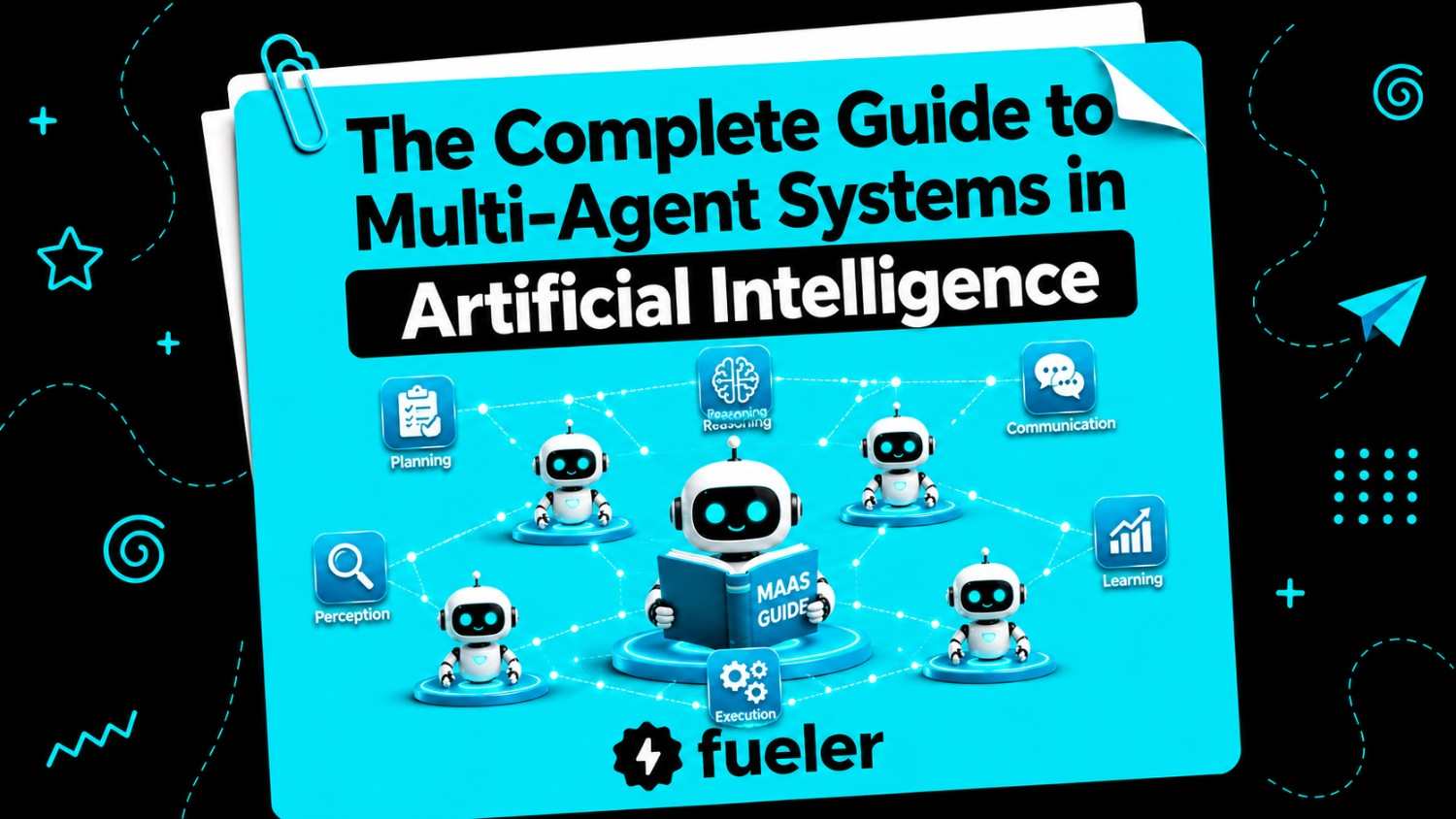
The Complete Guide to Multi-Agent Systems in Artificial Intelligence

Riten Debnath
04 Apr, 2026
Last updated: April 2026
The era of asking a single chatbot a question and receiving a static response is rapidly coming to an end. We are entering the age of Agentic Workflows, where instead of a lone digital assistant, we utilise a coordinated network of specialised intelligences. Imagine a corporate boardroom where every seat is occupied by an AI expert: one for data analysis, one for creative strategy, one for legal compliance, and one for technical execution. They don’t just sit there; they talk to each other, challenge each other's logic, and work toward a common goal. This is a Multi-Agent System (MAS), and it is the most significant architectural shift in the history of Artificial Intelligence.
I’m Riten, founder of Fueler, a skills-first portfolio platform that connects talented individuals with companies through assignments, portfolios, and projects, not just resumes/CVs. Think Dribbble/Behance for work samples + AngelList for hiring infrastructure.
1. Understanding the Core Mechanics of Multi-Agent Systems
To grasp why Multi-Agent Systems are revolutionary, we must first look at the limitations of standard AI. A traditional Large Language Model (LLM) acts like a very smart encyclopedia, it knows a lot, but it operates in a vacuum without the ability to verify its own claims through external actions. A Multi-Agent System, however, functions like a modern software company where tasks are delegated to specialists. In this setup, agents are autonomous entities that have been given specific personas, tools, and goals. They are programmed to behave like independent workers who can browse the web, write code, and interact through a communication layer to pass data back and forth until the task is perfected.
- Autonomous Reasoning and Planning: Each agent within the system possesses the internal logic to plan its own sub-tasks and sequences without requiring a human to provide a new prompt for every minor step, allowing for long-term execution of complex business objectives.
- Dynamic Environment Interaction: Agents are not restricted to their training data; they can actively observe and interact with their digital environment, such as querying a live database, scraping a website for real-time news, or even making API calls to external software services.
- Structured Social Ability and Negotiation: These agents use sophisticated communication protocols to negotiate with one another, share internal insights, and provide peer-review style corrections to the work of their digital colleagues to ensure the highest quality output.
- Decentralised Distributed Problem Solving: Instead of forcing one massive, generalised model to process an entire project, the workload is broken into smaller, highly manageable pieces handled by specialised agents who are experts in their specific niche domains.
Why it matters: This approach effectively solves the "jack of all trades, master of none" problem that plagues current AI models. By breaking down a complex project into specialised roles, the final output is significantly more accurate, nuanced, and professional than anything a single AI model could produce in a single prompt-response cycle.
2. The Evolution from Single-Agent to Multi-Agent Workflows
In the early days of AI adoption, the tech world focused heavily on prompt engineering, which was the art of finding the perfect string of words to get a single model to behave correctly. While this was effective for simple tasks like summarising a paragraph, it inevitably fails when you need to write a fifty-page technical manual or develop a full-stack application from scratch. The evolution to Multi-Agent Systems represents a permanent move toward Flow Engineering. This is the sophisticated process of designing the pathways and logic gates through which information moves between different AIs, prioritising the organisation of the digital team over the phrasing of a single question.
- Linear Sequential Hand-offs: This is a structured workflow where Agent A completes a specific part of a task and hands the refined results off to Agent B, much like a traditional industrial assembly line, ensuring each stage of production is verified.
- Joint Synchronous Collaboration: In this model, multiple agents work on the same document or codebase simultaneously, providing live peer reviews, suggesting edits in real-time, and resolving conflicts through a shared digital workspace for maximum efficiency.
- Hierarchical Managerial Supervision: A designated Manager Agent oversees several specialized Worker Agents, checking their individual outputs against a strict set of quality standards and project requirements before allowing the work to proceed to the final stage.
- Iterative Feedback Loops and Refinement: This involves a system where an Evaluator Agent critically analyzes the work of a Creator Agent and sends it back for revision if specific criteria are not met, ensuring a continuous cycle of improvement until perfection is achieved.
Why it matters: Understanding this evolution is crucial for any business leader or developer in 2026. It marks the transition from AI as a simple "tool" to AI as a fully functional "workforce," allowing for the automation of complex, high-level logic and decision-making that was previously thought to be strictly human territory.
3. Essential Frameworks: AutoGen, CrewAI, and LangGraph
Building a Multi-Agent System from scratch is an immense technical challenge that involves managing memory, state, and complex communication logic. Thankfully, several powerful frameworks have emerged to act as the "operating system" for these AI teams, providing the necessary infrastructure to manage these interactions. These tools handle the messy parts of AI communication, ensuring that agents don't talk over each other and that data is preserved across long sessions. If you are looking to build a system that can actually "do" professional work, these libraries are the essential building blocks you must master.
- Microsoft AutoGen Framework: A high-level library that excels at creating customizable and conversational agents that can work together to solve complex tasks through automated, multi-turn dialogues that mimic human brainstorming sessions.
- CrewAI Role-Based Orchestration: This framework focuses heavily on the concept of role-playing, where you define a "crew" of agents with specific personas, such as a Researcher or a Technical Writer, and give them a defined sequence of tasks to execute collaboratively.
- LangGraph for Stateful Workflows: Developed by the LangChain team, this tool allows developers to create complex, circular workflows where agents can loop back to previous steps based on new data, making it ideal for software debugging or iterative research.
- OpenAI Assistants and Swarm APIs: These are managed services that allow for the creation of persistent agents with built-in memory and tool-calling capabilities, simplifying the process of building agents that can interact with files and external applications.
Why it matters: These frameworks are the "construction kits" of the modern tech era. Just as WordPress made it easy for everyone to build professional websites, these tools are making it possible for anyone with basic technical skills to build a sophisticated, autonomous AI company in a box.
4. Communication Protocols: How Agents Talk to Each Other
The most fascinating part of a Multi-Agent System is the conversation that happens behind the scenes. When agents communicate, they don't just send text; they exchange highly structured data packets that contain instructions, context, and results. For a system to be truly effective, the agents must have a clear understanding of their hierarchy and the specific protocol for sharing information. If a Researcher Agent finds a data point, it needs to know exactly how to format that data so the Analyst Agent can process it immediately without errors or hallucinations.
- Structured JSON Data Exchange: Most professional agents communicate using JSON (JavaScript Object Notation), which ensures that technical data, such as code snippets or numerical values, is passed between models in a clean and organized manner.
- Centralized Blackboard and Shared Memory: This is a central digital repository where all agents can post their findings, read what others have discovered, and maintain a "long-term memory" of the project's progress to avoid repeating unnecessary work.
- Trigger-Based Task Hand-offs: These are clear logic triggers that tell an agent when its specific job is finished and automatically notify the next person in the chain of command, ensuring the project moves forward without human oversight.
- Automated Conflict Resolution Protocols: These are specific rules that help the system decide what to do when two different AIs come to different conclusions about a piece of data, often escalating the issue to a third "Judge" agent for a final decision.
Why it matters: Communication is the glue that holds a Multi-Agent System together. In a professional setting, the efficiency and speed of your AI team depend entirely on how well they can share and process information without human intervention, reducing the risk of data loss or confusion.
5. Real-World Applications: MAS in Finance, Healthcare, and Tech
Theory is great, but the true power of Multi-Agent Systems is best seen when they are deployed in high-stakes environments. We are seeing these systems used where data is overwhelming and the cost of an error is high. In the world of finance, a Multi-Agent System can have one agent watching global news, another analysing historical price charts, and a third checking for regulatory changes in real-time. When they all agree on a trend, the system can execute a high-confidence trade with much more reliability than a human or a single AI model could achieve.
- Advanced Healthcare Diagnosis and Planning: In medical settings, one agent reviews diagnostic images, another checks the patient's genetic history, and a third cross-references the latest clinical trials to suggest a personalised treatment plan for the doctor to review.
- Autonomous Software Development Cycles: A team of agents can take a high-level feature request, write the necessary code, create the unit tests to ensure quality, and perform a security audit before the human developer ever sees the pull request.
- Comprehensive Content Marketing Engines: A Strategy Agent creates a long-term content calendar, a Writer Agent drafts the actual posts, and an SEO Agent optimises every word for search engines to ensure maximum organic reach and traffic.
- Large-Scale Legal Discovery and Risk Audit: Agents can sort through millions of legal documents in minutes, identifying relevant case law, flagging potential contract risks, and summarising complex litigation histories with surgical precision for legal teams.
Why it matters: MAS is moving technology from "assisting" with simple tasks to "executing" entire business functions. For professionals, this means you can scale your individual productivity tenfold by managing these systems rather than doing the manual data entry and analysis yourself.
6. Overcoming Challenges: Latency, Cost, and Token Usage
While Multi-Agent Systems are incredibly powerful, they are not without their hurdles, and the primary challenge is often the cost of "talking." Because agents are constantly debating and passing context back and forth, they use a massive amount of data, which translates to high token costs. If you have five agents debating a topic through several rounds of conversation, you might find that the process is significantly slower and more expensive than a single model. Architects of these systems must be careful to find the balance between "too much talk" and "not enough collaboration."
- Recursive Prompt Inflation and Cost: As agents pass their conversation history back and forth, the prompts get progressively longer and more expensive to process, requiring clever strategies to summarise past messages and save on token usage.
- Infinite Loop Hazards and Deadlocks: Sometimes agents get stuck in a recursive loop where they correct each other indefinitely without ever reaching a final answer, requiring strict "max iteration" settings to prevent wasting computational resources.
- Context Window Limitations: Even the most advanced AIs have a limit on how much information they can remember at once, meaning designers must decide which data is "mission-critical" and which should be discarded to save space.
- Increased Execution Time and Latency: Because multi-agent workflows involve multiple steps and decision-making gates, they take longer to complete than single queries, which can be a drawback for applications requiring instant responses.
Why it matters: To be an expert in this field, you must understand the basic economics of AI. Knowing when to use a single agent versus a multi-agent team is the difference between a profitable, scalable project and a massive waste of technical and financial resources.
7. The Role of Human-in-the-Loop (HITL) in MAS
Despite the autonomy of these systems, the human element remains the most important part of the equation for long-term success. We call this "Human-in-the-Loop" (HITL). This is the strategic point in the process where the AI team pauses and asks a human for approval or clarification. This prevents the system from going off the rails and ensures that the final output aligns perfectly with human values and business goals. A Multi-Agent System without a human supervisor is like a ship without a captain; it might be moving fast, but it could easily be going in the wrong direction.
- High-Level Strategic Approval: The human sets the initial goal and approves the "master plan" created by the agents, ensuring the digital team understands the nuances of the business objective before they start working.
- Critical Quality Control Gates: The system is programmed to stop and wait for human feedback at critical milestones, such as before a piece of code is deployed to a live server or before a major financial trade is executed.
- Complex Edge Case Handling: When the AI team encounters a unique or ambiguous situation it hasn't seen before, it is trained to escalate the problem to a human expert rather than guessing and making a costly mistake.
- Creative Refinement and Final Polish: Humans provide the "final 10%" of the work, adding the emotional intelligence, brand voice, and subtle nuance that machines still lack even in the most advanced multi-agent configurations.
Why it matters: The future isn't about AI replacing humans; it’s about humans becoming the high-level managers of specialised AI teams. Learning how to effectively provide feedback to a Multi-Agent System is the most valuable skill you can develop as a professional in 2026.
8. Security and Ethics: Managing Autonomous AI Teams
When you give AI the power to act autonomously, security becomes a top priority. What happens if an agent is tricked into sharing sensitive company data during its research phase? Or what if an agent accidentally deletes a database while trying to "fix" it? Managing the permissions and ethical boundaries of a Multi-Agent System is a new and critical field of study. We need to build "guardrails" that prevent agents from performing harmful actions, even if they think those actions will help them achieve their assigned goal faster.
- Granular Permission Scoping: This involves only giving an agent access to the specific files, folders, and tools it absolutely needs to complete its task, following the "principle of least privilege" to keep data safe.
- Detailed Audit Logs and Transparency: Keeping a permanent record of every "thought" and "action" the AI team takes, allowing human managers to trace back mistakes and understand why the system made a particular decision.
- Digital Sandboxing and Safety Environments: Running AI agents in a restricted and isolated digital environment where they can't cause damage to the real-world system if they encounter a bug or an unexpected error.
- Algorithmic Bias Mitigation: Ensuring that the collective "opinion" of the AI team doesn't amplify the biases found in individual models, often by having a "Bias Checker" agent specifically look for unfair or skewed results.
Why it matters: Trust is the primary currency of the digital age. For Multi-Agent Systems to be widely adopted by major corporations, they must be certain that these digital teams are safe, ethical, and fully under human control at all times.
9. Future Trends: Toward Artificial General Intelligence (AGI)
Many experts believe that Multi-Agent Systems are the clearest path we have toward Artificial General Intelligence (AGI). By combining many specialised intelligences, we are essentially building a digital "brain" that can handle any task thrown at it. In the near future, we will see "Self-Evolving Systems" where agents can actually write their own code to create new agents as they need them. This level of self-improvement could lead to a rapid acceleration in technological progress, changing everything from how we cure diseases to how we explore space.
- Autonomous Self-Healing Software Systems: These are systems that can detect their own bugs in real-time and automatically deploy a team of agents to write a fix and update the software without any human help.
- Dynamic and Elastic Team Scaling: This refers to an AI system that realizes it is overwhelmed by a task and automatically "hires" or spins up more digital agents to help with the workload until the project is finished.
- Cross-Platform Agency and Mobility: This involves agents that can move seamlessly between your phone, your computer, and your smart home devices to provide a truly integrated and helpful experience that follows you everywhere.
- Integration of Artificial Emotional Intelligence: Giving agents the ability to understand and react to human emotions during the collaboration process, making the interaction between humans and AI teams feel much more natural and productive.
Why it matters: We are standing on the edge of a new frontier in human history. Those who understand how to build, manage, and scale these systems today will be the architects of the world tomorrow, leading the charge into an AI-driven society.
As these AI systems become more complex, the burden of proof shifts to you. Companies won't just want to know that you understand AI; they will want to see what you have orchestrated. At Fueler, we see this shift every day. Professionals who can show a portfolio of projects where they managed AI agents or built specialised workflows are getting hired instantly. It is about moving from "I know how to use ChatGPT" to "I built a multi-agent system that automated a marketing department." Having a skills-first portfolio is your way of proving that you have the "human-in-the-loop" expertise that companies are desperate for.
Final Thoughts
The transition to Multi-Agent Systems is not just a technical update; it is a fundamental change in how we perceive work and intelligence. By leveraging the power of collaboration between AI entities, we can solve problems that were once considered impossible. However, the success of these systems still relies on human direction, ethical oversight, and a commitment to quality. As you explore this technology, focus on the logic of the "flow" and the results of the "team." The future belongs to those who can direct the digital symphony.
Frequently Asked Questions (FAQs)
1. Is a Multi-Agent System better than a single LLM for business?
Yes, for complex tasks. While a single LLM is great for quick answers, a Multi-Agent System provides better accuracy and specialised expertise by breaking tasks into smaller, manageable parts that can be verified and refined.
2. What are the best tools for building Multi-Agent Systems in 2026?
The industry leaders currently include CrewAI for role-based task workflows, Microsoft AutoGen for conversational agent interaction, and LangGraph for complex, state-driven applications that require iterative loops.
3. Do Multi-Agent Systems cost more to run than standard AI?
Generally, yes. Because multiple agents are communicating and processing data in a collaborative manner, they use more tokens and compute power than a single query to a standard AI model, though the quality is often much higher.
4. How do I prevent my AI agents from getting stuck in a loop?
You must implement "max iterations" settings and human-in-the-loop checkpoints. This ensures that the system automatically stops and asks for human intervention if it cannot reach a conclusion after a certain number of steps.
5. Can I use different AI models in the same Multi-Agent System?
Absolutely. One of the greatest strengths of these systems is being "model agnostic." You can have a GPT-4 agent acting as the manager while using cheaper, faster models like Claude or Llama for basic data processing and research tasks.
What is Fueler Portfolio?
Fueler is a career portfolio platform that helps companies find the best talent for their organisation based on their proof of work. You can create your portfolio on Fueler. Thousands of freelancers around the world use Fueler to create their professional-looking portfolios and become financially independent. Discover inspiration for your portfolio
Sign up for free on Fueler or get in touch to learn more.

What should you do next?
You've read the article. Now turn your skills into proof of work and unlock more opportunities.
Build your proof of work portfolio
Create a clean portfolio with projects, assignments, resumes, and AI stack details that companies actually want to see.
Create your Fueler portfolio →Apply through assignments, not resumes
Stand out by solving real tasks from companies hiring on Fueler.
Explore assignments →Get discovered by companies
Make your work public and let recruiters discover your skills through actual projects instead of keywords.
Get discovered →
