15 Stunning Digital Portfolio Examples Across Industries

Riten Debnath
02 Apr, 2026
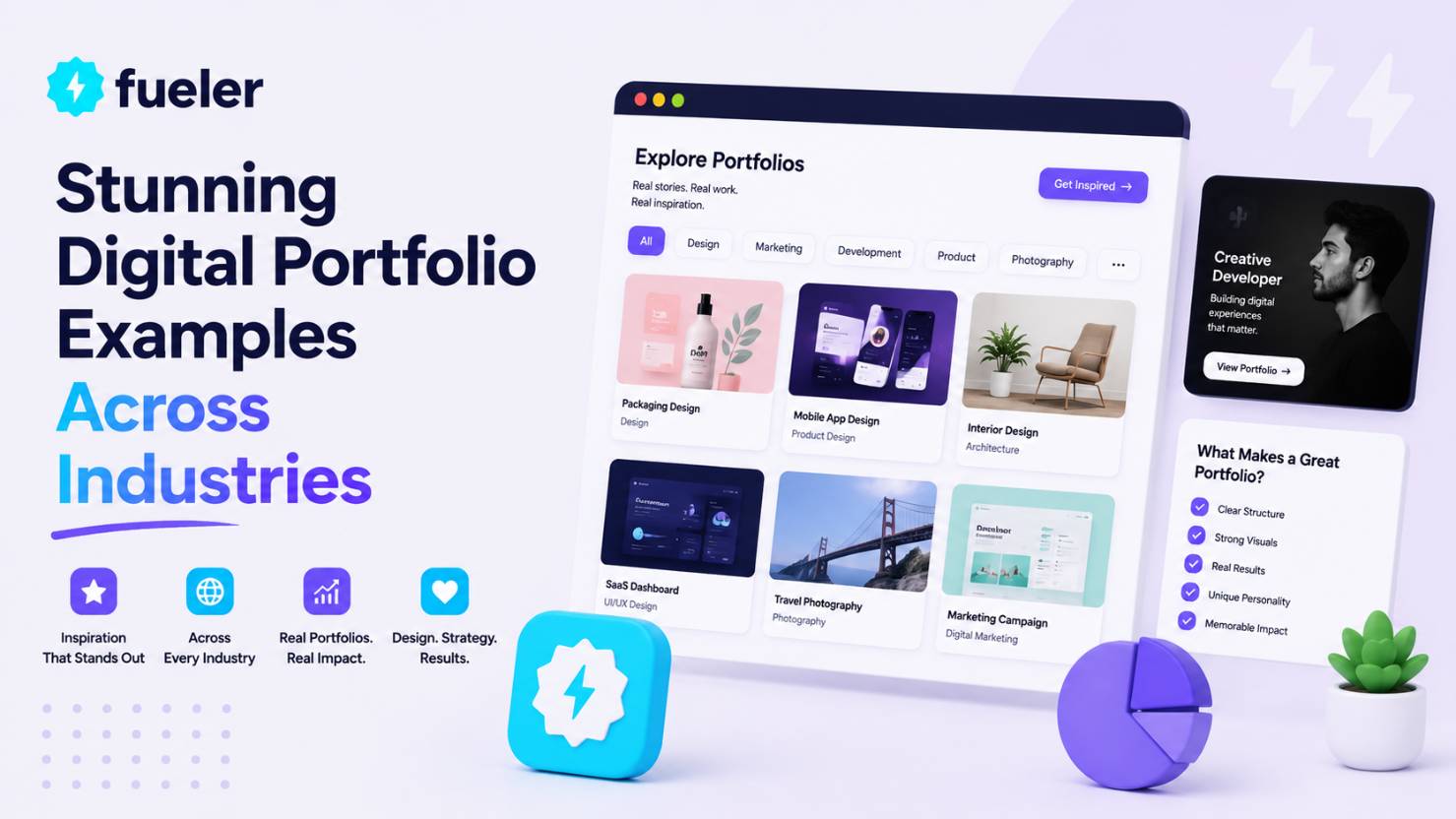
I am Riten, founder of Fueler. The best way to understand what a great digital portfolio looks like is to study real examples across different professions. Not abstract descriptions of what one should contain, but actual examples of the types of work, structure, and storytelling that make portfolios compelling to employers and clients.
In this article, I am walking you through 15 digital portfolio examples across different industries, along with the specific elements that make each one work. Use these as a framework and inspiration for building your own.
1. Product Designer Portfolio
The portfolio opens with a clear professional headline. Each project entry includes the design challenge, the research process, wireframe iterations, the final UI, and a usability metric like task completion rate or time-on-task improvement. One featured project shows a complete redesign of a mobile onboarding flow that reduced drop-off by 31 percent.
What works: The process documentation is as detailed as the final design. The metric is specific and credible.
2. Brand Strategist Portfolio
Five brand projects, each structured as a case study. The context, the competitive landscape, the brand strategy developed, the identity system created, and how the client used it in market. One case study notes that the rebrand contributed to a 40 percent increase in qualified leads within six months of launch.
What works: The bridge between creative output and business outcome is explicit and documented.
3. Full-Stack Developer Portfolio
Four live applications with GitHub links and detailed README documentation. Each project entry explains the technical problem, the technology choices made and why, the challenges encountered, and the current state of the product. One project has been used by over 3,000 active users.
What works: The code is real and working. The reasoning behind technical decisions shows engineering maturity.
4. SEO Specialist Portfolio
Three client case studies with keyword ranking screenshots taken at specific dates, organic traffic growth charts from Google Analytics, and written explanations of the strategy used for each client. One case study shows a site that went from zero first-page rankings to 47 first-page keywords in nine months.
What works: Hard data tied to specific strategic decisions. The before-and-after is undeniable.
5. Video Editor Portfolio
A curated showreel that opens with the strongest 30 seconds of work from across different projects. Below the reel, individual project entries describe the brief, the creative direction, the tools used, and for commercial projects, the performance metrics when available.
What works: The showreel filters out weak work ruthlessly. Every second is the editor's best.
6. Social Media Manager Portfolio
Three account case studies showing starting follower counts, content strategy used, posting frequency, and growth metrics over 90 days. Top-performing posts from each account are included with engagement rate data. The portfolio also shows a content calendar template developed for one client.
What works: Growth is documented with specifics. The strategy document shows thinking, not just execution.
7. Email Marketing Specialist Portfolio
Four email campaigns with full screenshots of the email design, the subject line, open rates, click-through rates, and in one case, the revenue directly attributed to a welcome sequence. The portfolio explains the segmentation strategy and the A/B tests run for each campaign.
What works: The direct line from email to revenue is explicit. The testing approach shows strategic sophistication.
8. Business Analyst Portfolio
Three process improvement projects. Each one starts with a description of the inefficiency identified, the analysis approach used, the recommendation made, the implementation process, and the measurable outcome. One project shows a manual reporting process that was automated, saving a team of six people approximately four hours per week each.
What works: The quantified time and cost savings make the value immediately obvious.
9. HR and People Operations Portfolio
A hiring process redesign case study, an employee engagement program that improved retention by 18 percent, and a diversity hiring initiative with before-and-after representation data. The portfolio also includes an anonymized onboarding playbook the professional developed.
What works: People outcomes are quantified in ways that are credible and meaningful to HR hiring managers.
10. Copywriter Portfolio
Six pieces across different formats: website homepage copy with conversion rate data, an email sequence with open and conversion rates, long-form SEO article with current ranking position, social media ad copy with click-through rate, and a product launch campaign brief with sales results.
What works: Range of formats plus evidence that the copy performed. Two different skills demonstrated simultaneously.
11. Financial Analyst Portfolio
Four anonymized financial analyses. Each includes the business question being answered, the data sources and methodology used, the key insight or recommendation, and in two cases, the outcome when the recommendation was implemented. Sensitive client data is fully redacted.
What works: Complex work is made accessible through clear explanation. The insight-to-outcome connection demonstrates real-world impact.
12. Operations Manager Portfolio
Process maps showing before and after states of three operational improvements. One shows a supply chain redesign that reduced lead times by 22 percent. Another shows a customer support workflow redesign that improved first-response time by 40 percent. Each includes a written explanation of the approach and the cross-functional coordination required.
What works: Visual process documentation makes operational impact concrete and easy to understand.
13. Growth Marketer Portfolio
Five growth experiments documented in full. Hypothesis, test design, audience, duration, results, and learning. One experiment that failed is included with a clear explanation of what was learned and how it changed subsequent strategy. The willingness to show a failure with analysis makes the portfolio more credible, not less.
What works: The scientific approach to marketing is demonstrated directly. Showing a failure demonstrates intellectual honesty.
14. Customer Success Manager Portfolio
Three client retention case studies where the CSM identified an at-risk account, developed an intervention plan, and documented the outcome. Net Promoter Score improvements are included for two accounts. A customer onboarding playbook developed from scratch is also featured.
What works: At-risk account retention stories are extremely compelling to CS hiring managers who understand how rare and valuable that skill is.
15. Recent Graduate With No Formal Experience
Five entries built entirely from non-paid work. A marketing analysis completed for a university course. A personal blog with six months of traffic growth data. A social media account managed for a local nonprofit with growth metrics. A freelance logo project for a friend's business with a short testimonial. And a personal app prototype built during a hackathon.
What works: Every entry is documented with the same professionalism as paid work. The initiative shown across five different self-initiated projects is a stronger signal than one internship entry would be. A Fueler portfolio can be a simple way for students to bring those self-initiated projects together and show what they can actually do, even before they have formal work experience.
Here, you can explore five different digital portfolios from creative, product, marketing, and technical fields. These examples show how professionals in different industries can structure their work and use a portfolio to communicate their skills and experience.
Profile | What You Can Learn | |
|---|---|---|
Learn how a creative strategist can present strategic and creative work through a focused portfolio. | ||
Learn how a developer can use a portfolio to showcase technical projects and practical skills. | ||
Learn how a digital marketer can present practical marketing work and demonstrate experience across digital channels. | ||
Learn how a product designer can use a portfolio to communicate design thinking and product-focused work. | ||
Learn how an SEO and performance marketer can showcase specialised marketing skills through a professional portfolio. |
Build Your Portfolio on Fueler
Every one of these portfolio types can be built on Fueler. The platform is designed to work for any profession, any experience level, and any career stage. You can document projects with full context and outcomes, tag the skills each project demonstrates, and share a clean public link that makes your work accessible to anyone.
Visit fueler.io to start building yours today.
Frequently Asked Questions
What are some good digital portfolio examples across different industries?
Great portfolios exist in every field from design and development to HR, finance, operations, and marketing. What they all share is real projects documented with clear context, specific contributions, and measurable outcomes.
How do I create a portfolio for a non-visual or non-creative profession?
Use case studies with clear problem-action-result structure, process documents, redacted deliverables, data visualizations, and testimonials. Non-visual work is just as compelling when explained clearly and connected to outcomes.
What makes a digital portfolio stand out to employers?
Specific results tied to specific work, clear documentation of your role and contribution, honest storytelling including what you learned, and a clean presentation that is easy to navigate quickly.
Where can I see digital portfolio examples for inspiration?
Fueler has thousands of public portfolio examples across every industry. Visit fueler.io to browse real portfolios from professionals in your field.
Can I build a digital portfolio without any paid work experience?
Yes. Personal projects, coursework, volunteer work, spec projects, and hackathons all count. Document them with the same professionalism as paid work and they demonstrate capability just as effectively.
What is Fueler Portfolio?
Fueler is a career portfolio platform that helps companies find the best talent for their organization based on their proof of work. You can create your portfolio on Fueler. Thousands of freelancers around the world use Fueler to create their professional-looking portfolios and become financially independent. Discover inspiration for your portfolio
Sign up for free on Fueler or get in touch to learn more.

What should you do next?
You've read the article. Now turn your skills into proof of work and unlock more opportunities.
Build your proof of work portfolio
Create a clean portfolio with projects, assignments, resumes, and AI stack details that companies actually want to see.
Create your Fueler portfolio →Apply through assignments, not resumes
Stand out by solving real tasks from companies hiring on Fueler.
Explore assignments →Get discovered by companies
Make your work public and let recruiters discover your skills through actual projects instead of keywords.
Get discovered →
