Single-Agent vs Multi-Agent Systems: Which AI Agent Architecture Should You Choose?

Riten Debnath
22 Feb, 2026
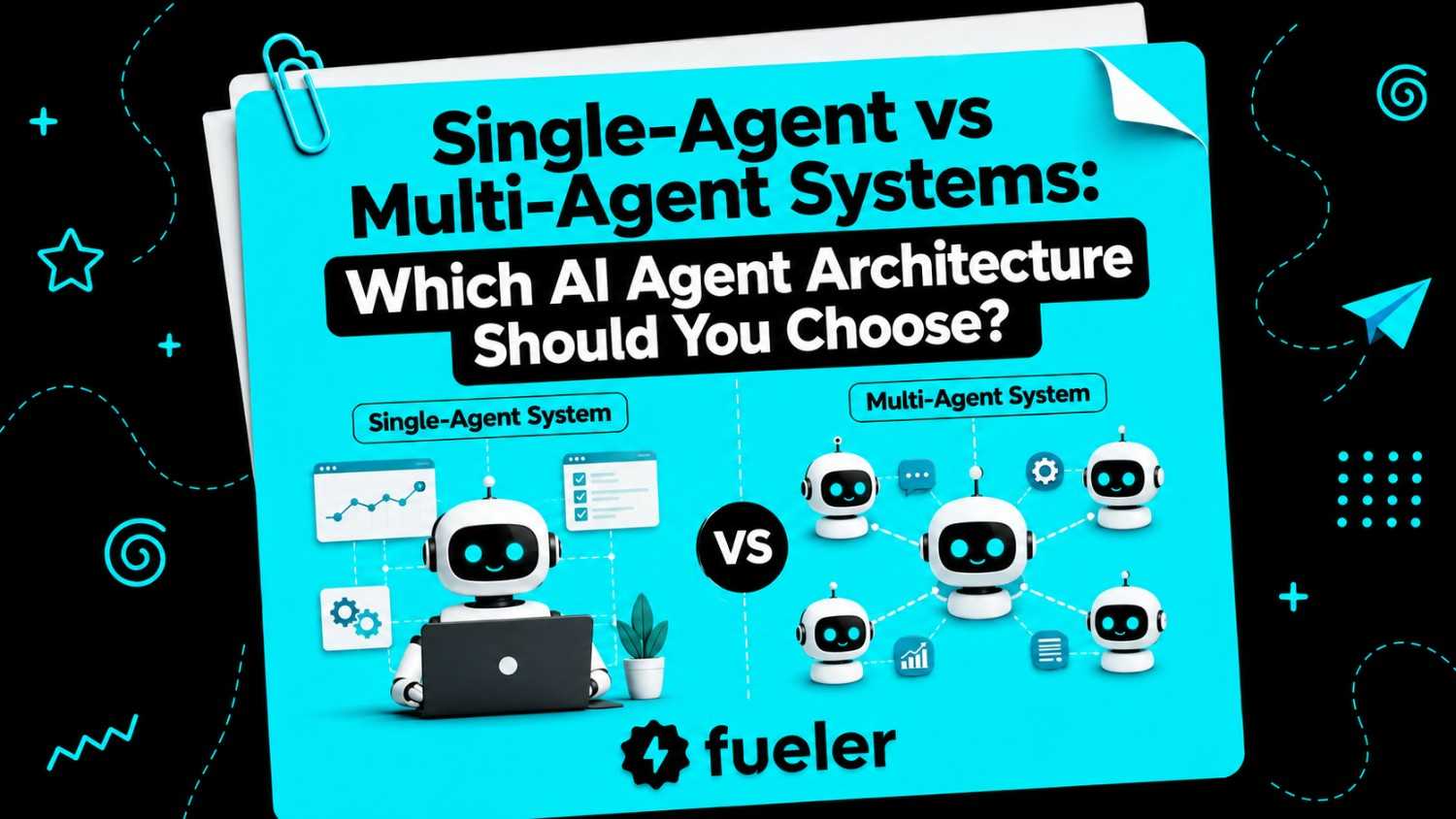
The AI revolution has moved past the "asking questions" phase and entered the "getting things done" era, but now every business leader is facing a massive technical crossroads. You have likely seen individual AI bots that can write code or draft emails, but the real power shift is happening in how these agents are organized, whether you use one "super-brain" or a "digital army" of specialized workers. Choosing the wrong setup can lead to a system that is either too simple to handle complex work or so complicated that it breaks under its own weight, making this choice the most important decision you will make for your 2026 tech stack.
I’m Riten, founder of Fueler, a skills-first portfolio platform that connects talented individuals with companies through assignments, portfolios, and projects, not just resumes/CVs. Think Dribbble/Behance for work samples + AngelList for hiring infrastructure.
Defining the Single-Agent Architecture
A Single-Agent system is essentially a lone wolf, a high-powered AI model like GPT-4o or Claude 3.5 that handles every part of a task from start to finish within a single conversation thread. Think of it like hiring a brilliant generalist who is capable of writing, coding, and researching, but does all the work inside one "brain" without asking for outside help or delegating tasks. While it is incredibly fast and simple to deploy, the entire success of the project rests on that one model's ability to stay focused and not lose track of the instructions as the task gets longer and more detailed.
- Linear Reasoning and Direct Execution: Single agents work in a straight line, taking your initial prompt and processing it through a single logic chain, which makes them perfect for straightforward tasks like summarizing a long document or writing a specific piece of Python code without the need for complex back-and-forth communication.
- Low Latency and High-Speed Responses: Because there is only one model "thinking" and no time wasted on agents talking to each other, the response time is nearly instant, making this the ideal choice for real-time customer service bots or simple personal assistants that need to provide answers in a matter of milliseconds.
- Simplified Error Tracking and Debugging: When something goes wrong in a single-agent setup, it is very easy to find the mistake because there is only one prompt and one output to analyze, allowing developers to quickly tweak the instructions and get the system back on track without digging through multiple logs.
- Cost-Effective Resource Management: Running one agent is significantly cheaper than running ten, as you are only paying for the tokens used by a single model, making this a great starting point for startups or small projects that need AI power without a massive monthly API bill or complex cloud hosting requirements.
Why it matters: This streamlined approach is the foundation for most basic automation, providing a clear path for those wondering which AI agent architecture to choose for simple, high-speed tasks that don't require a committee of experts.
The Complexity of Multi-Agent Systems (MAS)
Multi-Agent Systems (MAS) are the digital equivalent of a high-performing corporate department, where different AI models are assigned specific roles like "Manager," "Editor," or "Researcher." Instead of one brain trying to do everything, these systems use "orchestration" to let agents collaborate, peer-review each other’s work, and solve problems that are far too big for a single model to handle. This team-based approach allows for much higher accuracy because if the "Writer Agent" makes a mistake, the "Fact-Checker Agent" is there to catch it and send it back for a rewrite before the human user ever sees it.
- Specialized Role Playing and Persona Focus: By giving each agent a specific "identity" and a narrow set of tools, you ensure that the AI stays in its lane, allowing a "Legal Agent" to focus strictly on compliance while a "Creative Agent" focuses on tone, resulting in a much more professional and polished final product.
- Collaborative Problem Solving and Reasoning: Agents in a multi-agent system can actually "talk" to each other, debating the best way to solve a problem or asking each other for missing information, which mimics the way a human team brainstorms to find the most efficient solution to a difficult business challenge.
- Advanced Error Correction and Quality Assurance: Because these systems include internal feedback loops, one agent can act as a "critic" to another, checking for logic flaws, tone inconsistencies, or factual errors, which dramatically reduces the "hallucination" problems that often plague lone AI models.
- Modular Scalability for Large Projects: You can easily "plug in" new agents as your project grows, such as adding an "SEO Agent" to a content team or a "Security Auditor" to a coding squad, allowing the system to grow in complexity without needing to rebuild the entire architecture from scratch.
Why it matters: This collaborative structure is essential for high-stakes business operations, offering a powerful alternative when deciding which AI agent architecture to choose for tasks that require absolute precision and expert-level quality.
Decision Matrix: Complexity vs. Reliability
When you are trying to decide between these two paths, the most important factors are the complexity of the task and the level of reliability you need. A single agent is like a fast-moving freelancer who is great at quick turnarounds, while a multi-agent system is like an established agency that takes longer but delivers a more comprehensive result. If your task has more than five steps or requires checking data across three different platforms, the "lone wolf" model will likely start to hallucinate or forget earlier instructions, making the "team" approach the safer bet for enterprise-grade work.
- Task Multi-Step Requirements: If your workflow involves more than three distinct stages, such as research, followed by drafting, followed by formatting, a multi-agent system is better at maintaining the "state" and quality of the work across those transitions without losing the original goal.
- Accuracy and Hallucination Risk: For projects where a single mistake could be costly, such as financial reporting or medical advice, the built-in "debate" and "review" cycles of a multi-agent system provide the necessary safety net that a single agent simply cannot offer.
- Development Time and Technical Overhead: Single agents can be set up in minutes with a simple prompt, whereas multi-agent systems require careful "orchestration" and "prompt engineering" for each individual role, meaning they take much longer to build and require a more skilled technical team.
- API Token Usage and Financial Costs: Multi-agent systems can get expensive very quickly because every time the agents "talk" to each other, it costs tokens, so you must weigh the increased quality against the significantly higher operational costs of running a digital squad.
Why it matters: Balancing these trade-offs is the core of smart AI implementation, helping you determine which AI agent architecture you should choose based on your specific budget and the level of risk your project can handle.
When to Choose a Single-Agent Architecture
You should stick with a single-agent architecture when your primary goals are speed, simplicity, and low cost. This setup is perfect for "input-output" tasks where the context doesn't change much, and the instructions are clear-cut. For example, if you need an AI to translate a document, write a short blog post from a clear outline, or answer basic customer questions based on a provided FAQ sheet, adding more agents would only slow down the process and add unnecessary complexity to a task that the model can already do perfectly on its own.
- Straightforward Data Transformation: Use a single agent when you just need to turn one type of data into another, such as converting a transcript into a bulleted list or turning a raw data set into a clean JSON file for your developers to use.
- Personal Productivity and Basic Assistance: For daily tasks like scheduling meetings, drafting quick replies, or brainstorming a few headline ideas, a single agent is more than enough to act as a highly efficient digital secretary that doesn't need a team to manage it.
- Prototyping and Minimum Viable Products (MVPs): When you are just testing an idea, it is always better to start with a single agent to see if the core logic works before investing the time and money into building a complex multi-agent "crew" that might be overkill for your needs.
- High-Speed User Interactions: If you are building a tool that needs to respond to a user in real-time, like a voice assistant or a live chatbot, the low latency of a single agent is a massive advantage that keeps the user experience feeling fluid and natural.
Why it matters: Staying simple prevents "over-engineering," which is a common trap for those trying to figure out which AI agent architecture to choose for agile and fast-moving projects.
When a Multi-Agent System (MAS) is Non-Negotiable
A multi-agent system becomes non-negotiable the moment your project requires "expert" level results across different domains at the same time. If you are building a system that needs to write code, test that code, and then deploy it, a single agent will almost certainly fail because the "context window" becomes too cluttered with different types of information. In these scenarios, having a specialized "Developer Agent" and a separate "QA Agent" ensures that the code is actually functional and secure, mimicking the "separation of powers" found in the world's most successful software companies.
- Complex Software Development Pipelines: Multi-agent systems excel at coding because they can have one agent write the script, a second agent write the unit tests, and a third agent attempt to "hack" the code to find security vulnerabilities before it goes live.
- In-Depth Market Research and Analysis: For tasks that require searching the live web, comparing multiple sources, and synthesizing a 20-page report, a squad of agents can divide the work, with each one focused on a different sub-topic to ensure no stone is left unturned.
- Content Engines with Built-In Brand Safety: If you are automating your company's social media, you need a "Creative Agent" to write the posts, a "Compliance Agent" to check for legal issues, and a "Brand Agent" to make sure the tone matches your company's specific voice.
- Long-Running Autonomous Workflows: For tasks that take hours or days to complete, such as monitoring a stock market or managing a supply chain, multi-agent systems can "hand off" tasks to each other to ensure the process never stops even if one model hits a rate limit or a temporary error.
Why it matters: Investing in a multi-agent setup is the only way to achieve true "enterprise-grade" automation, making it the clear winner when deciding which AI agent architecture should you choose for high-complexity, mission-critical business systems.
Building Your Portfolio as an AI Architect
As the world shifts between these two architectures, companies are no longer just looking for "AI users," they are looking for "AI Architects" who know when to deploy a single agent and when to build a complex multi-agent crew. This is a highly specialized skill set that involves understanding model limits, token costs, and orchestration frameworks like CrewAI or AutoGen. To get hired in 2026, you need to prove that you can build these systems and that you understand the strategic trade-offs between different digital worker setups.
This is where Fueler becomes your most powerful career tool. Instead of just claiming you understand AI on a resume, you can use Fueler to showcase your actual projects, whether it’s a single-agent bot you built for a local business or a massive multi-agent squad you designed for a complex data task. By hosting your "proof of work" on Fueler, you show recruiters the exact logic, code, and results of your AI architectures. In a world where anyone can talk about AI, Fueler helps you prove you can actually build it.
Final Thoughts
Choosing between a single-agent and a multi-agent system is not about finding the "better" technology; it is about finding the right tool for the specific job at hand. Single agents offer unmatched speed and simplicity for basic tasks, while multi-agent systems provide the depth, accuracy, and collaboration needed for complex professional work. By understanding the strengths of both architectures, you can build smarter, more efficient AI systems that truly transform how you work and how your business grows.
Frequently Asked Questions (FAQs)
Which AI agent architecture is best for a small startup in 2026?
For most startups, starting with a single-agent architecture is the best move because it is cheaper, faster to build, and much easier to maintain. As your product grows and the tasks become more complex, you can then start "splitting" that single agent into a multi-agent system to handle higher volumes of specialized work without losing quality.
Is it more expensive to run a multi-agent system than a single agent?
Yes, multi-agent systems are generally more expensive because they require more "tokens" for the agents to communicate with each other and peer-review the work. However, the cost is often offset by the fact that you don't have to spend as much human time fixing errors, which can save a business a significant amount of money in the long run.
Can a single agent eventually become a multi-agent system?
Absolutely, and this is actually the recommended path for most developers. You start with a single-agent bot to prove the concept, and once you identify the specific "bottlenecks" where the AI is making mistakes, you can "spin off" those specific tasks to new, specialized agents to create a more robust multi-agent squad.
What are the best tools for building multi-agent systems today?
In 2026, the leading frameworks for building multi-agent systems are CrewAI for role-based automation, Microsoft's AutoGen for conversational agents, and LangGraph for high-precision, stateful workflows. These tools provide the "orchestration" needed to help different AI models talk to each other and work toward a common goal.
How do I prove to employers that I know how to build AI agents?
The best way is to create a "proof of work" portfolio on a platform like Fueler, where you can document the specific agents you've built, the architecture you chose, and the results they achieved. Showing a real-world project is ten times more valuable to an employer than a certification or a list of skills on a traditional CV.
What is Fueler Portfolio?
Fueler is a career portfolio platform that helps companies find the best talent for their organization based on their proof of work. You can create your portfolio on Fueler. Thousands of freelancers around the world use Fueler to create their professional-looking portfolios and become financially independent. Discover inspiration for your portfolio
Sign up for free on Fueler or get in touch to learn more.

What should you do next?
You've read the article. Now turn your skills into proof of work and unlock more opportunities.
Build your proof of work portfolio
Create a clean portfolio with projects, assignments, resumes, and AI stack details that companies actually want to see.
Create your Fueler portfolio →Apply through assignments, not resumes
Stand out by solving real tasks from companies hiring on Fueler.
Explore assignments →Get discovered by companies
Make your work public and let recruiters discover your skills through actual projects instead of keywords.
Get discovered →
