The Role of Social Media in Teenage Mental Health and Privacy Boundaries

Team Fueler
13 Jan, 2026
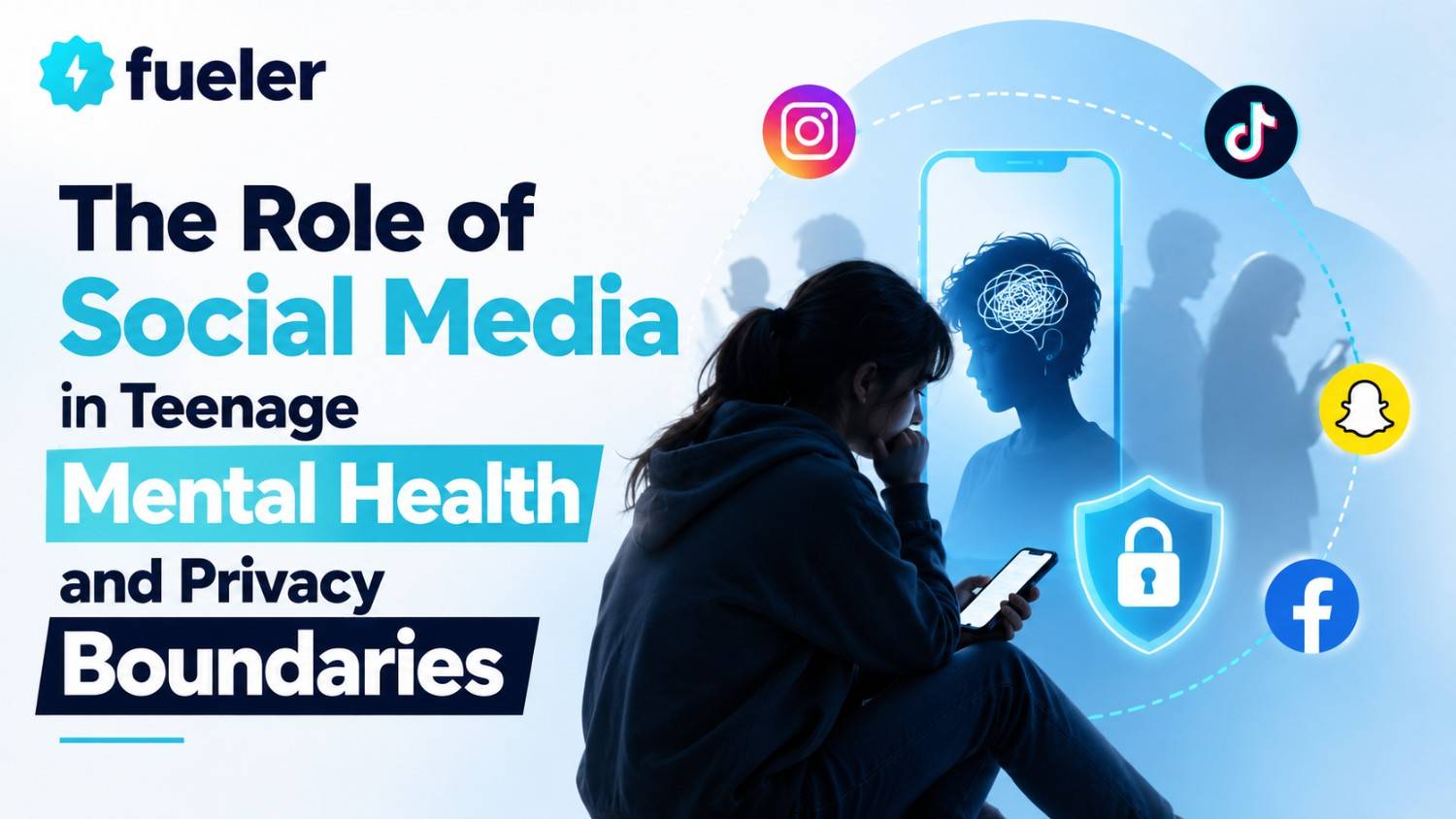
Social media is no longer a means of exchanging photos or videos, it is part and parcel of the teenage way of life. The teens are constantly involved in the online world, whether they are chatting with their friends or fads, and finding new things and interests. Although these platforms provide an opportunity to be creative, learn, and connect, they are also a cause of issues that may lead to issues related to mental health and privacy.
These are highly significant dynamics to us as marketers, parents, and educators. The brands must have an ethical contact with the younger generation, and the parents and teenagers must be able to use the Internet safely. In this paper, I will address the impact of social media on teenage mental health, the importance of privacy boundaries, and possible interventions to be used to use social media responsibly.
The Reason Teens Are So Drawn to Social Media
Social media is attractive to teens since this is one method of fulfilling various emotional and social needs, which include validation, connection, and identity formation.
Social validation and Self-esteem
One of the strongest motivations of teens is social validation. Their self-perception will be directly affected as the likes, comments, and shares will provide them with immediate feedback. Healthy interaction could lead to an improvement in confidence, whereas bad experiences can cause anxiety, self-doubt, and stress.
According to one of the most prominent psychologists who studies adolescent behavior, Dr. Jean Twenge:
Social media establishes an online reality around teens that makes them more validated and self-critical.
Life situation: A teenager shares a video of a dance. When friends interact positively, they can be assured and proud. But when the post gets many likes or negative feedback, the teenager will feel rejected, despite the fact that a good performance was made.
Teens often trade personal boundaries for validation without fully understanding the long tail of digital footprints. Parents struggle to guide without surveilling. Platforms aim to protect but still reward oversharing. The warning signs are usually subtle: withdrawal, mood swings, obsession with metrics, or sudden secrecy. Inigo Rivero, Managing Director of House Of Marketers
Online Identity Formation
Teenagers tend to build their personalities by using their social media accounts. In contrast to other generations, they have their identity continuously in view of their colleagues and even strangers. Social media promotes experimentation, yet can prove to be more insecure.
- Teenagers tend to post ideal personalities on the internet.
- Self-esteem may be linked to the response of peers instead of being linked to personal satisfaction.
- Internet communication could influence the way of life, which includes dressing and socializing.
This duality implies that social media is empowering to handle carefully, but dangerous in case of exposure to judgment or exclusion.
Connection and Community
With social media, teens can identify with other people and communities without being physically in their immediate environment. These societies can bring in support, belonging, and friendship. They can, though, also create pressures, i.e., the need to impress and conform to the trends or get into online competitions that are not relevant to personal values.
Impact of Social Media on the Mental Health of Teenagers
Even though social media may be utilized to provide social contact, invention, and learning, it also has a severe influence on mental health.
Anxiety and Peer Comparison
One of the characteristics of teenagers is comparison, and social media enhances it. Youths are constantly in comparison with other humans and influencers and are more likely to appreciate their worth on the basis of likes, comments, or followers.
- One may feel anxious because of constant comparisons and have lower self-esteem.
- The unrealistic norms can result from exposure to edited images and content.
- This could eventually lead to depression or stress symptoms.
Statista (2021) states that teenagers who cataloged their mental health as less than optimal say that they spend more than three hours daily on social media (Statista).
According to a Cyber security expert. Rafay Baloch, CEO and Founder of REDSECLABS, Said, Teens want freedom without fully understanding digital consequences. Warning signs tend to be subtle: late-night posting, mood shifts, withdrawal, or obsession with feedback. The healthiest solution isn’t restriction. It’s control. When teens learn how data works and feel trusted to manage it, confidence rises and anxiety falls.
“Most advice focuses on screen time, but the deeper issue is control. Teens don’t spiral because they’re online; they struggle when they feel watched without consent or understanding. Teaching teens how data flows, how permissions work, and how to pause visibility gives them agency. When privacy becomes a skill instead of a rule, mental resilience follows. The shift that matters most is helping teens move from being tracked users to informed digital decision-makers.”
Marketing intuition: The advertisement with perfect lifestyles can cause some sort of teen anxiety against their will. The ethical brands will not use the content that will draw unhealthy comparisons, but will use the authenticity and inspiration.
Fear of Missing Out
FOMO is another significant cause of teen mental health. The teenagers will get anxious because they feel like they are not doing or enjoying what the trend is doing. This will affect the internet behaviors, such as being vulnerable to advertisements that capitalize on peer acceptance.
Emotional Fatigue and Oversensitization
As per the view of Alex Jasin, Co-Founder & CMO at Refine Packaging, emotional exhaustion can be an outcome of perpetual messages, communication, and interaction. Even good content may become overburdened because teens are pressured to act within the moment or be available online at all times.
The emotional exhaustion may be expressed in the following way:
- Irritability or mood swings
- Problem with concentration on the school assignments or offline tasks.
- Disturbed sleep patterns
- Burnout or feeling overwhelmed.
The way of breaking and creating boundaries can also help a lot in the mental well-being of teenagers by teaching them to take breaks deliberately.
Teen Privacy: Secrets of Security Online
One of the least important aspects of social media use in teenagers is privacy, but it is one of the most significant. Not all teens understand the level of personal information they share and how it can be used for marketing or other purposes.
Dmitriy Shelepin, Founder & Head Of SEO at Miroimind, points out that teens grow up inside feedback loops where likes feel like approval and silence feels personal. That pressure can quietly increase anxiety, stress, and self-doubt. Privacy plays a bigger role than most people realize. When teens feel watched, by peers, parents, or platforms- they change how they behave and how they see themselves. Oversharing often isn’t careless; it’s a search for connection.
Types of Data Teens Share
- Images and videos with a geolocation tag or recognisable information.
- Browsing behavior, likes, and comments.
- Biographical information on the profile or messages.
- Friend lists and contacts.
- Enabling the patterns of engagement applied to targeted advertising.
This information can be utilized in developing an extraordinarily personalized marketing campaign, but it also leaves teens vulnerable to exploitation, identity theft, or cyberbullying.
What Teenagers Can Do to Defend Their Privacy
- Change profile visibility to regulate visibility.
- Control access to commenting, messaging, and interaction of posts.
- Check and delete superfluous third-party applications.
- Always be critical when providing personal information.
To make teens responsible in their online behaviors, parents ought to promote online safety and privacy conversations without instilling a feeling of surveillance in them.
Ethical Marketing To Teenage Audiences
The marketing approach to the teen audience must be moderated between good marketing and responsible behavior according to Sari Honkala, Digital Marketer & Co-Founder at Glow Digital. Teens can trust and be loyal to brands that consider the welfare of their minds and privacy; brands that use deceptive methods are detrimental to teens and the image of the brand.
Rafael Sarim Oezdemir, Head of Growth at EZContacts, points out that trust with younger audiences starts with restraint. He explains that brands targeting teens should avoid aggressive personalization and data-driven pressure tactics, even when the technology allows it. Clear privacy controls, age-appropriate messaging, and opt-in engagement help reduce anxiety while signaling respect. When teens feel their data and boundaries are protected, they are more likely to engage with brands in a healthier, more sustainable way.
Development of Open Data
Teenagers are getting more conscious of online surveillance. Brands should answer the question of what information is gathered and why.
- Well-described data collection practices.
- One should avoid underhanded tracking or controlling.
- Discuss the advantages of collected data to its users.
Affirmative Advertising and Conscientious Advertising
Marketing should focus on ensuring that people are encouraged to adopt a healthy lifestyle rather than exploiting the weak.
- Promote creativity and self-expression, and self-confidence.
- Mental health awareness Support.
- Promote responsible and safe use of social media.
Teen Educational Content
Brands can offer value-added in terms of offering learning tools that enhance credibility:
- Screen time management tips.
- Mental health and emotional resources.
- We'd provide directions on how to keep the web safe.
Example: A fashion brand might post about self-expression and confidence and should also have tips on how not to be cyberbullied and how to spend time on the screen.
André Disselkamp, Co-Founder & CEO of Insurancy, points out that when identity is still forming, endless comparison can quietly feed anxiety, stress, and low self-esteem. Privacy sits at the center of this. Teens often share first and think later, not realizing how visibility changes how they feel about themselves. When personal moments become public, emotional safety can slip away.
Real-world Advice on Teens and Parents
The issue of teen mental health and privacy is to be supported by purposeful steps and routines.
Healthy Social Media Habits
- Establish weekly or daily restrictions on social media.
- Plan the unplanned breaks in order to decrease emotional burnout.
- Curate feeds to target good and inspirational content.
Privacy and Security Management
- Set up privacy to regulate the viewing and responding to posts.
- Unlink extraneous applications or third-party permissions.
- Talk about digital footprints and their effect in the long run.
Open Communication
Get teens to discuss the experiences of using the internet, problems, or materials that make them feel uncomfortable.
In the virtual world, open-ended discussions are used to make the teens relaxed, and responsible decision-making is encouraged.
FAQ’s
Is Social Media Good in the Time of Teens?
Yes. One can use social media in a conscious manner and result in creativity, education and social interaction. The adolescents are able to experience websites that promote positive communication and control.
How Much is the Safe Use of Social Media?
There is no strict rule. The trick is to make sure that online communication does not interfere with sleep, studies or mood. The quality of the interaction is superior to the quantity.
Can Teenagers Protect their Privacy?
Privacy is not an absolute thing, but where individuals are aware of what they are posting and possibly have the capability of doing so, then risks can be significantly reduced.
Final Thoughts
Social networking of teen relations, self-expression, and identity is still underway. Its effects on mental health and privacy should be known by teenagers, parents and marketers. Good messages, moral engagement and openness rescue teenagers and build trust. With the help of such dynamics, brands will be capable of establishing responsible, meaningful, and effective campaigns and supporting teen well being.
What is Fueler Portfolio?
Fueler is a career portfolio platform that helps companies find the best talent for their organization based on their proof of work.
You can create your portfolio on Fueler, thousands of freelancers around the world use Fueler to create their professional-looking portfolios and become financially independent. Discover inspiration for your portfolio
Sign up for free on Fueler or get in touch to learn more.
What should you do next?
You've read the article. Now turn your skills into proof of work and unlock more opportunities.
Build your proof of work portfolio
Create a clean portfolio with projects, assignments, resumes, and AI stack details that companies actually want to see.
Create your Fueler portfolio →Apply through assignments, not resumes
Stand out by solving real tasks from companies hiring on Fueler.
Explore assignments →Get discovered by companies
Make your work public and let recruiters discover your skills through actual projects instead of keywords.
Get discovered →
