Resumes Are Dead for AI Engineers: How to Show True “Proof of Work” in the Age of “Vibe Coding”

Team Fueler
28 Aug, 2026
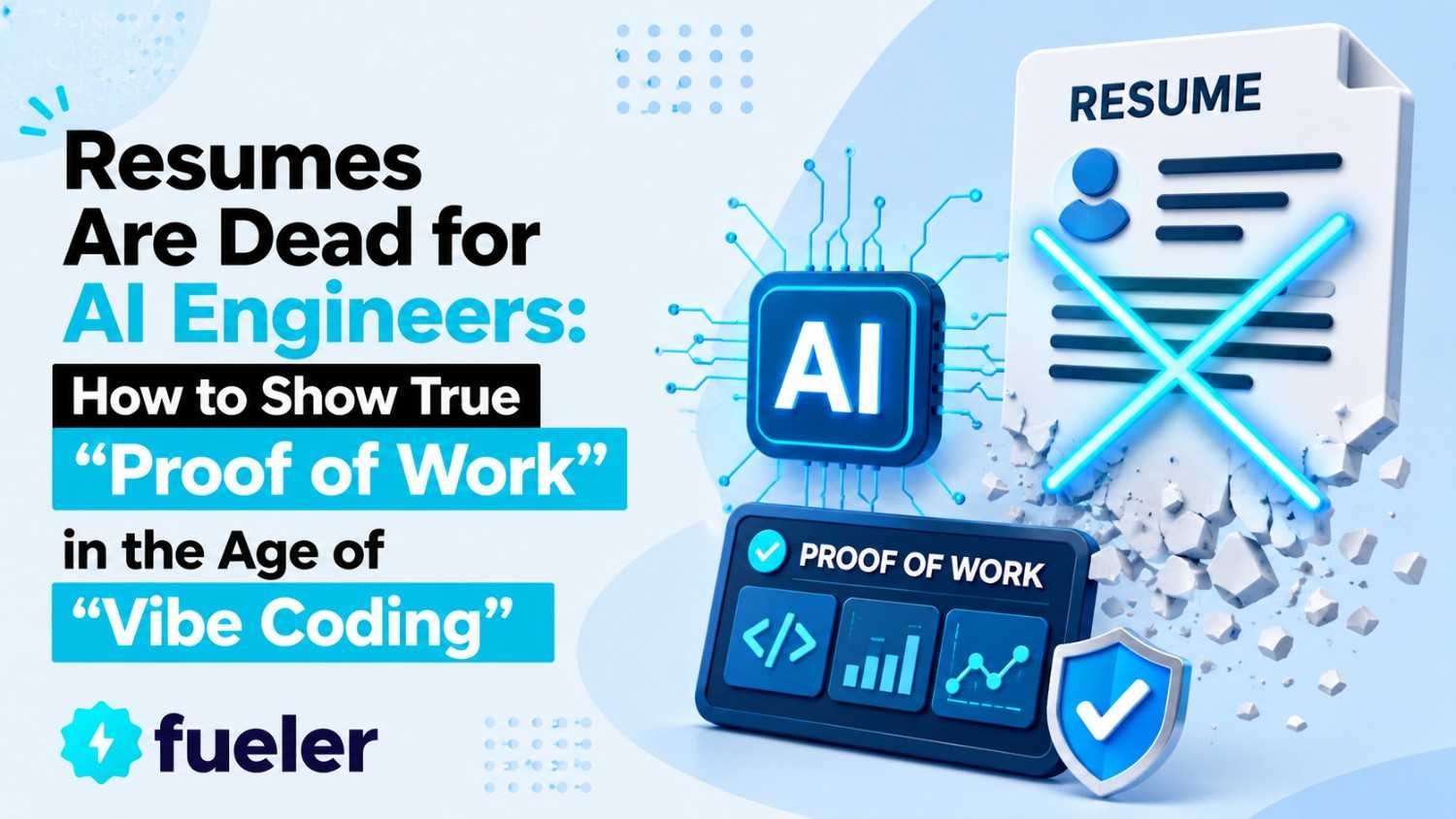
The era of the optimized resume has officially arrived. In 2026, any job seeker can use a large language model to polish their CV to perfection, sprinkle in high-demand buzzwords like “LangChain,” “RAG,” and “AI Agents,” and pass the initial ATS screens with ease.
But this has created a massive credibility gap in the tech industry. For hiring managers, traditional CVs are increasingly broken. Demos can look spectacular in a slide deck or sandbox, yet a staggering 95% of AI pilots fail to ever reach production. When unmanaged AI code generation is rolled out, companies quickly realize that writing code at machine speed without engineering discipline creates a nightmare of review overhead and fragile systems.
To survive and thrive in this shifting landscape, software engineers must stop relying on resume theater. To stand out, a portfolio needs to showcase tangible proof of engineering judgment, validation standards, and architectural control, not just an ability to copy and paste prompts.
The Rise of the “Vibe Coder”
The developer ecosystem is rapidly splitting into distinct tiers, and hiring managers are actively filtering out what the industry now calls the “Vibe Coder.”
Vibe Coders are developers who use AI tools heavily but treat them as a black box. They prompt, accept the suggestion, and ship. They operate without clear architectural specifications or written test coverage, relying on the model to do the thinking. While they can spin up an impressive prototype in an afternoon, their code often collapses under real production pressure, quietly accumulating massive technical debt.
AI Solutions Architects, or Applied AI Engineers, on the other hand, are builders who keep traditional engineering integrity intact while utilizing modern autonomy. They treat AI-generated code as a draft from a junior engineer, subjecting it to rigorous spec-first planning, automated verification, and deep validation.
This difference is highly measurable. A landmark METR study exposed a 19% perception gap where developers utilizing unmanaged AI tools believed they were 20% faster, but were objectively 19% slower because they spent their time sifting through poor suggestions, debugging silent model errors, and dealing with massive integration overhead.
To prove that an engineer is an AI Solutions Architect rather than a vibe coder, a portfolio needs to showcase a different category of “proof of work"
Redefining “Proof of Work” for AI-Native Engineers
For a portfolio to command immediate respect from risk-averse CTOs and engineering leaders, case studies should be structured around the four pillars of real-world production readiness.
1. Can You Specify? Spec-First Engineering
Most developers jump straight into their IDE and start prompting. This is a massive red flag. True AI-native engineering starts with planning. Before a single line of code is generated, a machine-readable, behavior-oriented architectural specification, such as a SPEC.md, should be produced.
In a portfolio: Showcase how system behaviors, API boundaries, and edge cases are mapped out before deploying an AI assistant. The goal is to prove that AI is being used to execute architectural intent rather than allowing the AI to decide the architecture.
2. Can You Navigate? Codebase Context Mastery
Any junior developer can generate a standalone script. But can an engineer safely refactor a legacy module inside a complex, 100,000+ line codebase without causing a cascade of silent failures?
In a portfolio: Document a case study where an existing system was refactored or modernized using agentic coding tools like Claude Code or Cursor. Explain how AI context window boundaries were managed, how cross-file dependency awareness was handled, and how AI outputs were validated with automated test harnesses.
3. Can You Architect? System and Cost Design
As autonomous systems scale, a major engineering bottleneck is token economics and latency. Running expensive, high-context frontier models for every simple classification task is an easy way to burn through a startup’s budget overnight.
In a portfolio: Share architectural patterns for multi-agent system design. Show how custom routing layers are built, how retrieval-augmented generation (RAG) is evaluated against long-context approaches, and how strict cost controls and circuit breakers are implemented to prevent loop traps.
4. Can You Govern? Incident Response & Safety
In production, AI failures are rarely loud. They are silent and probabilistic. If an agent hallucinates, runs into API timeouts, or executes an unauthorized database action, how does the system contain the blast radius?
In a portfolio: Detail governance strategies. Show how three-layer guardrails are implemented at the policy, workflow, and runtime levels, how secure sandboxed execution environments are designed, and how “human-in-the-loop” checkpoints are built for high-stakes database writes.
The New Standard of Engineering Portfolios
Resumes are no longer a reliable signal for hiring. The future of technical recruiting belongs to transparent, telemetry-driven verification of actual shipping habits.
At GoGloby, an Applied AI Engineering partner featured among the best AI consulting companies for enterprise teams, targeted outbound sourcing runs alongside a strict four-stage vetting funnel that tests candidates against these exact production standards. Of that highly curated outbound pipeline, only 4% clear the multi-layer assessment.
For engineers looking to capture the attention of high-caliber startups and scale-ups in 2026, the answer is no longer simply writing a better resume. Build a portfolio that publishes verifiable proof of engineering discipline, and let the actual work do the talking.
What should you do next?
You've read the article. Now turn your skills into proof of work and unlock more opportunities.
Build your proof of work portfolio
Create a clean portfolio with projects, assignments, resumes, and AI stack details that companies actually want to see.
Create your Fueler portfolio →Apply through assignments, not resumes
Stand out by solving real tasks from companies hiring on Fueler.
Explore assignments →Get discovered by companies
Make your work public and let recruiters discover your skills through actual projects instead of keywords.
Get discovered →
