Resume vs Proof of Work in 2026: What Recruiters Actually Trust

Riten Debnath
12 May, 2026
Last updated: May 2026
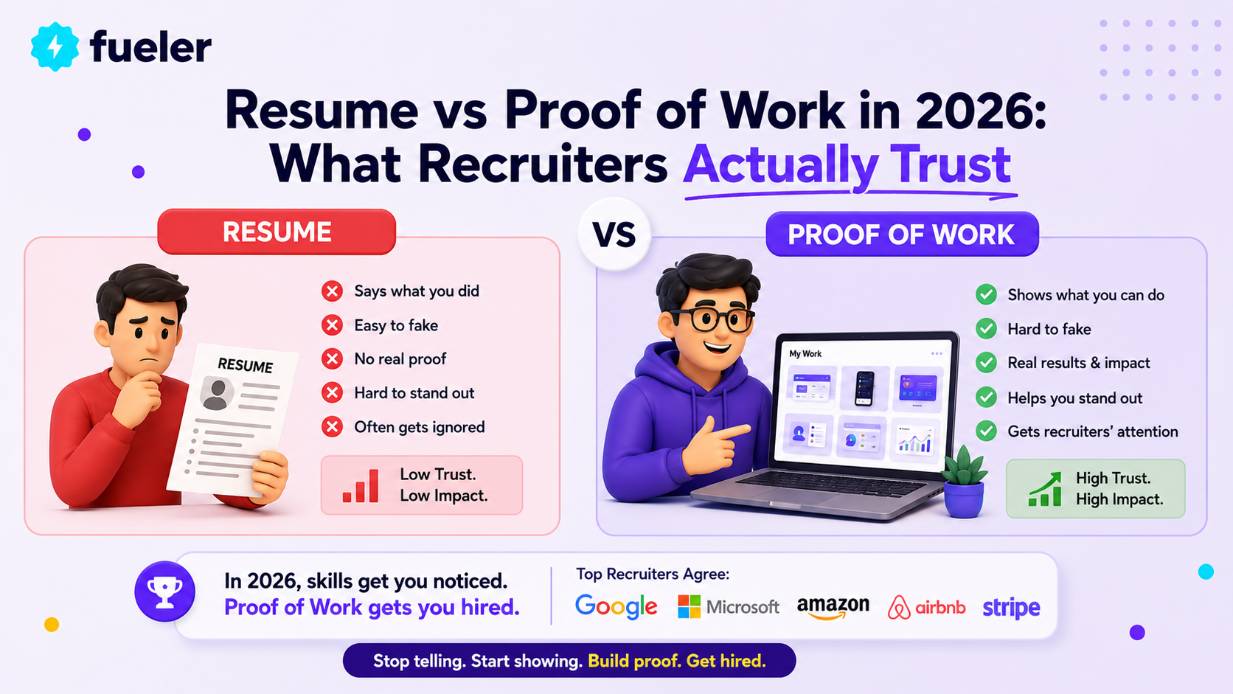
The job market has officially entered its "Show, Don't Tell" phase. If you are still relying on a two-page document filled with buzzwords like "passionate leader" or "critical thinker," you are essentially bringing a knife to a laser-tag fight. In 2026, recruiters are exhausted by polished, AI-generated resumes that all look the same. They are looking for evidence. They want to see the scars of a project, the logic in your spreadsheets, and the actual results of your marketing campaigns. The shift is permanent, and understanding this gap is the only way to stay employed.
I’m Riten, founder of Fueler, a skills-first portfolio platform that connects talented individuals with companies through assignments, portfolios, and projects, not just resumes/CVs. Think Dribbble/Behance for work samples + AngelList for hiring infrastructure.
The reality is that trust is at an all-time low. Companies are tired of hiring someone who "interviews well" but can't actually ship a project on day one. Proof of work solves this by acting as your 24/7 digital salesperson. Let's break down the 10 core reasons why the traditional resume is losing the war to proof-of-work portfolios.
1. Verification of Actual Skill vs Claimed Experience
A resume is essentially a list of claims that a recruiter has to take at face value until the interview stage. In 2026, companies no longer have the time or the budget to "bet" on someone who might be good. Proof of work allows a hiring manager to see your technical depth immediately without needing to call three previous bosses for a reference check.
- Instant Trust Building: When you show a live link or a detailed case study, you remove the doubt that usually exists during the initial screening process. It shifts the conversation from "Can you do this?" to "How did you do this specifically?", which is a much stronger position to be in for any candidate.
- Eliminating the AI Noise: Because anyone can use a chatbot to generate a perfect-looking resume today, these documents have lost their signaling power. A project, however, requires a level of personal touch and specific logic that is much harder to fake or automate without having actual, deep-seated professional knowledge.
- Focusing on Output Over Input: Resumes focus on where you went to school or how many years you sat in a chair at a specific company. Proof of work focuses entirely on what you produced during that time, which is the only thing that actually moves the financial needle for a business.
- Demonstrating Problem-Solving Skills: A project shows how you handle obstacles, whereas a resume just shows the final, polished title you held. By sharing your "work in progress" or the challenges you faced during an assignment, you prove that you can think critically under real-world pressure and tight deadlines.
- Reducing Hiring Bias: When recruiters look at a portfolio of work, they are forced to judge the quality of the output rather than the pedigree of the candidate. This levels the playing field for self-taught professionals who have incredible skills but might lack a fancy degree or a big-name past employer.
2. The Shift From Tenure to Project Impact
The old way of hiring cared about how many years you spent at a company, but in 2026, tenure is often seen as a vanity metric. Recruiters now care about the intensity and impact of the projects you handled. Someone with two years of high-impact project work is often more valuable than someone who spent ten years doing the bare minimum.
- Quantifiable Success Metrics: Proof of work allows you to attach real data to your skills, such as "increased conversion by 20%" or "reduced server costs by $5k." These numbers provide a concrete foundation for your value proposition that a simple job description on a resume simply cannot match.
- Adaptability Evidence: By showcasing a variety of projects, you prove that you can adapt to different industries or tech stacks quickly. This is vital in 2026 because the tools we use are changing every few months, making "long-term experience" in a single tool much less relevant.
- Active Learning Documentation: A project-based approach shows that you are constantly building and shipping things, which signals a growth mindset. Recruiters love seeing that you have taken the initiative to learn a new skill and immediately applied it to a real-world scenario without being prompted.
- Clarity of Role Contribution: In a resume, people often take credit for team wins without explaining their specific part. Proof of work requires you to break down exactly what you did, ensuring the recruiter knows your specific strengths and how you fit into a larger team structure or workflow.
- Shorter Feedback Loops: When a recruiter can see your work immediately, the hiring process moves much faster. Instead of waiting for multiple rounds of technical tests, your portfolio acts as a "pre-test" that proves you have the chops before the very first phone call even happens.
3. Real-World Assignment Performance Over Interview Prep
Most people are great at practicing for interviews but terrible at actually doing the job. Recruiters in 2026 have caught on to this, which is why they trust "work samples" over "interview answers." If you can complete a sample assignment effectively, it is a much better predictor of job success than your ability to answer generic questions.
- Predictive Hiring Accuracy: Data shows that work sample tests are one of the most effective ways to predict how someone will actually perform on the job. By providing proof of work upfront, you are giving the recruiter the highest level of confidence possible in your future performance.
- Reduced Training Time: When a company sees you have already done similar work, they know they won't have to spend months training you on the basics. This makes you a "plug-and-play" hire, which is extremely attractive for fast-growing startups and high-performance corporate teams today.
- Cultural and Technical Alignment: A work sample shows how you document your code, how you structure your writing, or how you design a layout. This gives the hiring team a clear look at your "style," ensuring that you will fit into their existing internal workflows seamlessly.
- Confidence in Remote Environments: For remote or hybrid roles, trust is the most important factor. Showing that you can take a brief, work independently, and ship a high-quality project proves that you don't need a manager hovering over your shoulder to get things done on time.
- Eliminating the "Junior" Label: Many talented people are stuck in junior roles because their resume lacks years of experience. High-quality proof of work allows you to skip the line by proving you have senior-level skills regardless of what your previous official job title might have said.
4. The Power of Public Accountability
Resumes are private documents, but proof of work is often public. When you put your work out there for the world to see, it carries a different level of weight. It shows you are willing to stand by your results and that you have a reputation to maintain in your specific industry.
- Building a Professional Brand: Every project you publish adds to your online footprint. In 2026, recruiters are searching for candidates who are "known" for something specific. A public portfolio makes you discoverable to companies that aren't even posting job ads yet, creating passive opportunities for you.
- Social Proof and Recommendations: Public work often attracts comments, likes, or shares from other professionals. This acts as a form of "social proof" that a resume can't replicate. When a recruiter sees that other experts in the field respect your work, your credibility skyrockets instantly.
- Proof of Consistency: A resume is a snapshot, but a portfolio is a timeline. Showing that you have been shipping work consistently over months or years proves that you have the discipline and the stamina required for high-level professional roles in any competitive market.
- Open Source Contributions: For technical roles, contributing to public repositories is the ultimate proof of work. It shows you can collaborate with strangers, follow coding standards, and contribute to something larger than yourself, which is exactly what happens in a real corporate engineering team.
- Visibility to Decision Makers: Sometimes, the person who hires you isn't a recruiter but a CEO or a Product Manager who stumbled upon your work online. Public proof of work bypasses the traditional "gatekeepers" and puts your talent directly in front of the people who make the final decisions.
5. Depth of Documentation and Process Transparency
A resume only shows the "what," but proof of work shows the "how." In 2026, recruiters care deeply about your thought process. They want to know why you made a specific decision, how you handled a failure, and how you iterated on an idea to make it better.
- Showing the "Messy Middle": Great portfolios include sketches, wireframes, or early drafts. This transparency shows that you understand that work is a process, not just a final product. It proves you can handle feedback and refine your ideas until they are actually ready for the market.
- Evidence of Strategic Thinking: By writing a short case study for each project, you explain the "why" behind your actions. This demonstrates that you aren't just a "doer" who follows instructions, but a strategic thinker who understands the business goals behind the tasks you are assigned.
- Tool Mastery in Context: Anyone can list "Python" or "Figma" on a resume. Proof of work shows how you actually use those tools to solve specific problems. It provides a context that proves your level of mastery is practical rather than just theoretical or academic.
- Clear Communication Skills: The way you describe your work samples is a test of your communication skills. If you can explain a complex technical project in simple terms, you prove that you can work effectively with non-technical stakeholders, which is a massive plus for any role.
- Handling Project Constraints: Every real project has constraints like budget, time, or technical limitations. Discussing these in your proof of work shows recruiters that you are grounded in reality and can deliver high-quality results even when the conditions are not perfect or ideal.
6. Avoiding the "Keyword Optimization" Trap
Job seekers spend hours trying to hack Applicant Tracking Systems (ATS) by stuffing resumes with keywords. In 2026, recruiters are looking past the keywords to see the substance. Proof of work doesn't need to be "optimized" for a bot because its value is obvious to a human being.
- Focusing on Quality Over Quantity: Instead of sending out 100 generic resumes, you can send five highly relevant project links. This high-touch approach shows you are actually interested in the specific role, rather than just blasting out applications to see what sticks in the system.
- Human-to-Human Connection: A portfolio tells a story about who you are as a professional. It has a personality that a resume lacks. When a recruiter looks at your work, they feel like they are getting to know you, which builds an emotional connection before the first interview.
- Contextual Keyword Relevance: Keywords in a project description feel natural because they are tied to real actions. "Managed a $10k ad spend" is much more powerful than just listing "Digital Marketing" as a skill. The context makes the keyword believable and much more impactful.
- Demonstrating Niche Expertise: If you want to work in a specific niche like Fintech or Edtech, your proof of work can reflect that perfectly. You can build projects that specifically target the problems those companies face, making you the most obvious and logical choice for the job.
- Standing Out from the "Templates": Most resumes look like they came from the same five Canva templates. A custom portfolio or a well-curated project list shows a level of effort and creativity that automatically puts you in the top 1% of applicants for any competitive position.
7. The Role of Micro-Credentials and Proof
In the past, a degree was the only credential that mattered. Today, micro-credentials and completed assignments are the new standards. Recruiters trust a verified project from a reputable platform more than a degree from ten years ago because it proves your skills are current and relevant.
- Up-to-Date Technical Skills: Proof of work shows what you can do right now. In a world where software updates every week, showing a project you finished last month is much more valuable than showing a certification you earned three or four years ago.
- Validation from Peers: Many portfolio platforms allow for peer reviews or endorsements on specific projects. This decentralized validation is a powerful signal to recruiters that you are respected within your community and that your work meets a high standard of quality.
- Supplementing Formal Education: For those with a degree, proof of work acts as the "bridge" between theory and practice. It shows that you didn't just pass your exams, but you actually know how to apply that knowledge to create value in a professional corporate environment.
- Stacking Small Wins: You don't need one massive project to impress a recruiter. A collection of "micro-proofs"small, well-executed tasks or assignments can be just as effective at proving your consistency, attention to detail, and overall reliability as a professional hire.
- Global Recognition: Proof of work doesn't care where you are located. A recruiter in New York can judge the work of a designer in Bangalore purely on the quality of their portfolio. This global accessibility is what makes the project-based economy so powerful for everyone.
8. Resilience Against Career Gaps
Resumes make career gaps look like a red flag. Proof of work changes the narrative. If you took a year off but spent that time building a side project or learning a new skill, your portfolio will show the growth you achieved during that time, turning a "gap" into a "growth phase."
- Narrative Control: You get to decide how to present your time. Instead of explaining why you weren't "employed," you can show what you were "building." This shifts the focus from your employment status to your productivity and your constant desire to improve your craft.
- Maintaining Skill Sharpness: A career gap often scares recruiters because they think your skills have gone stale. Showing fresh projects completed during that gap proves that you have stayed sharp and are ready to hit the ground running without any "re-learning" phase.
- Showing Entrepreneurial Spirit: If you spent your gap year trying to start a business or a freelance career, those projects are incredible proof of work. They show initiative, risk-taking, and a business-first mindset that most "safe" employees simply do not possess.
- Focusing on Competence Over Timeline: In 2026, the timeline of your career is less important than the trajectory of your skills. Proof of work allows you to showcase your most recent and most impressive work first, regardless of when it happened or what your official status was.
- Evidence of Self-Motivation: Taking the time to build something without a boss telling you to do it is the ultimate sign of a self-motivated employee. Recruiters love people who don't need a structured environment to stay productive and focused on their professional goals.
9. Enhancing Cultural and Mindset Fit
Recruiters are looking for people who "get it." The way you present your work, the tone of your case studies, and the types of problems you choose to solve tell a recruiter a lot about your professional mindset and whether you will fit their company culture.
- Demonstrating Aesthetic and Style: For creative or front-end roles, your style is your identity. A resume can't show your taste, but a portfolio can. This ensures that you are hired by companies that actually appreciate your specific creative vision and professional style.
- Evidence of "Work Ethic": High-quality, detailed proof of work doesn't happen by accident. It requires a lot of "behind-the-scenes" effort. When a recruiter sees the depth of your portfolio, they are seeing your work ethic in action, which is something a resume can only claim in words.
- Alignment with Company Missions: You can tailor your proof of work to reflect the values of the companies you want to work for. If you want to work for a sustainability-focused company, showing projects in that space proves that your personal interests align with their corporate mission.
- Proving Collaborative Ability: Including projects where you worked with a team and clearly labeling your contributions/shows that you are a team player. You can document how you handed off designs or how you reviewed a teammate's code, proving you are a "culture add" rather than just a "culture fit."
- Showing Long-Term Commitment: A portfolio that has been updated over several years shows that you are committed to your career for the long haul. It proves that your profession isn't just a job for you, but a craft that you are dedicated to mastering over time.
10. Future-Proofing Your Career in a Changing Economy
The job market is no longer stable, and "job security" is a myth. The only real security you have is your ability to prove your value to the next person who might hire you. Proof of work is the ultimate insurance policy for your career in a volatile, AI-driven world.
- Portability of Your Reputation: Your resume belongs to the companies you worked for, but your proof of work belongs to you. If you get laid off, you take your portfolio with you. You aren't starting from scratch; you are starting with a library of evidence that proves your worth.
- Attracting High-Value Freelance Gigs: If the full-time job market slows down, a strong portfolio allows you to pivot to high-paying freelance or contract work instantly. Clients in the freelance world care 100% about proof of work and 0% about your resume or your college degree.
- Higher Negotiating Power: When you have a portfolio that proves you can solve a $100k problem, it is very easy to ask for a $150k salary. You aren't guessing about your value; you are showing them exactly what you have done for others and what you will do for them.
- Easier Career Pivots: If you want to change careers, you don't need a new degree; you need a new project. Building a few high-quality projects in a new field is the fastest way to prove you can do the work, allowing you to switch industries without taking a massive pay cut.
- Long-Term Asset Accumulation: Think of every project as a stock that pays dividends. Over time, your accumulated proof of work builds a "compounding interest" effect on your reputation, making it easier and easier to get hired as you get older and your portfolio gets deeper.
How does this connect to Building a Strong Career or Portfolio?
Building a career is no longer about climbing a ladder; it is about building a library. Every project you finish is a brick in the wall of your professional reputation. When you focus on proof of work, you are creating assets that work for you while you sleep. A resume is a static document you only send out when you are desperate, but a portfolio is a living ecosystem that attracts opportunities to you organically.
By consistently documenting your work and showcasing it in a structured way, you transition from being a "job seeker" to a "sought-after expert." This shifts the power dynamic in your favor. Instead of begging for an interview, you are presenting a gallery of solutions. This is the ultimate form of career security because even if a company goes under, your proof of work remains yours forever. It gives you the freedom to choose who you work with and what you work on.
Why Fueler is the Best Way to Showcase Your Proof of Work?
Fueler is built specifically for this new era of hiring. It allows you to organize your best work into a clean, professional portfolio that focuses on what you’ve built rather than where you’ve worked. Whether it is a marketing campaign, a piece of code, or a design project, Fueler helps you present the context, the process, and the results in a way that recruiters actually trust and understand. It’s the platform that bridges the gap between your skills and your next big opportunity without the fluff of a traditional CV.
Final Thoughts
The transition from resumes to proof of work is the most significant change in the hiring world in the last fifty years. In 2026, your "reputation" is simply the sum of the projects you have made public. Stop trying to optimize your resume keywords and start spending that time building something real. When you have a portfolio full of high-quality work, you don't need to "sell" yourself anymore, the work does the selling for you. It’s time to stop talking about what you can do and start showing it.
FAQs
What is the difference between a resume and proof of work?
A resume is a summary of your work history and education, while proof of work is a collection of actual projects and assignments you have completed. Resumes tell a story, but proof of work provides the evidence that the story is actually true and verifiable by any recruiter or hiring manager.
Why are recruiters ignoring resumes in 2026?
Recruiters are overwhelmed by AI-generated content that makes every candidate look perfect on paper. To cut through the noise, they are prioritizing candidates who can show live examples of their skills, as this is much harder to fake than a standard list of bullet points on a PDF document.
How do I start building proof of work if I have no experience?
You don't need a job to create proof of work. You can do "ghost projects" for brands you like, contribute to open-source software, or complete practice assignments found online. The goal is to show how you solve problems, regardless of whether you were officially paid to do it at the time.
Is a portfolio only for designers and developers?
No, proof of work is essential for writers, marketers, project managers, and even HR professionals. Any role that produces an output, whether it is a strategy document, a spreadsheet, or a content plan, can and should be documented in a professional portfolio to prove your professional value.
Can proof of work help me get a higher salary?
Yes, because it reduces the risk for the employer significantly. When you prove you can deliver results before you are even hired, you have much more leverage during salary negotiations. You are no longer an "unknown variable," you are a proven asset with a clear and trackable record of success.
What is Fueler Portfolio?
Fueler is a career portfolio platform that helps companies find the best talent for their organization based on their proof of work. You can create your portfolio on Fueler. Thousands of freelancers around the world use Fueler to create their professional-looking portfolios and become financially independent. Discover inspiration for your portfolio
Sign up for free on Fueler or get in touch to learn more.

What should you do next?
You've read the article. Now turn your skills into proof of work and unlock more opportunities.
Build your proof of work portfolio
Create a clean portfolio with projects, assignments, resumes, and AI stack details that companies actually want to see.
Create your Fueler portfolio →Apply through assignments, not resumes
Stand out by solving real tasks from companies hiring on Fueler.
Explore assignments →Get discovered by companies
Make your work public and let recruiters discover your skills through actual projects instead of keywords.
Get discovered →
