60+ Remote Work Statistics in 2026 (Global Data)

Riten Debnath
10 May, 2026
Last updated: May 2026
The transition to remote and hybrid work was once labeled a "grand experiment." In 2026, the results are in: the experiment is over, and the new era of work has officially stabilized. What we are seeing today is no longer a temporary adjustment to a crisis, but a fundamental restructuring of the global labor market.
I’m Riten, founder of Fueler, a skills-first portfolio platform that connects talented individuals with companies through assignments, portfolios, and projects, not just resumes/CVs. Think Dribbble/Behance for work samples + AngelList for hiring infrastructure.
From the rapid integration of agentic AI into daily workflows to the sophisticated shift toward "structured flexibility," the landscape of 2026 is data-driven and increasingly decentralized. For business leaders and professionals, understanding these shifts is the difference between thriving in a global talent pool or struggling with a rigid, legacy mindset.
1. The Global Equilibrium: Hybrid and Remote Stability
The "Great Return" mandates of previous years have largely plateaued, leading to a stabilized workforce distribution. In 2026, the data confirms that flexibility is no longer a perk but a structural requirement for knowledge-based industries.
- 52% of remote-capable U.S. employees currently work in a hybrid environment as of February 2026, representing a massive shift from 18% in 2020 and establishing the "split-week" as the definitive standard for modern professional life.
- 26% of the knowledge workforce remains exclusively remote in 2026, a figure that has remained remarkably resilient over the last 24 months despite significant corporate pressure from traditional sectors to return to physical office spaces.
- 22% of workers in remote-capable roles are working entirely on-site in 2026, which indicates that nearly four out of five employees with the capacity to work off-site are utilizing flexibility to manage their responsibilities.
- 83% of global employees across all demographics report a distinct preference for hybrid work schedules over any other model, citing the ability to balance collaborative in-person sessions with the deep focus time of home.
- 1.4 days per week is the current global average for working from home across 35 surveyed countries, showing a standardized international movement toward a "balanced" philosophy in most developed economies.
- 40% of office workers state they would likely quit or begin an active job search immediately if their current flexibility was removed, highlighting that remote options have become a non-negotiable benefit for top talent.
- 98% of workers expressed a desire to work remotely at least some of the time for the rest of their careers, a statistic that has remained virtually unchanged since the initial global shift in 2020.
- 40% of global job postings now explicitly offer some form of remote flexibility, proving that companies are using geographical freedom as a primary competitive advantage in a tight and specialized global labor market.
Trends and Implications: This data reflects a "settling" of the labor market. While the total number of fully remote roles has decreased slightly from the 2021 peak, the hybrid model has absorbed the majority of the workforce. Companies have moved away from "work from anywhere" to "structured flexibility," where specific days in the office are mandated to ensure collaborative synchronicity and cultural cohesion.
2. Real Estate and the Urban Transformation
The shift in work has fundamentally altered the "Center of Gravity" in major cities. 2026 sees the continued "office-to-residential" conversion trend as urban centers redefine their purpose for a post-commuter world.
- 1 billion square feet of office space in the United States is currently estimated to be vacant or underutilized in 2026, leading to a significant decline in commercial property valuations in once-booming urban hubs.
- 25% of all office leases set to expire in 2026 are expected not to be renewed, as companies continue to consolidate their physical footprints into smaller, high-end "collaboration hubs" used only for specific meetings.
- 15% of urban office buildings in the U.S. are currently undergoing or being evaluated for conversion into residential units, as cities attempt to solve housing shortages and revitalize quiet downtown corridors.
- A 30% increase in "Zoom Towns"in smaller, high-amenity rural or suburban areas has been recorded as remote workers migrate away from expensive cities in search of a lower cost of living and better quality of life.
- 73% of companies now require some form of office attendance, averaging three days per week, but the purpose of that attendance has shifted from "work" to "social and cultural integration."
- 45% of commercial real estate investors have pivoted their portfolios toward industrial and data center properties, moving away from traditional office space as the "safe" investment of the past 50 years.
- 75% of companies with fewer than 500 employees offer remote or flexible work options, compared to much lower rates in massive legacy corporations, allowing SMEs to gain a competitive edge in the urban talent wars.
- 18.6% CAGR for cloud deployment in the workplace market validates the consensus that the "office" is now a digital destination rather than a physical one for the majority of the global knowledge workforce.
Industry Changes: The "Central Business District" is being replaced by the "Social Hub." Cities that are thriving in 2026 are those that have stopped trying to bring workers back and instead started making downtown places where people want to live. The death of the office cubicle is the birth of more vibrant, mixed-use urban environments.
3. Productivity Metrics and Performance Reality
The long-standing skepticism among managers regarding remote output is fading as longitudinal studies provide concrete evidence that remote work does not hinder and often helpstotal output.
- A 13% productivity increase among remote workers has been consistently observed in long-term performance studies, primarily driven by fewer office distractions, shorter breaks, and a significant reduction in the total number of sick days taken.
- 77% of part-time remote workers report they are significantly more productive when working from home, with 52% of all hybrid employees specifically citing "higher productivity" as a primary advantage of their current arrangement.
- 4.4% increase in total output was noted by the National Bureau of Economic Research (NBER) for firms that transitioned to remote-friendly models, largely due to the "reclaimed time" workers spend on tasks rather than commuting.
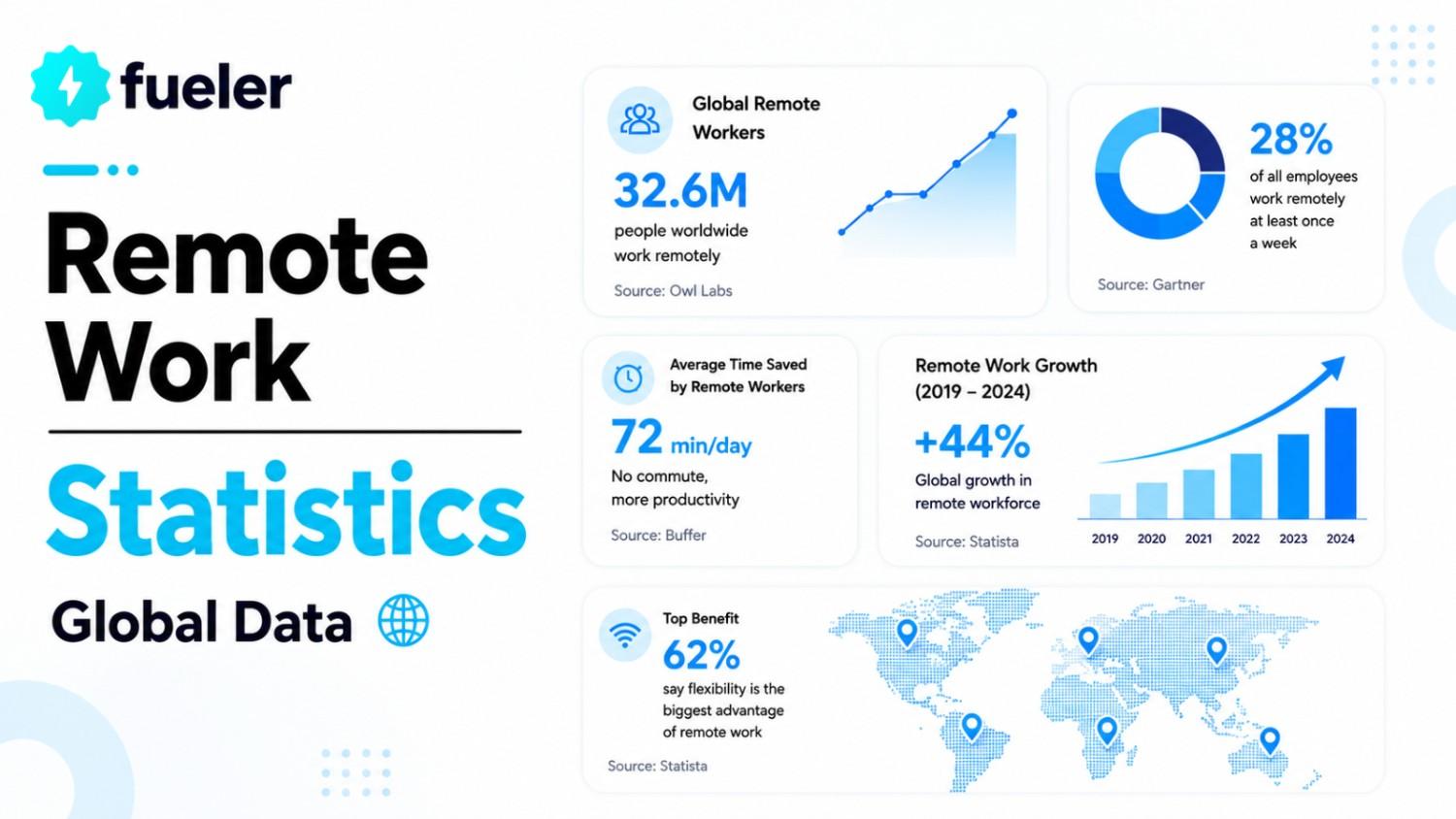
- 72 minutes per day is the average amount of time saved by remote workers by eliminating their commute, with data showing that approximately 40% of that saved time is reinvested back into work.
- 35% increase in workflow efficiency is reported by companies that have centralized their tasks into modern project management platforms, effectively bridging the communication gap created by physical distance through transparent, asynchronous documentation.
- 85% of leaders still report struggling to trust employee productivity in hybrid setups, a phenomenon known as "productivity paranoia" that continues to drive the adoption of invasive and often counter-productive monitoring software.
- 88% of remote employees feel an intense need to prove they are being productive, leading 64% of workers to keep their chat status "green" even when they are not actively working to avoid negative perceptions.
- 14 times less likely to disengage are employees who have the option of working in their preferred location, which directly translates to higher quality work and fewer errors compared to those forced into rigid schedules.
Consumer Behavior: Productivity in 2026 is measured by outcomes rather than hours spent at a desk. The "reclaimed commute time" has become a dual benefit, providing employees with better work-life balance while simultaneously providing employers with additional high-focus hours. Companies that struggle with remote productivity usually lack the proper asynchronous communication infrastructure.
4. Well-being, Mental Health, and Demographic Shifts
The human element of remote work has become a primary focus for HR departments. While the benefits to work-life balance are clear, 2026 data shows that isolation remains a hurdle that requires intentional management.
- 82% of professionals report better mental health when working remotely, with women showing even higher rates of improvement at 84% compared to 77% for men, often due to better management of domestic responsibilities.
- 71% of remote workers report they feel more balanced and satisfied with their lives, citing better sleep, improved nutrition, and more time for physical exercise as the primary drivers of their improved daily well-being.
- 25% lower stress levels are reported by employees who have the autonomy to choose their workspace, demonstrating a direct correlation between personal agency and mental health in the modern corporate environment of 2026.
- 23% of remote workers identify "loneliness" or "isolation" as their biggest struggle, highlighting that while the model is efficient, it requires companies to invest in intentional social interactions and regular in-person team retreats.
- 20% of Gen Z workers experience high-frequency loneliness (at least once or twice a week), which is double the rate reported by Millennials, suggesting that younger workers need more intentional mentorship and social integration.
- 57% of hybrid workers report experiencing burnout, which is slightly lower than the 61% reported by fully remote employees, indicating that occasional office presence can provide a necessary mental "reset" and social boost.
- 38% of Gen Z employees report emotional exhaustion and motivation dips, the highest rate of any generation, largely because they find it harder to "log out" mentally and digitally at the end of the day.
- 81% of parents working remotely say the arrangement has significantly improved their ability to manage childcare responsibilities, which has been a major factor in keeping women in the workforce at record-high levels.
Industry Changes: Mental health is the new frontier of the remote work era. Organizations are finding that while remote work solves the "stress of the commute," it can introduce "stress of isolation." Success in 2026 requires a proactive approach to community-building, ensuring that decentralized workers still feel connected to a larger corporate mission.
5. Technology Adoption and the AI Integration Shift
In 2026, remote work is inextricably linked with Artificial Intelligence. The tools used to collaborate have evolved from simple video calling to intelligent, agent-driven environments that handle administrative burdens.
- 92% of remote teams now use AI-powered collaboration tools to summarize meetings, manage calendars, and automate routine documentation, saving an average of 6 hours of administrative "work about work" per employee every week.
- 64% of organizations are now actively assessing the security and ethics of their AI tools in 2026, a massive jump from 37% in 2025 as AI moves from a novelty to a core infrastructure component.
- 67% of IT leaders have increased their cybersecurity budgets specifically to protect distributed networks, as the rise of remote work has expanded the "attack surface" of the average global corporation beyond the traditional firewall.
- 85% of enterprises have now implemented a "Zero Trust" security model, which assumes that no device or user is inherently safe, regardless of whether they are inside or outside the physical corporate office network.
- 80% of businesses have adopted cloud-first strategies for their entire tech stack, ensuring that every tool in the company is accessible from any location without the need for cumbersome VPNs or legacy hardware.
- 58% of global organizations have implemented "Asynchronous-First" policies, utilizing recorded video updates and documentation hubs to reduce the number of live meetings and combat the growing issue of "Zoom fatigue."
- 94% of security professionals identify AI as the most significant driver of change in cybersecurity for 2026, as AI is used both to defend systems and to create more sophisticated, automated phishing attacks.
- A 17% increase in disclosed vulnerabilities was recorded last year, totaling over 30,000 cases, highlighting the rising risks as more employees access sensitive systems from home or public networks without enterprise-grade security.
Future Opportunities: The "tech stack" of 2026 is designed to disappear. AI has become the silent partner in remote work, handling routine tasks so that humans can focus on high-value creative work. This shift is allowing smaller, distributed teams to compete with massive enterprises by leveraging automation to scale their impact globally.
6. Economic Gains and Operational Cost Savings
The financial narrative of 2026 is centered on organizational agility. Businesses are successfully trading fixed capital expenses for variable subscription costs and realizing gains through improved employee retention and reduced overhead.
- $11,000 per year is the average amount an employer saves for every half-time remote worker in 2026 when accounting for reduced real estate costs, lower absenteeism, decreased turnover, and significantly improved employee productivity rates.
- A 33% drop in employee resignations was recorded by Stanford researchers when workers shifted from full-time office attendance to a hybrid schedule, proving that flexibility is currently the most powerful tool for reducing recruitment costs.
- $46.94 Billion is the estimated global market size for remote workplace services in 2026, reflecting a massive investment in the digital infrastructure required to manage decentralized and distributed global teams across various time zones.
- 10% to 50% savings on office space costs are being realized by mid-to-large enterprises implementing aggressive hybrid policies, as they downsize physical footprints and optimize square footage for collaborative meetings rather than individual desks.
- 26.5% Compound Annual Growth Rate (CAGR) is the projected growth rate for remote work technology through 2031, suggesting that the industry is still in a heavy expansion phase as tools for virtual collaboration become immersive.
- $19,000 per year is the average savings reported by fully remote companies per employee, as they completely eliminate the need for commercial leases, utility payments, and on-site facility management teams in high-cost urban centers.
- 70.3% of the remote services market is currently held by large enterprises, though SMEs are the fastest-growing segment as they adopt cloud-based "office-in-a-box" solutions to compete with much larger, established global corporations.
- 11.7% CAGR for SMEs in the remote work sector indicates that smaller businesses are closing the maturity gap by utilizing scalable SaaS bundles that provide professional-grade infrastructure without the need for massive up-front capital.
Business Impact: By leveraging decentralized work, organizations are not only cutting costs but also reinvesting those funds into digital transformation. The focus has shifted from "where" people work to "how" they are supported. Leading firms are prioritizing digital employee experience (DEX) as a core pillar of their 2026 financial strategies to maintain an edge in a globalized economy.
7. Cybersecurity Risks and the Zero-Trust Era
As the workforce has moved home, the risks have followed. 2026 is the year of identity-first security, as businesses scramble to protect sensitive data across millions of residential internet connections.
- $10.5 Trillion is the projected annual cost of cybercrime globally by 2026, with a significant portion of attacks targeting the vulnerabilities inherent in remote and home-based network configurations and personal devices.
- 87% of survey respondents identified AI-related vulnerabilities, such as deepfake audio and automated phishing, as the fastest-growing cyber risk they have faced over the course of the last 12 months.
- 31% of organizations report low confidence in their nation's ability to respond to major cyber incidents, a 5% increase from the previous year as the complexity of distributed network attacks continues to outpace regulation.
- 32% of CEOs now rate "cyber-enabled fraud" as their top concern, shifting focus away from traditional ransomware toward more sophisticated identity deception and social engineering attacks targeting remote staff.
- 64% of organizations are accounting for geopolitically motivated cyberattacks in their 2026 budgets, recognizing that remote infrastructure is a prime target for disruption of critical business and national services.
- 23% of public-sector organizations report having "insufficient" cyber-resilience capabilities, making them the most vulnerable segment as they struggle to compete with the private sector for high-priced cybersecurity talent.
- 86% of fully remote employees report experiencing burnout at least once a year, and tired employees are significantly more likely to click on phishing links or bypass security protocols to save time.
- 3x less likely to suffer a breach are companies that have adopted "Continuous Threat Exposure Management," a proactive security model that moves beyond periodic scanning to real-time, identity-based monitoring.
Consumer Behavior: Security is no longer the responsibility of the IT department alone; it is a core competency for every remote employee. In 2026, "Human Risk Management" will become as important as technical firewalls. Companies are realizing that the greatest vulnerability in a remote setup is the behavior of the person using the device.
8. Recruitment, Talent Acquisition, and Diversity
The geographical boundaries of the talent market have effectively dissolved. In 2026, companies are no longer hiring based on who is within a 30-mile radius, but who is the best fit for the role globally.
- A 340% larger candidate pool is accessed by organizations that offer fully remote roles compared to those restricted to local hiring, allowing for much higher specialization in technical and creative positions.
- 76% greater retention is reported by companies that offer flexible work arrangements, as employees are less likely to leave a role that integrates seamlessly with their established lifestyle and personal responsibilities.
- 62% of Gen Z workers rank "flexibility" as their top priority when evaluating a potential employer, frequently placing it above salary in sectors like software development, digital marketing, and data science.
- 37% of employees would accept a 10% pay cut specifically to maintain their work-from-home option, illustrating that flexibility has a concrete "cash value" in the eyes of the modern global workforce.
- An 18% increase in workforce diversity has been seen in firms that hire remotely, as they are able to reach candidates from varied socioeconomic backgrounds and geographic locations that were previously inaccessible.
- 70% of job seekers now specifically use filters for "Remote" or "Hybrid" on major job boards, making on-site roles increasingly difficult to fill without offering significant "on-site" salary premiums or bonuses.
- 38% of men will work remotely full-time in 2026, compared to 30% of women, though women are more likely to seek out hybrid roles that offer localized support networks for family care.
- 86% of CEOs plan to reward employees who come into the office with favorable assignments, raises, or promotions, creating a "proximity bias" that many HR experts warn could undermine diversity and inclusion efforts.
Trends and Implications: The power dynamic has shifted toward the employee. In a globalized market, companies that insist on on-site presence are finding themselves paying a "locality tax"higher salaries for a smaller, often less-qualified talent pool. The most successful recruiters in 2026 are those who sell "lifestyle integration" alongside professional growth.
Final Thoughts
As we cross the midpoint of 2026, the data confirms that remote work has moved past the era of debate and into the era of refinement. The most successful organizations are no longer trying to recreate the legacy office experience; instead, they are leveraging "structured flexibility" to drive a more inclusive, cost-effective, and highly productive global economy.
The focus has officially shifted from where we work to how well we collaborate across digital and physical boundaries. Whether it’s through AI-driven efficiency or the revitalization of urban centers into social hubs, the decentralized workforce is the new baseline for innovation. For businesses and professionals alike, the message is clear: flexibility is no longer a permit and is the primary competitive advantage for the future of work.
FAQs
Is remote work still as productive as in-office work in 2026?
Yes. Comprehensive data from 2026 shows a 13% increase in productivity for remote workers, primarily driven by fewer office distractions and the reinvestment of commute time into actual work tasks.
What is the most popular work model today?
The hybrid model is the dominant standard. Currently, 52% of remote-capable employees work in a hybrid arrangement, mixing home and office time to balance focus and collaboration.
Are companies actually saving money with remote work?
Significantly. On average, an employer saves $11,000 per year for every half-time remote worker through reduced real estate costs, lower absenteeism, and higher employee retention.
What is the biggest challenge for remote workers in 2026?
While satisfaction is high, 23% of remote workers cite loneliness and isolation as their primary struggle, with younger Gen Z workers being twice as likely to feel isolated as their older colleagues.
How has AI affected remote work?
AI has automated the "administrative load." In 2026, 92% of teams use AI tools to manage meetings and documentation, saving hours of work each week and making asynchronous collaboration more effective than ever.
What is Fueler Portfolio?
Fueler is a career portfolio platform that helps companies find the best talent for their organization based on their proof of work. You can create your portfolio on Fueler. Thousands of freelancers around the world use Fueler to create their professional-looking portfolios and become financially independent. Discover inspiration for your portfolio
Sign up for free on Fueler or get in touch to learn more.

What should you do next?
You've read the article. Now turn your skills into proof of work and unlock more opportunities.
Build your proof of work portfolio
Create a clean portfolio with projects, assignments, resumes, and AI stack details that companies actually want to see.
Create your Fueler portfolio →Apply through assignments, not resumes
Stand out by solving real tasks from companies hiring on Fueler.
Explore assignments →Get discovered by companies
Make your work public and let recruiters discover your skills through actual projects instead of keywords.
Get discovered →
