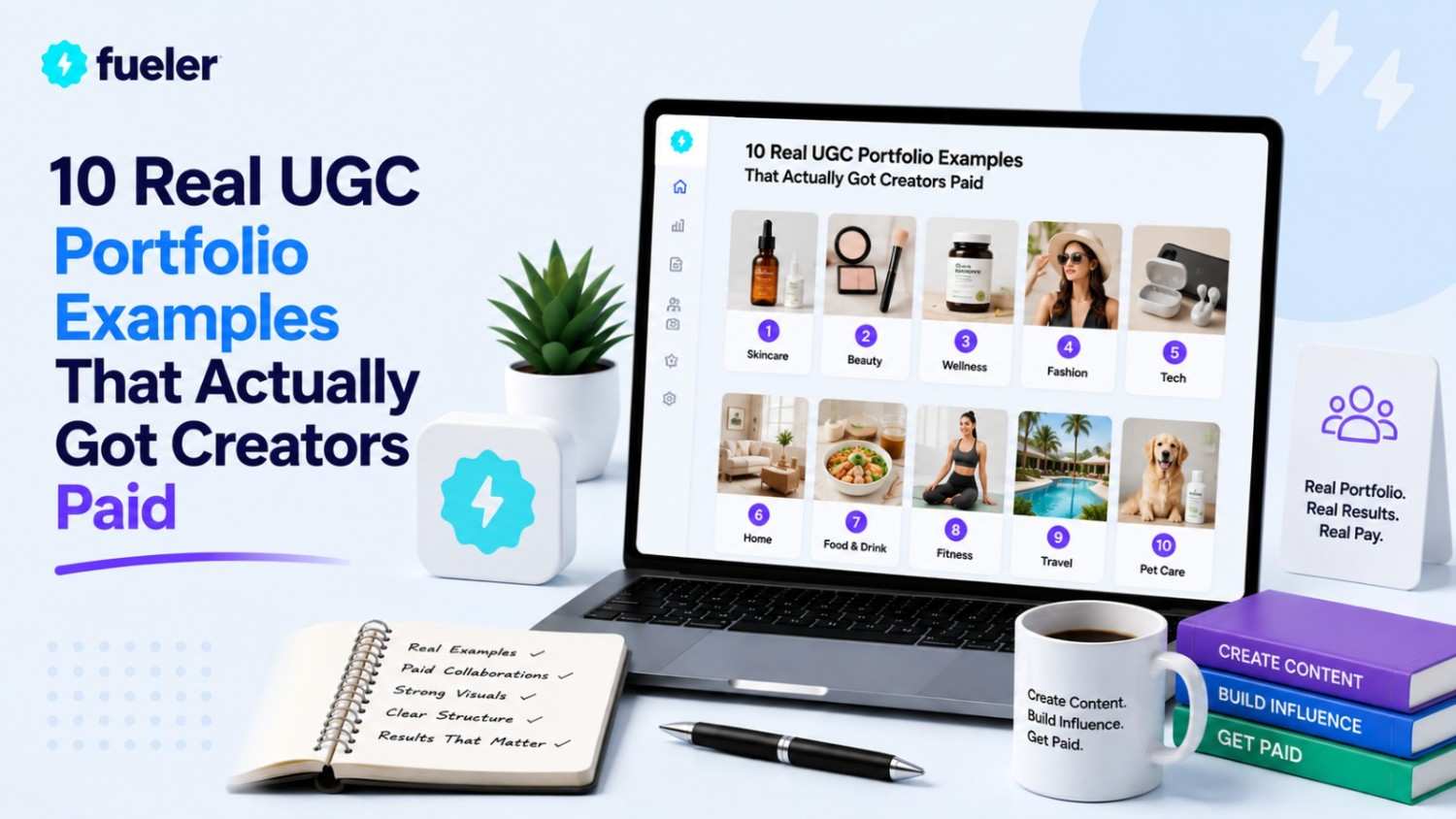
10 Real UGC Portfolio Examples That Actually Got Creators Paid

Riten Debnath
05 Apr, 2026
Last updated: April 2026
The era of the "polished supermodel" ad is officially dead. If you spend any time scrolling through TikTok or Instagram, you know that the videos making you stop and reach for your credit card aren't the ones filmed in a million-dollar studio. They are the ones filmed in a messy kitchen, a sunlit bedroom, or a car. This is the world of User-Generated Content (UGC), and it is currently the fastest way for creative people to build a career without needing a massive following. But here is the catch: brands don't hire you based on your face; they hire you based on your portfolio.
I’m Riten, founder of Fueler, a skills-first portfolio platform that connects talented individuals with companies through assignments, portfolios, and projects, not just resumes/CVs. Think Dribbble/Behance for work samples + AngelList for hiring infrastructure.
1. The "Problem-Solution" Skincare Transformation
One of the most effective UGC examples that consistently lands paid deals involves a clear narrative of a "pain point." A creator recently landed a high-paying contract with a sustainable skincare brand by showing their actual struggle with dry skin during winter. Instead of just showing the bottle, they filmed a 3-second clip of their flaky skin, followed by a transition of them applying the cream, and ending with a glowy, hydrated finish. This works because it feels like a recommendation from a friend rather than a corporate sales pitch. Brands love this because it provides social proof that the product actually functions in the real world.
2. The "Day in the Life" Productivity App Walkthrough
Software companies are now some of the biggest spenders in the UGC space. A viral portfolio example that got a creator hired by a major task-management app featured a "Day in the Life" style montage. The creator didn't just explain the features; they showed how they used the app to manage a chaotic morning of meetings and errands. By overlaying the screen recording of the app over footage of their real-life busy schedule, they made the software feel essential. This storytelling approach proves to the brand that you understand their target audience's busy lifestyle.
3. The High-Energy "Amazon Find" Unboxing
We have all seen unboxings, but the ones that get creators paid are the ones that nail the "hook." A successful creator built their entire portfolio around 15-second "Amazon Must-Haves" clips. The key example that landed them a long-term brand deal featured a kitchen gadget. Within the first two seconds, they showed the gadget solving a messy problem (cracking an egg perfectly), which immediately hooked the viewer. This style is high-energy, fast-paced, and focuses entirely on the physical interaction with the product, making it perfect for top-of-funnel social media ads.
4. The "No-Face" Aesthetic Home Decor Setup
You don't actually have to be on camera to get paid for UGC. A very successful portfolio case study features a creator who specializes in "silent" aesthetic videos. They filmed a luxury candle brand by focusing entirely on the lighting of the match, the trail of smoke, and the way the candle looked on a marble coffee table. This "vibe-based" content is highly sought after by premium brands that want to associate their products with a specific lifestyle. It proves that the creator has an eye for cinematography and lighting without needing to be a "personality."
5. The Honest "Wait, Don't Buy This..." Hook
Reverse psychology is a powerful marketing tool. One creator landed a deal with a travel gear company by using a portfolio sample that started with the line, "Stop buying cheap suitcases." They then went on to explain why most luggage breaks and why this specific brand was the exception. This "expert authority" tone makes the creator look like a trusted advisor. Brands are increasingly looking for creators who aren't afraid to be slightly edgy or opinionated because it feels much more authentic than a scripted commercial.
6. The "Voiceover Only" Recipe Tutorial
Food and beverage brands are constantly looking for UGC creators who can make their products look delicious. A standout portfolio example involved a creator making a 30-second iced coffee using a specific brand of oat milk. Instead of talking to the camera, they used a high-quality voiceover recorded later to explain the steps clearly while the visuals focused on the "pour shot" and the ice clinking. This separation of audio and visual allows for a very polished, professional feel that still looks like it was filmed in a real home kitchen.
7. The Clothing "Haul and Style" Lookbook
Fashion UGC is about more than just wearing clothes; it is about showing how to style them. A creator got paid by a mid-range clothing brand after submitting a portfolio that showed one single white t-shirt styled in five different ways for five different occasions. This "utility" content provides extra value to the viewer and shows the brand that the creator understands fashion trends. It moves the needle from "this shirt looks nice" to "I need this shirt because it is versatile."
8. The Tech "Stress Test" and Durability Proof
For hardware and tech accessories, durability is a huge selling point. A creator landed a deal with a phone case company by filming themselves "accidentally" dropping their phone in various daily scenarios, like getting out of a car or walking the dog. This real-world stress test is much more convincing to a consumer than a lab test. It shows the creator is willing to go the extra mile to prove a product's worth, which is a trait brands find incredibly valuable in a long-term partner.
9. The "ASMR" Sensory Experience
Audio is half the battle in UGC. A creator who focuses on sensory experiences created a portfolio sample for a skincare brand that featured the "click" of the cap, the "squish" of the cream, and the sound of the glass bottle touching a vanity. There was no talking and no music. This sensory-heavy content is proven to increase watch time because it is satisfying to hear. Brands in the beauty and wellness space pay a premium for this level of audio detail.
10. The Comparison: "Expensive vs. Affordable"
One of the most shared types of UGC is the comparison video. A creator made a portfolio piece comparing a high-end designer bag with an affordable "dupe" from a startup brand. They focused on the stitching, the fabric quality, and the weight. By showing that the affordable version was just as good, they provided a massive incentive for people to buy the cheaper brand. The startup brand saw this, recognized the creator's ability to "sell" the value proposition, and hired them for a full campaign.
Showcase Your Proof of Work with Fueler
If you are looking at these examples and thinking, "I can do that," the next step is actually putting your work in front of people who can pay you. This is exactly why we built Fueler. Instead of sending a brand a link to a social media profile where your best work gets buried under personal posts, Fueler allows you to create a professional, streamlined portfolio. You can categorize your UGC by niche, add descriptions of the tools you used, and show the impact your content had. It is about moving away from "I'm a creator" to "I'm a professional who delivers results," and Fueler is the platform that helps you bridge that gap.
Final Thoughts
The secret to getting paid for UGC isn't having the best camera or the most followers. It is about having a portfolio that solves a problem for a brand. Whether you choose to be the face of the brand or stay behind the scenes with aesthetic shots, your work needs to show that you understand how to grab attention and hold it. Use these ten examples as a blueprint for your own samples. If you can prove that you can create content that feels real and drives action, you won't have to chase brands; they will start chasing you.
FAQs
What is the best way to get a paid UGC deal with 0 followers?
Focus entirely on your portfolio. Brands hire UGC creators for the content itself, not the audience. If your portfolio shows you can create high-quality, high-converting videos, the brand will put its own money behind your video as an ad.
How do I reach out to brands for UGC work?
The most effective way is to find the "Social Media Manager" or "Influencer Marketing Manager" on LinkedIn. Send them a short, personalized message with a link to your proof of work portfolio on a platform like Fueler.
Do I need a contract for UGC deals?
Yes, always. A contract should specify who owns the rights to the video, how long the brand can use it, and whether they are allowed to put paid ad spend behind it. This protects both you and the brand.
What are the most profitable UGC niches in 2026?
Health and wellness, SaaS (Software as a Service), sustainable fashion, and pet products are currently seeing the highest demand for authentic user-generated content.
How much should I charge for a single UGC video?
Beginners often start between $150 and $250 per video. As you build a portfolio of successful case studies that show high conversion rates, you can easily scale your rates to $500 or more per 30-second clip.
What is Fueler Portfolio?
Fueler is a career portfolio platform that helps companies find the best talent for their organization based on their proof of work. You can create your portfolio on Fueler. Thousands of freelancers around the world use Fueler to create their professional-looking portfolios and become financially independent. Discover inspiration for your portfolio
Sign up for free on Fueler or get in touch to learn more.

What should you do next?
You've read the article. Now turn your skills into proof of work and unlock more opportunities.
Build your proof of work portfolio
Create a clean portfolio with projects, assignments, resumes, and AI stack details that companies actually want to see.
Create your Fueler portfolio →Apply through assignments, not resumes
Stand out by solving real tasks from companies hiring on Fueler.
Explore assignments →Get discovered by companies
Make your work public and let recruiters discover your skills through actual projects instead of keywords.
Get discovered →
