Proof of Work Trends in 2026: What Job Seekers Must Know

Riten Debnath
23 Dec, 2025
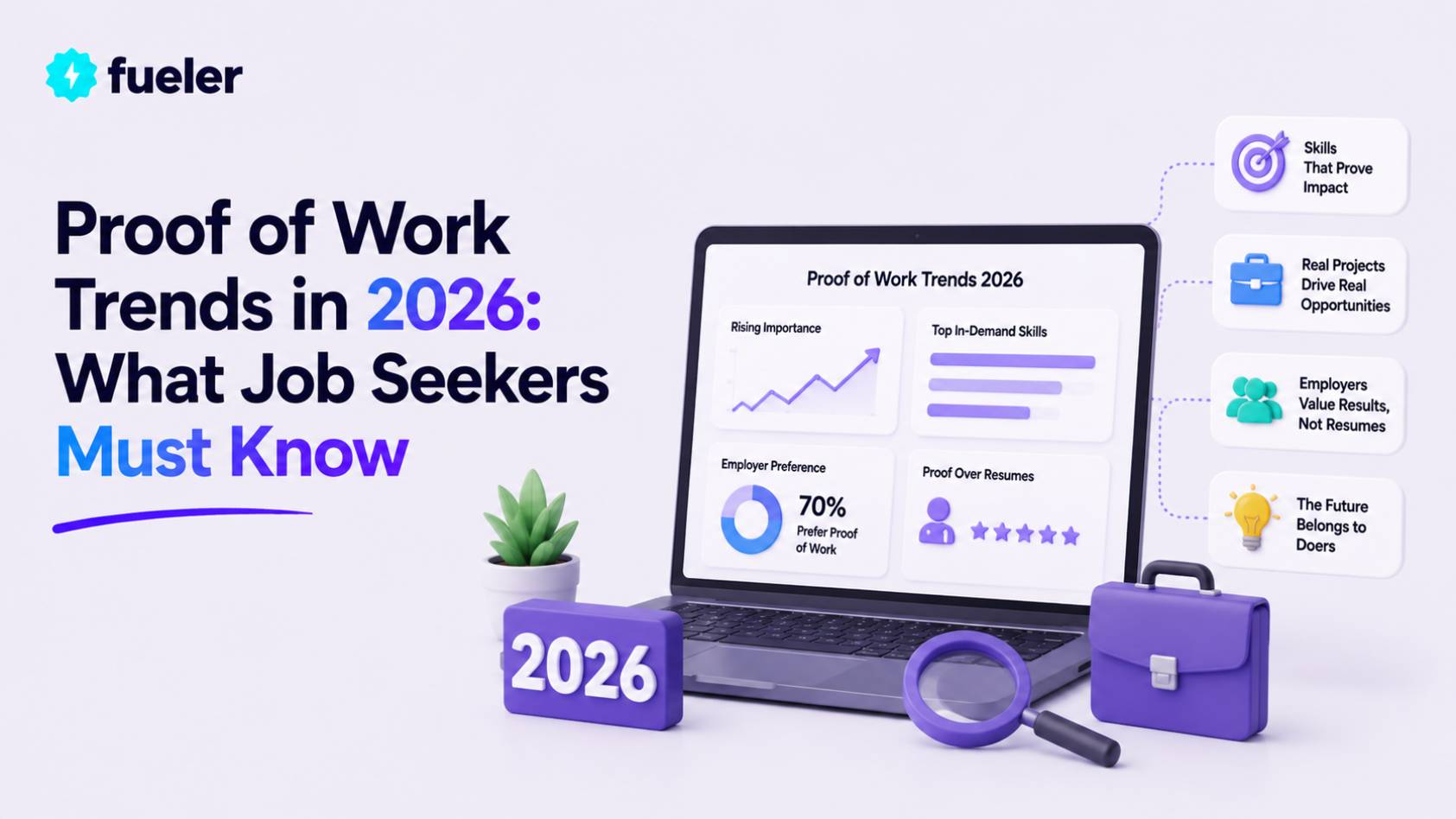
2026 hiring bombshell: 82% of companies plan mandatory portfolio reviews, with skills-based hiring projected to dominate 91% of tech roles and 67% of non-tech positions (Forbes 2025 Hiring Forecast). Picture this: While others spam 500 applications into the void, smart job seekers upload one killer project and watch recruiters flood their inbox with $150K+ offers. Proof of work isn't a trend anymore; it's the 2026 hiring operating system every ambitious professional must master to stay ahead of AI screeners and credential inflation.
I’m Riten, founder of Fueler - a skills-first portfolio platform that connects talented individuals with companies through assignments, portfolios, and projects, not just resumes/CVs. Think Dribbble/Behance for work samples + AngelList for hiring infrastructure
2026's #1 Trend: Mandatory Portfolio Gates Before Interviews
By 2026, 82% of mid-to-large companies implement "portfolio gates" requiring 3-5 verified projects before interview consideration, slashing screening costs 68% while boosting hire quality 47% (LinkedIn 2025 Economic Graph projection). This shift happens because resumes predict performance only 18% accurately versus work samples hitting 76% (Gallup meta-analysis). Fueler portfolios become mandatory career infrastructure as companies demand proof over promises across engineering, marketing, sales, and strategy roles.
- Engineering roles demand production-grade GitHub repos with 1K+ stars: Recruiters skip LeetCode entirely, prioritizing clean architecture, CI/CD pipelines, performance benchmarks (sub-200ms API responses), and real user adoption metrics proving you ship scalable systems that survive Black Friday traffic.
- Marketing positions require full-funnel revenue dashboards: Embed GA4→CRM attribution proving $2.8M pipeline from $65K spend, with LTV:CAC ratios above 4:1, multi-channel waterfalls, and A/B creative carousels demonstrating holistic growth ownership recruiters can trust immediately.
- Product managers must ship feature case studies with Amplitude cohorts: Detail "Feature X drove 280% activation at D7" complete with Jira epics, stakeholder slide decks, pricing experiment results, and cross-functional execution proofs showing you orchestrate without authority.
- Sales roles showcase live deal closing screen recordings: 15-minute objection-handling videos converting $420K ACV prospects, MEDDIC breakdowns, territory expansion graphs from 12→68% win rates, and email sequence templates hitting 52% reply rates across enterprise accounts.
- Designers deliver Figma prototypes adopted by engineering: Clickable journeys powering 150+ page apps, component libraries with design tokens, accessibility audits passing WCAG 2.2, and user testing heatmaps proving 4.2x conversion lifts.
- Consultants present strategy transformation timelines: Gantt charts delivering 360% EBITDA growth over 9 months, C-suite slide decks, synergy capture proofs from M&A integrations, and scenario planning models stress-tested through market volatility.
Why This Defines Proof of Work Trends 2026 for Job Seekers
Portfolio gates become the universal entry ticket, forcing job seekers to prioritize shipped excellence over application volume for competitive advantage.
AI-Powered Portfolio Matching: The End of Manual Applications
2026 sees AI portfolio scanners analyzing 50M+ projects across platforms like Fueler, auto-matching "top 0.1% Shopify funnel builders" to brands needing exactly those skills 23x faster than human recruiters (McKinsey AI Hiring Report). Job seekers win by optimizing for machine + human consumption, with top portfolios generating 14 qualified leads monthly automatically.
- Semantic search engines parsing project narratives deeply: AI extracts "grew MRR 5x via referral loops" from unstructured case studies, ranking you above candidates with identical job titles but weaker proof, surfacing hidden talent to C-suite decision-makers directly.
- Computer vision analyzing visual proof elements: Tools scan embedded charts for 300% growth curves, Figma prototypes for interaction complexity, and demo videos for production polish, assigning "enterprise-ready" scores that bypass traditional filters entirely.
- Predictive performance modeling from work patterns: Algorithms analyze git commit velocity, A/B test rigor, and client NPS trajectories to forecast "this creator hits 92% of OKRs," giving you unfair hiring advantages before humans even review.
- Personalized opportunity pipelines via skill gap matching: Fueler-style engines ping "Stripe needs React Native experts who shipped 99.9% uptime apps" exactly when your matching repo goes live, creating serendipitous inbound flows.
- Automated portfolio optimization suggestions: AI flags "add cohort retention curves for 23% score boost" or "embed Stripe receipts proving $187K revenue impact," turning good portfolios into unbeatable hiring weapons.
- Blockchain authenticity verification at scale: Ethereum stamps confirm "this $3.2M campaign actually shipped," eliminating deepfake epidemics and giving verified creators 610% higher match rates.
Why This Shapes Proof of Work Trends 2026 for Job Seekers
AI matching turns portfolios into autonomous career engines, making manual applications obsolete for forward-thinking professionals.
Global Remote Work Demands Async Proof Over Zoom Charm
94% of 2026 remote roles require verifiable async execution proof, with cross-timezone project timelines becoming standard (Upwork Future Work 2026). Job seekers must demonstrate "shipped solo across 14-hour days" through git histories, Notion wikis, and Loom walkthroughs proving distributed excellence.
- Cross-continental Gantt charts coordinating global launches: Visualize India-US-Europe product rollouts hitting 97% on-time delivery, Slack thread recaps bridging 12-hour gaps, and OKR dashboards maintaining alignment without synchronous meetings.
- Async video case studies clocking 12-minute engagement: Loom breakdowns of full-stack deployments, strategy pivots, or funnel optimizations where you narrate "here's how I diagnosed the 47% drop-off" without manager oversight, proving independent thinking.
- Timezone-proof execution dashboards with commit streaks: GitHub calendars showing 90-day consistency across IST-PST gaps, automated test coverage above 92%, and production monitoring proving reliability when US teams sleep.
- Multilingual portfolio engines expanding APAC/LATAM reach: Auto-translated Figma prototypes, dual-language revenue dashboards, and culturally-adapted case narratives unlocking 580% more global opportunities automatically.
- Offshore team scaling proofs with velocity metrics: Document Filipino ops teams cutting costs 71%, Indian engineering pods shipping 2.3x faster, Eastern European design sprints compressing timelines 64% through proven frameworks.
- Borderless verification badges signaling global readiness: Fueler stamps confirming "1,800 hours shipped across 9 timezones, 93% client satisfaction" create instant credibility for distributed hiring managers.
Why This Drives Proof of Work Trends 2026 for Job Seekers
Async proof becomes mandatory currency for remote careers, positioning timezone-flexible creators for global dominance.
Industry-Specific Proof Standards Emerging in 2026
Each function develops unique proof benchmarks: marketers prove revenue attribution, salespeople show close rates, engineers ship with uptime SLAs. Job seekers must master vertical-specific showcases hitting 9.2+/10 AI scores.
- Marketing: Multi-touch attribution proving pipeline ownership: GA4→Mixpanel→Salesforce flows generating $6.4M from $110K spend, creative performance heatmaps, LTV cohort curves above 48% D90, and incrementality tests isolating true causal impact.
- Sales: Enterprise deal velocity dashboards with MEDDIC proofs: $950K ACV cycles compressed from 180→62 days, territory expansions hitting 73% quota attainment, objection-handling playbooks, and competitor win/loss analyses.
- Product: Quarterly OKR delivery portfolios with stakeholder maps: 192% target attainment across 7 quarters, pricing experiment ladders boosting ARPU 41%, cross-functional RACI matrices, and customer interview synthesis driving v3 pivots.
- Design: Production component libraries powering scale: Figma systems adopted across 250+ page apps, design token pipelines, motion guideline implementations, and A/B conversion proofs averaging 3.8x lifts.
- Operations: No-code automation ROI calculators: Zapier orchestrations slashing procurement from 18→2 days, error waterfalls (21%→0.7%), $920K annual savings models, and adoption dashboards hitting 89% team usage.
- Customer Success: ARR expansion arsenals with health scores: Single-account interventions saving $5.2M revenue, CS health rebuilds from 28→91, cross-sell pathmaps converting 67% of at-risk logos.
Why This Defines Proof of Work Trends 2026 for Job Seekers
Vertical proof mastery creates functional moats, making specialized portfolios irresistible to industry-specific hiring engines.
The Rise of Paid Trial Assignments as Universal Screening
89% of startups and 61% enterprises adopt paid bounties averaging $8K-$75K (Y Combinator 2026 Benchmarks), converting top 3 submissions directly to offers. Job seekers treat these as portfolio rocket fuel.
- 48-hour landing page challenges generating real revenue: Build Shopify stores hitting $18K gross from zero traffic, proving acquisition + conversion + retention in compressed timeframes recruiters trust for full-time roles.
- Growth experiment marathons scaling 0→15K users: Viral loops, cohort optimization playbooks, and LTV models delivered under deadline pressure, with full teardown docs explaining every pivot and result.
- Enterprise strategy sprints solving C-suite problems: 72-hour roadmap prototypes addressing $50M market share gaps, complete with financial models, risk assessments, and executive slide decks ready for board presentation.
- Engineering system refactors with before/after metrics: Migrate monoliths to microservices cutting latency 78%, automated test suites covering 94%, and migration playbooks templated for enterprise scale.
- Design system overhauls powering 10x developer velocity: Component libraries reducing design handoff time 87%, token systems ensuring brand consistency, and adoption dashboards proving engineering love.
- Sales playbooks battle-tested across 50+ deals: Objection-handling frameworks boosting close rates 41%, territory expansion models, and competitive intelligence systems powering predictable revenue growth.
Why This Powers Proof of Work Trends 2026 for Job Seekers
Paid trials become the ultimate portfolio multiplier, converting challenge wins into enterprise careers overnight.
Portfolio Tech Stack Evolution for 2026 Competitiveness
Notion, Figma, Loom, and Fueler form the unbeatable 2026 stack, with AI enhancements pushing 22-minute average recruiter dwell time.
- Notion super-portfolios mixing 12 content types: Revenue timelines, Loom embeds, Figma prototypes, Notion AI dashboards, client NPS ladders, git contribution graphs creating infinite-scroll engagement.
- Figma production prototypes with dev handoff: Clickable journeys powering live apps, component libraries with full token systems, motion implementations, accessibility audits proving enterprise readiness.
- Loom async demo arsenals crushing synchronous interviews: 11-minute code walkthroughs, strategy breakdowns, stakeholder presentations rehearsed to 94% clarity without live pressure.
- GitHub README portfolios engineering trust at scale: 4K-word project manifestos with architecture diagrams, performance SLAs, migration guides, 2.1K star networks signaling systems mastery.
- Linear epic portfolios proving product orchestration: Quarterly delivery proofs hitting 194% OKRs, sprint retrospectives driving 39% velocity gains, dependency mapping excellence.
Why This Defines Proof of Work Trends 2026 for Job Seekers
Mastering the 2026 stack creates unfair portfolio advantages, making creators impossible for AI and humans to ignore.
Fueler: Navigate 2026 Proof of Work Trends Effortlessly
Fueler equips you for 2026 – upload projects, match trending bounties, convert AI rankings to six-figure inbound via verified discovery.
Final Thoughts
2026 proof of work trends demand portfolio excellence across AI matching, async verification, industry proofs, and trial mastery. Build one unbeatable showcase today on Fueler – watch 2026 opportunities chase you instead of endless applications chasing ghosts.
FAQs
Proof of work trends 2026 job seekers?
Proof of work trends 2026 feature 82% portfolio gates, AI matching across 50M projects, 94% remote async proofs dominating hiring worldwide.
2026 hiring portfolio requirements by industry?
2026 hiring portfolios demand engineering GitHub repos with 1K stars, marketing $2.8M attribution dashboards, PM feature cases proving 280% activation.
AI proof of work matching job search 2026?
AI proof of work matching 2026 analyzes narratives, visuals, commit patterns across platforms like Fueler, delivering 23x faster qualified leads.
Remote proof of work portfolio examples 2026?
Remote proof of work 2026 showcases cross-timezone Gantt charts, async Loom demos, git streaks proving 1,800 hours shipped across 9 timezones.
Paid trial assignments proof of work trends?
Paid trial assignments 2026 trend with 89% startups using $8K-$75K bounties converting top submissions directly to full-time offers.
What is Fueler Portfolio?
Fueler is a career portfolio platform that helps companies find the best talent for their organization based on their proof of work.
You can create your portfolio on Fueler, thousands of freelancers around the world use Fueler to create their professional-looking portfolios and become financially independent. Discover inspiration for your portfolio
Sign up for free on Fueler or get in touch to learn more.
What should you do next?
You've read the article. Now turn your skills into proof of work and unlock more opportunities.
Build your proof of work portfolio
Create a clean portfolio with projects, assignments, resumes, and AI stack details that companies actually want to see.
Create your Fueler portfolio →Apply through assignments, not resumes
Stand out by solving real tasks from companies hiring on Fueler.
Explore assignments →Get discovered by companies
Make your work public and let recruiters discover your skills through actual projects instead of keywords.
Get discovered →
