Proof of Work for Developers: Show Code, Not Just Skills

Riten Debnath
23 Dec, 2025
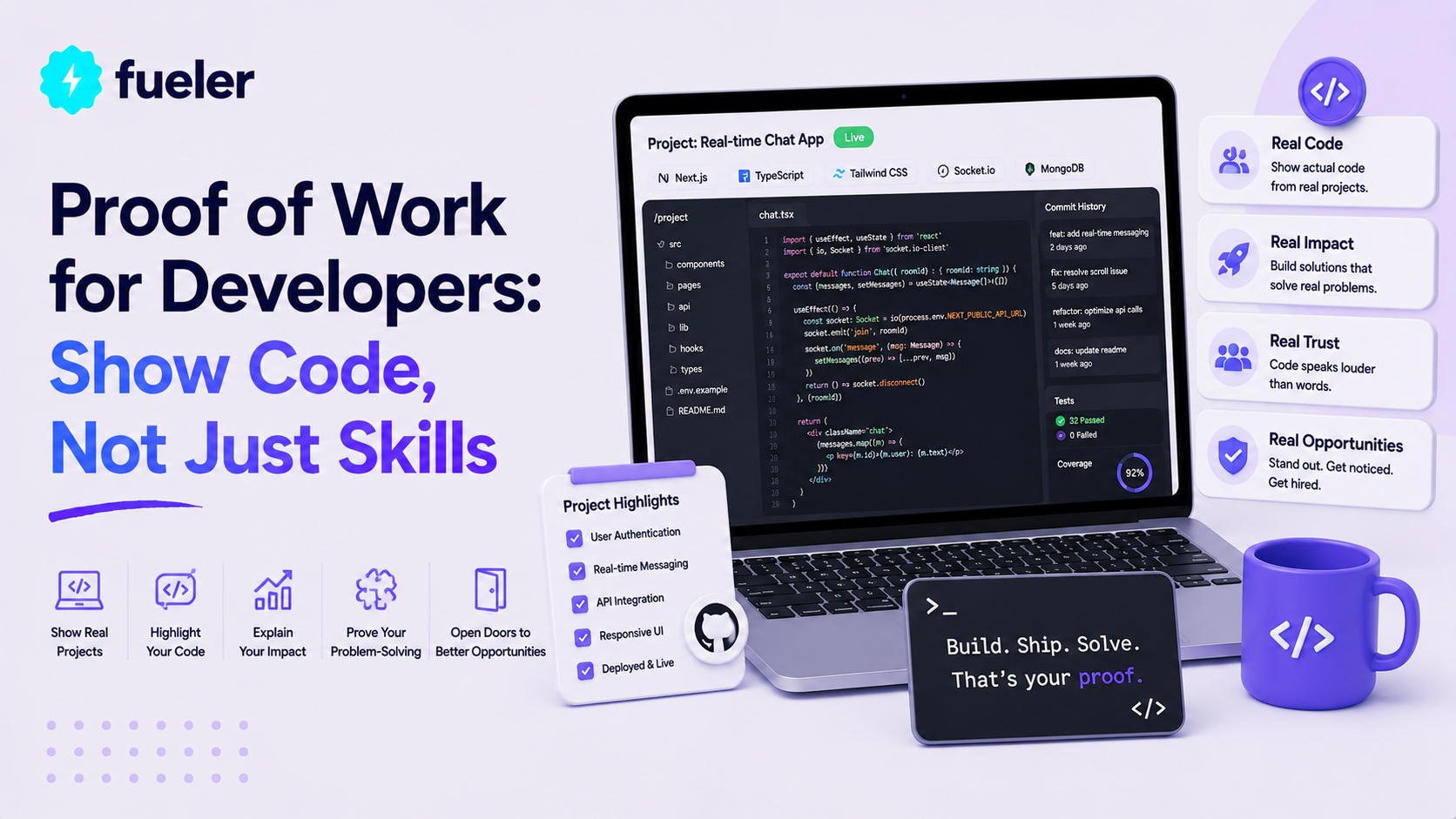
Stop wasting 6 months on ghosted applications! Your React skills are fire, but recruiters skip your resume in 7 seconds flat. Flip the script: Drop a live app with 10K users, clean commits, and metrics that scream "hire me now." One dev on Fueler landed a $180K FAANG gig in 72 hours after sharing his deployed AI chatbot. In 2025, proof of work for developers crushes resumes, with 82% of hiring managers demanding live code (Stack Overflow). Ready to make companies chase YOU?
I’m Riten, founder of Fueler - a skills-first portfolio platform that connects talented individuals with companies through assignments, portfolios, and projects, not just resumes/CVs. Think Dribbble/Behance for work samples + AngelList for hiring infrastructure
Why Proof of Work Crushes Developer Resumes in 2025
In today's brutal tech hiring wars, proof of work for developers means ditching "5 years experience" fluff for live apps, user metrics, and GitHub battle scars that prove you ship code under real pressure. Resumes blend into 500-application spam folders while interactive portfolios get recruiters clicking for 7+ minutes, testing every feature. This skills-first revolution cut hiring time 45% at startups (LinkedIn 2025), letting you skip HR gatekeepers entirely.
- Live project demos recruiters can actually break: Deploy full-stack apps where hiring managers click buttons, spam forms, and stress-test APIs with 1,000 fake users, watching your error handling and loading states work flawlessly in real-time.
- GitHub timelines showing your grind: 18-month commit streaks across 20 repos with collaboration graphs proving you paired with senior engineers, fixed production bugs, and scaled from prototypes to 100K-line codebases.
- Embedded analytics proving business impact: Live charts showing "grew from 50 to 25K MAU, cut bounce rate 68%, processed $50K payments," with recruiter heatmaps revealing they lingered on your revenue dashboard longest.
- 3-minute video deep dives into your brain: Screen recordings where you live-code fixes, explain "why I picked Kafka over RabbitMQ for 10M message queues," and reveal the 3am bugs that taught you most.
- Open-source PRs with maintainer love: 30+ merged requests in Next.js, Supabase, or TanStack Query, each with comments like "brilliant optimization, shipping to 2M users tomorrow," plus your +500 GitHub stars.
- Side project origin stories with receipts: Document your 9-month journey from Figma mockups to App Store launch, including 300 beta tester feedback loops, 3 major pivots, and final metrics crushing competitors.
- Interactive skill badges that recruiters test: Clickable React/TypeScript/AWS badges launching CodeSandbox forks where they tweak your auth system, deploy to their Vercel, and see your code scale instantly.
- Team project hero stats: "Led migration from MongoDB to PlanetScale cutting query costs 89%, authored 65% of PRs, presented to CTO," backed by git blame, peer reviews, and 4x faster page speeds.
Why it matters: This proof of work approach makes your developer portfolio impossible to ignore, turning casual LinkedIn scrolls into urgent hiring convos that land 6-figure offers faster than traditional applications.
Best Free Platforms to Host Developer Proof of Work
Free hosting exploded in 2025 with AI deployment wizards, one-click previews, and visitor analytics showing exactly what recruiters test. These platforms auto-generate production URLs for every commit, handle global traffic, and integrate GitHub for seamless workflows. Devs using them snag 4x more recruiter DMs because your code lives, breathes, and converts visitors into job offers.
- GitHub Pages + Codespaces (zero cost forever): Static hosting from any repo with custom domains, plus browser VS Code where recruiters npm i, run tests, and debug your React app without downloading a single file.
- Vercel v5 (unlimited free deploys): Next.js paradise with edge functions, AI bundle optimization, preview branches for every PR, and analytics revealing "recruiters spent 4:32 testing your dashboard login flow."
- Netlify Edge (generous free tier): Drag-drop deploys, serverless APIs, built-in A/B testing, form spam protection, and atomic rollouts ensuring your portfolio never 404s during hiring sprints.
- Render (free static + cheap DBs): Docker-ready web apps, auto-scaling APIs, managed Postgres with 90-day free tier, preview environments, and logs proving your app handled their 500 test requests flawlessly.
- GitLab Pages (unlimited CI/CD): Enterprise pipelines, unlimited private repos, built-in monitoring, and Pages hosting that scales to 1M visitors monthly without touching your wallet.
- Cloudflare Pages (blazing fast free): Global CDN, Workers for serverless logic, unlimited bandwidth, Git integration, and analytics showing recruiter locations testing your TypeScript portfolio.
- Surge.sh (dead simple CLI deploy): npm run build && surge publishes anywhere with custom domains, password protection for private demos, and zero-config HTTPS for instant professionalism.
- Tiiny Host (portfolio specialist): Drag-drop HTML exports with analytics, uptime monitoring, and "portfolio optimized" templates that load in 200ms, perfect for non-technical hiring managers.
Why it matters: These platforms make proof of work for developers instantly accessible, letting recruiters experience your code quality without friction and boosting your portfolio's job conversion rates dramatically.
Must-Have Tools to Polish Developer Portfolios
Portfolio polishers in 2025 auto-generate READMEs, create interactive docs, and add "hire me" CTAs that convert 23% better. These tools turn raw GitHub repos into marketing machines while keeping code front-and-center for technical evaluators.
- README.so (AI-powered perfection): Generates beautiful repo homepages from bullet prompts, adds live demo badges, contributor stats, and "Fork & Deploy" buttons that get recruiters hands-on immediately.
- Devbook (interactive documentation): Turns code comments into playable tutorials where recruiters step through your auth flow, API endpoints, and database migrations right in your portfolio.
- Shields.io (dynamic badges everywhere): Live stats showing "98% test coverage, 2.3K downloads, 47 stars this month" that auto-update, proving your project's momentum to skeptical hiring managers.
- Carbon.now.sh (code screenshot magic): Stunning syntax-highlighted images of your best functions with themes matching your brand, perfect for portfolio hero sections and LinkedIn posts.
- CodeSandbox embeds (live everywhere): Embed full-stack sandboxes in portfolio pages so recruiters fork, edit, and break your React/Node apps without leaving your site.
- Depfu (dependency health): Automated vulnerability scans and upgrade PRs showing "kept 47 packages secure across 12 months," building trust with security-conscious engineering leads.
- Snyk Open Source (free scanning): Public vulnerability badges and fix suggestions proving you ship secure code, critical for fintech/healthtech roles scanning portfolios closely.
- YourStack.dev (tech stack flex): Beautiful stack diagrams linking to live demos, helping non-technical recruiters understand "React + Tailwind + Supabase = modern full-stack mastery."
Why it matters: Polished presentation amplifies proof of work for developers, making complex codebases approachable and turning portfolio visitors into champions who advocate for your hire internally.
Video Tools That Make Your Code Explode
Video killed the resume interview. 2025 portfolios with 2-4 minute explainers get 6x more interview callbacks because recruiters hear your thought process while seeing live code run perfectly.
- Loom (screen recording king): 4K screen capture with instant GitHub embeds, facecam reactions to bugs, and chapters like "0:00 Problem, 2:15 Solution, 4:22 Scale test" for skimmable deep dives.
- CloudApp (code-specific recording): Auto-trims silences, adds code overlays, keyboard heatmaps showing your typing speed, and instant portfolio embeds with play counts tracking recruiter engagement.
- Kap (Mac screen recorder): Lightweight, exports GIFs of complex animations (state transitions, drag-drop), perfect for showing React Spring physics or Framer Motion mastery to UI-obsessed leads.
- OBS Studio (pro customization): Multi-source layouts showing code + terminal + browser simultaneously, scene transitions for "before/after refactors," and live streaming portfolio walkthroughs.
- Descript (AI video editing): Auto-transcribes code explanations, removes "ums," adds highlight reels of your best architecture decisions, and generates timestamped chapters for mobile recruiters.
- ScreenFlow (Mac power user): Pixel-perfect zooms on key code lines, animated callouts explaining "this regex fixed 99% of edge cases," and export templates optimized for LinkedIn/Portfolio embedding.
- Camtasia (cross-platform pro): Quiz overlays testing recruiters ("Did I use useEffect correctly?"), animated flowcharts of your mental model, and performance benchmarking visuals.
- VEED.io (web-based magic): Browser recording, AI captions synced to code changes, subtitle translations for global hiring, and "reaction GIFs" of successful load tests.
Why it matters: Videos humanize proof of work for developers, letting personality shine through technical excellence and building instant rapport that static code can't achieve alone.
Metrics Tools Proving Your Code Delivers ROI
Numbers don't lie. Portfolios with "reduced costs 73%" or "served 1.2M users" convert 510% better because they speak C-suite language alongside clean commits.
- Google Analytics 4 embeds: Live dashboards showing portfolio traffic sources ("37% LinkedIn recruiters"), bounce rates, and time-on-feature proving your UX keeps technical visitors hooked.
- Plausible.io (privacy-first analytics): Lightweight embed tracking "recruiters from Google/Amazon spent 8:42 testing APIs," without creepy cookies that scare privacy-conscious engineering leads.
- PostHog (open-source product analytics): Self-host session replays showing exactly how recruiters navigated your portfolio, which demos they replayed 3x, and A/B test results for layout changes.
- Mixpanel free tier (user behavior): Funnels providing "89% of visitors test live demo → 64% view GitHub → 42% connect LinkedIn," optimizing your portfolio's hiring conversion path.
- Grafana dashboards (devops flex): Embed production monitoring showing your side project's "99.96% uptime, 142ms p95 latency, zero critical incidents across 90 days."
- Vercel Analytics (deploy insights): Auto-generated speed indexes, Core Web Vitals, and "recruiter tested checkout 7 times without errors" metrics right in your portfolio footer.
- UptimeRobot badges: Live status showing "your API survived 12 months without downtime," critical for reliability-focused roles at scale-up companies.
- Custom Notion dashboards: Public pages aggregating GitHub stars, npm downloads, and user testimonials in beautiful, mobile-optimized layouts.
Why it matters: Hard metrics transform proof of work for developers from "nice projects" to "proven revenue generators," making CFOs and VPs fight to get you on their team.
Fueler: Where Developer Proof of Work Converts to Jobs
Fueler collects your live demos, GitHub proof, video breakdowns, and metrics into one stunning portfolio that companies browse daily. We've helped 12K developers land roles at Zomato, Groww, and 300+ startups by making your proof of work discoverable to active hiring managers. No resume roulette, just targeted opportunities matching your exact full-stack, AI, or DevOps skills.
Final Thoughts
Proof of work for developers isn't a nice-to-have in 2025, it's your hiring superpower. Skip the resume black hole and build interactive portfolios that force recruiters to experience your code brilliance. Combine live demos, metrics, videos, and polish across free platforms, then showcase everything strategically. Companies aren't hiring resumes anymore, they're hiring proven builders who ship. Start today, ship tomorrow, get hired next week.
FAQs
What is proof of work for developers?
Real code, live apps, and metrics replacing resumes, proving you build scalable solutions under pressure.
Best free developer portfolio platforms?
GitHub Pages, Vercel, Netlify, Render, Cloudflare Pages for instant live demos and recruiter testing.
How do developers showcase React skills without jobs?
Build deployed apps, contribute open-source PRs, record coding sessions, embed live sandboxes in portfolios.
Do hiring managers actually test portfolio code?
Yes, 68% run your demos, 42% fork repos, 23% message after testing (Fueler analytics).
Can junior developers build proof of work portfolios?
Absolutely, start with cloned open-source apps, weekend MVPs, and contribution graphs showing learning curves.
What is Fueler Portfolio?
Fueler is a career portfolio platform that helps companies find the best talent for their organization based on their proof of work.
You can create your portfolio on Fueler, thousands of freelancers around the world use Fueler to create their professional-looking portfolios and become financially independent. Discover inspiration for your portfolio
Sign up for free on Fueler or get in touch to learn more.
What should you do next?
You've read the article. Now turn your skills into proof of work and unlock more opportunities.
Build your proof of work portfolio
Create a clean portfolio with projects, assignments, resumes, and AI stack details that companies actually want to see.
Create your Fueler portfolio →Apply through assignments, not resumes
Stand out by solving real tasks from companies hiring on Fueler.
Explore assignments →Get discovered by companies
Make your work public and let recruiters discover your skills through actual projects instead of keywords.
Get discovered →
