A Simple, Practical Guide to Personal Branding on LinkedIn for Startup Founders in Tripura

Riten Debnath
05 Jan, 2026
Hey there, I'm Riten (my LinkedIn), founder of Fueler, and I'm building a career portfolio platform for 100 million Indian professionals.
Our vision is simple: help organizations hire based on skills, not just resumes. Over the past few years, I've learned that personal branding on LinkedIn can change everything for founders, especially those of you building amazing things from Tripura.
I am a startup founder based out of Tripura, and recently got our new office in Bangalore after working from Agartala for a few years.
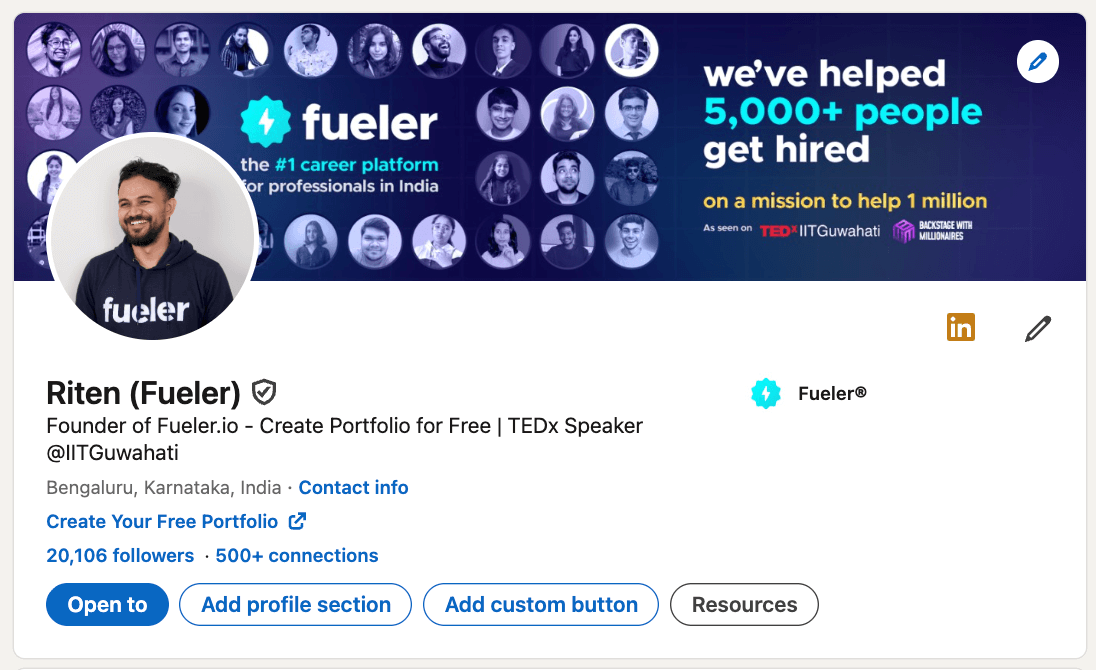
Let me be honest with you. If you are a founder from Tripura, LinkedIn is one of the most powerful tools available to you right now.
You do not need:
- A big PR budget
- Fancy cameras
- A large team
- Perfect English
You only need:
- Consistency
- Clear thinking
- Real experiences
LinkedIn helps you:
- Build credibility beyond geography
- Attract customers, partners, hires, and investors
- Represent Tripura on a national and global stage
- Create opportunities that would otherwise take years
This guide blow is written to make execution extremely easy. No jargon. No theory-heavy advice. Everything here can be done with your phone and 30 to 45 minutes a day.
I currently have over 20,000 followers (as on Jan'26) on LinkedIn. 2025 is when I took LinkedIn very seriously. I was active on Twitter for the first few years, but it's only in 2025 that I became consistent on Linkedin. With the help of Pranav, I have worked on my strategies and executed them for the last 365 days. Here are the results we have achieved in the last 365 days.
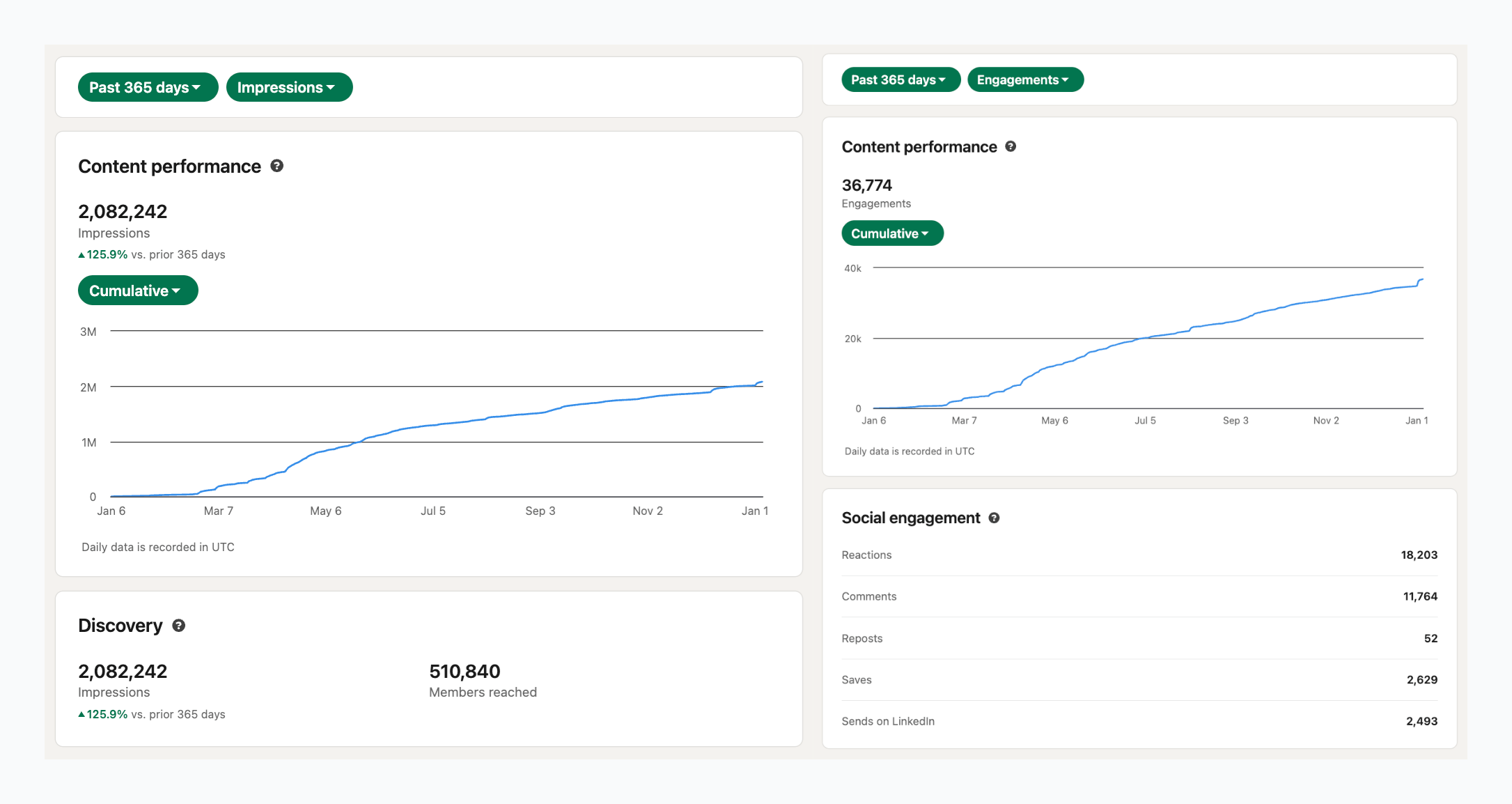
My LinkedIn data from last 365 days (updated Jan'26)
I've seen countless talented founders from the Northeast struggle to get noticed simply because they don't share their journey online. I thougth of workng on this simple and practical guide to help you start your content creation journey on LinkedIn. Let me show you exactly how to build your personal brand on LinkedIn in the simplest way possible.
Here's is quick structure for the entire guide below
Structure:
- Why Founders in Tripura need to use LinkedIn
- Profile optimization checklist
- Content pillars explanation
- Monthly posting framework (3x per week schedule)
- 100 ready-to-use prompts
- Step-by-step writing guide
- Best practices and timing
- Network growth strategies
- Progress tracking metrics
- Common mistakes to avoid
- First week action plan
- Long-term 6-month strategy
- 5 detailed FAQs
- Advanced LinkedIn Strategies
Why Tripura Founders Need LinkedIn Personal Branding (Mindset)
Let me be honest with you. When I started Fueler, nobody knew who I was. But LinkedIn changed that. And for founders in Tripura, LinkedIn is even more important. Why?
First, Tripura is far from major startup hubs like Bangalore or Mumbai. LinkedIn removes that distance. Second, investors and customers are actively looking for authentic founder stories. Third, the Tripura startup ecosystem is growing fast, and you can be the face of this growth.
Your story matters. The fact that you're building something from Agartala makes you unique. People want to hear about the challenges you face, the problems you're solving, and how you're doing it differently.
Work on your Mindset. Most of use think, What to Post When You Think You Have Nothing to Say
Most founders do not post because they think:
- I am not famous
- My startup is small
- Who will care
Reality. Your journey from Tripura is your unfair advantage.
People follow:
- Honest stories
- Learning journeys
- Practical insights
- Consistent voices
You are not here to impress. You are here to document.
Step 1: Fix Your LinkedIn Profile (Profile Hygiene Checklist)
Before you post anything, your profile needs to look professional. Think of it as your digital storefront. Here's what you need to fix right now:
Profile Photo: Use a clear headshot where your face takes up 60% of the frame. Smile naturally. Make sure the background is not distracting. No group photos, no sunglasses, no party pictures.
Banner Image: This is the big image at the top. Create a simple banner that says what you do. You can use Canva for free. Example: "Building [Your Startup Name] | Solving [Problem] for [Target Audience] | Based in Tripura"
Headline: This is the text right below your name. Don't just write "Founder at XYZ". Instead, write what you actually do. Example: "Helping Tripura businesses grow online | Founder at XYZ | Building tools for local entrepreneurs"
About Section: Write in first person. Tell your story in 3-4 short paragraphs. Start with what you're building now, then why you started, and end with what makes you different. Keep it under 1300 characters. Add a clear call to action at the end like "DM me if you want to discuss [topic]".
Featured Section: Pin your best posts, articles, or media coverage here. If you don't have any yet, don't worry. You'll create them soon.
Experience Section: List your current startup first. Write 3-4 bullet points about what you're achieving, not just what you do. Include numbers if possible.
Skills: Add at least 10 relevant skills. Make sure "Entrepreneurship", "Startups", and your industry-specific skills are there.
Custom LinkedIn URL: Go to settings and create a custom URL like linkedin.com/in/yourname. It looks more professional.
Do all of this today. It takes just 30 minutes but makes a huge difference.
Understanding Content Pillars
Before we jump into posting, you need to understand content pillars. Think of these as the main topics you'll talk about. For founders, I recommend 4-5 pillars:
Pillar 1: Your Startup Journey - Behind the scenes, challenges, wins, losses, lessons learned.
Pillar 2: Industry Insights - What's happening in your industry, trends you're seeing, problems that need solving.
Pillar 3: Founder Lessons - Business advice, mistakes you made, things you learned the hard way.
Pillar 4: Tripura/Northeast Focus - Local ecosystem, opportunities in the region, why you chose to build from here.
Pillar 5: Personal Growth - Books you're reading, skills you're learning, how you're improving as a leader.
Each week, post content from different pillars. This keeps your profile interesting and shows different sides of your journey.
The Monthly Content Framework
Now, let me give you a simple framework for your monthly content. This removes all the friction to start from day 1. Here's a weekly breakdown you can follow
Week 1: Story Week
- Monday: Share a challenge you faced this month
- Wednesday: Post about a customer win or testimonial
- Friday: Talk about something you learned
Week 2: Value Week
- Monday: Share a tip related to your industry
- Wednesday: Post a carousel (multiple slides) with steps/lessons
- Friday: Share a resource or tool you find helpful
Week 3: Engagement Week
- Monday: Ask a question to your audience
- Wednesday: Share your opinion on industry news
- Friday: Post about your team or someone who helped you
Week 4: Personal Week
- Monday: Share something about Tripura or the Northeast
- Wednesday: Talk about your vision and goals
- Friday: Share what you're reading or learning
On weekends, engage with other people's content. Comment, share, and build relationships.
This framework means you're posting 3 times per week, which is perfect for consistency without burnout. Follow the same every month and slowly increase the frequency to 4x-5x per week. Don't forget to comment on other comments. This is also a very imprtnat part of your LinkedIn Journey.
100 Content Prompts to Start With
I know the hardest part is figuring out what to write. So here are 100 prompts you can use right away. Just pick one, fill in your details, write about it and post.
Journey & Challenges (1-20)
- The real reason I started [startup name] was...
- Here's what nobody tells you about being a founder in Tripura...
- I failed at [something] last month. Here's what I learned...
- The hardest decision I made this week was...
- When I started, I thought [X]. Now I know [Y]...
- Here's how we survived our first year with no funding...
- Three things I wish I knew before starting my company...
- Why I chose to build from Tripura instead of moving to a metro...
- The moment I realized my idea could actually work...
- How I balance being a founder and [other role]...
- My typical day as a Tripura-based founder looks like...
- The biggest myth about startups that I've learned is false...
- Here's what bootstrapping really looks like...
- How I deal with imposter syndrome as a founder...
- The advice I ignored that I now regret...
- Why I'm building in public and what it has taught me...
- The one skill that has helped me most as a founder is...
- How I stay motivated when things get tough...
- The mistake I made this week and how I'm fixing it...
- What I would tell my past self before starting this journey...
Customer & Product (21–40)
- Our first customer said yes because…
- Here’s the problem we’re actually solving…
- How we validated our idea with zero budget…
- A customer told us [feedback] and it changed everything…
- The feature everyone wants vs. what they actually need…
- How we got our first 10 customers…
- Here’s what our customers love most about us…
- The feedback that hurt but helped us grow…
- Why we decided to pivot from [X] to [Y]…
- How we’re different from [competitor]…
- The one question we ask every potential customer…
- Here’s how we price our product and why…
- What we learned from customers who said no…
- The biggest assumption we had about our users was wrong…
- How we built our MVP in [time] with [budget]…
- Why we’re focusing on [specific market] first…
- The customer success story that made me cry…
- Here’s how we’re solving [specific pain point]…
- What users are really asking for when they say [X]…
- How we turned a complaint into our best feature…
Industry & Market (41–60)
- Here’s what’s changing in [your industry] right now…
- Three trends every [industry] founder should watch…
- Why [industry problem] is bigger than people think…
- The opportunity in Tripura that nobody is talking about…
- How [industry] in Northeast India is different from metros…
- What I learned at [event or conference] this week…
- Here’s why [common belief] is wrong in our industry…
- The biggest gap I see in [industry] in India…
- How technology is changing [specific aspect] of our industry…
- Why now is the perfect time to build [type of solution]…
- Three problems in [industry] that need solving urgently…
- What [big company] is getting wrong about [topic]…
- How Tripura can become a hub for [industry]…
- The one stat about [industry] that shocked me…
- Here’s what I learned from [competitor or other founder]…
- Why the Northeast is perfect for [type of business]…
- How government policies are affecting [your space]…
- The future of [industry] looks like this…
- What founders in [industry] need to know about [topic]…
- Here’s the market research that changed our strategy…
Lessons & Advice (61–80)
- If I were starting over today, I would…
- Five tools every early-stage founder needs…
- How to validate your startup idea in one week…
- The framework I use to make tough decisions…
- Why most startup advice doesn’t work in Tripura…
- How to find your first customers with no marketing budget…
- Three books that changed how I think about business…
- The one habit that made me a better founder…
- How I learned [important skill] in 30 days…
- Why you don’t need funding to start…
- How to stay productive when you’re a solo founder…
- The questions you should ask before hiring anyone…
- How to build a team when you can’t pay market salaries…
- Why I stopped doing [common practice] and what I do instead…
- The mental models I use every day as a founder…
- How to know when to quit vs. when to keep going…
- Why your network matters more than your idea…
- How I built relationships with mentors, investors, and customers…
- The one thing I do every morning that changed everything…
- How to deal with failure and rejection as a founder…
Personal & Vision (81–100)
- Why I’m passionate about building from the Northeast…
- Here’s what success looks like for me…
- The person who inspired me to become a founder…
- How my background in [field] helps me as a founder…
- What I’m learning right now and why…
- My vision for [company] in 5 years…
- Why representation matters in the startup ecosystem…
- How being from Tripura shapes my perspective…
- The values we won’t compromise on as a company…
- What I want the Tripura startup ecosystem to become…
- How I take care of my mental health as a founder…
- The side project I’m working on for fun…
- Why I believe [cause or mission] matters…
- Here’s what lights me up about this work…
- The legacy I want to build through this company…
- How my team keeps me grounded and inspired…
- What I’m grateful for this week…
- The podcast or article that changed my thinking recently…
- Why I share my journey publicly despite the vulnerability…
- Where I see myself and my company in 10 years…
Pick any prompt, spend 10 minutes, make it deeply personal, write, and post. That's it.
How to Write Each Post
Now you have prompts, but how do you actually write?
Here's my simple formula:
Hook (First Line): Start with something that makes people stop scrolling. Ask a question, share a surprising fact, or make a bold statement. Example: "I lost 50,000 rupees in 5 minutes yesterday."
Story/Context (Middle Part): Share what happened, what you learned, or what you're thinking about. Be specific. Use simple words. Write like you're talking to a friend. Keep paragraphs short (2-3 lines max).
Lesson/Takeaway (End): What should people take away? What's the point? Make it clear and actionable.
Call to Action (Optional): Ask a question, invite comments, or tell people what to do next. Example: "What's your experience with this?" or "Save this for later".
Keep your posts between 150-300 words. That's about what I've written here in this section. Not too long, not too short.
Use line breaks. White space makes posts easier to read. See how I'm doing it?
Posting Best Practices
Timing: Post between 7-9 AM or 5-7 PM IST. That's when most people check LinkedIn. But consistency matters more than perfect timing. Pick a time and stick to it.
Hashtags: Use 3-5 relevant hashtags. Include #TripuraStartups, #IndianStartups, and hashtags related to your industry. Don't use more than 5, it looks spammy.
Engagement: Spend 15 minutes after posting to reply to comments. This boosts your post's reach. Also comment on other people's posts daily. LinkedIn rewards engagement.
Visuals: Not every post needs an image, but they help. Take photos of your work, create simple graphics in Canva, or use screenshots. Make sure images are clear and relevant.
Consistency: Post at least 2-3 times per week. LinkedIn's algorithm loves consistency more than perfection. It's better to post 3 okay posts per week than 1 perfect post per month.
Growing Your Network
Personal branding isn't just about posting. It's about building relationships. Here's what to do:
Connect with the Right People: Send 5-10 connection requests daily. Focus on other founders, people in your industry, potential customers, and the Tripura startup community. Always add a personal note. Example: "Hi [Name], I'm also building a startup from Tripura. Would love to connect and learn from your journey."
Engage Authentically: Comment on other people's posts. Not just "Great post!" but actual thoughts. Share what you learned or ask questions. Do this for 10-15 minutes daily.
Direct Messages: When someone engages with your content multiple times, send them a DM. Thank them, start a conversation, build a relationship. Don't immediately pitch your startup.
Support Others: Share other people's content, congratulate them on wins, offer help when you can. What you give comes back.
Tracking Your Progress
You need to know if this is working. Check these metrics monthly:
Profile Views: Are more people viewing your profile? This should grow steadily.
Post Impressions: How many people are seeing your posts? Aim for at least 500-1000 impressions per post in the first few months.
Engagement Rate: Likes, comments, shares divided by impressions. Anything above 3% is good for beginners.
Follower Growth: Are you gaining followers? Even 50-100 new followers per month is great progress.
Opportunities: This is most important. Are people reaching out? Are you getting customer inquiries, investor interest, or partnership offers?
Don't obsess over numbers, but track them. They tell you what's working.
Common Mistakes to Avoid
Let me save you from mistakes I made:
Posting Only Achievements: Nobody relates to someone who only shares wins. Share struggles, failures, and lessons too. Vulnerability builds trust.
Being Too Salesy: Don't promote your startup in every post. Share value first, sell occasionally. The ratio should be 9 value posts to 1 promotional post.
Copying Others: Get inspired by successful creators, but write in your own voice. Your unique perspective as a Tripura founder is your biggest asset.
Inconsistency: Posting 10 times one week and then disappearing for a month doesn't work. Slow and steady wins.
Ignoring Engagement: If people comment on your posts and you don't reply, they'll stop engaging. Always respond.
Overthinking: Perfection is the enemy of progress. Post something, learn from it, and improve. Don't spend 3 hours on one post.
Let me share a framework for a month so that you can start creating content on Linkedin
Your Action Plan for Week 1
Here's exactly what to do in your first week:
Day 1: Fix your profile using the checklist above. Update photo, headline, about section, and experience.
Day 2: Pick 10 prompts from the list that resonate with you. Write them down.
Day 3: Write your first post using one prompt. Use the formula (hook, story, lesson, call to action). Schedule it for tomorrow morning.
Day 4: Post your content at 8 AM. Spend 30 minutes engaging with other posts. Reply to any comments you get.
Day 5: Send 10 connection requests to other founders or people in your industry. Add personal notes.
Day 6: Write your second post for next week. Engage with your network for 20 minutes.
Day 7: Rest or review what worked this week. Plan next week's content using pen paper or use Google Sheet
That's it. Simple, actionable, and you'll have started your LinkedIn journey.
Bonus: Long-Term Strategy
Think of LinkedIn personal branding as a marathon, not a sprint. Here's what the next 6 months look like:
Months 1-2: Focus on consistency. Post 2-3 times per week. Engage daily. Build the habit.
Months 3-4: Experiment with content types. Try carousels, polls, articles. See what your audience loves.
Months 5-6: Start getting intentional. Repurpose your best content. Collaborate with other creators. Maybe start a newsletter.
By month 6, you should have a strong personal brand, a growing network, and real opportunities coming your way.
Frequently Asked Questions
How long does it take to build a personal brand on LinkedIn?
Building a strong personal brand on LinkedIn takes 6-12 months of consistent effort. You'll start seeing small results (more profile views, engagement) in the first 2-3 months, but meaningful opportunities usually come after 6 months of posting regularly. The key is consistency. Posting 2-3 times per week consistently beats posting daily for a month and then disappearing. Think of it like going to the gym - you won't see results after one week, but after 6 months, the change is noticeable.
Should I post from my personal profile or company page as a founder?
Always post from your personal profile as a founder. Personal profiles on LinkedIn get 5-10 times more engagement than company pages. People connect with humans, not brands. Your personal story, struggles, and lessons are what make people care. Use your company page for official announcements and job postings, but build your personal brand through your own profile. This also means if you ever start another company, you take your audience with you.
What should I do if I'm not getting any engagement on my posts?
Low engagement usually means one of three things: your network is too small, your content isn't resonating, or you're not engaging with others. First, grow your network by sending 10 connection requests daily to relevant people. Second, analyze your best-performing posts and create more content like that. Third, spend 20 minutes daily commenting on other people's content. LinkedIn's algorithm rewards engagement. If you engage with others, they'll engage back. Also, make sure your first line (hook) is strong enough to make people stop scrolling.
Can LinkedIn personal branding help me get investors for my startup?
Yes, absolutely. Many investors actively look for founders on LinkedIn. A strong personal brand shows investors that you can communicate clearly, build an audience, and have thought leadership in your space. It also demonstrates consistency and commitment, which investors value. However, don't expect investors to reach out after your first post. Build your brand consistently for 6-12 months, share your journey authentically, and investors will start noticing. Many founders have received their first investor interest through LinkedIn connections and DMs.
How do I find time to post on LinkedIn when I'm busy running my startup?
You don't need hours every day. Here's a realistic schedule: spend 30 minutes on Sunday planning your week's content using the prompts in this guide. Write 2-3 posts at once and schedule them. Spend 15-20 minutes daily (maybe during your morning tea or lunch break) engaging with other posts and replying to comments. That's less than 2 hours per week total. You spend more time on Instagram or WhatsApp. The trick is batching your content creation and being disciplined about engagement time. Use your phone - you don't need a laptop to post on LinkedIn.
Advanced LinkedIn Strategies for Small Town Founders
Now that you understand the basics, let me share some powerful LinkedIn features and strategies that most founders in small towns don't know about. These can seriously level the playing field for you.
Writing LinkedIn Articles
LinkedIn Articles are different from regular posts. Posts are short updates that appear in the feed. Articles are long-form content (like blog posts) that live on your profile forever. Here's why articles matter for you as a Tripura founder:
Why Write Articles:
- Articles establish you as an expert in your field
- They stay on your profile permanently, like a portfolio
- LinkedIn promotes articles to people beyond your network
- They rank on Google, which means more visibility
- You can link back to your startup website
- Articles get featured in LinkedIn's discovery section
When to Write Articles: Write an article once a month after you've been posting regularly for 2-3 months. Don't start with articles because they take more effort. Your regular posts should come first.
What to Write About:
- Deep dive into a problem you're solving
- Complete guide to something in your industry
- Your complete startup story (2000-3000 words)
- Lessons from your first year as a founder
- How-to guides that help your target audience
- Industry analysis from your unique perspective
- Case studies of your customers or projects
How to Write LinkedIn Articles:
Step 1 - Choose a Topic: Pick something you've talked about in posts that got good engagement. If people liked your post about "3 lessons from bootstrapping", expand it into a full article.
Step 2 - Create an Outline: Break your article into 5-7 sections with clear headings. Example outline for "How I Built My Startup from Tripura":
- Why I stayed in Tripura
- The challenges I faced
- How I found my first customers
- Building a team locally
- Lessons for other Northeast founders
- What's next
Step 3 - Write in Simple Language: Write like you're explaining to a friend. Use short paragraphs (2-4 lines). Add subheadings every 200-300 words. Include real examples and stories.
Step 4 - Add Visuals: Include 3-5 images in your article. These can be photos of your work, simple graphics, or screenshots. Images make articles more engaging.
Step 5 - Strong Opening: Your first 2-3 paragraphs must hook readers. Start with a surprising fact, a personal story, or a bold statement. Example: "I was told I'd fail if I didn't move to Bangalore. Two years later, I'm proving them wrong."
Step 6 - End with a Call to Action: Tell readers what to do next. Ask them to share the article, follow you, comment with their thoughts, or check out your startup.
Step 7 - Optimize for Discovery: Use a clear, specific title. Include relevant keywords naturally. Add 3-5 hashtags at the end. Tag relevant people or companies mentioned in the article.
Publishing Your Article:
- Click "Write Article" on LinkedIn (it's in the post box)
- Write your headline (keep it under 100 characters)
- Write your content
- Add a cover image (use Canva to create one)
- Preview before publishing
- Publish and immediately share it as a post with a summary
Promoting Your Article: After publishing, create a regular post saying "I just wrote an article about [topic]. Here are 3 key takeaways..." and link to your article. This drives more views.
Article Writing Tips:
- Aim for 1000-2000 words minimum
- Use bullet points and numbered lists
- Bold important sentences
- Write in first person (I, my, we)
- Share personal experiences and data
- Edit before publishing (read it twice)
- Check for spelling mistakes
One well-written article per month can bring you hundreds of new profile views and establish you as a thought leader.
LinkedIn Creator Mode
This is a game-changing feature that most people don't use. Creator Mode optimizes your profile for content creation and thought leadership.
What Creator Mode Does:
- Replaces "Connect" button with "Follow" button on your profile
- Shows your content and activity first when people visit
- Gives you access to Creator Analytics
- Lets you add up to 5 topics you talk about
- Makes you eligible for LinkedIn's creator programs
- Increases your content's reach
How to Turn It On: Go to your profile, click "Resources", then "Creator mode", and toggle it on. Choose 5 topics you'll create content about (like "Startups", "Entrepreneurship", "Tripura", your industry, etc.).
Why It Matters for You: As a founder from a small town, you need maximum reach. Creator Mode tells LinkedIn's algorithm that you're a content creator, so it pushes your posts to more people. I've seen reach increase by 30-40% after turning this on.
LinkedIn Live
LinkedIn Live lets you broadcast video to your network in real-time. This is powerful for building deeper connections.
How to Get Access: You need to apply for LinkedIn Live access. Go to linkedin.com/help and search for "LinkedIn Live". Fill out the application. It usually takes 2-4 weeks to get approved.
What to Broadcast:
- Monthly Q&A sessions about your startup journey
- Behind-the-scenes of your work
- Product demos or launches
- Interviews with other founders or customers
- Workshops teaching something valuable
- Team meetings or brainstorming sessions (with permission)
Live Tips:
- Announce your Live session 3-4 days in advance
- Go live for 15-30 minutes (not too long)
- Interact with comments during the session
- Save the video and share it later
- Do Lives consistently (once a month is good)
Even if only 20-30 people watch live, the video stays on your profile and can get hundreds more views later.
LinkedIn Newsletter
This feature lets you publish regular content that people can subscribe to. It's different from articles because subscribers get notified every time you publish.
How to Start a Newsletter: You need creator mode turned on first. Then look for "Create a Newsletter" option in your writing tools. You need at least 150 followers or connections to start one.
Newsletter Ideas for Founders:
- "Weekly Founder Lessons from Tripura"
- "Building [Your Industry] in India"
- "Startup Survival Guide"
- "Northeast Startup Stories"
Publishing Schedule: Publish weekly or bi-weekly. Consistency matters more than frequency. If you commit to weekly, stick to it.
What to Write: Each newsletter edition should be 800-1500 words covering one main topic. Share lessons, insights, stories, or industry updates. Keep the same format each time so readers know what to expect.
Benefits: Subscribers are your most engaged audience. When you publish, they get a notification. This builds a loyal community around your content.
LinkedIn Polls
Polls are extremely underused but very powerful for engagement and learning.
Why Use Polls:
- Get 3-5x more engagement than regular posts
- Learn what your audience thinks
- Generate discussion in comments
- Show up in more feeds
- Easy to create, no writing needed
How to Create Good Polls:
- Ask questions related to your industry or startup journey
- Keep options clear and distinct
- Make the poll duration 1-2 weeks
- Always add context text above the poll explaining why you're asking
- Reply to everyone who comments
Poll Examples:
- "What's the biggest challenge for startups in Tier 2/3 cities? A) Funding B) Talent C) Market Access D) Infrastructure"
- "Which content do you want more of? A) Founder Stories B) Industry Tips C) Behind the Scenes D) Book Recommendations"
- "If you're building a startup, what's your biggest struggle right now?"
Create one poll every 2-3 weeks. The insights you get are valuable for your business too.
LinkedIn Events
You can host virtual events directly on LinkedIn. This is perfect for building community and establishing authority.
Event Ideas:
- Monthly founder meetup for Tripura/Northeast entrepreneurs
- Workshop on a specific skill (marketing, sales, fundraising)
- Product launch event
- Panel discussion with other founders
- Networking session for your industry
How to Create an Event: Click "Post" then select "Event". Fill in details (title, date, time, description). Make it free. Invite your connections. Promote it in your posts leading up to the event.
Making Events Successful:
- Announce the event 2 weeks early
- Post reminders 1 week before, 2 days before, and day of
- Use LinkedIn Live or a Zoom link for the actual event
- Record the session and share later
- Follow up with attendees after
Even small events with 20-30 people can create strong connections. Many founders have found co-founders, team members, and customers through LinkedIn events.
Collaborative Articles
LinkedIn has AI-generated articles on various topics and invites experts to contribute. You can add your perspective to these articles.
How It Works: LinkedIn might send you invitations to contribute, or you can find collaborative articles and request to contribute. You write a short response (100-200 words) sharing your expertise.
Why Contribute:
- Shows up on your profile
- Positions you as an expert
- Gets seen by people searching that topic
- Takes only 10 minutes
- Builds your credibility
Check your notifications for invitations or search for collaborative articles in your industry.
LinkedIn Groups
Groups are communities around specific topics. Join relevant groups and become an active member.
Groups to Join:
- Indian startup and founder groups
- Your industry-specific groups
- Northeast India business groups
- Groups for your target customers
How to Use Groups:
- Post your content in relevant groups (1-2 times per week)
- Answer questions from group members
- Start discussions
- Connect with active members
- Don't spam or over-promote
Some groups have thousands of members. Being active can get your content seen by many more people.
Leveraging LinkedIn for Direct Business Benefits
Beyond personal branding, here are specific ways LinkedIn can help your startup:
1. Customer Discovery: Use LinkedIn search to find potential customers. Filter by industry, location, job title. Send personalized connection requests. Once connected, have genuine conversations to understand their problems. Many founders get their first customers through LinkedIn DMs.
2. Recruiting: Post about job openings on your profile. Share your company culture through content. When you build a strong personal brand, talented people want to work with you. I've hired team members who first followed my content for months.
3. Partnership Opportunities: Other founders, companies, and organizations discover you through your content. Partnerships often start with someone commenting on your post, then a DM conversation, then a real opportunity.
4. Media Coverage: Journalists and bloggers are active on LinkedIn. They look for interesting founder stories. If you're sharing your journey authentically, you might get featured in publications. Always include your location (Tripura) in your content because "Founder building from Northeast India" is newsworthy.
5. Investor Relations: Even if you're not raising funding now, investors notice founders who share insights consistently. When you're ready to raise, having built an audience makes you more attractive. Some investors have "founder outreach lists" they build by following people on LinkedIn.
6. Mentorship: Connect with experienced founders and investors. Engage with their content thoughtfully. Many are willing to help if you approach them genuinely (not asking for money or intros immediately). I've gotten advice from people I'd never have access to otherwise.
7. Market Research: Your LinkedIn audience tells you what matters to them through engagement. Notice which posts get more reactions. Read the comments. This is free market research for your product or service.
Advanced Engagement Strategies
Engagement is the currency of LinkedIn. Here are techniques to maximize it:
Comment Thoughtfully: Don't just say "Great post!" Write 2-3 sentence comments adding your perspective. Ask questions. Share a related experience. The LinkedIn algorithm shows your comment to your connections, which means more visibility for you.
Tag Strategically: When you mention someone or a company in your post, tag them. They get notified and might engage or share. Don't overdo it (max 2-3 tags per post) and only tag when genuinely relevant.
Reshare with Commentary: When you see a great post, click "Repost with your thoughts". Add your 2-3 sentence perspective. This shows you're engaged with your industry and brings valuable content to your network.
Respond to Every Comment: When someone comments on your post, reply within the first hour if possible. This keeps the engagement going, which tells LinkedIn's algorithm your post is valuable, so it shows it to more people.
Use the LinkedIn Algorithm: The algorithm looks at early engagement. If your post gets 5-10 engagements in the first hour, LinkedIn shows it to more people. So post when your audience is active, engage with others right before posting (so they're online), and respond quickly to comments.
Create Engagement Pods (Carefully): Some founders create small groups (5-10 people) who agree to engage with each other's content genuinely. This can help, but don't make it fake. Only do this with people whose content you actually find valuable.
LinkedIn Premium: Is It Worth It?
LinkedIn offers paid plans. Here's my honest take:
Premium Career (around Rs. 1,650/month): Features: See who viewed your profile, send InMails to people you're not connected with, access LinkedIn Learning courses.
Worth it if: You're actively recruiting, reaching out to many potential customers, or need to connect with people outside your network regularly.
Not worth it if: You're just starting out. Build your foundation first with the free version.
My Recommendation: Start with free LinkedIn for the first 6 months. Once you've built consistency and need advanced features, try Premium for a month and see if it helps your specific goals.
Creating a Content Repository
As you create content, save your best-performing posts. Here's a system:
Use Google Docs or Notion: Create a document with these sections:
- High-engagement posts (save ones with 50+ likes)
- Post ideas for future
- Topics your audience loves
- Comments that sparked good discussions
Why This Matters: After 3-4 months, you'll have data on what works. You can repurpose successful content, avoid topics that don't resonate, and double down on what your audience loves.
Repurposing Content: A high-engagement post can become:
- A LinkedIn article
- A Twitter thread
- A newsletter edition
- A YouTube video
- Content for your blog
One piece of content can be used 5 different ways.
Measuring Real Business Impact
Beyond vanity metrics (likes, followers), track these:
Website Traffic: How many people visit your startup website from LinkedIn? Use UTM parameters in your links to track this in Google Analytics.
Lead Generation: How many potential customers reach out through LinkedIn? How many turn into actual customers?
Partnership Inquiries: Are other businesses or founders reaching out for collaborations?
Hiring Quality: Are better candidates applying after seeing your LinkedIn presence?
Media Mentions: Have journalists or bloggers reached out because of your LinkedIn content?
These metrics tell you if LinkedIn is actually helping your business, not just your ego.
🔥 The Tripura Founder Advantage
Let me be honest with you. Being from Tripura is not a disadvantage on LinkedIn. It's actually an advantage if you use it right.
Your Unique Angle: Most startup content on LinkedIn comes from Bangalore, Delhi, Mumbai. There are thousands of founders saying similar things. But how many founders are sharing stories from Tripura? Very few.
This makes you stand out. Use phrases like:
- "Building from Tripura..."
- "As a Northeast founder..."
- "Solving problems from Agartala..."
People are curious. They'll pay more attention.
Showcasing Local Innovation: Share how you're solving problems unique to Tripura or the Northeast. Talk about the local market, culture, challenges, and opportunities. This positions you as the expert on this region.
Building the Ecosystem: Your content can inspire other Tripura founders. You can become a leader in the local startup community. This brings opportunities, partnerships, and recognition.
National Visibility: When national media or investors look for "startup stories from Tier 2/3 cities" or "founders from Northeast", you want to be the first person they find. Consistent LinkedIn presence makes this possible.
Your 90-Day Advanced Plan
You've learned the basics and now the advanced strategies. Here's how to implement everything over 90 days:
Days 1-30 (Foundation):
- Post 3 times per week using the prompts
- Engage 20 minutes daily
- Turn on Creator Mode
- Write your first LinkedIn article
- Join 5 relevant groups
Days 31-60 (Expansion):
- Continue posting 3 times per week
- Create your first poll
- Apply for LinkedIn Live access
- Start a newsletter (if you have 150+ followers)
- Host a small LinkedIn event
- Increase engagement to 30 minutes daily
Days 61-90 (Optimization):
- Analyze what content performed best
- Write another article
- Go live if you got access
- Create engagement with collaborative articles
- Start using Stories 2-3 times per week
- Reach out to 10 potential customers via DM
After 90 Days: Review what worked. Double down on that. You should have strong momentum, a growing network, and real business opportunities coming through LinkedIn.
Common Questions About Advanced Features
1. Do I need all these features? No. Start with regular posts and engagement. Add one new feature per month. Don't overwhelm yourself. Articles and polls are easiest to start with.
2. Which feature gives the best return? For founders, LinkedIn articles have the longest lasting impact. One great article can bring opportunities for months. But consistency with regular posts matters most.
3. How do I balance all these features with running my startup? You don't use everything at once. Pick 2-3 features that align with your goals. If you want thought leadership, focus on articles. If you want community, focus on events and groups. Start small and add gradually.
Remember, LinkedIn is a tool to help your business grow. It's not the business itself. Use it strategically, but don't let it consume all your time.
The goal is simple: become the most visible, trusted founder in your space from Tripura. With these strategies, that's completely achievable.
My Final Thoughts For You
Look, I get it. LinkedIn can feel overwhelming. You're already busy building your startup, managing a team, talking to customers. Adding "content creator" to your list feels like too much.
But here's the truth: in today's world, your personal brand is your startup's biggest asset, honestly I have learned it hard way. Especially as a founder from Tripura, your voice can inspire others, attract opportunities, and open doors that would otherwise stay closed.
You don't need to be perfect. You don't need thousands of followers. You just need to be consistent, authentic, and willing to share your journey.
Start small. Pick one prompt from this guide. Write for 10 minutes. Hit post. That's how it begins.
The Tripura startup ecosystem needs more voices. Your story matters. Your struggles matter. Your wins matter. Share them.
At Fueler, we're building tools to help professionals showcase their skills. But before that, you need to be visible. You need to tell your story. LinkedIn is the perfect place to start.
I'm rooting for you. The entire Tripura startup community is rooting for you. Now go build your personal brand and show the world what you're capable of.
What is Fueler Portfolio?
Fueler is a career portfolio platform that helps companies find the best talent for their organization based on their proof of work.
You can create your portfolio on Fueler, thousands of freelancers around the world use Fueler to create their professional-looking portfolios and become financially independent. Discover inspiration for your portfolio
Sign up for free on Fueler or get in touch to learn more.
What should you do next?
You've read the article. Now turn your skills into proof of work and unlock more opportunities.
Build your proof of work portfolio
Create a clean portfolio with projects, assignments, resumes, and AI stack details that companies actually want to see.
Create your Fueler portfolio →Apply through assignments, not resumes
Stand out by solving real tasks from companies hiring on Fueler.
Explore assignments →Get discovered by companies
Make your work public and let recruiters discover your skills through actual projects instead of keywords.
Get discovered →
