Portfolio Hiring vs Traditional Hiring. A Complete Breakdown

Riten Debnath
02 Apr, 2026
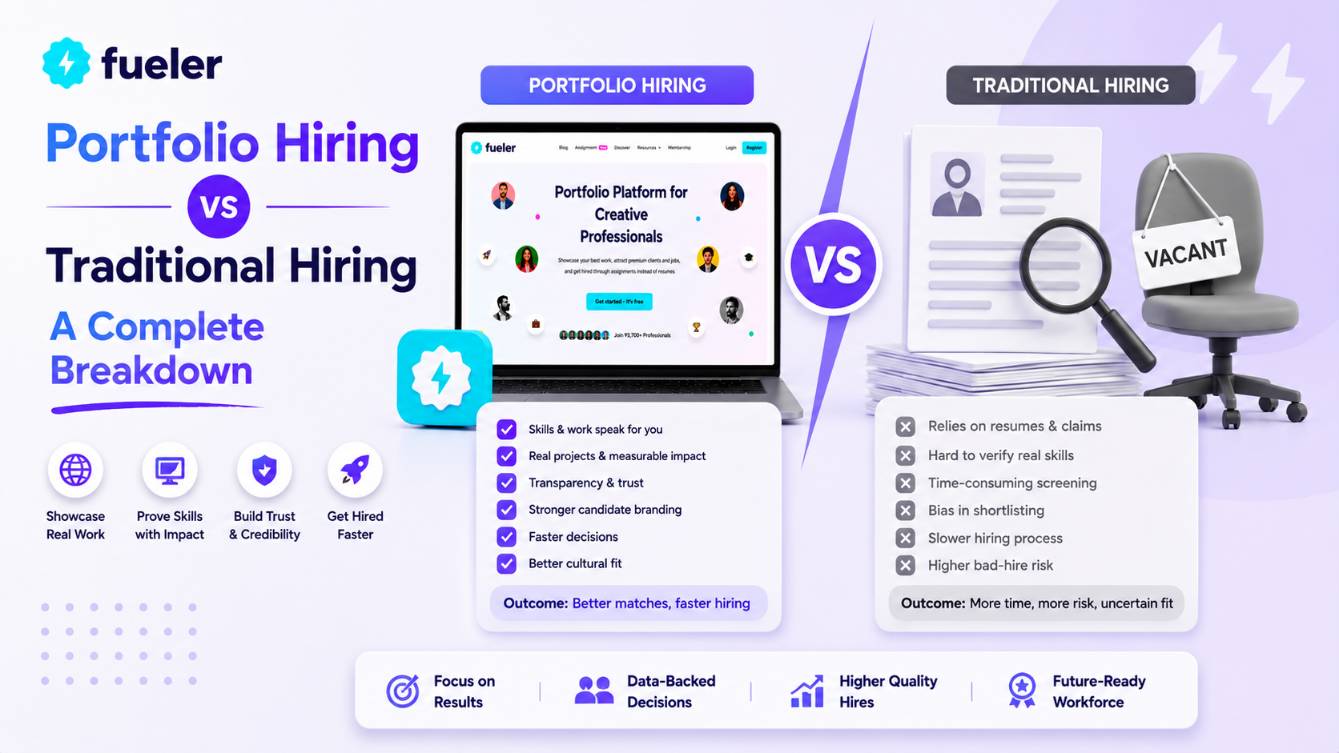
I am Riten, founder of Fueler. The hiring process is changing. Not gradually and not quietly. The change is fast and it is significant. And if you are a professional trying to navigate your career in 2026, understanding the difference between traditional hiring and portfolio hiring is one of the most valuable things you can know.
In this article, I am going to break down both models completely. What they look like, how they evaluate candidates, what they reward, and what they miss. By the end, you will know exactly how to position yourself to win in both worlds.
How Traditional Hiring Works
Traditional hiring follows a process that has been largely unchanged for decades. A company identifies a need and writes a job description. The job description is posted to job boards. Candidates submit resumes and cover letters. A recruiter screens submissions, typically using an applicant tracking system that filters based on keywords. Qualified candidates are invited to interview. Interviews may involve multiple rounds including HR screens, hiring manager conversations, case study presentations, and panel interviews. A final candidate is selected. An offer is made.
This process is designed for scale and standardization. It gives companies a way to handle hundreds of applications systematically. And it gives candidates a structured format for presenting their backgrounds.
The Problems Traditional Hiring Creates
The traditional model has significant flaws that become more apparent as the job market becomes more complex and more competitive.
For companies, the biggest problem is predictive validity. Traditional interview processes are remarkably poor predictors of actual job performance. Research in organizational psychology has shown that unstructured interviews, the kind most commonly used, predict job performance barely better than chance. Companies make expensive hiring mistakes regularly using a process they trust implicitly.
For candidates, the biggest problem is that traditional hiring rewards the wrong things. It rewards resume polish, interview performance, and credential signals rather than actual job capability. The person who gets the job is often the best interviewee, not the best performer.
Traditional hiring also disadvantages candidates from non-traditional backgrounds, people who are career changers, professionals from underrepresented groups, and talented people who are simply not comfortable performing in formal interview settings.
How Portfolio Hiring Works
Portfolio hiring evaluates candidates based on the quality of their actual work. The process looks fundamentally different from traditional hiring.
A company identifies what capability they need. They look for candidates who can demonstrate that capability through real work evidence. This evidence comes in the form of a portfolio of past work, assignment submissions where the candidate completes a real challenge as part of the evaluation, or both. The evaluation is based primarily on the quality of the work rather than on resume credentials or interview performance.
On Fueler, this process is built directly into the platform. Companies post assignments. Candidates complete them and submit their work alongside their portfolio. The hiring decision is made based on what the work demonstrates.
A Side-by-Side Comparison
How Candidates Are Discovered
In traditional hiring, candidates are found through job board applications, recruiter outreach based on resume databases, and employee referrals. In portfolio hiring, candidates are discovered through portfolio search based on skills and work evidence, assignment submissions, and platform-based talent discovery on Fueler.
What Is Evaluated
Traditional hiring primarily evaluates educational credentials, job title progression, company prestige, and verbal performance in interviews. Portfolio hiring primarily evaluates the quality of actual work produced, the measurable results of past projects, the clarity of thinking demonstrated in assignments, and the approach and process behind the work.
Bias and Fairness
Traditional hiring is heavily influenced by unconscious bias toward certain names, universities, companies, and interview styles. Portfolio hiring significantly reduces these biases because the evaluation centers on work quality rather than background signals. The work is evaluated independently of who produced it.
Predictive Accuracy
Traditional hiring is a poor predictor of job performance, particularly when it relies on unstructured interviews. Portfolio hiring is a much better predictor because the evaluation directly assesses the capability required for the role.
Time and Effort
Traditional hiring is time-intensive for companies that need to screen large volumes of applications and conduct multiple interview rounds. Portfolio hiring with assignments allows companies to evaluate candidates more efficiently because the work itself carries most of the evaluation weight.
Candidate Experience
Traditional hiring is often opaque, slow, and anxiety-inducing. Portfolio hiring gives candidates more agency. Your work speaks for itself. You know exactly what you are being evaluated on. The feedback loop is faster and clearer.
What Portfolio Hiring Does Not Replace
Portfolio hiring is not perfect. It is much better than traditional resume screening for evaluating technical and functional skills. But hiring decisions involve more than skill evaluation. Cultural fit, communication style, team dynamics, and long-term growth potential are harder to assess through portfolio review alone.
The best hiring processes use portfolio and assignment evaluation as the primary skills assessment and then use focused conversations to evaluate the human dimensions that work samples cannot fully capture. This hybrid approach is more effective than either pure traditional hiring or pure portfolio evaluation.
How to Win in Both Systems
In 2026, you will encounter both traditional and portfolio-based hiring processes. The smart strategy is to be prepared for both.
Build a strong portfolio on Fueler as your foundation. This serves you in portfolio-based processes and strengthens your traditional applications by giving you a link to share alongside your resume. Complete assignments on Fueler to build your proof-of-work track record. And continue developing your interview skills, because even companies using portfolio hiring will typically want a conversation before making a final decision.
The candidates who will have the most options in 2026 are the ones who are excellent at their work, have documented that excellence in a portfolio, and can communicate it clearly in any format. Start building yours at fueler.io.
The Future of Hiring Is Already Here
One of the most important things to understand about the shift from traditional to portfolio hiring is that it is not coming. It is already happening. Thousands of companies are already using Fueler's assignment-based model to hire. Hundreds of thousands of professionals have already built proof-of-work portfolios. The early adopters of this shift are already benefiting from it.
The question is not whether portfolio-based hiring will become mainstream. It will. The question is whether you will be positioned for it when the companies you want to work for make the transition. Building your portfolio today is the answer to that question.
Every project you document, every outcome you record, and every skill you tag in your Fueler portfolio makes you more competitive in a world that is rapidly moving toward evaluating talent on what they can actually do. That is not a threat to talented, hard-working professionals. It is a gift. Use it.
Start at fueler.io. Build your portfolio today. And step into the future of hiring with the confidence that comes from having real, documented proof of what you can do.
What Hiring Managers Say About Portfolio Candidates
I have spoken to dozens of hiring managers who have made the shift to portfolio-based and assignment-based evaluation on Fueler. The feedback is remarkably consistent. They say that reviewing a portfolio gives them more useful information in five minutes than a one-hour interview does. They say that candidates who have strong portfolios also tend to be better at receiving feedback, communicating their process, and performing once they are on the job. And they say that the traditional interview, while still useful for assessing cultural fit and communication style, is a significantly worse tool for evaluating whether someone can actually do the work.
That is the verdict from the people making hiring decisions. They want portfolios. They trust portfolios. And increasingly, they are building hiring processes around portfolios. If you are not building yours, you are ceding an advantage to every peer who is. Start building yours at fueler.io today and make sure you are on the right side of this shift.
Frequently Asked Questions
What is the difference between portfolio hiring and traditional hiring?
Traditional hiring evaluates candidates through resumes, credentials, and interviews. Portfolio hiring evaluates candidates through actual work evidence: portfolios, case studies, and assignment submissions. Portfolio hiring is more predictive of job performance and fairer to candidates from non-traditional backgrounds.
Is portfolio hiring better than traditional hiring?
For evaluating functional skills, yes. Portfolio hiring is a significantly better predictor of job performance than resume screening and unstructured interviews. Most experts recommend combining portfolio evaluation with focused conversations that assess non-technical dimensions.
How do I prepare for portfolio-based hiring?
Build a strong portfolio on Fueler with documented projects and measurable outcomes. Complete assignments on the platform. Share your portfolio link in every job application alongside your resume.
Are most companies using portfolio hiring in 2026?
Portfolio-based elements are increasingly common, especially in technology, design, marketing, and content roles. Full portfolio-first hiring is growing rapidly through platforms like Fueler. Traditional hiring still dominates in many industries, but the shift is accelerating.
What is Fueler's role in portfolio hiring?
Fueler is the platform where portfolio-based and assignment-based hiring happen in practice. Candidates build proof-of-work portfolios and complete company assignments. Companies discover talent and evaluate candidates through real work evidence.
What is Fueler Portfolio?
Fueler is a career portfolio platform that helps companies find the best talent for their organization based on their proof of work. You can create your portfolio on Fueler. Thousands of freelancers around the world use Fueler to create their professional-looking portfolios and become financially independent. Discover inspiration for your portfolio
Sign up for free on Fueler or get in touch to learn more.

What should you do next?
You've read the article. Now turn your skills into proof of work and unlock more opportunities.
Build your proof of work portfolio
Create a clean portfolio with projects, assignments, resumes, and AI stack details that companies actually want to see.
Create your Fueler portfolio →Apply through assignments, not resumes
Stand out by solving real tasks from companies hiring on Fueler.
Explore assignments →Get discovered by companies
Make your work public and let recruiters discover your skills through actual projects instead of keywords.
Get discovered →
