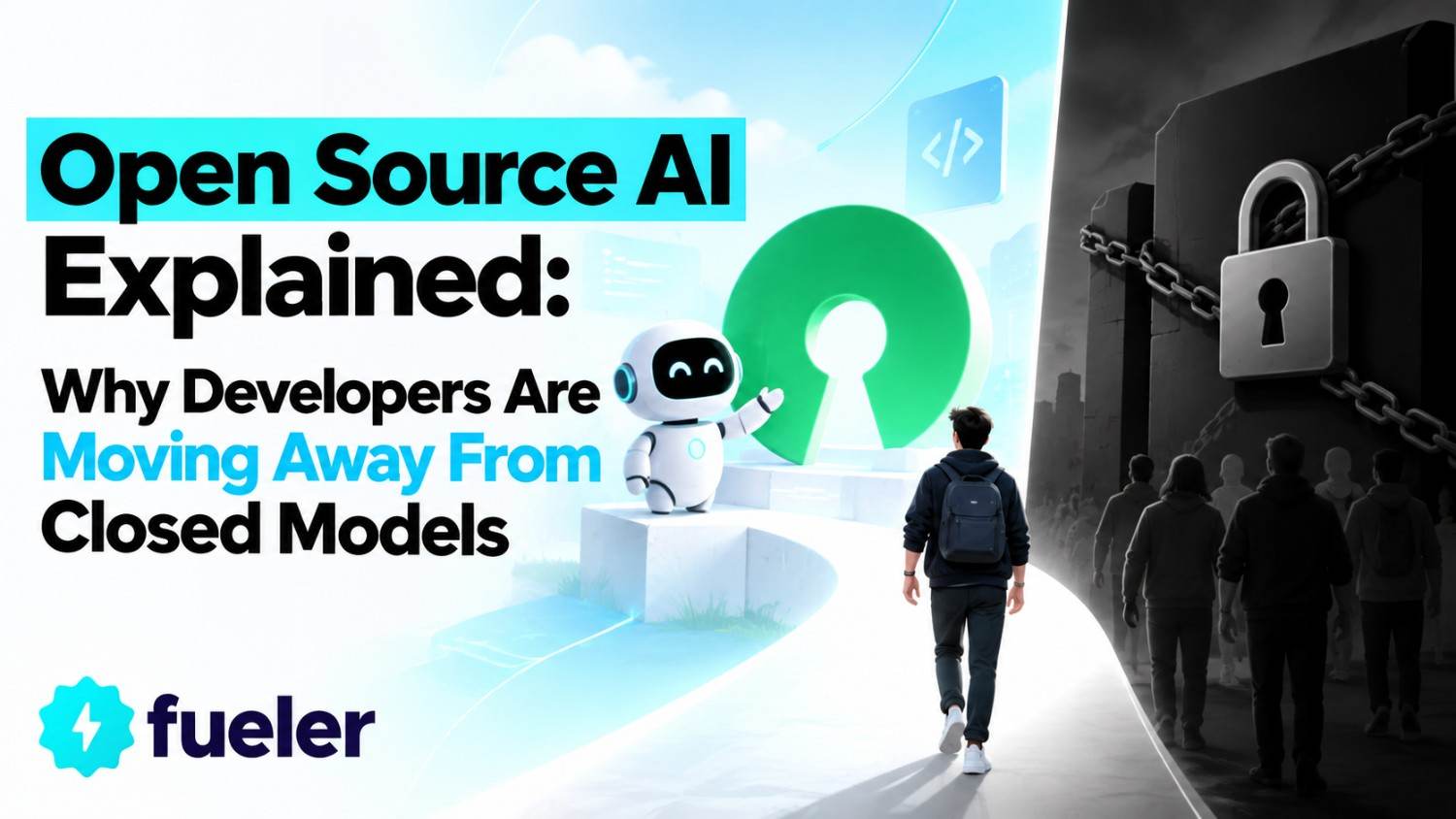
Open Source AI Explained: Why Developers Are Moving Away From Closed Models

Riten Debnath
04 Apr, 2026
Last updated: April 2026
The initial gold rush of Artificial Intelligence was dominated by a few massive, "closed" gates. Companies like OpenAI and Google built powerful models, but they kept the "source code" and the training data locked behind a paywall. In 2026, the tide has turned. Developers are increasingly realizing that building a business on a closed model is like building a house on rented land; the landlord can change the rules, raise the rent, or evict you at any time. This has sparked a massive migration toward Open Source AI, where the transparency of the code is the foundation of innovation.
I’m Riten, founder of Fueler, a skills-first portfolio platform that connects talented individuals with companies through assignments, portfolios, and projects, not just resumes/CVs. Think Dribbble/Behance for work samples + AngelList for hiring infrastructure.
1. Sovereignty Over Data Privacy and Security
In the professional world, data is the most valuable asset a company owns. When you use a closed model, you are essentially sending your company’s "brain" to an external server managed by a third party. For industries like healthcare, defense, or high finance, this is an unacceptable risk. Open-source models allow developers to host the entire AI "brain" on their own private servers, ensuring that sensitive information never leaves the building.
- On-Premise Deployment and Local Hosting: By using open-source models like Llama 3 or Mistral, developers can run the AI locally on their own hardware. This eliminates the need to send data over the internet to a provider’s cloud, which is the only way to guarantee 100% privacy for sensitive client information, medical records, or proprietary trade secrets that are too valuable to risk in a data breach.
- Full Auditability of the Model’s Codebase: Closed models are "black boxes"you have no idea how they process your data or if there are hidden "backdoors." Open source allows security engineers to inspect every single line of code. This level of transparency is required for high-level security certifications and gives companies the confidence that their AI isn't doing anything malicious behind the scenes.
- Air-Gapped Environments for Maximum Protection: Some of the most sensitive government and corporate projects require "air-gapping," meaning the computers have no connection to the outside internet. Closed models physically cannot function in these environments. Open-source AI is the only solution for high-security sectors that need the power of intelligence without the vulnerability of an internet connection.
- Compliance with Global Data Residency Laws: Many countries now have strict laws (like the updated GDPR) that forbid citizen data from leaving national borders. Because developers can choose exactly where an open-source model is hosted, they can ensure they stay compliant with local laws, avoiding the massive legal fines that come with accidentally shipping data to a foreign server.
- Custom Security Wrappers and Firewalls: When you own the model, you can build your own custom security layers directly around it. Developers can implement specialized filters that catch sensitive data before it even reaches the AI's processing unit. This "defense-in-depth" strategy is much more effective than relying on the generic, one-size-fits-all security measures provided by closed-model companies.
Why it matters
Privacy is no longer a "feature" it is a legal and ethical requirement. Developers are moving to open source because it is the only way to build AI products that truly respect user privacy and meet the strict security standards of the modern enterprise. Without data sovereignty, a startup is always one data leak away from total collapse.
2. Freedom from Vendor Lock-In and Price Hikes
Building a product on a closed API is a massive business risk. If the provider decides to double their prices, change their "Terms of Service," or shut down an older version of their model, your entire business could break overnight. Open-source AI provides "software insurance." It ensures that you own the technology that powers your product, giving you the freedom to move between different cloud providers or host it yourself to save money.
- Predictable Infrastructure Costs at Scale: Closed models charge you "per token" (basically per word), which means as your startup grows, your bill grows infinitely. With open source, your costs are tied to server power, not usage volume. Once you reach a certain size, it becomes significantly cheaper to rent a few powerful GPUs than to keep paying a middleman for every single word the AI generates.
- Permanent Access to Specific Model Versions: Closed-model providers often "deprecate" or delete older models to force users onto new ones. But a new model might behave differently, breaking your app's logic. With open source, you can download a specific version and keep it forever. Your software will work exactly the same way five years from now as it does today, providing much-needed stability.
- The Ability to Self-Host and Minimize Latency: When you rely on a closed API, you are at the mercy of their server speed. If their servers are busy, your app is slow. Open-source AI allows you to host the model in the same data center as your app, or even on the user's device. This "edge computing" reduces the delay to near-zero, making the user experience feel incredibly fast and fluid.
- Negotiating Leverage with Cloud Providers: When your tech stack is built on open standards, you aren't stuck with one cloud provider like AWS or Azure. You can easily move your open-source model to whoever offers the best price and performance. This competition between providers keeps your costs low and prevents any single company from having too much power over your business operations.
- Elimination of "Rate Limits" and Arbitrary Bans: Closed providers often set limits on how many requests you can make per minute, which can stifle a fast-growing startup. They can also ban your account if they decide your content violates their ever-changing policies. Open source removes these "hall monitors," giving you the freedom to scale as fast as you want without asking for permission.
Why it matters
Business continuity is about control. Developers are choosing open source because they want to build on a foundation they own, not one they are renting. This independence allows startups to grow sustainably and protects them from the "platform risk" that has killed many promising companies in the past.
3. Customization Through Deep Fine-Tuning
A closed model is designed to be a "jack-of-all-trades," which means it is often a "master of none." It knows a little bit about everything, but it doesn't understand the specific jargon or internal logic of your business. Open source allows developers to perform "Fine-Tuning," where they take a base model and "train" it on their own specific data. This transforms the AI from a general assistant into a specialized expert that speaks your company’s language.
- Niche Industry Expertise and Jargon Mastery: A general AI might struggle with the specific terminology used in high-end legal work or specialized chemical engineering. By fine-tuning an open-source model on industry-specific textbooks and documents, developers can create an AI that understands the nuances and "unspoken rules" of a profession, leading to much higher accuracy and professional-grade output.
- Adjusting the "Weights" for Specific Tasks: Closed models are locked; you can't change how they "think." With open source, developers can adjust the internal mathematical weights of the model to prioritize certain behaviors, like being more factual, more creative, or more concise. This level of surgical control allows for the creation of highly optimized tools that do one thing perfectly.
- Brand-Voice Alignment and Personality Control: If you want your AI to sound exactly like your brandperhaps witty, professional, or empathetic fine-tuning is the best way to achieve it. You can feed the model thousands of examples of your previous marketing copy or customer support logs until it perfectly mimics your unique style, ensuring a consistent experience across every single user interaction.
- Reducing Model Size for Faster Performance: Many open-source models come in different sizes. Developers can take a medium-sized model and "distill" it down to a tiny version that only knows about one specific task. This small model can then run on a smartphone or a basic laptop, providing "on-the-go" intelligence without the need for a massive, expensive supercomputer in the cloud.
- Building Proprietary Logic into the AI Core: When you customize an open-source model, that "fine-tuned version" belongs to you. It becomes a part of your company's intellectual property. Unlike a closed model where everyone uses the same "brain," your custom open-source model is a unique asset that competitors cannot easily replicate, giving you a long-term competitive advantage in the market.
Why it matters
Generic AI is becoming a commodity that everyone has. The real value is in specialization. Developers are moving to open source because it gives them the "surgical tools" needed to build AI that is deeply integrated into a specific business problem, providing far more value than a generic chatbot ever could.
4. Collaborative Innovation and Community Speed
The "open" in open source means that thousands of the world's smartest engineers are constantly looking at the code, fixing bugs, and adding new features. This "collective brain" moves much faster than any single company ever could. When a new breakthrough happens in AI research, it is usually available in the open-source community within days, whereas it might take months for a closed-model company to update its API.
- Rapid Bug Fixes and Security Patches: In the open-source world, if a vulnerability is found, someone in the community usually releases a fix within hours. You don't have to wait for a corporate "customer support" ticket to be processed. This community-driven maintenance ensures that the software stays sharp, secure, and up-to-date with the latest global standards and technological shifts.
- Access to a Massive Library of "Plugins" and Extensions: Developers around the world are building "wrappers" and tools that make open-source models easier to use. Whether you need a tool to help the AI read PDFs or a system to make it better at math, there is likely already a free, open-source library available to help you. This "lego block" ecosystem allows startups to build complex products in half the time.
- Shared Knowledge and "Recipes" for Success: Communities like Hugging Face act as a giant library where developers share their "fine-tuned" models and training techniques. Instead of starting from scratch, you can find a model that is already 90% of the way to what you need. This culture of sharing accelerates the entire industry and allows small teams to achieve results that used to require a billion-dollar budget.
- Cross-Platform Compatibility and Standardization: Open-source AI tends to follow standard formats that work across different types of hardware and software. This makes it much easier to integrate the AI into existing tech stacks, from web apps to mobile devices. Developers don't have to learn a new, proprietary language every time they want to switch models; the skills they learn are transferable.
- Democratization of "State-of-the-Art" Technology: Open source ensures that the most powerful technology in human history isn't controlled by just two or three people in Silicon Valley. It puts that power into the hands of a teenager in India or a startup founder in Nigeria. This global collaboration leads to more diverse ideas and ensures that AI is used to solve problems for everyone, not just the wealthy.
Why it matters
No single company can out-innovate the entire world. Developers are choosing open source because they want to be part of the "fastest lane" of progress. By building on open standards, they are tapping into a global engine of creativity that is constantly pushing the boundaries of what is possible with artificial intelligence.
5. Transparency and the "Right to Explain"
As AI begins to make important decisions like who gets a job or who is approved for a loan, transparency becomes a moral and legal necessity. Closed models are often criticized for being "biased" or "unfair," but since the code is secret, no one can prove why they make certain decisions. Open source allows for "Explainable AI," where developers can trace the logic of a decision and ensure it is fair and unbiased.
- Visualizing the AI’s "Thought Process": Open-source tools allow developers to see which parts of a prompt the AI is focusing on. By analyzing these "attention maps," engineers can identify if the AI is making a decision based on the wrong information. This transparency is crucial for high-stakes fields like medicine or law, where an unexplained "guess" simply isn't good enough.
- Removing Hidden Biases from Training Data: Because the training datasets for many open-source models are public, researchers can inspect them for prejudice. If a model is found to be biased, the community can "re-train" it with better data. This "self-cleaning" mechanism is the only way to ensure that AI grows to be a fair and equitable tool for all of humanity, rather than reflecting the biases of its creators.
- Meeting the Legal "Right to Explanation": Many new laws require companies to provide an explanation if an automated system makes a life-changing decision for a person. With a closed model, the company can only say "the AI said so." With open source, the company can point to the specific logic and data that led to the result, protecting itself from lawsuits and building trust with its customers.
- Ethical Guardrails You Can Actually Control: Closed models often have "built-in" ethics that might not align with your specific culture or business. Open source allows you to build your own ethical filters. You can ensure the AI follows your company's specific values and guidelines, rather than the political or social views of a tech company in another country.
- Building Long-Term Trust with Users: Users are becoming more skeptical of "black box" technology. When a company can say, "Our AI is built on open-source, auditable code," it builds a level of trust that a closed-model company cannot match. Transparency is a powerful marketing tool; it shows the user that you have nothing to hide and that you are committed to honesty and accountability.
Why it matters
Trust is the most difficult thing to build and the easiest to lose. Developers are moving to open source because transparency is the only way to prove that an AI is safe, fair, and reliable. In a future where AI is everywhere, the most "open" companies will be the ones that win the long-term loyalty of their customers.
Showcasing Your Skills in the Open-Source Era
In this new world of open standards, the way you prove your value as a professional has changed. It's no longer enough to say you "know how to use AI." Companies want to see that you can take an open-source model, fine-tune it for a specific task, and deploy it securely on private infrastructure. They want to see your "proof of work."
Fueler is the perfect place to document this journey. On Fueler, you can showcase the specific open-source projects you’ve contributed to, the custom models you’ve built, and the real-world problems you’ve solved. Instead of a boring list of skills, you can show a hiring manager the actual code and assignments that prove you are a leader in the AI-first era. In a world where anyone can "prompt" a closed model, the real rewards go to those who can build with open source.
Final Thoughts
The shift from closed to open-source AI is more than just a technical choice; it is a movement toward a more decentralized, transparent, and fair digital future. Developers are leaving closed models behind because they value their independence, their data privacy, and their ability to innovate without limits. Whether you are a founder building the next big startup or a professional looking to stay relevant, embracing open source is the smartest move you can make in 2026. The gates are opening it's time to start building.
FAQs
What is the best free open-source AI model for beginners in 2026?
The Llama 3 series from Meta is currently the most popular choice for beginners. It has a massive community, excellent documentation, and can be run on most modern consumer laptops using tools like Ollama or LM Studio.
How do open-source models compare to GPT-4 in terms of quality?
As of 2026, the gap has almost completely closed. While GPT-4 remains excellent for general tasks, "fine-tuned" open-source models often outperform it in specialized areas like coding, medical analysis, or specific brand-voice writing.
Can I use open-source AI for commercial projects without paying?
Yes, most open-source models (like those using the Apache 2.0 or MIT license) allow for full commercial use. However, some models have "weight" licenses that might require a fee if your company has more than 700 million monthly active users. Always check the specific license!
What are the hardware requirements to run an open-source model locally?
For a small model (7B parameters), you typically need at least 8GB of VRAM (a modern gaming laptop or a Mac with an M-series chip). For larger, "pro-level" models, you may need a dedicated GPU like an NVIDIA RTX 4090 or specialized cloud hardware.
Is open-source AI safer than closed AI?
In the long run, yes. Because anyone can audit the code, vulnerabilities are found and fixed much faster. It also prevents "data leaking" to third-party companies, which is the biggest security threat most businesses face when using artificial intelligence.
What is Fueler Portfolio?
Fueler is a career portfolio platform that helps companies find the best talent for their organization based on their proof of work. You can create your portfolio on Fueler. Thousands of freelancers around the world use Fueler to create their professional-looking portfolios and become financially independent. Discover inspiration for your portfolio
Sign up for free on Fueler or get in touch to learn more.

What should you do next?
You've read the article. Now turn your skills into proof of work and unlock more opportunities.
Build your proof of work portfolio
Create a clean portfolio with projects, assignments, resumes, and AI stack details that companies actually want to see.
Create your Fueler portfolio →Apply through assignments, not resumes
Stand out by solving real tasks from companies hiring on Fueler.
Explore assignments →Get discovered by companies
Make your work public and let recruiters discover your skills through actual projects instead of keywords.
Get discovered →
