10 Open-Source AI Agent Types Developers Are Building in 2026

Riten Debnath
24 Feb, 2026
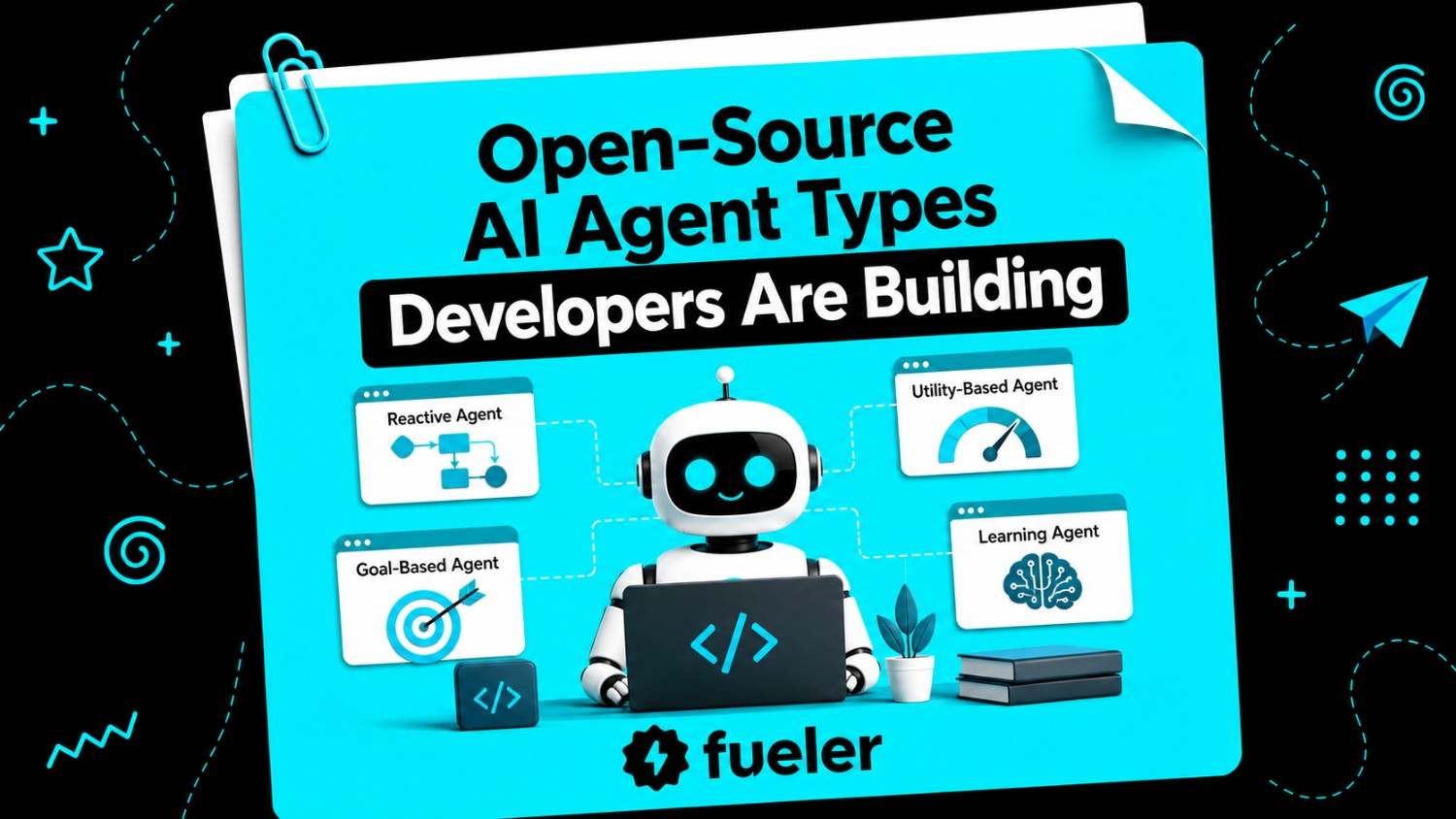
The era of passive chatbots is officially over. In 2026, the developer community has shifted its focus from simple conversational AI to "Agentic Workflows," where AI doesn't just talk, it acts. Whether it is managing a cloud infrastructure or writing and deploying its own code, open-source AI agents are becoming the backbone of modern software engineering. If you are a developer looking to stay ahead of the curve, understanding these specific agent architectures is no longer optional; it is a necessity for building the next generation of autonomous software systems.
I’m Riten, founder of Fueler, a skills-first portfolio platform that connects talented individuals with companies through assignments, portfolios, and projects, not just resumes/CVs. Think Dribbble/Behance for work samples + AngelList for hiring infrastructure.
1. Autonomous Software Engineer (SWE) Agents
Autonomous Software Engineer agents are the most sought-after tools in 2026, designed to handle end-to-end development tasks. Unlike basic code completion tools, these agents can read a GitHub issue, understand the codebase, write a solution, and even run tests to verify the fix. They operate within a "Plan and Act" deterministic workflow, ensuring that every move they make is logical and traceable. Developers are using these to clear out backlogs and handle repetitive bug fixes, allowing humans to focus on high-level system design and creative problem-solving.
- Contextual Codebase Understanding: These agents don't just look at a single file, they index your entire repository to understand how different modules interact, which allows them to make changes that don't break distant parts of the system or violate existing architectural patterns you have established.
- Self-Correction and Testing Loops: When an agent writes code that fails a unit test, it doesn't stop, it actually reads the error log, identifies the bug in its own logic, and iterates on the solution until the tests pass successfully, mimicking the exact behavior of a senior human developer.
- Natural Language Issue Resolution: You can simply point these agents at a Jira ticket or a GitHub issue written in plain English, and they will interpret the requirements, scout the relevant files, and generate a pull request that includes both the functional code and the necessary documentation updates.
- Sandboxed Execution Environments: To maintain security, these agents operate within isolated Docker containers where they can safely install dependencies, run shell commands, and execute code without any risk of damaging the host machine or accessing sensitive environment variables that aren't explicitly shared with them.
- Collaborative PR Reviews: Beyond just writing code, these agents act as proactive reviewers that can look at a human's pull request and suggest optimizations, point out potential security vulnerabilities, or flag styling inconsistencies before the code ever reaches the main branch for final deployment.
Why it matters:
These autonomous tools are transforming the development lifecycle by shifting the human role from syntax writing to intelligent workflow management. This shift is a core reason why these agents are trending in 2026.
2. Multi-Agent Orchestration Systems
In 2026, the real power lies in "Multi-Agent Systems" where specialized agents work together like a corporate department. Orchestration systems provide the glue, handling communication, state management, and task handoffs between different AI entities. One agent might act as a researcher, another as a technical writer, and a third as a quality assurance tester. This modular approach allows for much higher accuracy because each agent is given a narrow, manageable scope of work within a larger complex project.
- Hierarchical Role Delegation: These systems allow you to define a "Manager Agent" that breaks down a massive project into smaller sub-tasks and assigns them to specialized "Worker Agents," ensuring that the workload is distributed efficiently and that no single model is overwhelmed by context.
- Asynchronous Communication Protocols: Unlike traditional linear scripts, these agents can talk to each other in parallel, allowing a "UI Agent" to work on frontend components while a "Database Agent" designs the schema simultaneously, which significantly reduces the total time required to complete full-stack applications.
- Shared Long-Term Memory: By using a centralized vector database, all agents in a crew can access a shared "brain" that stores past decisions, project requirements, and user preferences, preventing the agents from repeating mistakes or asking the user the same clarifying questions multiple times.
- Dynamic Conflict Resolution: When two agents disagree on a technical approach, the system can automatically trigger a "Reviewer Agent" to weigh the pros and cons of each side and make a final decision based on pre-defined project constraints like cost, performance, or security standards.
- Human-in-the-Loop Interruption: These systems are designed to pause and ask for human feedback at critical decision points, such as before making a financial transaction or deploying to production, ensuring that the autonomous workforce stays aligned with human values and business goals at all times.
Why it matters:
These systems allow for "collaborative intelligence," where the sum of specialized agents is far greater than one general model. Mastering these is essential for building scalable agent systems this year.
3. DevOps and Infrastructure-as-Code (IaC) Agents
DevOps agents are revolutionizing how cloud infrastructure is managed by automating the "Day 2" operations that typically drain engineering resources. These agents can monitor logs in real-time, explain a failure in plain English, and even suggest the exact security patch needed for a cluster. By integrating directly into CI/CD pipelines, they act as an "On-Call" engineer that never sleeps, catching configuration drifts and performance bottlenecks before they reach the production environment or impact users.
- Proactive Log Monitoring: These agents ingest massive streams of telemetry data from tools like Prometheus and Grafana, using pattern recognition to identify "silent failures" or performance regressions that traditional threshold-based alerts might miss until it is far too late to prevent a system outage.
- Automated Root Cause Analysis: When a deployment fails, the agent doesn't just send a generic notification, it investigates the recent changes in the repository, checks the infrastructure logs, and provides a detailed report explaining exactly why the failure happened along with a suggested fix.
- Infrastructure Right-Sizing: By analyzing historical usage patterns, these agents can automatically adjust cloud resource allocations, such as scaling down idle instances or suggesting more cost-effective instance types, which helps companies save thousands of dollars on their monthly cloud bills without sacrificing performance.
- Security Vulnerability Patching: These agents constantly scan your infrastructure for known vulnerabilities (CVEs) and can automatically generate the necessary Terraform or Pulumi code to update libraries or close open ports, ensuring that your environment remains compliant with modern security standards at all times.
- Automated Disaster Recovery: In the event of a regional cloud outage, these agents can execute pre-defined failover protocols, spinning up copies of your infrastructure in a different region and redirecting traffic seamlessly so that your users never experience a second of downtime during the crisis.
Why it matters:
Automating the "Ops" in DevOps allows engineering teams to focus purely on feature development rather than server maintenance. This autonomy is a key factor for the agent types being built in 2026.
4. Personal Productivity and Life Assistant Agents
The boundary between professional and personal life is being managed by a new class of "Personal Agents" that handle the administrative overhead of daily living. These agents operate locally on your devices to maintain privacy while having full access to your calendar, emails, and file systems. They don't just "remind" you of tasks; they execute them, such as booking travel based on your preferences, summarizing missed Slack messages, or organizing your digital photo library using advanced semantic search.
- Cross-Application Task Execution: These agents can navigate between different software interfaces, such as taking a confirmed meeting time from an email and automatically creating a calendar invite, setting up a Zoom link, and drafting a brief agenda based on the previous conversation history.
- Intelligent Email Management: Instead of just filtering spam, these agents can draft high-quality responses to routine inquiries, flag urgent messages that require your personal attention, and even unsubscribe you from newsletters that you haven't opened in over a month to keep your inbox clean.
- Hyper-Personalized Content Synthesis: You can ask these agents to "catch me up on what happened today," and they will pull relevant news, project updates, and personal messages into a concise 5-minute audio or text summary tailored specifically to your interests and professional responsibilities.
- Context-Aware Scheduling: These agents understand the nuances of your energy levels and focus time, so they won't just find any open slot for a meeting, they will protect your "deep work" blocks and suggest meetings for times when you are traditionally more open to collaboration.
- Secure Local Execution: To protect your most sensitive personal data, these agents often run on "Edge AI" hardware, meaning your passwords, health data, and private conversations never leave your device and are processed locally using optimized small language models for maximum privacy and speed.
Why it matters:
These assistants are the ultimate "force multipliers" for individual professionals, freeing up cognitive space for high-value work. This personal utility is driving the massive growth of this agent category this year.
5. Web Navigation and Browser Agents
Browser agents are the "eyes and hands" of the AI world, capable of interacting with the web just like a human does. They don't rely on APIs, which often have limitations or costs, instead, they look at the Document Object Model (DOM) and visual pixels to click buttons, fill out forms, and scrape data. This allows developers to automate tasks on websites that don't have official integrations, such as comparing prices across obscure e-commerce sites or performing manual data entry into legacy government portals.
- Visual Perception of Web Elements: These agents use vision-language models to "see" the website layout, allowing them to identify buttons and menus even if the underlying code is messy or obfuscated, which makes them much more resilient to website updates than traditional scraping scripts.
- Complex Multi-Step Form Filling: They can handle complicated workflows that require multiple pages of input, such as applying for a visa or setting up a new business account, by intelligently mapping your provided information to the specific fields required by each individual website.
- Dynamic Data Extraction: Instead of rigid selectors, you can tell these agents to "find the latest quarterly earnings for these 50 companies," and they will navigate to each site, find the PDF report, extract the specific numbers, and compile them into a clean spreadsheet for you.
- Automated Testing of User Interfaces: Frontend developers use these agents to perform "End-to-End" testing by asking the agent to "try to buy a product as a guest user," which helps identify bugs in the checkout flow or navigation issues that a human might have missed during manual QA.
- Bypassing "Anti-Bot" Measures: In 2026, advanced agents can mimic human behavior patterns, such as natural mouse movements and realistic typing speeds, to navigate through modern security checks that usually block simple automated scripts, making them much more reliable for web-based research.
Why it matters:
By turning the entire web into a programmable interface, these agents remove the barriers created by closed ecosystems. This accessibility is a primary reason why they are a top agent type in 2026.
6. Cyber-Security Red-Teaming Agents
Security agents have evolved from simple scanners into active "Red-Teaming" entities that can simulate complex cyber-attacks to find vulnerabilities before the bad actors do. These agents use the same techniques as human hackers, such as social engineering, privilege escalation, and lateral movement, but they do so in a controlled environment to help security teams harden their defenses. They provide a continuous, automated "security audit" that is far more effective than an annual manual check.
- Autonomous Penetration Testing: These agents can perform full-scale attacks on a network, identifying weak passwords, unpatched software, and misconfigured firewalls, and then providing a detailed roadmap on how to fix these issues before they can be exploited by real criminals.
- Phishing Simulation and Education: They can generate highly realistic (but harmless) phishing emails to test employee awareness, and if someone clicks a link, the agent can immediately provide a short, engaging training session on how to spot similar threats in the future.
- Real-Time Threat Intelligence: By constantly monitoring the "Dark Web" and hacker forums, these agents can identify new exploit techniques as they emerge and automatically check your systems to see if you are vulnerable, giving you a head start on defending against "Zero-Day" attacks.
- Automated Incident Response: When a breach is detected, these agents can act in milliseconds to isolate the affected servers, revoke compromised user credentials, and begin the forensic investigation process, significantly reducing the "dwell time" of an attacker inside your network.
- Compliance and Audit Automation: These agents can automatically gather all the evidence needed for security certifications like SOC2 or ISO 27001, saving compliance officers hundreds of hours of manual work by proving that security controls are active and effective across the entire organization.
Why it matters:
In an era of AI-powered cybercrime, these agents are the only way for companies to keep up with the speed of modern threats. This defensive capability is a major focus for developers building agents in 2026.
7. Data Science and Autonomous Analytics Agents
Data agents are changing how businesses make decisions by removing the "bottleneck" of the human data analyst. These agents can connect to your databases, write the SQL queries themselves, generate beautiful visualizations, and most importantly, explain the "Why" behind the numbers. Instead of waiting a week for a report, a business owner can simply ask, "Why did our sales drop in Germany last month?" and the agent will analyze the data to find the root cause in seconds.
- Natural Language to SQL Generation: You don't need to know complex database syntax anymore, as these agents can translate your plain English questions into optimized SQL queries that run against your production or warehouse databases to fetch the exact data you need for your report.
- Automated Data Cleaning and Preparation: These agents can identify missing values, detect outliers, and normalize different data formats across various sources, which typically takes up 80% of a data scientist's time, allowing the human to focus on strategy rather than spreadsheets.
- Predictive Trend Forecasting: Using advanced machine learning models, these agents can look at your historical data to predict future trends, such as "How many customer support tickets will we have next Christmas?" which helps businesses plan their staffing and inventory levels with much higher precision.
- Automated Insight Discovery: Instead of just answering questions, these agents can proactively "scan" your data for interesting patterns, such as discovering that customers who use a specific feature are 3x more likely to renew their subscription, and then alerting the product team immediately.
- Narrative Report Generation: Beyond just showing a chart, these agents write a full story around the data, explaining the context, the trends, and the suggested actions in a way that a non-technical executive can easily understand and act upon without needing a technical translation.
Why it matters:
Democratizing data access means that every person in a company can make data-driven decisions without needing a degree in statistics. This accessibility is why analytics agents are a core development trend in 2026.
8. Customer Support and Experience Agents
In 2026, customer support agents are no longer just "FAQ bots" that frustrate users with generic answers. These modern agents have deep "Contextual Memory" and can actually solve problems by interacting with company's backend systems. They can process a refund, change a flight, or troubleshoot a technical issue by accessing the user's account history and performing the necessary actions autonomously, only escalating to a human when the situation requires emotional intelligence or complex negotiation.
- Multi-Modal Interaction: These agents can talk to customers through text, voice, and even video, using realistic AI avatars that can show empathy through facial expressions and tone of voice, making the automated support experience feel much more human and less robotic than before.
- Real-Time Language Translation: A single agent can support customers in over 100 languages simultaneously, allowing small companies to go global on day one without needing to hire a massive international team of support staff for every different region they operate in.
- Proactive Customer Outreach: Instead of waiting for a user to complain, these agents can detect when a user is struggling with a feature or if their package is delayed, and reach out first to offer a solution or an apology, which dramatically increases customer loyalty and satisfaction.
- Autonomous Problem Resolution: These agents have "Action Permissions" that allow them to perform tasks like resetting a password, updating a billing address, or issuing a partial credit, meaning the customer gets their problem solved in 2 minutes instead of waiting 2 days.
- Human-Agent Collaboration: When an agent does need to hand over to a human, it provides a full summary of the conversation so far, including the user's emotional state and the steps already taken, so the human doesn't have to start the whole conversation from the beginning.
Why it matters:
These agents are turning customer support from a cost center into a competitive advantage by providing instant, high-quality service. This business value is driving the development of support agents this year.
9. Specialized Research and Knowledge Agents
Research agents are the "super-librarians" of 2026, capable of synthesizing thousands of documents, research papers, and web pages into a single cohesive report. Unlike a simple search engine that gives you links, these agents read the content, identify contradictions, and cite their sources meticulously. They are being used by doctors to stay updated on medical journals, by lawyers for case law research, and by students to build a deep understanding of complex academic topics.
- Comprehensive Literature Synthesis: These agents can "read" 500 academic papers in an hour, identifying the core themes, the methodology used, and the gaps in current research, and then summarize all of that information into a single "State of the Industry" report for the user.
- Verified Fact-Checking and Citations: To prevent "hallucinations," these agents use a process called Retrieval-Augmented Generation (RAG), which means every single claim they make is linked directly to a specific sentence in a source document that you can click and verify for yourself.
- Cross-Document Contradiction Detection: If two different sources give conflicting information, the agent won't just pick one, it will highlight the disagreement to the user, explain why the sources might differ, and help the user decide which information is more likely to be accurate based on the context.
- Automated Patent and Legal Research: Lawyers use these agents to scan millions of existing patents or past court cases to find "prior art" or relevant legal precedents, which used to take a team of paralegals weeks of work but can now be done with much higher accuracy in just a few minutes.
- Continuous Knowledge Monitoring: You can "subscribe" an agent to a specific topic, like "Advances in Solid-State Batteries," and it will monitor all new publications, news, and patents, sending you a weekly update only when something truly significant or groundbreaking has happened in that field.
Why it matters:
In an era of information overload, these agents act as a filter that turns raw data into actionable knowledge. This intellectual power is a massive driver for research agent development in 2026.
10. Autonomous Healthcare and Wellness Agents
Healthcare agents are becoming a primary point of contact for preventative wellness and chronic disease management. While they don't replace doctors, they provide 24/7 monitoring and personalized advice based on data from wearable devices. They can help users stick to a medication schedule, interpret complex lab results in simple language, and even detect early signs of mental health issues by analyzing patterns in a user's speech or activity levels, providing a "safety net" that didn't exist before.
- Wearable Data Integration: These agents connect to your Apple Watch or Oura Ring to monitor your heart rate, sleep patterns, and activity levels, providing "Just-in-Time" nudges like suggesting a walk when your stress levels are high or a nap when your recovery is low.
- Personalized Nutrition and Fitness Planning: Instead of generic "one-size-fits-all" plans, these agents create daily meal and workout schedules based on your specific body metrics, dietary restrictions, and fitness goals, adjusting the plan in real-time as your progress or schedule changes.
- Medication Adherence Tracking: For elderly patients or those with chronic conditions, these agents act as a gentle companion that reminds them to take their pills, explains the side effects to look out for, and automatically notifies their doctor if a dose is missed several times.
- Mental Health Support and Coaching: These agents use "Cognitive Behavioral Therapy" (CBT) techniques to help users manage anxiety and depression through daily check-ins, guided meditation, and mood tracking, providing a low-cost and always-available alternative to traditional coaching or therapy.
- Medical Report Interpretation: When you get a blood test or an MRI back from the lab, these agents can explain what the "scary-looking" numbers actually mean for your health, helping you prepare the right questions to ask your doctor during your next scheduled appointment.
Why it matters:
These agents are shifting healthcare from a "reactive" system to a "proactive" one, focusing on keeping people healthy rather than just fixing them when they are sick. This social impact is why wellness agents are so important in 2026.
Show Off Your AI Skills on Fueler
As you build these advanced AI agents, having a way to prove your expertise is more important than ever. Companies in 2026 aren't just looking at degrees; they want to see "Proof of Work." Fueler is the perfect place to showcase your AI agent projects, whether it’s a custom DevOps bot or a complex multi-agent system. By building a portfolio on Fueler, you can display your actual code, the logic behind your agents, and the real-world impact they have, making it easy for top tech companies to find and hire you based on your demonstrated skills.
Final Thoughts
The rise of specialized open-source AI agents is not just a trend; it is a fundamental shift in how we interact with technology. From writing code to managing our health, these autonomous entities are becoming integrated into every aspect of our lives. For developers, the opportunity lies in moving beyond simple prompting and learning how to architect these complex, multi-layered systems. By mastering these 10 agent types, you are not just keeping up with the industry; you are positioning yourself at the very forefront of the next great technological revolution.
FAQs
What are the best free AI tools for developers in 2026?
In 2026, the best free tools for developers include open-source frameworks like LangGraph and CrewAI for building agentic workflows, along with local LLM runners like Ollama that allow you to run powerful models on your own machine without paying for expensive API credits.
How do I start building an AI agent as a beginner?
The best way to start is by using a "high-level" framework like CrewAI or SmolAgents, which allows you to define agents with simple Python code. Focus on solving a small, specific problem first, like a bot that summarizes your favorite newsletters, before moving on to more complex multi-agent systems.
Are open-source AI agents safe for enterprise use?
Yes, open-source agents are often preferred by enterprises because they can be self-hosted on private servers. This ensures that sensitive company data never leaves the internal network, providing a level of security and privacy that is difficult to achieve with "closed" proprietary AI models.
Will AI agents replace human software engineers?
AI agents are not here to replace engineers, but to "augment" them. They handle the repetitive, boring parts of coding, like bug fixing and documentation, which allows human engineers to spend more time on creative system design and solving the complex business problems that require a human touch.
What is the difference between an AI chatbot and an AI agent?
A chatbot is "reactive," meaning it only speaks when you talk to it. An AI agent is "proactive," meaning it has the ability to use tools, make decisions, and execute multi-step tasks autonomously to reach a goal, even if you are not actively guiding it every second.
What is Fueler Portfolio?
Fueler is a career portfolio platform that helps companies find the best talent for their organization based on their proof of work. You can create your portfolio on Fueler. Thousands of freelancers around the world use Fueler to create their professional-looking portfolios and become financially independent. Discover inspiration for your portfolio
Sign up for free on Fueler or get in touch to learn more.

What should you do next?
You've read the article. Now turn your skills into proof of work and unlock more opportunities.
Build your proof of work portfolio
Create a clean portfolio with projects, assignments, resumes, and AI stack details that companies actually want to see.
Create your Fueler portfolio →Apply through assignments, not resumes
Stand out by solving real tasks from companies hiring on Fueler.
Explore assignments →Get discovered by companies
Make your work public and let recruiters discover your skills through actual projects instead of keywords.
Get discovered →
