North East Growth Lab Roadshow and IIMA Ventures: The Full Story, the Startups, and How to Apply Before July 12

Riten Debnath
26 Jun, 2026
Something happened in Agartala on June 24, 2026 that did not make national headlines but should have.
I am Riten, founder of Fueler. A room full of startup founders in North East India sat down with one of the country's most credible startup institutions and worked through real business problems together. Not a panel discussion. Not a policy seminar. A working session where founders left with sharper thinking about their customers, their value propositions, and a clear path to apply for funding and mentorship from IIMA Ventures.
That event was the North East Growth Lab Roadshow. And the story behind it goes back much further than June 2026.
This is the full story: where the Northeast Growth Lab came from, what it has already done, which startups it has supported, what those startups are building now, and exactly how you can apply before the July 12, 2026 deadline.
Where It All Started: Assam, 2021
To understand the North East Growth Lab, you have to go back to Assam in 2021.
The Assam Agribusiness Growth Lab, known as AAGL, is an initiative of APART (Assam Agribusiness and Rural Transformation Project), ARIAS Society, and the Government of Assam, co-implemented by IIMA Ventures in partnership with ICCSPL (Innovative Change Collaborative Services Pvt. Ltd.).
The AAGL initiative was officially launched on June 30, 2021, as an eight-month acceleration program that seeks out 25 agribusiness enterprises per year. The four-year support from APART is designed to solve critical interventions in the entrepreneurship scene of Assam and is reviewed by the World Bank.
This was not a small experiment. The World Bank's Assam Agribusiness and Rural Transformation Project (APART) is a $200 million initiative approved in 2017, supporting over 500,000 farmers across sectors like rice, dairy, fisheries, livestock, and silk, with plans to reach additional farmers in enterprise development.
The AAGL was the entrepreneurship accelerator built inside this larger rural transformation effort. IIMA Ventures was brought in to run it because they had the track record and the methodology. What happened next is what made expansion possible.
What the AAGL Actually Achieved: The Numbers
The results from the first cohort of the Assam Agribusiness Growth Lab were specific enough to notice.
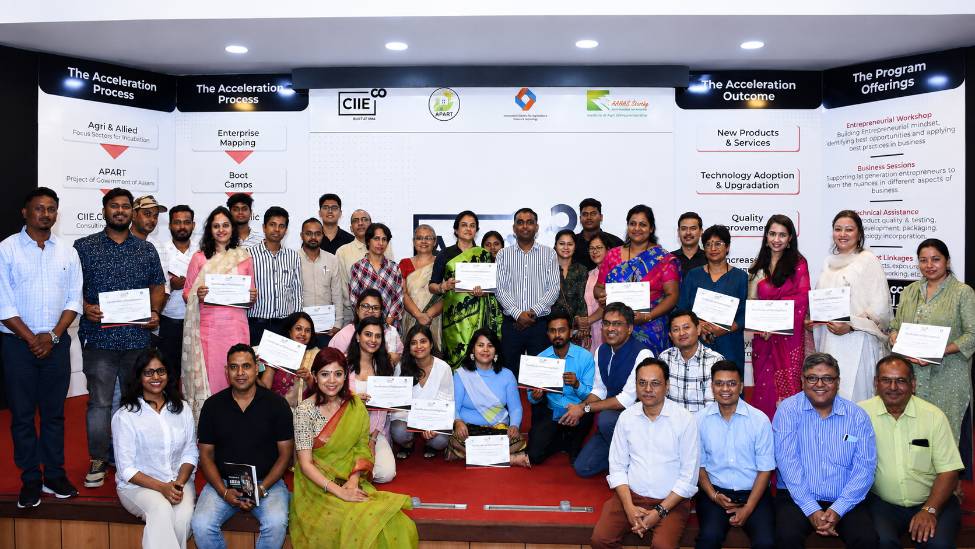
The first cohort of 25 enterprises was formed in mid-August 2021 with 32% representation from women-led enterprises. Altogether, 202 agri and allied enterprises from 23 districts of Assam submitted their applications to the AAGL programme.
That number, 202 applications from 23 districts, tells you something important. This was not a program chasing participants. Founders across Assam showed up because they needed what AAGL was offering.
The selection was serious. Applications went through intensive assessment consisting of three rounds and a final due diligence. Through two rounds of internal and external evaluations, 56 enterprises were shortlisted for final presentations. Each shortlisted enterprise pitched to a six-member jury panel consisting of industry experts, renowned business consultants, investors, mentors, and academicians from the agri domain.
And then came the outcomes. For Cohort 1: 88% of the cohort achieved at least 3 of the outcomes that are the focus of the AAGL program, with 20 new products launched, an increase in turnover across the cohort by at least 20%, and Rs. 5.6 crore mobilized in finance.
Those are not vague outputs. Twenty new products from a single cohort of 25 companies. Every company growing turnover by at least 20%. Rs. 5.6 crore in finance mobilized. This is what rigorous accelerator support actually looks like when it works.
The World Bank published a real human story behind these numbers. One founder, Mayashree, shared: "The training and support I received through the Agribusiness Growth Lab equipped me with the knowledge and skills to expand my micro-enterprise significantly. In 2022-23, my turnover doubled to around Rs. 13 lakhs. Now I have diversified my product range and expanded my market reach across large parts of Assam."
The AAGL ran through multiple cohorts. The program targeted 100 enterprises over four years with at least 30% participation from women-led businesses.
By the time Cohort 2 demo day came around in April 2023, the program had built enough of a track record that the logical next step became obvious: expand it beyond Assam.
From Assam to Eight States: The North East Growth Lab Is Born
The Northeast Growth Lab builds on the earlier Assam Agribusiness Growth Lab, a World Bank-supported initiative led by IIMA Ventures. While AAGL focused on agribusiness in Assam, NEGL expands its scope to include enterprises across Assam, Arunachal Pradesh, Manipur, Meghalaya, Mizoram, Nagaland, Tripura, and Sikkim.
This expansion was formalized through a partnership between IIMA Ventures and SAP, the global enterprise software and technology company.
As Chintan Bakshi, Partner at IIMA Ventures put it: "NEGL is not just a program extension. It's a bold regional platform combining capital, capacity, and connections to back fearless entrepreneurs solving for India's next frontier of innovation."
Manish Prasad, President and Managing Director of SAP Indian Subcontinent, added: "We've supported over 200 social enterprises, and our Northeast Growth Labs initiative, in partnership with IIMA Ventures, strengthens our commitment to sustainable, inclusive growth. These ventures are transforming communities and creating an equitable future."
The programme is designed to support over 90 startups and social enterprises over the next three years, with the goal of fostering inclusive economic development and enterprise growth in the region.
The NEGL officially launched in mid-2025. The initiative kicked off with an intensive bootcamp in Guwahati, where the first cohort of social enterprises gained actionable insights from ecosystem enablers on AI applications, business storytelling, B2B sales strategies, and sector-specific opportunity mapping.
The Startups the North East Growth Lab Is Already Supporting
This is not a program that is still figuring out who to back. There are already companies in the NEGL portfolio doing real things.
Here is what we know about the ventures publicly confirmed as part of the first NEGL cohort:
Dream Hives
Dream Hives is the North East's first honey-based heritage wine brand, sourcing directly from Farmer Producer Organizations and Farmer Producer Companies. This is not a generic honey company. It is building a premium beverage category from an ingredient the Northeast produces abundantly, with a supply chain model that directly benefits farming communities. The mead category, heritage wines made from honey, is growing internationally. Dream Hives is building for that market from the inside out.
Chezfresco
Chezfresco is a ready-to-eat B2B food brand, described as a food innovation venture supporting small-scale food entrepreneurs. The B2B model is smart for early stage: rather than building a consumer brand from scratch, Chezfresco is building food products for other food businesses, which means faster revenue cycles and more predictable customers.
Greengen Agri Biotech
Greengen has created a biofertiliser for tea plantations. Tea is one of the most important agricultural sectors in the Northeast, particularly in Assam. A biofertiliser specifically designed for tea growers is a targeted product for a large, accessible market. The "bio" positioning also matters as global buyers increasingly demand chemical-free tea production.
Fuloni Agritech
Fuloni Agritech assists low-income artisans with biodegradable urban gardening products. Plantable and biodegradable pots for home gardening is a product that sits at the intersection of sustainability, urban consumer demand, and rural artisan livelihoods. The production can be done locally using natural materials. The market is urban India, which is growing rapidly.
Pustikor Foods
Pustikor Foods promotes Assam's Joha rice heritage through sustainable farming practices. Joha rice is a GI-tagged fragrant rice variety native to Assam. GI-tagged products command premium pricing because they cannot be replicated anywhere else. Building a food brand around a GI-tagged ingredient is one of the smartest market positioning plays a Northeast founder can make right now.
These five ventures represent the breadth of what the NEGL backs. Different sectors, different business models, but a common thread: each one is building from the Northeast's genuine strengths, not trying to copy something that already exists in Bangalore.
The Roadshow Comes to Tripura: What Happened in Agartala
The NEGL Roadshow is how the program travels to founders rather than waiting for founders to travel to it.
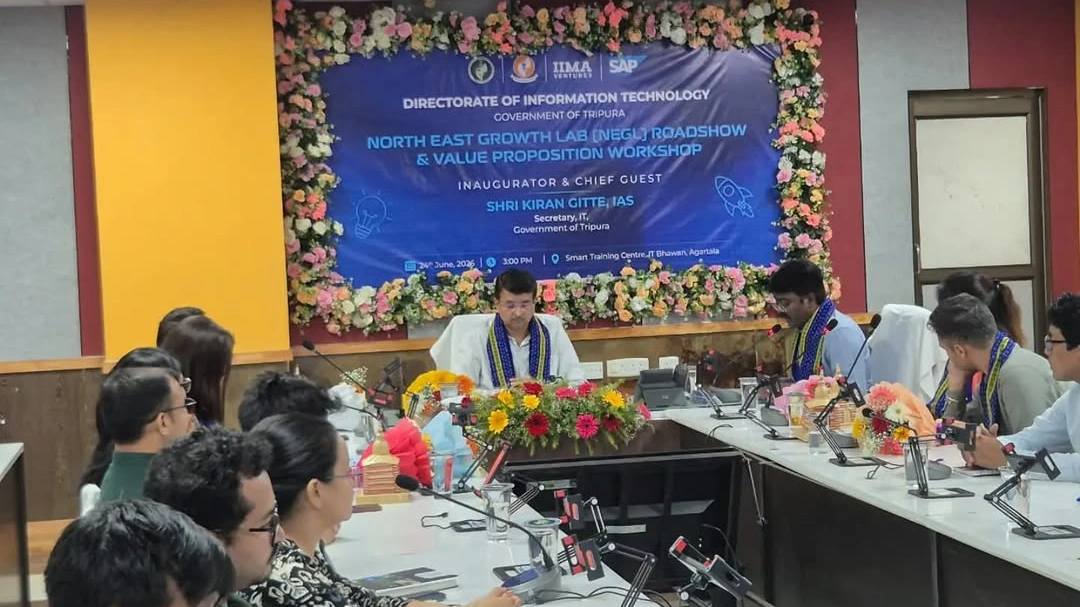
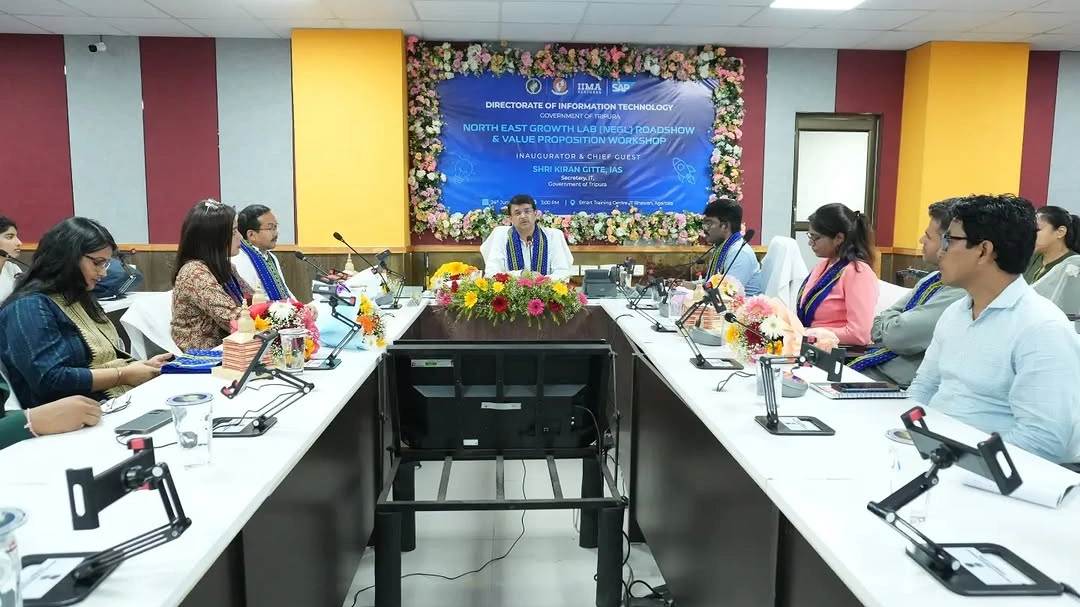
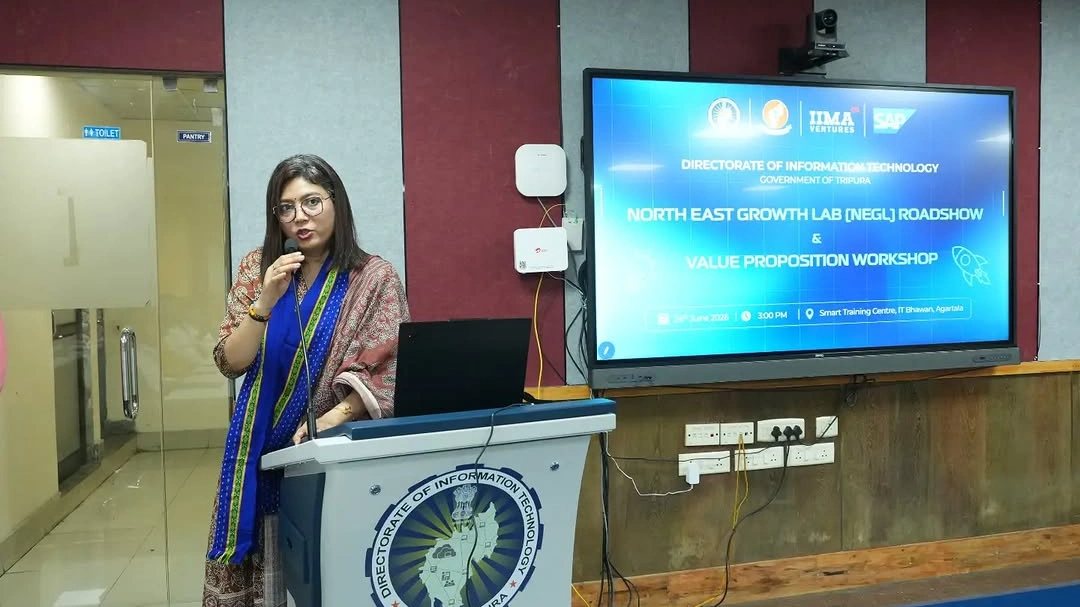
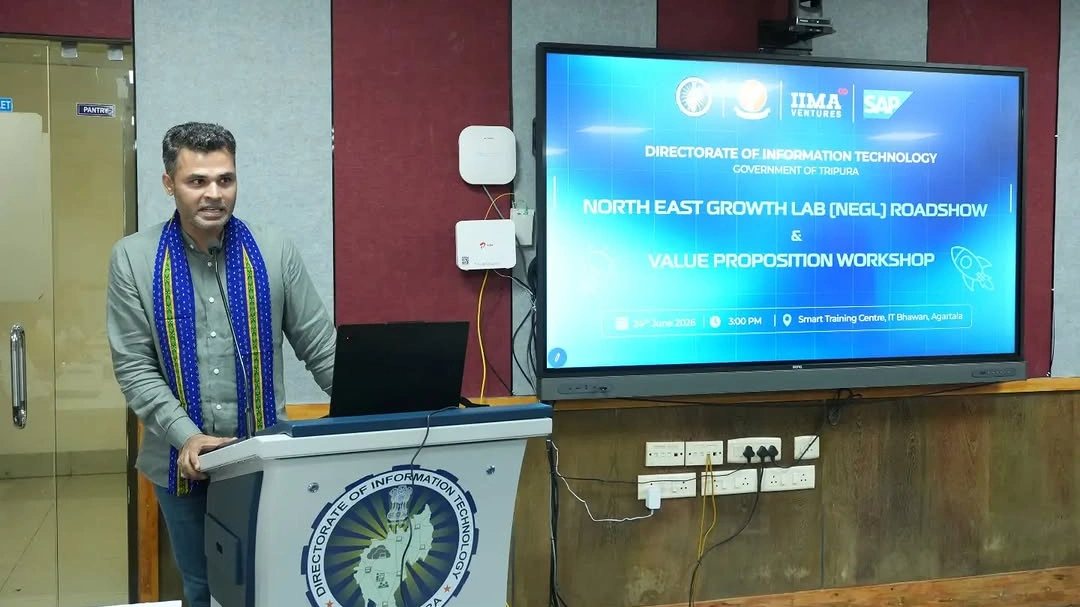
On June 24-25, 2026, Tripura took a significant step toward strengthening its startup ecosystem with the Directorate of Information Technology, Government of Tripura, organising the North East Growth Lab Roadshow and Value Proposition Workshop in collaboration with IIMA Ventures and SAP at the Smart Training Centre, IT Bhavan, Agartala.
I was in that room as a founder of Fueler. Here is what I saw.
The event began with a welcome address by Jeya Ragul Geshan B, IFS, Director of Information Technology, followed by a keynote address from Kiran Gitte, IAS, Secretary, Information Technology, who reiterated the Tripura government's commitment to nurturing entrepreneurship, promoting innovation, and positioning the state as an emerging startup destination in the Northeast.
Kiran Gitte did not speak in generalities. He pointed directly to bamboo and rubber as sectors where Tripura has a genuine supply-side advantage, and named specific high-value products like biochar and medical-grade rubber compounds as areas where Tripura can compete on a national and global level. That kind of specific, strategic thinking from a government official is different from the usual ribbon-cutting language. It tells founders exactly where the state wants them to build.
The working session was led by programme managers from IIMA Ventures including Abhimanyu Saxena, Shilpa Jain, and Gayatri Baruah, who walked participants through the NEGL structure, application process, and selection criteria in detail.
The centerpiece of the day was a hands-on Value Proposition Workshop. Founders worked through real frameworks on their actual businesses and then presented their thinking to the room for feedback. Companies like Fueler.io, Aaharan.com, and Bhasha.xyz were among those in the room, working live on their customer problem mapping.
A successful entrepreneur from Tripura also shared her own journey during the day. That session hit differently from anything else. Because it is one thing to hear about opportunity from someone visiting from Ahmedabad. It is another to hear from someone who built something real in the same geography, the same conditions, the same market you are navigating.
Tripura's Startup Ecosystem Right Now: The Bigger Context
The NEGL Roadshow did not arrive in a vacuum. Tripura's startup ecosystem has been building steadily.
In February 2026, Chief Minister Manik Saha inaugurated T-NEST (Tripura: Nurturing Entrepreneurship and Startups), Tripura's first premier incubation and innovation hub, established as a state-level plug-and-play incubation facility at the International Business Centre Building, Hapania, Agartala, developed over approximately 36,000 sq. ft. of dedicated space.
T-NEST offers ready-to-use office spaces, co-working areas, conference facilities, high-speed connectivity, and structured mentoring and advisory support. Over the next 24 months, T-NEST aims to support 30 to 60 startups, facilitate pilot deployments, and attract investor participation.
The Tripura Start-Up Policy 2025 marked a significant transition from the earlier IT/ITeS Start-Up Scheme 2019, moving to a sector-agnostic approach. Officials noted that Tripura-based startups recently participated in the India AI Impact Summit in New Delhi, proving that the state's innovators can compete on a national level in cutting-edge fields like artificial intelligence.
The NEGL Roadshow came to a state that is genuinely building the conditions for startups to survive and scale. The combination of T-NEST for physical infrastructure, the 2025 startup policy for legal and financial support, and the NEGL for mentorship and capital access creates a more complete support system than Tripura has ever had before.
What the NEGL Offers: Everything in One Place
Let me lay out exactly what a selected startup gets from the North East Growth Lab, so there is no ambiguity.
Catalytic Capital
Grants and optionally convertible debt. Not equity-only. This matters because most northeastern founders are at an early stage where giving away equity before product-market fit costs too much in the long run. Grants let you build without that pressure.
Structured Business Training
Workshops covering value proposition design, B2B sales strategies, financial management, business storytelling, and AI applications specific to your sector. These are not lectures. They are working sessions where you apply frameworks to your own business.
One-on-One Mentoring
Support includes virtual diagnostic and mentoring clinics tailored to individual founders, focusing on areas such as packaging, distribution channels, communication, markets, quality, and other forms of technical assistance.
Market Access
The initiative collaborates with key government and financial bodies, including NABARD, NEDFi, NEHHDC, NERAMAC, and the Ministry for Development of the North East Region (mDoNER). These are the organizations that can open actual distribution channels and procurement pipelines for northeastern products.
Twelve Months of Portfolio Support
Monthly office hours for a full year after the core program. Sustained support, not a short burst and goodbye.
Demo Days and Investor Forums
Access to institutional investors, development organizations, and national-level networks through showcasing events.
Outreach and Bootcamps
The programme runs a yearly schedule of activities such as outreach events, investor-focused demo days, and bootcamps, both within the Northeast and in metropolitan centres.
Who Can Apply: The Eligibility Criteria
This is directly from the NEGL program page: Eligible applicants include startups based in Sikkim, Assam, Tripura, Meghalaya, Arunachal Pradesh, Nagaland, Mizoram, or Manipur. Early-stage startups with scalable, innovative solutions, incorporated up to five years before the program starts. Social enterprises in tech, climate, food, agribusiness, agroforestry, agritech, crafts, traditional textiles, ethnic tourism, or financial inclusion. The program focus is to support Agri and Rural Livelihoods entrepreneurs.
One thing worth noting: The startup can be based out of any other geography in India. However, if their operations are based out of the North East and the impact is being created in the Northeast, they are still eligible to apply.
This is more flexible than many founders assume. If you started your company somewhere else but your supply chain, your team, or your market impact is rooted in the Northeast, you can still apply.
Also worth knowing: IIMA Ventures strongly encourages you to think through and submit only one application for the innovation you are most focused on building. If you are submitting two applications for the same innovation, the duplicate application with less context and poorly articulated thoughts will not be taken forward.
That is honest advice. Put your energy into one strong application, not two weak ones.
Your Pre-Application Checklist
Before you apply, work through this:
Know your problem clearly. Can you describe the problem you are solving in two sentences? Not the technology, not the product. The problem. Who feels it? How badly? The NEGL selection committee wants to see that you understand your customer's pain before they evaluate your solution.
Know your customer specifically. "Farmers in Northeast India" is not a customer. "Small tea growers in Assam with holdings under 5 acres who cannot afford chemical inputs" is a customer. Specificity is what separates strong applications from generic ones.
Have at least some proof. You do not need revenue or a fully built product. But you need something. A pilot. Five conversations with real potential customers. A prototype that someone has used. Some evidence that the world needs what you are building.
Know your sector alignment. The NEGL has priority sectors. Agri, rural livelihoods, climate, crafts, textiles, ethnic tourism, fintech, health tech, edtech. If your startup is in one of these, say so clearly and explain why the Northeast's specific context makes your venture stronger, not weaker.
Be registered or ready to register. For funding programs specifically, you will need a registered company. If you are not incorporated yet, use the time before July 12 to at least begin the process.
Prepare for the question of why you. IIMA Ventures backs founders, not just ideas. Why are you the right person to build this in this geography? What do you know about this problem that someone from outside the Northeast would not know?
Apply once, apply well. One focused application with specific answers beats two rushed ones.
How to Apply and Who to Contact
Application deadline: July 12, 2026
Apply here: iimaventures.com/programs/north-east-growth-labs-2026
For the 2026 cohort (Tripura Roadshow contact):
Email: gayatrib@iima.ac.in (Gayatri Baruah, NEGL Programme Manager)
For the previous cohort program page:
Email: abhimanyu@iima.ac.in (Abhimanyu Saxena, NEGL Programme Manager)
Main IIMA Ventures website: iimaventures.com
For Tripura-specific startup ecosystem queries:
The Directorate of IT, Government of Tripura, organized the Agartala roadshow and is the state-level partner for the NEGL in Tripura. Connect through the DIT Tripura office or follow their official communications.
T-NEST Agartala:
If you are in Tripura and need physical infrastructure, mentoring, and a startup community before or alongside your NEGL application, T-NEST at Hapania, Agartala is the state's flagship incubation hub.
How Fueler Connects to This
At Fueler, I am building a portfolio platform that helps companies hire through assignments. Instead of filtering people by resume or college name, companies post a real task, candidates do it, and the work speaks for itself.
I was in that room at IT Bhavan on June 24 as a founder, not as a visitor. And one thing I kept thinking about during the day was this: the NEGL gives founders capital, mentorship, and market access. But the next thing a growing startup needs after that is people. The right people, hired in the right way.
That is where Fueler fits. We recently added two features on every candidate profile specifically for this generation of knowledge workers: an AI Stack section where candidates can show exactly which AI tools they use, which workflows they have built, and which models they work with, and a Device Configuration section where they can show how their work setup is organized. For a founder hiring their first five people, these signals matter. You can see in seconds whether someone is genuinely building with modern tools or just saying they are.
If you are a NEGL founder scaling your team after getting funded, hiring through assignments rather than resumes changes the quality of every person you bring in. If you are a candidate from the Northeast wanting to work with ambitious startups, setting up your AI stack and device configuration on your Fueler profile is one of the most concrete things you can do to close the visibility gap. You can read more about how portfolio-based hiring helps northeast startups find better talent, why early-stage founders should never hire from resumes alone, and what the best knowledge workers in 2026 show on their Fueler profiles to get hired faster.
The Timeline at a Glance
Here is the full history of the NEGL movement, from start to today:
June 30, 2021: Assam Agribusiness Growth Lab officially launched. IIMA Ventures and ICCSPL begin implementation under World Bank-backed APART program.
August 2021: First cohort of 25 Assam agribusiness enterprises selected from 202 applications across 23 districts.
2022: Cohort 1 outcomes confirmed: 88% of companies achieved at least three program outcomes, 20 new products launched, 20%+ turnover increase across cohort, Rs. 5.6 crore finance mobilized.
April 2023: AAGL Demo Day in Guwahati for Cohort 2 startups at NEDFi House. Cohort 1 companies also return to network and showcase products.
2024: AAGL moves to Cohort 3 selection. Program has now supported approximately 75 Assam agribusiness enterprises across three years.
Mid-2025: Northeast Growth Lab officially launched by IIMA Ventures in partnership with SAP. Scope expands from Assam alone to all eight northeastern states.
July-August 2025: NEGL first cohort bootcamp held in Guwahati. First cohort ventures including Dream Hives, Chezfresco, Greengen, Fuloni, and Pustikor Foods begin program.
February 2026: T-NEST, Tripura's first premier startup incubation hub, launched in Agartala.
June 24, 2026: NEGL Roadshow and Value Proposition Workshop held at IT Bhavan, Agartala, Tripura. Organized by Government of Tripura's Directorate of IT in collaboration with IIMA Ventures and SAP.
July 12, 2026: Application deadline for the current NEGL cohort.
Frequently Asked Questions
1. What is the North East Growth Lab Roadshow and why does it matter for North East India startups?
The North East Growth Lab Roadshow is a traveling outreach event where IIMA Ventures and SAP bring the NEGL program directly to founders across the eight northeastern states, rather than waiting for founders to travel to them. The Tripura Roadshow held on June 24, 2026 in Agartala included a hands-on Value Proposition Workshop where founders worked through real business frameworks on their own companies. It matters because it lowers the barrier for northeastern founders to engage with a national-level startup institution and directly connects them to the NEGL application process.
2. What is the connection between the Assam Agribusiness Growth Lab and the North East Growth Lab?
The Assam Agribusiness Growth Lab (AAGL), launched in 2021 with World Bank backing under the APART project, was the direct predecessor to the Northeast Growth Lab. AAGL ran as an eight-month acceleration program for 25 Assam agribusiness enterprises per year, producing measurable outcomes including 20 new products from the first cohort and over Rs. 5.6 crore in finance mobilized. The success of AAGL gave IIMA Ventures and SAP the evidence to expand the model from Assam alone to all eight northeastern states, which became the Northeast Growth Lab in 2025.
3. Which startups has the North East Growth Lab supported and what are they building?
The first NEGL cohort includes Dream Hives (Northeast's first honey-based heritage wine brand sourcing from Farmer Producer Organizations), Chezfresco (a ready-to-eat B2B food brand), Greengen Agri Biotech (a biofertiliser for tea plantations), Fuloni Agritech (biodegradable gardening products supporting low-income artisans), and Pustikor Foods (products using Assam's GI-tagged Joha rice). All five ventures are currently active and building within the NEGL support structure.
4. How do I apply to the North East Growth Lab 2026 and what is the deadline?
The application deadline for the current NEGL cohort is July 12, 2026. You can apply at iimaventures.com/programs/north-east-growth-labs-2026. For queries, email Gayatri Baruah at gayatrib@iima.ac.in. Eligible applicants include founders based in any of the eight northeastern states, running early-stage startups incorporated within the last five years, working in sectors like agriculture, agribusiness, agroforestry, climate tech, crafts, textiles, ethnic tourism, fintech, health tech, or edtech.
5. What makes the North East Growth Lab different from other startup programs in India?
Most national startup programs treat the Northeast as an afterthought, if they cover it at all. The NEGL is purpose-built for this region, with funding structures (grants and convertible debt rather than equity-only), sector focus (agri, rural livelihoods, crafts, ethnic tourism), and institutional partnerships (NABARD, NEDFi, NEHHDC, NERAMAC, mDoNER) all specifically chosen for the northeastern context. It also provides 12 months of post-program portfolio support through monthly office hours, which is significantly more sustained than most accelerator programs offer. The track record of the predecessor AAGL, with 88% of first cohort companies achieving measurable outcomes, gives the NEGL methodology genuine credibility rather than just institutional backing.

What should you do next?
You've read the article. Now turn your skills into proof of work and unlock more opportunities.
Build your proof of work portfolio
Create a clean portfolio with projects, assignments, resumes, and AI stack details that companies actually want to see.
Create your Fueler portfolio →Apply through assignments, not resumes
Stand out by solving real tasks from companies hiring on Fueler.
Explore assignments →Get discovered by companies
Make your work public and let recruiters discover your skills through actual projects instead of keywords.
Get discovered →
