Non-IT Jobs in India That Pay Well

Riten Debnath
30 Jun, 2026
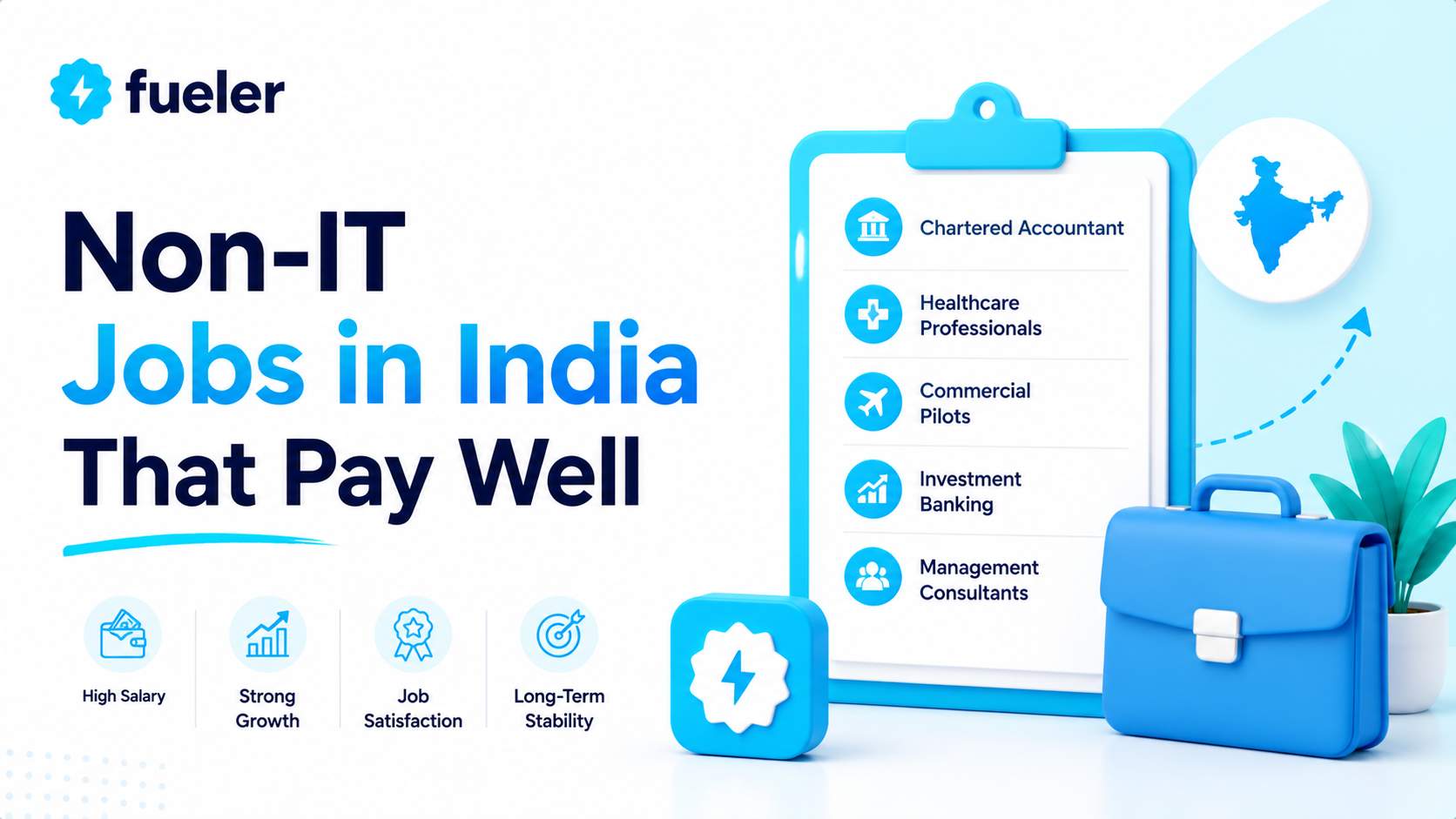
A few days ago, I came across a Reddit thread that I could not stop reading. It was posted in r/IndiaCareers, and the question was simple: "If you are from a non-IT background, how much do you earn per year, and what is your job role?"
I am Riten, founder of Fueler, a portfolio platform that helps people get hired through real assignments instead of just a resume. Career stories like this are close to my heart, so I read almost 200 comments that night, and I want to share what I learned with you in plain, simple words. If you have ever felt that only software engineers and IT folks make good money in India, this article will change your mind.
The Question That Started It All
The original poster, a digital marketing professional earning around 45,000 rupees a month, asked a fair question. He felt stuck while his friends moved ahead in their careers. He wanted to know if people outside the IT world were crossing 12 lakh rupees a year (LPA), and if so, how.What followed was one of the most honest salary discussions I have seen on Indian social media. People from law, finance, sales, government jobs, medicine, supply chain, and even chefs and divers shared their numbers openly. No sugarcoating, no flexing for the sake of it. Just real numbers from real people.
Non-IT Careers That Are Quietly Paying Very Well
Here is what stood out to me the most.
1. Finance and Investment Banking
A Chartered Accountant with 6 years of experience shared that he earns about 70 lakh rupees a year (LPA) as a Senior Associate in a domestic investment bank. Another commenter, a fresh MBA graduate from a top business school, mentioned a package of 31 LPA with ESOPs included, just 7 years into his career. This tells us something important. Finance is still one of the strongest non-tech career paths in India, especially if you pair it with a CA, CFA, or an MBA from a good college.
2. Government Jobs Still Pay Big
One comment that surprised many people was from a Railways officer who joined through UPSC Engineering Services. His total package, including allowances like HRA, vehicle, and domestic help, came to around 42 to 43 LPA after 12 to 13 years of service. His fixed cash component was about 26 to 27 LPA. Many of us assume government jobs are low paying. But for Group A officers selected through tough exams like UPSC, the pay and perks can match or beat many private sector roles.
3. Sales Is Still Underrated
A 26-year-old in US logistics sales shared a package of 30 LPA, with both fixed pay and commission. She started at a salary of 25,000 rupees a month and grew steadily over five years with hard work and the right opportunities.Sales is one of those fields people overlook, but it rewards performance directly. If you are good at building relationships and closing deals, your income can grow much faster than in many desk jobs.
4. Specialised Skilled Roles Abroad
A 23-year-old chef working at an international airport in a Gulf country shared that he earns 22 LPA in Indian currency, and he is only a 12th pass. This is proof that a skilled trade, learned well, can take you places that a degree alone cannot.Similarly, someone working in HSE (Health, Safety, and Environment) in Abu Dhabi shared that they earn about 2 lakh rupees a month, along with free food, housing, and transport.
5. Law, Medicine, and Other Professional Fields
A corporate lawyer with 3 years of experience shared a package of 23 LPA. A legal professional who later moved into legal technology shared how she went from earning just 1 LPA as a young lawyer to 29 to 30 LPA after seven years, by upskilling and switching into a growing niche field. On the medical side, a Senior Medical Officer working with Coal India shared a package of about 21 LPA fixed, along with several allowances, while an MBBS graduate preparing for her postgraduation mentioned that her income is likely to grow a lot once she specialises.
What Connects All These High Earners
After reading through the thread, I noticed a pattern. It was not about which degree they had. It was about three simple things. First, they picked a field and stuck with it long enough to get good at it. Most of the high earners had between 5 to 12 years of experience in the same domain.
Second, they kept upskilling. The legal technologist did not just sit in her first job. She learned new skills and moved into a growing area. The sales professional in logistics grew her salary by more than 10 times over five years by proving her value again and again. Third, many of them used networking and referrals to find better roles. One commenter openly said her close friend referred her for the job that changed her career. None of this needed a computer science degree. It needed consistency, curiosity, and the courage to switch when something was not working.
Why This Matters for Today's Job Seekers
I built Fueler because I believe resumes do not tell the full story of a person's skill. A resume can say you "managed social media campaigns," but it cannot show how good your actual work was. This Reddit thread proved the same point in a different way. The commenters were not just listing their college names. They were sharing their actual journey, their YOE (years of experience), their switches, and sometimes their struggles too.
If you are a non-IT professional reading this and feeling stuck, here is what I would suggest based on what worked for people in the thread.
Pick one skill area and go deep, not wide. The Reddit thread had Excel and SQL mentioned multiple times, even by people in non-tech roles like retail sales and finance. Build a portfolio of real work instead of just listing job titles. Be open to switching companies or even cities if it helps your growth, like the chef and HSE professional who moved abroad. Use referrals smartly. So many people in the thread got their breakthrough role through a friend or a connection.
If you want to understand how to build a portfolio that actually shows your real skills to hiring managers, I have written more on this in our guide on building a strong professional portfolio that gets you noticed by recruiters.
My Honest Take as a Founder
I did not start Fueler to glorify only tech jobs. I started it because I saw too many talented people, across every field, getting overlooked because their resume did not capture their real skill. This Reddit thread is proof that India's non-IT workforce is full of people earning well, growing fast, and building strong careers, often quietly, without much noise online. If there is one thing I want you to take away from this article, it is this. Your career growth is not locked by your degree or your first job. It is shaped by how consistently you build your skills, how openly you network, and how well you show your real work to the world. Whether you are in sales, finance, law, government service, or any other non-IT field, the path to a strong income is very much open to you.
If you want to read more real stories and practical career advice for professionals outside the IT world, you can browse our career growth resources for non-tech professionals on the Fueler blog, where we regularly publish guides based on real data and real people, not just theory. We also have a detailed piece on how showcasing real work beats a traditional resume when it comes to getting noticed by the right companies, which ties in closely with everything this Reddit thread showed us. And if you are someone early in your career trying to figure out your next step, our guide on how freshers can build a portfolio that gets interviews might be a good place to start. I will keep reading threads like this one, because they remind me why Fueler exists. To help people, no matter their background, show their real work and get the recognition they deserve.
Frequently Asked Questions
1. Which non-IT jobs pay the highest salary in India?
Based on real salary data shared online, finance and investment banking, corporate law, government jobs through UPSC, sales in logistics or B2B, and supply chain management are among the highest paying non-IT careers in India, especially with 5 or more years of experience.
2. Can a non-IT professional earn more than 12 LPA in India?
Yes. Many non-IT professionals, including those in finance, law, sales, government services, and even skilled trades like culinary arts, are earning well above 12 LPA, with some crossing 50 LPA or more after several years of experience.
3. What skills should non-IT professionals learn to earn more?
Skills like Excel, SQL, financial modelling, AI tools for their specific field, communication, and negotiation are commonly mentioned by high earners as skills that helped them grow their income, even without a technical degree.
4. How important is networking for career growth in non-IT fields?
Very important. Several professionals shared that they got their best job opportunities through referrals from friends or colleagues, which shows that building genuine professional relationships can directly impact your salary growth.
5. How can I show the tools I use to recruiters if I am from a non-IT background?
Don’t just name the tools in a resume. Add them to your portfolio alongside real samples, spreadsheets, dashboards, proposals, decks, writing, reports, or case studies. When someone can see both the work and the tools/process behind it, your profile becomes easier to evaluate.
Why 100,000+ professionals use Fueler
Fueler helps professionals showcase proof of work through projects, assignments, case studies, and achievements.
- Thousands of professionals use Fueler to create their digital portfolio
- Thousands of projects published on Fueler. Check here
- Startups and Companies hire through proof of work on Fueler
- Used by freelancers, creators, marketers, video editors, writers, designers, and product managers
Our mission is to help the next 100 million professionals build a verified professional identity through proof of work

What should you do next?
You've read the article. Now turn your skills into proof of work and unlock more opportunities.
Build your proof of work portfolio
Create a clean portfolio with projects, assignments, resumes, and AI stack details that companies actually want to see.
Create your Fueler portfolio →Apply through assignments, not resumes
Stand out by solving real tasks from companies hiring on Fueler.
Explore assignments →Get discovered by companies
Make your work public and let recruiters discover your skills through actual projects instead of keywords.
Get discovered →
