Mistakes New Digital Marketers Make and How to Avoid Them

Riten Debnath
29 Jul, 2026
Last updated: July 2026
Starting out in digital marketing feels like getting thrown into a high-stakes game where everyone else knows the cheat codes. You spend weeks designing social posts, writing articles, or launching ads, only to get crickets, zero sales, and a burnt marketing budget.
I’m Riten, founder of Fueler, a skills-first portfolio platform building the career infrastructure for 100 million creative professionals. Fueler connects talented individuals with companies through assignments, portfolios, and projects, not just resumes or CVs. Think of it as Dribbble/Behance for work samples combined with AngelList for hiring infrastructure.
Most entry-level marketers fail not because they lack passion, but because they follow outdated advice from self-proclaimed gurus.
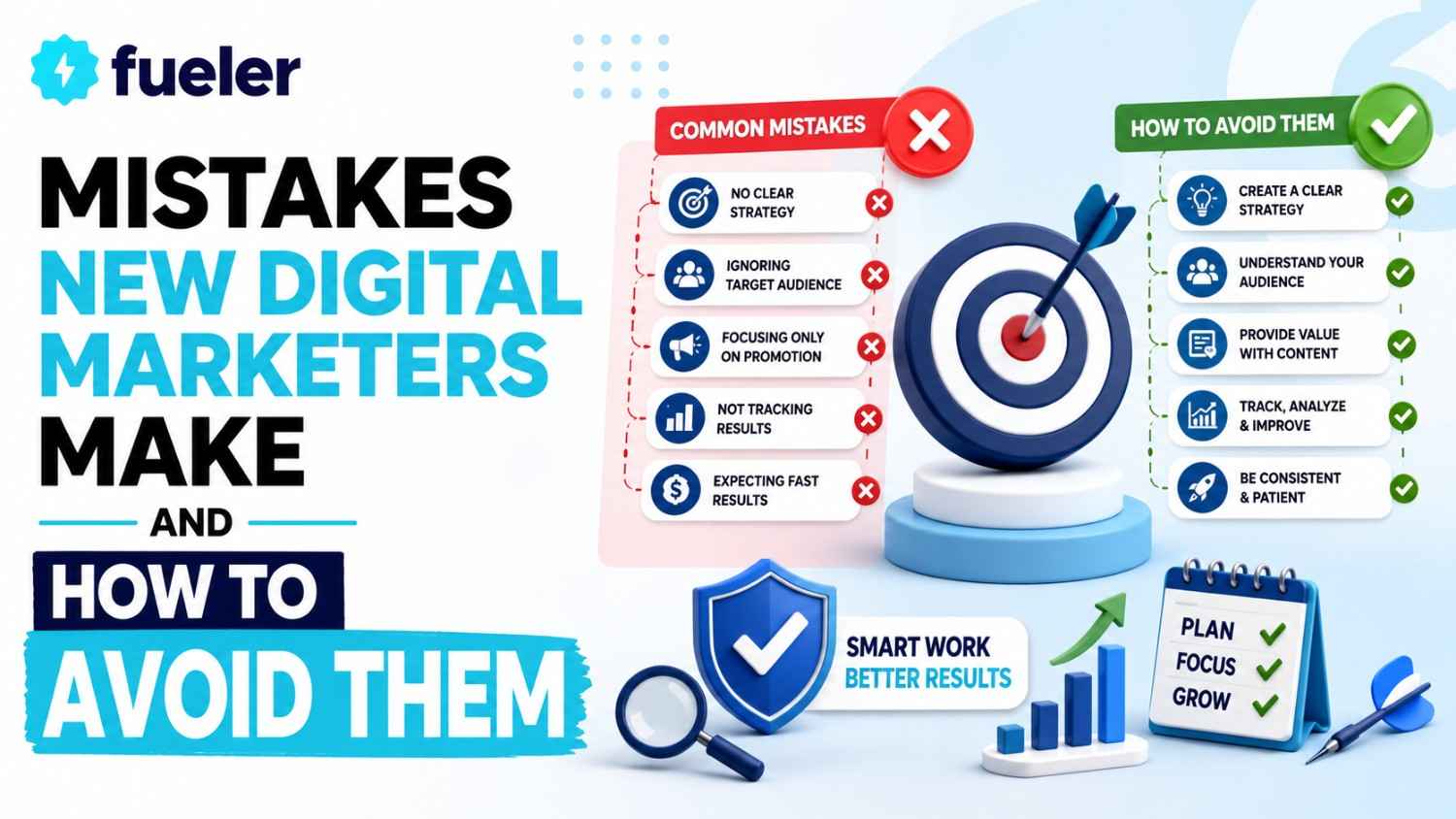
In this guide, we will break down the ten most common digital marketing mistakes beginners make, along with actionable frameworks to fix them before they destroy your campaigns.

Chasing Vanity Metrics Instead of Business Revenue
Getting thousands of post likes feels great for your ego, but likes do not pay company payroll or website hosting bills. Beginner marketers often celebrate deep social impressions while completely ignoring whether those visitors actually converted into paying customers.
Relying on vanity metrics creates a dangerous illusion of campaign success. You must shift your mindset from measuring simple audience views to tracking actual business lead volume, conversion rates, and revenue impact.
- Tracking wrong acquisition signals: Focusing strictly on page impressions or social media likes obscures true conversion metrics, leading teams to waste effort on campaigns that generate noise rather than actual sales revenue.
- Misinterpreting audience engagement data: Assuming high comment volume equals purchasing intent tricks marketers into scaling unhelpful content formats that attract curious onlookers rather than actual prospective buyers for your product.
- Ignoring customer conversion rates: Failing to measure how many website visitors turn into leads makes it impossible to identify friction points within your sales conversion funnel or calculate actual marketing profitability.
- Overestimating top-funnel value: Spending all your energy attracting broad website traffic without building retargeting mechanisms ensures potential leads leave your site permanently without taking meaningful commercial action.
- Neglecting revenue attribution models: Attributing success solely to the last customer click blinds you to early touchpoints that educated the buyer, resulting in poor budget distribution across marketing channels.
How to Avoid It
Focusing on vanity metrics wastes time on activities that never move the financial needle. To avoid this mistake, establish clear revenue-focused key performance indicators before starting any campaign. Track bottom-funnel metrics like cost per acquisition, customer lead quality, and conversion velocity directly inside your analytics dashboard.
Ignoring Audience Search Intent and Publishing Thin Content
Publishing shallow five-hundred-word blog posts stuffed with random keywords will not rank on Google. Beginners often create generic content without bothering to research what problems their target audience is actually trying to solve online.
Search engines prioritize depth, helpfulness, and explicit intent match above all else. If your written content fails to answer user questions thoroughly, readers will click back to search results instantly.
- Targeting incorrect query intent: Creating informational blog posts for high-intent transactional search keywords causes high bounce rates because visitors want quick product solutions rather than long background explanations.
- Publishing low-value surface content: Writing generic summaries without original research, expert quotes, or practical examples prevents search engine algorithms from viewing your domain as an authoritative source.
- Neglecting semantic keyword variations: Skipping related search terms and natural conversational queries limits your content's ability to capture long-tail search traffic across modern AI search engines.
- Failing to answer core questions: Leaving user queries partially answered forces readers to leave your website and seek complete solutions on competitor blogs, ruining your site retention metrics.
- Ignoring user content preferences: Forcing long text blocks on users who need quick visual tables or bulleted step-by-step guides reduces engagement and hurts organic keyword positions over time.
How to Avoid It
Thin content burns organic search visibility and drives potential customers directly into the arms of your competitors. To avoid this, perform deep intent research before writing. Map out primary customer pain points, structure comprehensive answers using clear subheadings, and provide actionable solutions that resolve search intent completely.
Running Paid Ad Campaigns Without Proper Analytics Tracking
Launching paid advertising campaigns without verified conversion tracking setup is the fastest way to set money on fire. Many new marketers set up ad accounts, select broad targeting, and start spending money before installing tracking pixels.
When you run ads blind, you cannot tell which ad creative, keyword, or audience demographic drove actual sales. You end up scaling losing ad sets while cutting profitable campaigns by complete accident.
- Skipping conversion pixel configuration: Launching paid campaigns without properly firing event tags prevents ad network algorithms from learning which user profiles actually convert into paying customers.
- Using broad unrefined targeting: Showing ads to massive, generic demographic groups drains your ad budget rapidly without acquiring qualified leads who possess genuine buying intent.
- Failing to implement UTM parameters: Omitting custom URL tracking tags makes it impossible to isolate traffic sources accurately within Google Analytics, ruining multi-channel reporting accuracy.
- Ignoring campaign A/B testing: Running a single ad creative variation prevents you from discovering higher-performing headline combinations, visual styles, or call-to-action buttons that lower acquisition costs.
- Scaling unoptimized campaign budgets: Increasing daily spending on unverified ad sets burns financial resources quickly before you have identified your benchmark cost-per-lead or target return on ad spend.
How to Avoid It
Unmonitored ad campaigns result in massive financial loss and inaccurate performance data. Avoid this trap by setting up complete tracking infrastructure using tag managers before launching any ad. Verify event triggers across every conversion step, test multiple ad creatives systematically, and scale budgets only after proving positive return on ad spend.
Relying Completely on Social Media Algorithms Without Email Ownership
Building your entire digital marketing strategy on rented land like social media platforms is a recipe for disaster. Algorithm changes happen overnight, instantly cutting your organic reach and wiping out audience distribution you spent years building.
Social platforms control audience access, but you own your email subscriber list completely. Smart marketers use social media channels as discovery engines to drive users into owned email conversion funnels.
- Ignoring subscriber list building: Focusing exclusively on social follower counts while neglecting lead magnets leaves your brand vulnerable to sudden platform algorithm shifts and policy updates.
- Failing to capture user emails: Sending social traffic directly to third-party marketplaces or homepage hero sections misses prime opportunities to capture contact information for long-term retention.
- Treating email as manual broadcasts: Sending occasional manual newsletters instead of building automated email sequences leads to inconsistent audience communication and lost customer lifecycle revenue.
- Sending unsegmented email campaigns: Blasting identical generic emails to your entire contact database causes high unsubscribe rates, low click-through metrics, and damaged domain deliverability.
- Neglecting email inbox deliverability: Ignoring domain authentication records and sender reputation maintenance causes your marketing emails to land straight in user spam folders unnoticed.
How to Avoid It
Relying solely on social networks leaves your marketing distribution entirely at the mercy of unpredictable algorithm updates. Avoid this vulnerability by placing lead generation mechanisms on every public channel. Offer high-value downloadable resources, build automated onboarding email funnels, and segment subscribers based on specific user interests.
Treating SEO as Keyword Stuffing Instead of Topical Authority
Repeating your target keyword twenty times in an article worked back in 2010, but doing it today will get your website penalized by search engines. Beginners often prioritize mechanical keyword density over content quality and topical coverage.
Modern search engines analyze entities, context, and topical relationships. Winning at organic search requires building comprehensive topic clusters that demonstrate complete subject matter authority across your entire domain.
- Overusing target keyword phrases: Forcing exact-match keywords awkwardly into sentences creates terrible reading experiences for human visitors while triggering algorithmic search spam filters.
- Creating isolated single pages: Publishing standalone articles without building supporting content clusters prevents search engines from recognizing your website as a trusted niche authority.
- Neglecting internal link architecture: Failing to connect related blog posts strategically leaves search crawlers unable to discover subtopics or understand content hierarchy across your domain.
- Ignoring search entity relationships: Writing content without mentioning relevant industry terms, concepts, and authoritative sources limits your visibility on modern conversational search platforms.
- Overlooking search snippet optimization: Omitting clear definitions, structured summary tables, and direct answers reduces your chances of earning valuable zero-click search features.
How to Avoid It
Keyword stuffing damages brand credibility and destroys organic search rankings. To avoid this mistake, focus on building topical authority. Map out core pillar topics, write detailed supporting guides, connect related articles using contextual internal links, and write naturally for human readers first.
Spamming Every Digital Channel Simultaneously Without Strategy
Trying to maintain an active presence on LinkedIn, TikTok, YouTube, X, Instagram, and Pinterest all at once destroys content quality. Beginners mistakenly assume that being everywhere automatically increases brand reach, resulting in total burnout and mediocre output.
Spreading your efforts too thin prevents you from mastering the unique content mechanics of any single channel. It is far better to dominate one or two primary distribution platforms than to post noise everywhere.
- Diluting content execution quality: Attempting to publish across five social platforms daily forces you to post rushed, generic content that fails to engage users anywhere.
- Ignoring platform-native formats: Cross-posting identical text or visual formats across different platforms ignores unique user behaviors and algorithmic preferences specific to each channel.
- Failing to build deep audience engagement: Splitting community management across too many apps leaves comments unanswered, direct messages ignored, and potential customer relationships completely neglected.
- Lacking channel-specific strategic goals: Posting content without understanding why a specific platform fits your business model wastes creative bandwidth on channels where your target audience does not hang out.
- Exhausting operational resources quickly: Burning through creative energy trying to feed multiple content channels leads to inconsistent publishing schedules and abandoned accounts.
How to Avoid It
Fragmenting your attention across too many networks results in weak distribution and zero platform traction. Avoid this mistake by identifying where your target audience spends time online. Pick one primary channel and one secondary channel, master their native content formats, and build consistent engagement before expanding.
Neglecting Mobile User Experience and Page Speed Optimization
If your website takes more than three seconds to load on a smartphone, over half of your visitors will close the tab before reading a single word. Beginners frequently design websites on desktop screens, completely forgetting that most web traffic comes from mobile devices.
Unoptimized mobile layouts, giant uncompressed images, and intrusive popup forms create massive user friction. Search engines penalize slow websites because they deliver bad user experiences.
- Serving uncompressed image files: Uploading raw high-resolution images bloats page sizes dramatically, causing mobile load times to spike and driving impatient visitors away instantly.
- Ignoring responsive page design: Failing to adjust text sizes, navigation menus, and button placement for small mobile screens creates frustrating user experiences.
- Overloading pages with dynamic scripts: Adding unnecessary tracking plugins, heavy animations, and third-party widgets slows down page rendering speed on mobile cellular networks.
- Using intrusive newsletter popups: Displaying screen-blocking popups immediately upon mobile page load annoys users, increases bounce rates, and violates search engine usability guidelines.
- Neglecting core web vitals metrics: Overlooking layout shifts, cumulative loading delays, and main-thread blocking leaves technical issues unresolved, hurting mobile search rankings.
How to Avoid It
Poor mobile optimization drives potential customers away and destroys search engine rankings. To avoid this, adopt a mobile-first design philosophy. Compress all visual assets, audit site loading speeds regularly using performance tools, remove unnecessary plugins, and ensure seamless navigation across all device screens.
Ignoring Competitor Analysis and Customer Feedback Loops
Creating marketing campaigns inside an isolated bubble without studying market landscape competitors or listening to customer feedback guarantees failure. Beginners often assume their offer is totally unique without researching existing market solutions.
Your potential customers tell you exactly what they want in review sections, community forums, and support tickets. Successful marketers study competitor positioning to identify messaging gaps and tailor offers directly to customer desires.
- Failing to audit market competitors: Launching campaigns without studying competitor pricing, messaging strategies, and content formats leads to copycat marketing that fails to differentiate your brand.
- Ignoring real customer language: Writing sales copy using internal company jargon instead of copying the exact words customers use in reviews creates disconnects with buyers.
- Overlooking negative product reviews: Neglecting to read competitor customer complaints prevents you from uncovering unaddressed pain points you could highlight within your positioning.
- Operating without feedback channels: Skipping post-purchase surveys and customer interviews leaves you making wild guesses about why prospects buy or abandon shopping carts.
- Refusing to adapt to market shifts: Sticking rigidly to an initial marketing campaign hypothesis despite clear market data showing customer disinterest wastes time and financial resources.
How to Avoid It
Ignoring market intelligence leads to weak positioning and messaging that falls completely flat. Avoid this mistake by conducting regular competitor audits. Spend time reading customer forum discussions, track review sites, collect direct survey feedback, and refine your messaging using the exact language your target audience uses.
Expecting Instant Growth and Abandoning Campaigns Too Early
Digital marketing is a long-term compounding game, not an overnight lottery ticket. Many beginners launch a content strategy or SEO campaign, see minimal traffic after two weeks, assume it failed, and quit entirely.
Compounding growth requires patience, consistent execution, and iterative refinement. Quitting early means abandoning campaigns right before they reach the inflection point where organic traffic and conversions begin to scale exponentially.
- Prematurely killing organic campaigns: Expecting search engine optimization or content strategies to deliver massive results within thirty days leads to premature campaign cancellation.
- Lacking publishing consistency: Posting sporadically whenever inspiration strikes prevents search algorithms and social audiences from trusting your brand consistency.
- Constantly pivoting messaging strategies: Changing your core offer, brand positioning, or target audience every few weeks confuses followers and destroys long-term brand equity.
- Misinterpreting early testing data: Misjudging small initial traffic numbers as failure prevents you from making minor optimizations that could turn struggling ad sets into winners.
- Underestimating long-term compound value: Failing to realize that assets like blog articles, email sequences, and YouTube videos drive traffic and sales for years after creation.
How to Avoid It
Impatience causes marketers to abandon viable strategies right before they start generating positive returns. To avoid this, set realistic timelines for every channel. Commit to publishing consistently for at least six months, track leading performance indicators, and iterate based on data rather than emotion.
Collecting Certificates Instead of Building Proof of Work
Accumulating a dozens of online digital marketing certificates looks nice on a resume, but it does not prove you can execute in the real world. A common trap for fresh marketers is spending hundreds of hours completing theoretical courses while never launching a live campaign.
Hiring managers and founders care about execution visibility over passive credentials. Showing a live blog you ranked, an ad campaign teardown you built, or a portfolio of practical assignments beats a pile of digital badges every single time.
- Over-indexing on theoretical courses: Spending months watching video lectures without applying the concepts in real-world scenarios creates a false sense of operational readiness.
- Lacking tangible execution samples: Arriving at job interviews with zero live projects, written ad copy examples, or analytics reports leaves employers doubting your practical skills.
- Failing to document campaign learnings: Running small marketing tests without documenting the setup, data insights, and final results wastes valuable opportunities to prove your strategic thinking.
- Waiting for permission to practice: Delaying real execution until someone hires you instead of launching personal projects, side blogs, or pro-bono client audits independently.
- Relying on generic traditional resumes: Submitting standard text resumes that list claimed skills without providing direct links to verified work samples or project portfolios.
How to Avoid It
Theoretical knowledge without practical application leaves you unprepared for real marketing roles. Avoid this by shifting from passive learning to active creation. Launch personal projects, conduct teardowns of existing brand funnels, run small experiments, and document your actual proof of work publicly.
How Does This Connect to Building a Strong Career or Portfolio?
Building a successful marketing career requires execution visibility over claimed skills. Employers hire proof of work, not promises. Documenting your marketing experiments, campaign teardowns, and growth projects proves you can generate real business outcomes. Displaying your live projects on Fueler gives you a clean way to show verified proof of work, instantly setting you apart from candidates using generic resumes.
Final Thoughts
Avoiding common digital marketing mistakes comes down to focusing on real business metrics, understanding customer search intent, and building owned distribution channels. Shift your energy from passive learning to active project execution. Document your work publicly, analyze your data, and let your tangible proof of work drive your career forward.

Frequently Asked Questions
What is the biggest mistake beginner digital marketers make?
The biggest mistake is launching campaigns without clear conversion goals or analytics tracking. Without tracking, you cannot measure campaign ROI, identify friction points, or understand which marketing channels drive actual sales revenue.
How do I start digital marketing without making costly errors?
Start by mastering core acquisition skills like SEO and copywriting. Build real projects, run small growth experiments, and document your proof of work in a public portfolio instead of relying solely on traditional resumes.
Is digital marketing still worth learning in 2026?
Yes. Businesses rely heavily on digital acquisition, but success requires data-driven execution, audience research, and multi-channel strategies rather than basic posting. Skilled marketers who understand conversion optimization remain in high demand.
Why are my digital marketing campaigns not converting?
Campaigns fail to convert due to unclear messaging, poor audience targeting, or landing page friction. Audit user search intent, review analytics drop-off points, and test clearer call-to-action messaging to improve conversions.
How can fresh graduates prove marketing skills without job experience?
Build live project teardowns, run personal blog experiments, or write sample ad campaigns. Documenting your process and displaying tangible proof of work in an organized portfolio proves execution ability to potential hiring managers.
Why 100,000+ professionals use Fueler
Fueler helps professionals showcase proof of work through projects, assignments, case studies, and achievements.
- Thousands of professionals use Fueler to create their digital portfolio
- Thousands of projects are published on Fueler. Check here
- Startups and Companies hire through proof of work on Fueler
- Used by freelancers, creators, marketers, video editors, writers, designers, and product managers
Our mission is to help the next 100 million professionals build a verified professional identity through proof of work

What should you do next?
You've read the article. Now turn your skills into proof of work and unlock more opportunities.
Build your proof of work portfolio
Create a clean portfolio with projects, assignments, resumes, and AI stack details that companies actually want to see.
Create your Fueler portfolio →Apply through assignments, not resumes
Stand out by solving real tasks from companies hiring on Fueler.
Explore assignments →Get discovered by companies
Make your work public and let recruiters discover your skills through actual projects instead of keywords.
Get discovered →
